Struggling with unreliable water access and rising fuel costs for your pump?
There is a more sustainable way.
To choose the right solar pump, you must first identify your water source depth to decide between a surface or submersible pump. Next, calculate your required water volume (flow rate) and total vertical lift (head). Match these needs with the pump's specifications and motor efficiency for optimal performance.
Choosing the right solar pump can seem complex with all the technical specifications and options available.
However, breaking the decision down into a few logical steps makes the process straightforward.
This guide will walk you through everything from understanding the basic components to comparing advanced pump types and motor technologies.
By the end, you will have the confidence to select a solar water pump system that perfectly matches your application, budget, and long-term goals, ensuring a reliable and cost-effective water supply for years to come.
What is a solar water pump?
Are you tired of the labor and expense of traditional water pumps in remote locations?
Solar energy offers a powerful, independent solution.
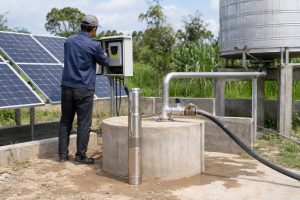
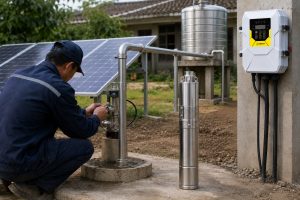
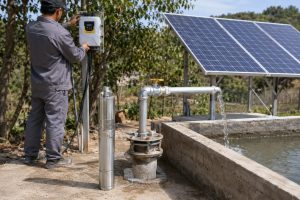
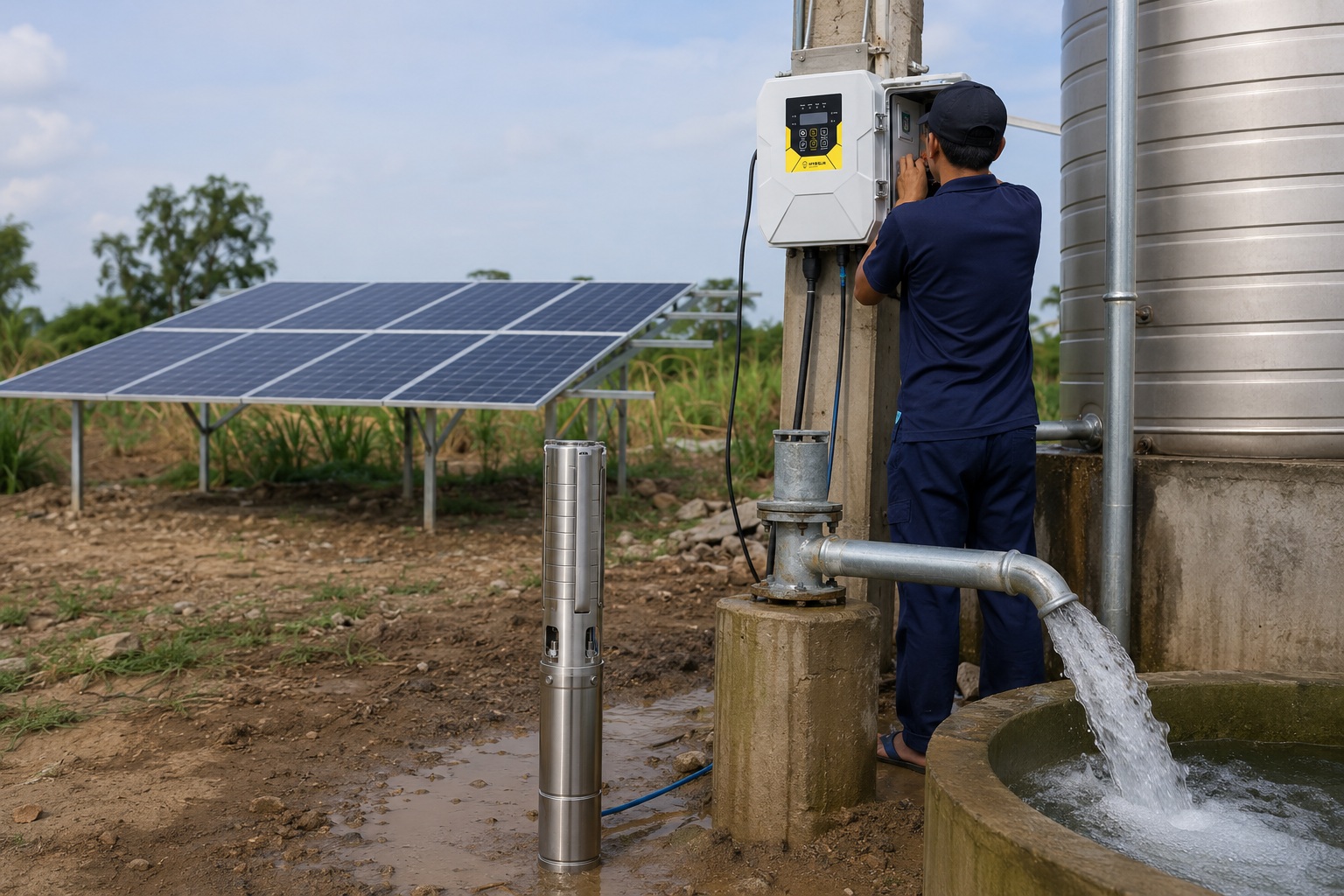
A solar water pump is a system that uses sunlight as its energy source. It consists of one or more solar PV panels, a pump unit, and an electronic controller. The panels convert solar energy into electricity to drive the pump and move water without needing grid power or fuel.
The Core Components of a Solar Pumping System
A solar water pump functions in the same way as any other water pump.
Its unique feature is its power source: the sun.
The system is elegantly simple and comprises a few key parts.
- Solar Panels: These are the system's power plant. The size and number of photovoltaic (PV) panels depend on the pump's power requirement, the amount of water needed, the pumping height, and the solar irradiance available at the location.
- Pump Unit: This is the heart of the system that moves the water. It can be a surface pump or a submersible pump, each designed for different water source depths.
- Controller/Inverter: This is the brain of the operation. It manages the power from the solar panels, matching it to the pump's needs. It also provides vital protections against over-voltage or under-voltage, ensuring the motor's longevity. Some controllers convert DC power from the panels to AC power if the pump uses an AC motor.
Occasionally, a battery is included as a backup power source.
This allows the pump to operate during cloudy periods or after sunset, though many modern systems are designed to work without batteries by pumping water into a storage tank during the day.
A Brief History and Modern Advancements
The idea of harnessing solar power is ancient, but practical solar pumps emerged in the 19th century using steam engines.
These early systems used the sun to heat water, creating steam to power a pump.
Parallel to this, the science of photovoltaics (PV) was developing.
Initially, PV technology was incredibly expensive and inefficient.
In the 1960s, producing a single watt of solar power could cost around $1,000.
A major breakthrough in the 1970s semiconductor industry changed everything.
This ignited a trend of rapidly increasing panel efficiency and decreasing costs that continues today.
Modern solar pumps are almost exclusively powered by PV panels.
The technology has made solar pumps more powerful, portable, and affordable than ever before, making them a viable and often superior alternative to fossil fuel pumps.
They are ideal for providing water in remote areas for farming, rural homes, and construction.
What are the types of solar water pump?
Choosing the wrong pump type can lead to inefficiency, wasted money, and system failure.
Understanding the main categories is your first step.
Solar pumps are primarily categorized as surface pumps, for water sources less than 7 meters deep, and submersible pumps, for deep wells and boreholes. Within these, specific models like screw, plastic impeller, and stainless steel impeller pumps cater to different flow, head, and water quality requirements.
Surface vs. Submersible Pumps
The first and most important decision is based on the depth of your water source.
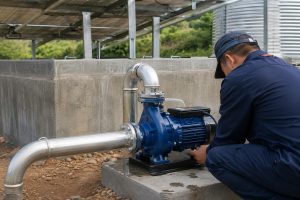
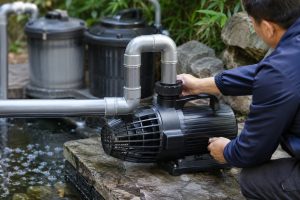
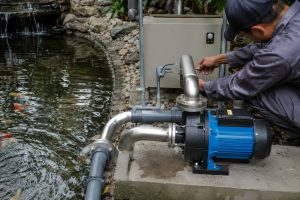
A surface water pump is placed on the ground near the water.
It works by sucking water up (suction lift) and then pushing it to its destination.
Due to the laws of physics, a surface pump has a maximum suction lift of about 7-8 meters.
They are optimized for higher flow rates from easily accessible water sources like rivers, ponds, and shallow wells.
A submersible pump, as the name suggests, is fully submerged in the water source.
These are used for deep wells and boreholes where the water level is below the 7-meter limit of a surface pump.
Instead of sucking water, they push it up from below, allowing them to lift water from great depths.
| Feature | Surface Pump | Submersible Pump |
|---|---|---|
| Placement | On the ground, near the water source | Fully submerged in the water |
| Max Water Depth | ~7 meters (22 feet) | 100+ meters |
| Primary Action | Sucks, then pushes water | Pushes water upwards |
| Best For | Rivers, ponds, shallow wells, tanks | Deep wells, boreholes |
| Flow Rate | Generally higher for a given power | Varies by design, can be high |
| Priming | May require initial priming | Self-priming (already in water) |
The choice is clear: if your water level is within 7 meters of the surface, a surface pump is likely the most efficient option.
If it's deeper, you need a submersible pump.
A Deeper Dive: Submersible Pump Technologies
For deep wells, several types of submersible pumps exist, each with unique strengths. The three most competitive designs use different mechanisms to move water, making them suitable for diverse global needs.
1. Solar Screw Pump
This pump uses a single stainless steel helical screw (rotor) rotating inside a rubber stator. As the screw turns, it creates sealed cavities that move water upward through compression.
- Characteristics: Low Flow, High Head. They are masters of vertical lift.
- Best Applications: Domestic water supply in very deep wells, livestock drinking water, and small-scale drip irrigation. They excel in electricity-scarce regions of Africa and Latin America.
- Key Advantages: Exceptional ability to handle sandy or gritty water. The design is robust and can operate in harsh water conditions where other pumps might fail. It can achieve heads over 150 meters, albeit with lower flow rates, typically 1-2 cubic meters per hour.
2. Solar Plastic Impeller Pump
This is a multi-stage centrifugal pump. It uses a series of stacked, durable plastic impellers that spin to create pressure and push water upwards.
- Characteristics: High Flow, Medium Head. These are workhorses for moving large volumes of water.
- Best Applications: Farm irrigation, pasture water supply, and filling large tanks for home or community use. Widely used in farming regions across Africa and the Americas.
- Key Advantages: High water output, capable of delivering over 10 m³/hour at moderate heads (40-60 meters). They are lightweight, cost-effective, and offer good resistance to fine sand.
3. Solar Stainless Steel Impeller Pump
This premium model functions like the plastic impeller pump but uses SS304 stainless steel for the impellers and pump housing.
- Characteristics: High Flow, High Durability, Corrosion Resistance.
- Best Applications: Water conditions that are acidic or alkaline. This makes them ideal for certain geological areas in Australia and the Americas with corrosive water, or for high-end homes and ranches demanding maximum reliability.
- Key Advantages: Superior corrosion resistance ensures a very long service life. It can operate reliably in water with a pH range of 4-9, extending its lifespan by up to 50% compared to other materials in such conditions. This reliability justifies its higher initial cost.
How to choose the best solar pump for your needs?
Buying a pump without knowing your numbers is a recipe for disappointment.
A few key calculations can guarantee you get the right fit.
To choose the best solar pump, you must precisely measure your water source depth, calculate your Total Dynamic Head (vertical lift + friction loss), and determine your required daily water volume (flow rate). Match these three critical figures to the pump's performance chart.
Step 1: Analyze Your Water Source
Before looking at any pump, you must understand your water.
- What is the source? Is it a river, lake, shallow well, or deep borehole? This will give you the first clue.
- How deep is the water level? This is the most critical measurement. Use a weighted string to find the static water level (the distance from the ground to the water surface when the pump is off). If this is less than 7 meters, a surface pump is an option. If it's more, you must use a submersible.
- How clean is the water? Is there sand, silt, or debris? If so, you'll need a pump designed to handle it, like a screw pump or one with a good intake filter. For chemically aggressive water (acidic or alkaline), a stainless steel pump is a must.
- Will the source run dry? If your well has a slow recovery rate, choose a pump with run-dry protection to prevent damage.
Step 2: Calculate Your Total Dynamic Head (TDH)
"Head" is the total height the pump must move water against gravity. It's the most significant factor affecting flow rate.
- Static Head: This is the total vertical distance the water needs to be lifted.
Static Head = Suction Lift (distance from water level to pump) + Discharge Lift (distance from pump to the highest point of delivery)- For a submersible pump, the suction lift is zero.
- Friction Loss: As water moves through pipes, friction slows it down. This is equivalent to adding more vertical height. Longer pipes and smaller pipe diameters create more friction. A 10% friction loss is a safe estimate for initial calculations, but for long distances, it's better to use an online friction loss calculator.
- Total Dynamic Head (TDH):
TDH = Static Head + Friction Loss
Every pump has a performance curve showing its flow rate at different TDH values. A pump might deliver 2,000 gallons per hour at 20 meters of head, but only 500 gallons per hour at 60 meters.
Step 3: Determine Your Required Flow Rate
How much water do you need per day? This depends entirely on your application.
- For Irrigation: A common formula is
Area of land (in sq. meters) x Crop water requirement (in mm/day) = Liters of water required per day. - For Livestock: Requirements vary by animal. For example, a dairy cow needs about 75-100 liters per day.
- For Domestic Use: An average person uses 80-100 liters per day for basic needs.
Once you have your daily volume, divide it by the number of peak sun hours in your area (usually 4-6 hours) to get the required hourly flow rate (Liters Per Hour or Gallons Per Hour).
Example Calculation:
You have a 1-hectare (10,000 m²) farm of tomatoes needing 5mm of water per day.
10,000 m² x 5 mm = 50,000 Liters/day
With 5 peak sun hours:
50,000 Liters / 5 hours = 10,000 Liters/hour or 10 m³/hour
You need a pump that can deliver 10 m³/hour at your calculated TDH.
What is the core powering a solar pump?
The pump itself is only half the story.
The motor's efficiency determines your system's overall performance and cost.
The core of a modern, high-performance solar pump is a Brushless DC (BLDC) permanent magnet motor. Its efficiency, often exceeding 90%, is the key to reducing the number of solar panels needed, lowering total system cost, and ensuring long-term reliability.
Why BLDC Motors are a Game-Changer
For decades, pump motors were less of a focus than the pump's hydraulic design.
The rise of solar power has changed that completely.
With a limited power source (the sun), motor efficiency is paramount.
A BLDC motor is fundamentally different from older AC or brushed DC motors.
- No Brushes: Traditional DC motors use carbon brushes to transfer power, which wear out, create dust, and require regular maintenance. BLDC motors are electronically commutated, meaning there are no brushes to wear out. This results in a maintenance-free design and a significantly longer service life.
- Permanent Magnets: Instead of using electricity to create a magnetic field in the rotor, BLDC motors use powerful permanent magnets, typically made of neodymium iron boron. This dramatically reduces the electrical energy needed to make the motor spin, boosting efficiency.
- Higher Power Density: Because they are more efficient, BLDC motors can be much smaller and lighter than traditional motors of the same power output. A BLDC motor can be up to 47% smaller and 39% lighter, which simplifies installation and reduces shipping costs.
The Financial Impact of Motor Efficiency
The difference between an average motor and a high-efficiency BLDC motor has a direct impact on your wallet.
| Consider two 1HP (750W) pump systems: | Feature | System A (Standard Motor) | System B (BLDC Motor) |
|---|---|---|---|
| Motor Efficiency | 75% | 92% | |
| Power Draw | 1000W (750W / 0.75) | 815W (750W / 0.92) | |
| Solar Panels Needed | Four 300W panels | Three 300W panels | |
| Cost Impact | Higher upfront cost for extra panel | Lower upfront cost, less wiring |
The 17% efficiency gain in the BLDC motor reduces the required input power by nearly 20%.
This means you can run the same pump with fewer solar panels, saving hundreds of dollars on the initial purchase.
Over the lifetime of the system, this efficiency translates into more water pumped for every minute of sunlight.
The Role of the MPPT Controller
The motor's potential can only be realized with an intelligent controller.
The best solar pump controllers use Maximum Power Point Tracking (MPPT).
Solar panel output (voltage and current) changes constantly with the sun's intensity.
An MPPT controller continuously adjusts the electrical load to find the "maximum power point," ensuring that every available watt of solar energy is harvested and sent to the motor.
A system with an MPPT controller can increase the total daily water output by as much as 30% compared to a system without one, especially on days with variable cloud cover.
What are the advantages and disadvantages of solar water pumps?
Is a solar pump always the right investment?
A balanced look at the pros and cons is essential before you buy.
The key advantages of solar pumps are zero ongoing fuel costs, very low maintenance, and environmental friendliness. The main disadvantages are a higher initial purchase price compared to conventional pumps and their reliance on sunlight, which limits operation to daylight hours without a hybrid system or batteries.
The Compelling Advantages
Once installed, a solar water pump offers a host of benefits that accumulate over time.
- Eliminated Fuel Costs: This is the most significant financial benefit. Solar energy is free. Compared to a diesel or petrol pump, which requires constant refueling, the savings are substantial. Many users in agriculture report saving between $100 and $200 per year on fuel alone.
- Low Maintenance and Labor Costs: Modern solar pumps, especially those with BLDC motors, have very few moving parts that can wear out. There are no oil changes, no spark plugs, and no filters to replace. This dramatically reduces maintenance costs and the labor required to keep the system running.
- Reduced Transport Costs: There is no need to travel to town to buy fuel. This saves both time and money, a crucial benefit for those in remote rural areas.
- Environmentally Friendly: Solar pumps produce zero carbon emissions during operation. They reduce reliance on fossil fuels, contributing to cleaner air and combating climate change.
- Ideal for Remote Areas: They are the perfect solution for locations without access to the electrical grid. Installing a solar pump is often far cheaper and faster than extending power lines over long distances.
- Long-Term Reliability: Solar panels are incredibly durable, often coming with a 25-year performance warranty. A well-maintained pump and motor can also last for many years, providing a reliable water source long after a cheaper conventional pump would need replacement. The return on investment is clear; savings from fuel and maintenance can often pay for the pump in just 3-5 years.
The Practical Disadvantages
While the benefits are strong, it's important to be aware of the limitations.
- High Upfront Cost: A solar water pump system is an investment. The initial cost for the panels, pump, and controller is typically higher than for a comparable petrol pump. This can be a barrier for some buyers, though financing options are becoming more common.
- Weather Dependent: No sun, no power. Performance is directly tied to sunlight. On heavily overcast days, the water output will be significantly reduced. They do not operate at night unless paired with a battery bank or a hybrid power system.
- Potentially Lower Flow Rates: For the same price point, a large diesel pump can often produce a higher instantaneous flow rate than a solar pump. This can be managed by implementing water-efficient irrigation (like drip systems) or by pumping water to a storage tank throughout the day for use as needed.
What about hybrid power systems?
Worried that cloudy days or nighttime needs will leave you without water?
You don't have to be limited by the sun's schedule.
A hybrid solar pump system provides the ultimate reliability by incorporating a dual-power controller. This smart device automatically switches between free solar energy during the day and an AC power source (grid or generator) at night or during poor weather, ensuring a 24/7 water supply.
How a Hybrid Controller Works
The magic of a hybrid system lies in its intelligent controller.
This advanced controller is designed with two power inputs: one for DC power from the solar panels and one for AC power from the grid or a generator.
The controller's programming is simple but highly effective: prioritize solar.
During the day, when there is sufficient sunlight, the controller draws 100% of its power from the PV panels.
The system functions as a standard solar pump, using free energy to pump water.
As clouds pass over or as the sun begins to set, the solar input power decreases.
When the photovoltaic power is not enough to run the pump at the required speed, the hybrid function activates.
It seamlessly blends the AC power with the available DC solar power to maintain a consistent output.
When there is no solar input at all, such as at night, the controller automatically switches to the AC power source completely.
This ensures you have a worry-free water supply 24 hours a day, 365 days a year.
The Strategic Benefits of Going Hybrid
Choosing a hybrid system offers the best of both worlds, combining the cost savings of solar with the reliability of conventional power.
- Uninterrupted Water Security: For critical applications like supplying drinking water for a community, watering valuable livestock, or managing industrial processes, a constant water supply is non-negotiable. A hybrid system eliminates the risk of running dry due to bad weather.
- Maximized Solar Utilization: The system is designed to use every last drop of solar energy. It only draws from the more expensive AC source when absolutely necessary. This keeps your operating costs to an absolute minimum while still providing round-the-clock performance.
- Cost-Effective Infrastructure: A hybrid system can often be more affordable than a pure off-grid system designed for 24/7 operation. Building a battery bank large enough to run a pump through the night can be very expensive and requires regular maintenance and eventual replacement. A hybrid controller leverages an existing power source, removing the need for a costly battery bank.
- Ultimate Flexibility: It gives you complete freedom. You can irrigate at night to reduce evaporation, fill tanks whenever you choose, and never have to worry if a string of cloudy days will impact your water supply. It is the definitive solution for users who have access to AC power but want to slash their electricity bills and carbon footprint.
Conclusion
Choosing the right solar pump means matching its design, motor, and controller to your specific water needs.
This ensures a reliable, cost-effective, and sustainable water solution for years to come.
FAQs
How many solar panels does it take to run a water pump?
This depends on the pump's wattage and your location's sun hours. A small 100W pump might only need one panel, while a large 2HP pump could require 8-10 panels.
Can a solar pump run without a battery?
Yes, most modern solar pumps are designed to be "direct-drive." They pump water whenever there is sufficient sunlight, often into a storage tank for later use, eliminating the need for batteries.
How long do solar water pumps last?
Solar panels have a lifespan of over 25 years. A high-quality brushless motor and pump can last 10+ years with minimal maintenance, offering excellent long-term value.
Can a solar pump work on cloudy days?
Yes, but at a reduced flow rate. The pump's output is directly proportional to the sunlight intensity. Hybrid systems can supplement with AC power on very cloudy days.
What is "head" in a solar pump?
Head, or Total Dynamic Head (TDH), is the total equivalent height the pump must lift the water. It includes the vertical distance plus friction loss from the pipes.
How do I calculate the size of solar pump I need?
You need three numbers: your required daily water volume, your total vertical lift (head), and your location's peak sun hours. Match these to a pump's performance chart.
Is a submersible or surface pump better?
It depends on your water source depth. Use a surface pump for sources less than 7 meters deep, like ponds or rivers. For deep wells, you must use a submersible pump.
What is an MPPT controller?
MPPT (Maximum Power Point Tracking) is a feature in advanced controllers that constantly optimizes the power drawn from the solar panels, increasing daily water output by up to 30%.