Tired of sky-high fuel bills and unreliable grid power just to get water?
These unpredictable costs eat into your profits and leave you wondering if you'll have water when you need it most.
Solar pumps offer a powerful, cost-effective, and reliable solution.
Yes, modern solar-powered pumps are an excellent investment.
They are more efficient, powerful, and affordable than ever before.
These systems provide dependable water for farms, ranches, and homes, completely eliminating electricity bills and reducing maintenance headaches.
The key is matching the right technology to your specific water needs.
The idea of harnessing the sun for power isn't new, but the technology has made incredible leaps.
What was once a niche, expensive curiosity has become a mainstream, practical solution for water management across the globe.
Many people still have questions about performance, cost, and reliability.
Let's move past the old myths and explore the real-world performance of today's solar water pump systems.
This guide will walk you through everything you need to know, from how they work to which type is the perfect fit for your operation.
Pros and Cons of Solar Water Pumps
Are you hesitant to invest in a solar pump because of what you've heard?
Letting old myths guide your decisions can mean missing out on significant long-term savings and greater water security.
It's time for a clear, honest look at the real advantages and disadvantages.
The primary benefits of solar pumps are zero ongoing energy costs and remarkably low maintenance requirements.
These advantages easily outweigh the main perceived drawback of sunlight dependency, a challenge that modern systems solve with elegant solutions like water storage tanks, battery backups, or hybrid AC/DC power options.
The Unbeatable Pro: Zero Energy Costs
The most compelling advantage of a solar water pump is the price of its fuel.
It's free.
Once the system is installed, the sun provides all the energy needed to run your pump day after day.
This stands in stark contrast to the ever-increasing and unpredictable costs associated with traditional pumping methods.
A gasoline or diesel-powered pump requires constant refueling, which means not only the cost of fuel but also the time and labor spent traveling to get it.
Grid-powered pumps may seem more convenient, but they tether you to monthly utility bills that can fluctuate wildly.
Over the lifespan of a pump, these costs add up to a staggering amount.
A solar pump immediately begins paying for itself by eliminating this single largest operating expense.
Many farm and ranch owners report savings of hundreds, even thousands of dollars per year.
This financial relief allows you to redirect funds to other critical areas of your operation.
| Pump Type | Initial Cost | 5-Year Fuel/Energy Cost* | 5-Year Maintenance Cost* | 5-Year Total Cost of Ownership |
|---|---|---|---|---|
| Solar Pump | $3,000 | $0 | $100 | $3,100 |
| Gas Pump | $800 | $7,500 | $1,000 | $9,300 |
| Grid AC Pump | $1,500 | $4,500 | $500 | $6,500 |
*Estimates for a typical livestock watering application. Actual costs will vary.
As the table shows, while the upfront investment for solar is higher, the total cost of ownership is drastically lower, with a return on investment often achieved in as little as 1 to 3 years.
The Myth of the Cloudy Day
A common concern is what happens when the sun isn't shining.
"Do solar pumps work on cloudy or rainy days?" is a question we hear all the time.
The answer is yes, they do.
Modern photovoltaic (PV) panels are highly efficient and can generate power even from diffuse or indirect sunlight.
While the pump's flow rate may decrease on a heavily overcast day, it often continues to pump water effectively.
For example, many high-quality systems can still operate at 40-60% of their peak output on moderately cloudy days.
However, for true 24/7 water security, solar pumping systems are designed with simple, effective strategies to ensure water is always available.
- Water Storage: This is the most common and cost-effective solution. The pump fills a large storage tank during peak solar hours. Water is then available for use at any time, day or night, through gravity feed or a small pressure pump. A single day of good sun can often store enough water for 2-3 cloudy days.
- Battery Backup: For applications requiring on-demand pressure without a large storage tank, batteries can be integrated. The solar panels charge the batteries during the day, which then power the pump when there's no sunlight.
- Hybrid AC/DC Systems: The most advanced systems offer ultimate flexibility. These controllers can be connected to both solar panels and a secondary power source, like the grid or a backup generator. The system intelligently prioritizes solar power, only drawing from the AC source when sunlight is insufficient, ensuring you get water without interruption while maximizing your use of free solar energy.
Labor and Maintenance: The "Set It and Forget It" Advantage
Compared to their fossil-fuel-powered counterparts, solar pumps are a dream to maintain.
Think about the routine for a gas generator pump.
You have to haul fuel, perform oil changes, replace spark plugs, and deal with engine servicing.
Windmills, while iconic, require climbing towers for regular maintenance and are useless on calm days.
A solar water pump, on the other hand, has very few moving parts that require service.
The core of the system is a brushless motor designed for a long, service-free life, often rated for over 20,000 hours of operation.
Maintenance typically consists of two simple tasks.
First, you periodically wipe down the solar panels with a cloth to remove dust and debris, ensuring they produce maximum power.
Second, depending on your water source, you may need to check the pump's intake screen for clogs.
That's it.
No more emergency trips to the gas station when your livestock are thirsty.
No more climbing.
This drastic reduction in labor and maintenance not only saves you money on parts and service but, more importantly, it saves you valuable time.
A quality system with a solid warranty, like a 2-year or even 10-year warranty offered by some manufacturers, provides peace of mind and makes a solar pump a truly resilient, long-term asset for your property.
How Do Solar Pumps Actually Work?
The technology behind solar pumps can seem complex from the outside.
This perceived complexity can be intimidating, preventing people from exploring a powerful solution.
In reality, the operating principle is wonderfully straightforward and elegant.
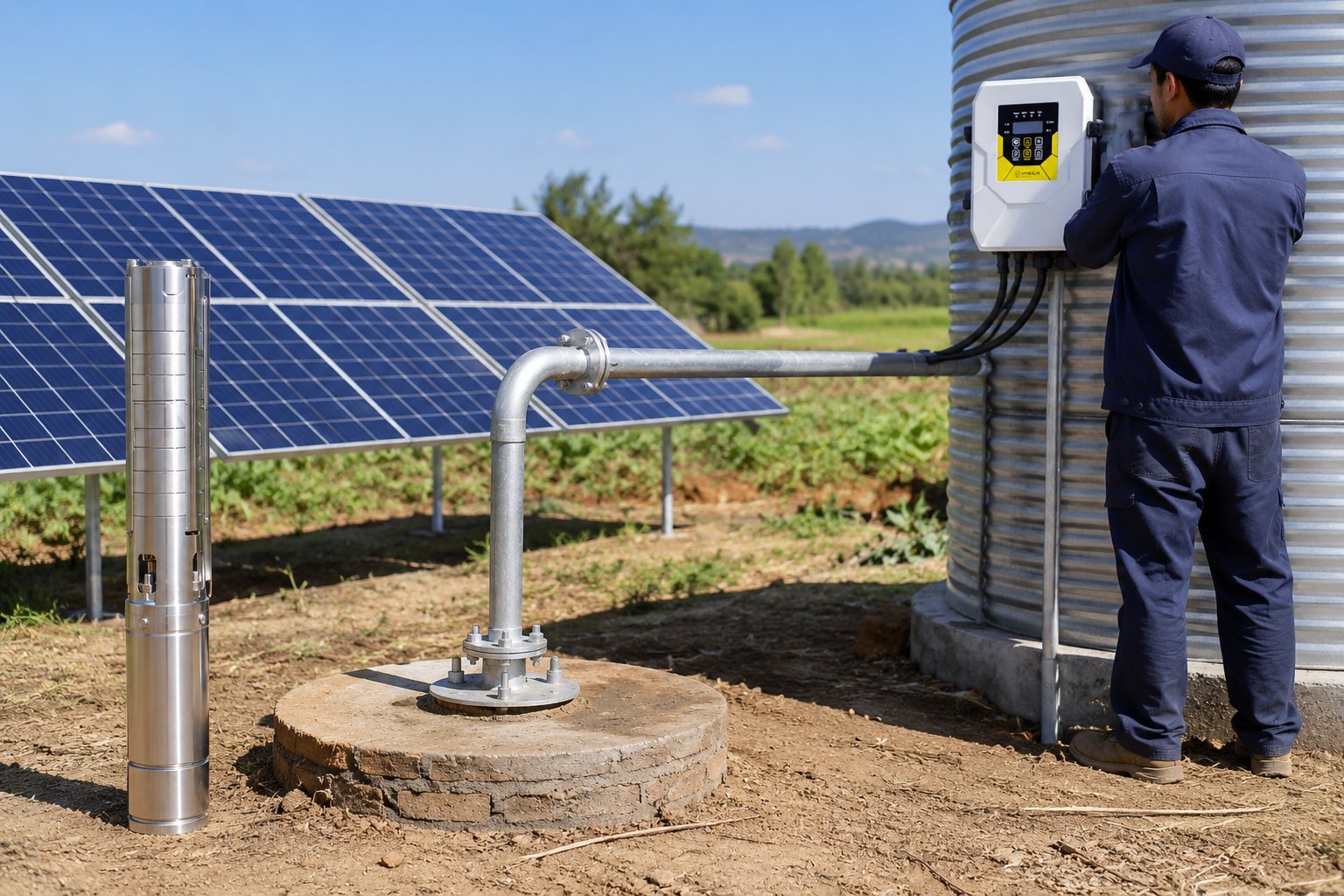
A solar pump system uses photovoltaic (PV) panels to convert sunlight directly into DC electrical energy.
This electricity is managed by an intelligent controller that powers a highly efficient brushless motor.
The motor, in turn, drives the pump, which moves water from your source to where you need it.
The Core Components of a Solar Pumping System
A complete solar water pumping system is an integrated package of three key parts.
Each component is designed to work seamlessly with the others to deliver water efficiently and reliably.
-
1. The Solar Panel Array: This is the system's power plant. Composed of one or more photovoltaic (PV) panels, the array captures sunlight and converts it into direct current (DC) electricity. The size of the array (the number and wattage of the panels) is determined by the pump's power requirement, the amount of water you need, and your geographic location's solar intensity. Modern monocrystalline panels are the industry standard, offering high efficiency even in low-light conditions.
-
2. The Pump Unit: This is the heart of the system, consisting of the motor and the pump end.
- The Motor: Modern solar pumps almost exclusively use Brushless DC (BLDC) permanent magnet motors. These are marvels of efficiency, converting over 90% of the electrical energy they receive into mechanical motion. They are sealed, maintenance-free, and designed for a very long operational life.
- The Pump End: This is the part that physically moves the water. It attaches to the motor and can be one of several designs (such as screw or centrifugal), each suited to different conditions, which we will explore later.
-
3. The Controller: This is the brains of the operation. The controller is a sophisticated electronic device that sits between the solar panels and the pump motor. It performs several crucial functions. It optimizes the power from the panels, protects the motor from over-voltage or under-voltage, and provides features like dry-run protection to shut the pump off if the well runs dry.
The Brains: The MPPT Controller
The most critical feature of a modern solar pump controller is Maximum Power Point Tracking, or MPPT.
Solar panels have a unique characteristic.
The amount of power they can produce changes continuously with the amount of sunlight hitting them and their operating temperature.
An MPPT controller constantly monitors the panel's voltage and current to find the "maximum power point"—the ideal combination that extracts the absolute most energy possible at any given moment.
It then converts this power into the optimal voltage and current required by the pump motor.
This intelligent management is not a minor tweak.
A system with an MPPT controller is typically 25-30% more efficient than one without.
This means you get more water pumped per hour, better performance on cloudy days, and the ability to run a powerful pump with a smaller, less expensive solar array.
It is the key technology that makes modern solar pumping so effective.
The Heart: The BLDC Motor
The unsung hero of the solar pump revolution is the Brushless DC (BLDC) permanent magnet motor.
This isn't the same kind of motor you'd find in a standard power tool.
BLDC motors have no brushes that wear out, which is the most common point of failure in traditional DC motors.
This design makes them virtually maintenance-free.
Their real advantage, however, is their staggering efficiency.
A typical AC motor might convert 75% of electricity into motion, wasting 25% as heat.
A high-quality BLDC motor used in a solar pump can exceed 90% efficiency.
This efficiency is further enhanced by the use of powerful rare-earth magnets, such as neodymium iron boron.
This technology allows the motors to be incredibly powerful yet compact.
Compared to older motor designs, a modern BLDC motor might be up to 47% smaller and 39% lighter for the same power output.
What does this mean for you?
A more efficient motor requires less power, which means you need fewer solar panels to do the same amount of work.
This directly reduces the system's overall cost and simplifies installation.
The combination of a high-efficiency BLDC motor and an intelligent MPPT controller is the one-two punch that makes today's solar water pumps a truly viable and powerful technology.
Which Type of Solar Pump is Right for You?
You've decided solar is the way to go, but now you're faced with a dizzying array of pump types.
Choosing the wrong one is more than an inconvenience; it's a costly mistake that leads to poor performance and frustration.
The secret is to stop looking at pumps and start looking at your water source.
Choosing the right pump is a process of matching the technology to your specific needs.
Key factors include your well depth (head), required water volume (flow), and water quality.
The main categories are screw pumps, ideal for deep wells requiring high lift, and centrifugal pumps, which deliver higher volumes of water for applications like irrigation.
Deep Wells & High Lifts: The Solar Screw Pump
When your water source is deep underground, you need a pump that can generate immense pressure to lift the water to the surface.
This is the domain of the solar screw pump, also known as a progressing cavity pump.
Its design is both simple and brilliant.
It consists of a single helical rotor (the screw) that turns inside a double helical rubber stator.
As the rotor turns, it creates sealed cavities of water that "progress" up through the pump and out the pipe.
This mechanism acts like a hydraulic piston, allowing it to generate very high pressure, or "head."
It's not uncommon for a screw pump to lift water from depths of 100 meters (over 300 feet) or more.
The trade-off for this incredible lifting power is a lower flow rate.
This makes it a "low flow, high head" solution.
- Primary Applications: These pumps are the perfect choice for domestic water supply from deep wells, filling storage tanks from a borehole, and providing drinking water for livestock in pastures where the water table is low.
- Key Advantage: Besides high head, screw pumps are exceptionally resistant to sand and grit. The rubber stator can flex to allow small particles to pass through without damaging the pump, making them highly durable in less-than-perfect water conditions, which is common in many parts of Africa and Latin America.
High Volume & Irrigation: The Solar Centrifugal Pump
When you need to move a lot of water for applications like farm irrigation or watering large herds of livestock, a centrifugal pump is the answer.
Unlike a screw pump that pushes water, a centrifugal pump uses a rapidly spinning impeller to throw water outwards, creating pressure that moves it through the system.
These are "high flow, medium head" pumps.
They can't lift water from the extreme depths a screw pump can, but they can deliver a much larger volume of water per hour.
Within this category, the material of the impeller is a critical choice that affects performance, durability, and cost.
-
Plastic Impeller Centrifugal Pumps: These pumps use impellers made from high-strength, engineered polymers. They represent an excellent balance of performance and cost. They are lightweight, which simplifies installation, and their design provides excellent resistance to abrasion from fine sand. This makes them a workhorse solution for general farm and ranch irrigation in places with moderately deep wells (e.g., up to 70 meters or 230 feet). They are a highly popular and economical choice for agricultural users.
-
Stainless Steel Impeller Centrifugal Pumps: This is the premium option for demanding environments. The pump body and all impellers are crafted from high-grade stainless steel (like SS304). This provides superior durability and, most importantly, exceptional corrosion resistance. If your water is acidic or alkaline, or if you are in a region with known corrosive groundwater like parts of Australia or coastal areas, a stainless steel pump is a wise long-term investment. They offer high reliability and a longer service life, justifying their higher initial cost for users who prioritize quality and operate in harsh water conditions.
Comparison Table: Choosing Your Pump
This table provides a quick reference to help you match your needs with the right pump technology.
| Feature | Solar Screw Pump | Solar Plastic Impeller Pump | Solar Stainless Steel Impeller Pump |
|---|---|---|---|
| Pumping Principle | Progressing Cavity | Multi-Stage Centrifugal | Multi-Stage Centrifugal |
| Best For | Very deep wells, domestic use | Farm irrigation, livestock | Corrosive water, high-end homes |
| Typical Head | Very High (100m+) | Medium (up to 70m) | Medium-High (up to 80m) |
| Flow Rate | Low | High | High |
| Sand Resistance | Excellent | Very Good (for fine sand) | Good |
| Corrosion Resistance | Good | Moderate | Excellent |
| Relative Cost | $$ | $ | $$$ |
Ultimately, the best choice is a conversation.
A good supplier will ask you about your well depth, your desired gallons per day, your pipe distance, and your water quality before recommending a solution.
How Much Does a Solar Water Pump Cost?
The upfront cost of a solar water pump can seem like a big number at first.
This initial "sticker shock" might tempt you to stick with familiar, but ultimately more expensive, methods like gas generators.
To make a smart business decision, you have to look beyond the initial purchase price and consider the total cost of ownership over the pump's lifetime.
While the initial purchase price of a solar water pump system can be higher than a conventional fuel pump, the savings begin on day one.
With zero fuel costs and minimal maintenance, the return on investment is often achieved within just 1 to 3 years, making it the most economical choice in the long run.
Breaking Down the Upfront Cost
The price of a solar water pump system can vary widely, from as little as $150 for a small fountain pump to over $3,000 for a powerful system designed for deep wells and large-scale agriculture.
It's important to understand what you are paying for.
A complete system, or "kit," typically includes:
- The Pump Unit: The submersible pump and the integrated high-efficiency brushless motor. The type (screw vs. centrifugal) and materials (plastic vs. stainless steel) are major cost factors.
- The Controller: The intelligent MPPT controller that optimizes power and protects the system.
- The Solar Panels: The number and size of panels required to power the pump. This is often a significant portion of the total cost.
- Accessories: Some kits may also include wiring, connectors, a water level sensor, and mounting hardware for the panels.
The final price tag is directly related to the system's capability.
A pump that needs to lift water 100 meters will require a more powerful motor and more solar panels than one lifting water 20 meters, and its cost will reflect that.
Always ensure you are comparing "apples to apples"—complete systems with similar performance specifications—when looking at prices.
Calculating Your Return on Investment (ROI)
The most powerful way to evaluate the cost is to calculate the payback period.
Let's consider a real-world example.
Imagine a rancher in a sunny region like Australia or the American Southwest currently using a gas-powered pump to water his livestock.
Diesel/Gas Pump Annual Costs:
- Fuel Cost: Let's say the pump uses 1 gallon of fuel per day, running for 3 hours. At $4/gallon, that's $1,460 per year.
- Maintenance: Oil changes, parts, and repairs might average $250 per year.
- Total Annual Operating Cost: $1,710
Solar Pump Investment:
- A suitable solar pump kit for this application might cost $2,500.
ROI Calculation:
- Payback Period = Initial Investment / Annual Savings
- Payback Period = $2,500 / $1,710
- Payback Period = 1.46 years
In this scenario, the solar pump pays for itself in less than 18 months.
After that point, the rancher banks the full $1,710 in savings every single year.
This simple calculation reveals that sticking with the "cheaper" gas pump is actually the far more expensive long-term decision.
Long-Term Value: Beyond the Payback Period
The financial benefits of a solar pump extend far beyond the initial payback period.
The operational lifespan of a quality pump system with a brushless motor can be 10 years or more.
Over a decade, the savings from our example above would exceed $17,000, and that's assuming fuel prices don't increase.
Furthermore, there are other valuable benefits that aren't captured in a simple ROI calculation:
- Increased Reliability: Fewer moving parts means fewer breakdowns and less time spent on repairs.
- Water Independence: You are no longer vulnerable to power outages or fuel shortages. You control your water supply.
- Environmental Benefits: A zero-emissions system reduces your carbon footprint.
- Increased Property Value: A reliable, off-grid water source is an attractive asset that can increase the value of your land.
When you consider the total lifetime savings and the added benefits of reliability and independence, the upfront cost of a solar water pump is not a liability, but a strategic and highly profitable investment.
Conclusion
Modern solar-powered pumps are a proven, reliable, and highly cost-effective technology.
They provide water independence and significant long-term savings by eliminating fuel costs.
The key is choosing the right system to match your specific well depth, water volume, and application needs.
FAQs
How long do solar water pumps last?
A quality solar pump with a brushless motor can last for 10 years or more. The solar panels themselves often have a warranty for 20-25 years of power output.
Do solar pumps work on cloudy days?
Yes, they continue to operate on cloudy days, but at a reduced flow rate. Systems are typically designed with water storage tanks to ensure a consistent supply through several days of poor weather.
Can a solar pump run a sprinkler system?
Yes, but it requires careful planning. You must select a pump that provides enough pressure (PSI) and flow rate (GPM) to meet the specific requirements of your sprinkler system.
Do solar pumps need batteries?
Not necessarily. The most common and cost-effective method is to pump water into a storage tank during the day. Batteries are an option for applications that require on-demand water pressure at night.
Are solar pumps difficult to install?
Many modern solar pump kits are designed for DIY installation with plug-and-play connections. However, for deep wells or complex plumbing, professional assistance is always a good idea.
How much water can a solar pump move?
This varies dramatically based on the system's power. Small pumps might move a few gallons per minute, while large agricultural systems can pump thousands of gallons per hour.
Can solar pumps handle sandy or dirty water?
Some pump designs, like screw pumps, are excellent at handling sand. It's crucial to match the pump type to your water quality to prevent premature wear and damage.
What is the difference between a DC and AC solar pump?
DC pumps run directly off the solar panels' power. AC pumps require an inverter to change the DC power from the panels to AC power for the motor, which adds complexity and a point of potential failure. Most modern submersible solar well pumps use highly efficient DC motors.