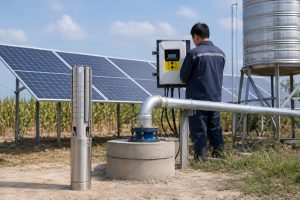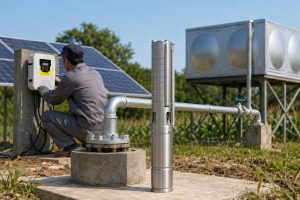
Struggling with weak showers or inconsistent water flow?
Low pressure can disrupt your home or business, causing frustration and inefficiency.
To choose a booster pump, you must first assess your flow rate and pressure needs. Then, calculate the total system head loss from friction and elevation. Finally, select the right control type, such as a Variable Frequency Drive (VFD) or a simpler pressure switch, to match your application.
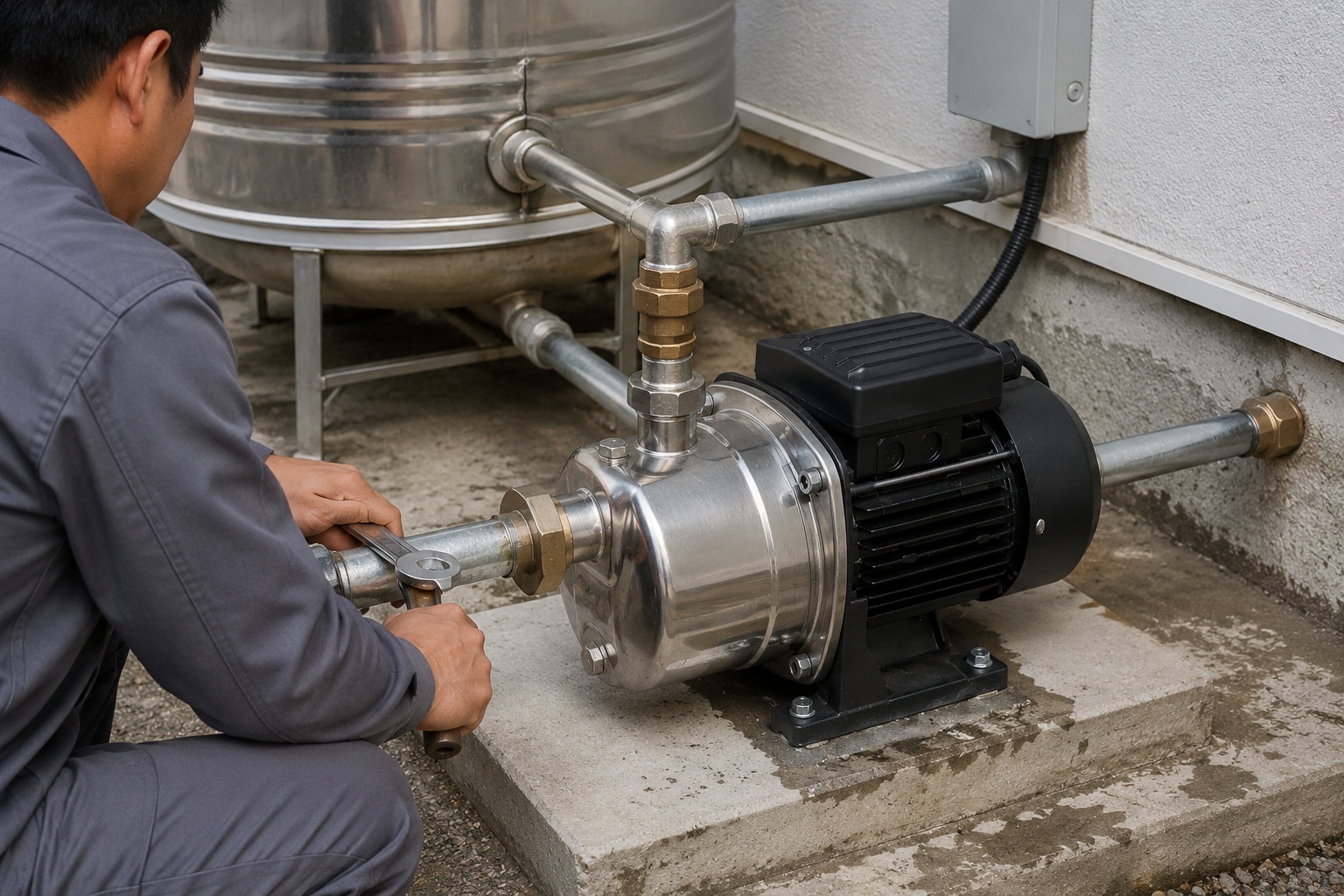
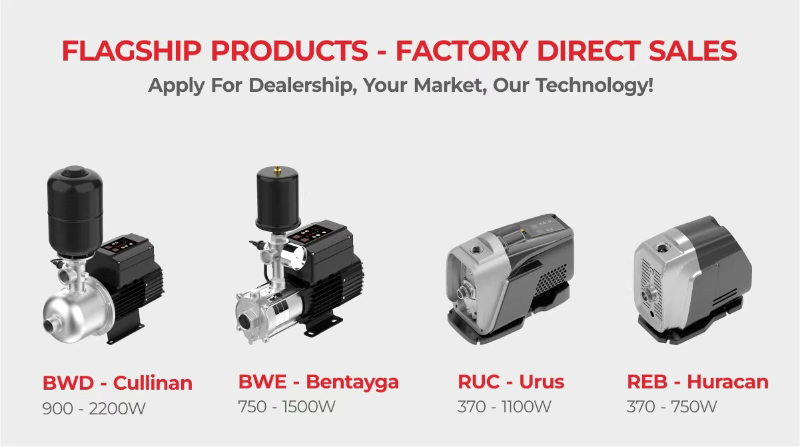
Choosing the right water booster pump can feel complex.
You need to balance performance, cost, and long-term reliability.
This guide breaks down the essential factors you need to consider.
We will walk you through everything from basic definitions to advanced controls.
This will ensure you select the perfect pump that meets your demands without wasting energy or money.
Let's dive in and find the right solution for your water pressure challenges.
What is a Booster Pump and How Does It Work?
Is your water pressure just not cutting it for your high-rise building or irrigation system?
A booster pump can solve this, but understanding how it functions is key to making the right choice.
A booster pump is a type of centrifugal pump designed to increase, or "boost," the pressure within a water system. It uses a spinning impeller to accelerate water, converting that velocity into pressure to overcome losses from elevation, long pipe runs, or high demand.
A booster pump is essentially a "helper" pump.
It takes existing pressure from a source, like a municipal line or a water tank, and increases it to a desired level.
This is different from a primary pump that might draw water from a well or a lake.
The booster pump works within an already pressurized line.
The Core Components
A booster pump system is built from a few key parts working together.
- Impeller(s): These are rotating blades that spin at high speed. They grab the incoming water and accelerate it outward.
- Motor: The motor provides the power to spin the impeller. The size and efficiency of the motor are critical to the pump's performance and energy consumption.
- Pump Casing (Volute): This housing directs the water from the impeller. Its shape is designed to slow the water down, which converts the water's velocity into higher pressure.
- Controls: These are the brains of the operation. They can range from a simple pressure switch that turns the pump on and off to a sophisticated Variable Frequency Drive (VFD) that adjusts the motor's speed based on demand.
The Step-by-Step Process
The operation is a straightforward principle of physics.
- Water enters the pump at the center of the impeller, an area called the "impeller eye," at a low pressure.
- The motor spins the impeller, and its blades fling the water outward at a high velocity.
- The water enters the pump casing, which gradually widens. This forces the fast-moving water to slow down.
- As the water's velocity decreases, its kinetic energy is converted into potential energy, or pressure.
- The now-pressurized water exits the pump and flows through the rest of the system.
In a multi-stage booster pump, this process is repeated through several impellers in a series, with each stage adding more pressure.
Booster Pump vs. Pressure Pump
The terms are often used interchangeably, but there's a subtle difference.
A "pressure pump" is a broad category for any pump that delivers water at a certain pressure.
A "booster pump" is a specific type of pressure pump used to increase pressure that already exists.
For example, if municipal water enters your building at 30 psi (207 kPa), but the top floors require 60 psi (414 kPa) for fixtures to work correctly, you need a booster pump.
| Feature | Booster Pump | Standard Transfer Pump |
|---|---|---|
| Primary Function | Increase existing pressure | Move fluid from one point to another |
| Typical Setup | Inline, downstream of a pressure source | At the source (well, tank, reservoir) |
| Main Goal | Stabilize and maintain system pressure | Achieve a specific flow rate |
| Control Focus | Pressure-sensing (VFD, pressure switch) | Flow-based or simple on/off |
Understanding this distinction helps clarify that a booster pump is a specialized tool for solving pressure deficit problems, not just for moving water.
Key Specifications to Consider Before You Buy
Choosing the wrong pump leads to wasted energy, poor performance, and premature failure.
Avoid these costly mistakes by understanding the critical specifications before you make a purchase.
Before buying, you must focus on three main specifications: the required flow rate (GPM or LPM), the necessary discharge pressure (PSI or Bar), and the total dynamic head (TDH). Matching the pump's performance curve to your system's unique demands is essential for efficiency and longevity.
Selecting a booster pump is not a one-size-fits-all task.
It requires a careful analysis of your system's specific needs.
Getting these numbers right is the most important step in the selection process.
An undersized pump will fail to deliver adequate pressure, while an oversized pump will waste energy and can damage your plumbing through issues like water hammer.
Calculating Flow Rate Requirements
Flow rate is the volume of water the pump needs to deliver, usually measured in gallons per minute (GPM) or liters per minute (LPM).
To determine your required flow rate, you need to estimate the maximum amount of water that will be used at any one time.
This involves adding up the flow rates of all fixtures and outlets that could be running simultaneously.
For example, a typical shower might use 2.5 GPM, a toilet 1.6 GPM, and a faucet 1.5 GPM.
In a commercial building, you would use a "fixture unit" calculation method to estimate peak demand more accurately.
A small office building might require 50 GPM, while a large hotel could need over 500 GPM during peak hours.
Understanding Pressure and Head
Pressure and head are two ways of measuring the same thing: the force the pump must generate.
- Pressure is the force exerted per unit area, measured in pounds per square inch (PSI) or Bar.
- Head is the vertical height to which a pump can raise water, measured in feet or meters. (1 PSI ≈ 2.31 feet of head).
To find your total requirement, you must calculate the Total Dynamic Head (TDH).
TDH is the sum of three factors:
- Static Head: The vertical distance you need to lift the water. For a 10-story building, this could be 100 feet or more.
- Friction Loss: The pressure lost due to friction as water moves through pipes, valves, and fittings. Longer, narrower pipes have significantly higher friction loss. A 500-foot run of 2-inch pipe could add 20-30 feet of head loss.
- Required Residual Pressure: The minimum pressure needed at the furthest fixture for it to operate correctly (e.g., 30 PSI for a commercial faucet).
The Importance of the Pump Curve
Every pump has a performance curve.
This chart, provided by the manufacturer, shows the relationship between the pump's flow rate and the head (pressure) it can produce.
The vertical axis shows head, and the horizontal axis shows flow rate.
Your goal is to find a pump where your system's required flow and TDH intersect at or near the pump's Best Efficiency Point (BEP).
Operating at the BEP means the pump is running at its highest efficiency, using the least amount of energy and experiencing the least amount of wear and tear.
Operating too far to the left or right of the BEP can lead to vibration, cavitation, and a drastically shortened pump life.
| Fixture Type | Typical Flow Rate (GPM) | Typical Flow Rate (LPM) |
|---|---|---|
| Residential Shower | 2.0 - 2.5 | 7.6 - 9.5 |
| Kitchen Faucet | 1.5 - 2.2 | 5.7 - 8.3 |
| Commercial Toilet | 1.3 - 1.6 | 4.9 - 6.0 |
| Irrigation Sprinkler Head | 1.0 - 4.0 | 3.8 - 15.1 |
| Industrial Washdown Hose | 5.0 - 10.0 | 18.9 - 37.9 |
What Are the Different Types of Booster Pumps?
Not all booster pumps are created equal.
Picking the right type for your specific need, from a high-rise building to an off-grid farm, is crucial for success.
Booster pumps are categorized by their construction, such as single-stage or multi-stage, and by their power source. Specialized models, like solar-powered pumps, offer unique advantages for applications in remote or energy-conscious areas, with options tailored for different flow and pressure needs.
The right type of booster pump depends entirely on your application's demands.
Key factors include the required pressure increase, the necessary flow rate, the available space, and the power source.
Understanding the main categories will help you narrow down your options and make an informed choice.
Single-Stage vs. Multi-Stage Pumps
This is the most fundamental distinction in booster pump design.
- Single-Stage Pumps: These pumps have one impeller. They are ideal for applications where only a moderate pressure increase is needed. They are generally simpler, more compact, and less expensive. They might boost pressure by 40-60 PSI.
- Multi-Stage Pumps: These pumps have two or more impellers arranged in a series. The water passes from one impeller to the next, and each "stage" adds more pressure. They are used for high-pressure applications, such as supplying water to the top of tall buildings or for long-distance irrigation. A 5-stage pump could easily add over 200 PSI to the system.
Multi-stage pumps can be configured vertically to save floor space, a common choice in commercial building mechanical rooms.
Specialized Solutions for Off-Grid Applications: Solar Pumps
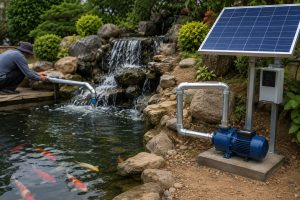
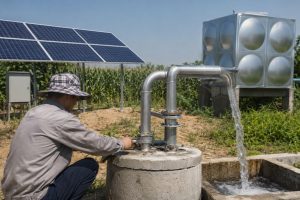
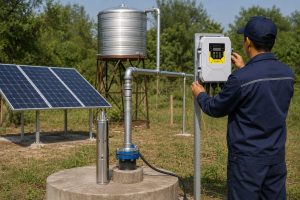
In regions with unreliable or non-existent power grids, solar-powered booster pumps are a game-changing solution.
They are essential in Africa, Australia, and Latin America for domestic water, livestock, and irrigation.
These systems use a high-efficiency motor paired with different pump ends to meet specific needs.
- Solar Screw Pump: This type uses a stainless steel helical screw rotating inside a rubber stator. It's a positive displacement pump, meaning it excels at creating very high pressure (head) but at a low flow rate. It's perfect for drawing water from extremely deep wells (over 200 meters) and is highly resistant to sand, a common issue in many regions.
- Solar Plastic Impeller Pump: This is a multi-stage centrifugal pump that uses durable, wear-resistant plastic impellers. It is designed to deliver high flow rates at a medium head. This makes it an economical and lightweight choice for farm irrigation, livestock watering troughs, and residential water supply where the well is not excessively deep.
- Solar Stainless Steel Impeller Pump: This is the premium option. It uses SS304 stainless steel for the impellers and pump body, making it highly resistant to corrosion. It is the ideal choice for applications with acidic or alkaline water, or in coastal areas with salty air. It delivers high flow and good pressure, with a focus on durability and long service life.
| Solar Pump Type | Best For | Flow Rate | Head (Pressure) | Key Advantage |
|---|---|---|---|---|
| Screw Pump | Deep wells, domestic use | Low | Very High | Excellent sand resistance |
| Plastic Impeller | Farm irrigation, high volume | High | Medium | Cost-effective & wear-resistant |
| SS Impeller | Corrosive water, premium homes | High | Medium-High | Superior durability & corrosion resistance |
The Role of Controls and Drives in Modern Systems
A pump running at full speed 24/7 wastes energy and wears out fast.
Modern controls offer a smarter, more efficient way to manage water pressure and protect your investment.
Modern booster systems use advanced controls like Variable Frequency Drives (VFDs) to precisely match pump output to system demand. This is far superior to older pressure switches, as a VFD can reduce energy consumption by up to 50% and significantly extend the motor's lifespan.
The control system is just as important as the pump itself.
It dictates how efficiently and reliably the booster system operates.
The right controls can turn a good pump into a great system, saving thousands of dollars in energy and maintenance costs over its lifetime.
Fixed Speed vs. Variable Speed (VFD)
This is the most critical choice in pump control technology.
- Fixed Speed Control: This is the traditional method. A pressure switch senses when system pressure drops below a setpoint and turns the pump on at 100% speed. When the pressure hits the upper setpoint, the pump shuts off completely. This constant starting and stopping (cycling) causes electrical surges, mechanical stress, and pressure fluctuations.
- Variable Frequency Drive (VFD) Control: A VFD is a "smart" controller. It continuously monitors system pressure with a transducer. Instead of just turning the pump on or off, it adjusts the motor's speed. If demand increases slightly (e.g., one faucet opens), the VFD speeds the motor up just enough to maintain constant pressure. This results in massive energy savings, stable system pressure, and a much longer life for the motor and pump.
A VFD-controlled system can often pay for its higher initial cost in energy savings within just 1-2 years.
The Power of High-Efficiency BLDC Motors
The motor is the heart of the pump, and modern motor technology has made huge leaps.
The most advanced solar pumps use a Brushless DC (BLDC) permanent magnet motor.
These motors have an operational efficiency exceeding 90%, compared to 70-80% for traditional AC motors.
The rotor is made from high-strength neodymium iron boron magnets.
This advanced design makes the motor significantly more compact and powerful.
A BLDC motor can be up to 47% smaller and 39% lighter than a conventional motor with the same power output.
This high efficiency directly reduces the number of solar panels needed to run the pump, lowering the total system cost and simplifying installation.
Advanced Hybrid Controllers (AC/DC)
For critical applications that need water 24/7, relying solely on the sun isn't always enough.
This is where hybrid AC/DC controllers come in.
These intelligent controllers have inputs for both DC power from solar panels and AC power from the grid or a generator.
The controller prioritizes using the free energy from the sun.
When solar power is abundant, the pump runs entirely on DC.
If clouds reduce the solar input, the controller can blend AC power with the available DC power to maintain pump operation.
When there is no solar input at all, like at night, it automatically switches over to the AC source.
This ensures a completely uninterrupted water supply, providing the best of both worlds: the cost savings of solar and the reliability of the grid.
Common Applications and Installation Pitfalls
Even the best pump will fail if it's installed or applied incorrectly.
Knowing the common applications and avoiding typical installation mistakes saves time, money, and customer headaches.
Booster pumps are critical in high-rise buildings, industrial processes, and large-scale irrigation. However, common installation pitfalls like oversizing the pump, ignoring space constraints, or using mismatched components can increase labor time by hours and lead to system failure.
A successful booster pump system depends on proper application and installation.
Understanding where these pumps are used and what can go wrong during setup is key to ensuring long-term, trouble-free operation.
Many issues that are blamed on the pump are actually caused by mistakes made during the design or installation phase.
Typical Commercial & Industrial Uses
Pressure booster pumps are essential anywhere line pressure is insufficient or inconsistent.
Common applications include:
- High-Rise Buildings: To counteract the pressure loss caused by gravity and supply adequate water to the upper floors.
- HVAC Systems: To maintain pressure in chilled-water and condenser loops for efficient heating and cooling.
- Industrial Processes: For recirculation loops, washdown stations, and processes that require constant, high-pressure water.
- Irrigation Systems: To ensure sprinklers and drip lines cover large areas on golf courses, farms, and parks.
- Fire Protection Systems: As auxiliary pumps to guarantee that sprinkler systems have enough pressure to be effective during a fire.
The Danger of Oversizing
A common mistake is to select a pump that is "a little bigger, just in case."
This is a costly error.
An oversized pump is forced to operate far away from its Best Efficiency Point (BEP).
This leads to several problems:
- High Energy Use: An oversized pump can consume 20-30% more energy than a correctly sized one.
- Water Hammer: The pump can cause intense pressure spikes in the piping system when it starts and stops, leading to noise and potential pipe damage.
- Control Instability: A VFD will struggle to maintain a stable setpoint if the pump is too powerful for the system's needs.
- Reduced Lifespan: Operating off-BEP causes vibration and excessive wear on the pump's bearings and seals, leading to premature failure.
Always use a proper sizing calculation; never guess.
The Advantage of All-in-One Systems
Traditional booster systems are complex to assemble on-site.
You have to source the pump, motor, expansion tank, valves, and control system separately.
This complexity increases the risk of using mismatched components and can add hours to the installation time.
Modern, all-in-one booster systems integrate all of these components into a single, compact, factory-assembled unit.
These systems offer significant advantages:
- Quick Installation: What used to take half a day can now be done in under an hour. Simply connect the pipes and power.
- Compact Footprint: They are ideal for retrofits or installations where space is limited.
- Guaranteed Compatibility: All components are designed to work together perfectly, eliminating performance issues from mismatched parts.
- Simplified Selection: Sizing is much easier, as the manufacturer has already done the work of matching the components.
Choosing an all-in-one system can reduce installation time by up to four hours and prevent the costly mistakes associated with component-based assembly.
Conclusion
Choosing the right booster pump requires a clear understanding of your system's needs.
Assess your flow and pressure, understand the specifications, and select the right type and controls.
A well-chosen pump ensures reliability, efficiency, and consistent performance for any application.
FAQs
Q: Can a booster pump increase water volume?
A: No, a booster pump only increases water pressure. The volume (flow rate) is determined by the capacity of your main water supply line.
Q: How much pressure can a booster pump add?
A: This varies widely. Small residential models might add 20-40 PSI, while large commercial multi-stage pumps can add over 200 PSI to the system.
Q: Do booster pumps use a lot of electricity?
A: It depends on the model and controls. A pump with a VFD uses significantly less energy, adjusting power to demand, while older fixed-speed pumps can be less efficient.
Q: Where should a booster pump be installed?
A: It should be installed on the main water line after the water meter or pressure-reducing valve, before the line branches out to different fixtures.
Q: Is a booster pump noisy?
A: Modern booster pumps, especially those with VFDs and high-quality motors, are designed for quiet operation. However, noise levels vary by model and installation quality.
Q: How do I know what size booster pump I need?
A: You need to calculate your peak flow rate demand and the Total Dynamic Head (TDH) of your system. It's best to consult a pump professional for an accurate sizing.
Q: Can I install a booster pump myself?
A: While some compact, all-in-one models are designed for easier installation, it generally requires plumbing and electrical knowledge. Professional installation is recommended to ensure safety and proper performance.
Q: What is the difference between a booster pump and a circulator pump?
A: A booster pump increases pressure in an open-loop system (like a water supply line). A circulator pump moves water in a closed-loop system (like a hydronic heating system) and is designed for flow, not high pressure.