Finding a reliable water pump can be stressful.
A poor choice leads to high energy bills and frustrating breakdowns.
Understanding your specific needs is the first step toward a perfect solution.
The best pump for most homes is a submersible pump for deep wells or a centrifugal pump for surface water tasks. However, solar-powered pumps offer the best long-term value, combining over 90% efficiency with grid independence, making them a superior choice for modern domestic water solutions.
Choosing the right water pump is a big decision for any homeowner.
It affects your daily life, from your morning shower to watering your garden.
While many traditional brands offer reliable options, the landscape is changing.
New technologies are delivering better efficiency, greater reliability, and lower running costs.
This guide will walk you through the essential types of pumps, from classic models to advanced solar solutions.
We will help you understand what makes a pump truly "the best" for your home.
Let's dive in to find a pump that saves you money and provides a steady water supply for years.
Understanding Well Pump Types and Their Applications
Confused by the different types of water pumps?
Choosing the wrong one is a common and expensive mistake.
Let's break down the main options to help you make a confident choice for your home.
Submersible pumps are best for deep wells over 90 feet, pushing water up efficiently. Jet pumps are versatile for shallow wells up to 90 feet, pulling water from above ground. Centrifugal pumps are ideal for moving surface water for tasks like garden irrigation.
Selecting the right pump starts with knowing your water source and needs.
The three main types—submersible, jet, and centrifugal—each serve a specific purpose.
Your well's depth, your household's water demand, and your pressure requirements are the key factors that will guide your decision.
A pump that is perfectly matched to your system will operate efficiently for over a decade.
An incorrect choice can lead to constant problems, from low pressure to premature failure.
Let's explore each type in more detail to see which one fits your home.
Submersible Pumps: The Deep Well Champion
Submersible pumps are the go-to solution for deep wells, typically those exceeding 90-110 feet.
As their name suggests, these pumps are fully submerged in the well water.
This design is highly efficient because it pushes water to the surface rather than pulling it.
This pushing action requires significantly less energy compared to suction-based pumps.
Because the motor is cooled by the surrounding water, these pumps can run for long periods without overheating.
They are known for their quiet operation and long lifespan, often lasting 10 to 15 years with minimal maintenance.
The sealed motor design also protects them from the elements and reduces the risk of cavitation.
Jet Pumps: The Versatile Shallow Well Choice
Jet pumps are installed above ground and are perfect for shallow wells, typically less than 25 feet deep.
They work by creating a vacuum to pull water up from the well.
One of their main advantages is ease of access for maintenance and repairs since they are not submerged.
Convertible jet pumps add another layer of versatility.
By changing the ejector nozzle, they can be adapted to work in wells as deep as 90 feet.
This makes them a great option for areas with fluctuating water tables.
However, jet pumps are generally less efficient than submersible pumps and can be noisier.
They also need to be primed before first use, which means the pump housing and suction line must be filled with water.
Centrifugal Pumps: The Surface Water Mover
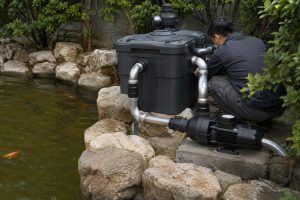
Centrifugal pumps are designed to move large volumes of water at relatively low pressure.
They are not used for drawing water from wells.
Instead, their primary use is for boosting water pressure from a storage tank or moving water for irrigation.
You will often find them used in sprinkler systems, garden watering, and pool circulation.
Their design is simple and robust, making them affordable and easy to maintain.
They work by using a spinning impeller to create centrifugal force, which pushes water out of the pump.
Like jet pumps, they must be primed and are not self-priming.
| Pump Type | Ideal Well Depth | Key Advantage | Common Application |
|---|---|---|---|
| Submersible Pump | 90 - 400+ feet | High efficiency, quiet operation | Deep well residential water supply |
| Jet Pump | 0 - 90 feet | Easy maintenance access, versatile | Shallow wells, fluctuating water tables |
| Centrifugal Pump | Surface level | High flow, low cost | Garden irrigation, pressure boosting |
Why Solar Pumps Are Redefining Domestic Water Supply
Are you tired of rising electricity bills?
Grid dependence makes your water supply vulnerable to power outages and unpredictable costs.
Solar water pumps offer a clean, cost-effective, and fully independent alternative.
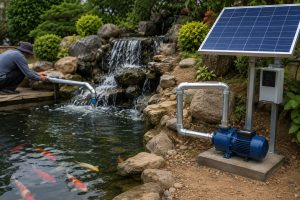
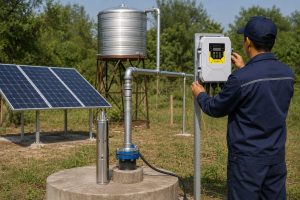
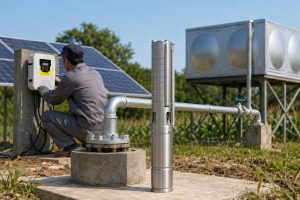
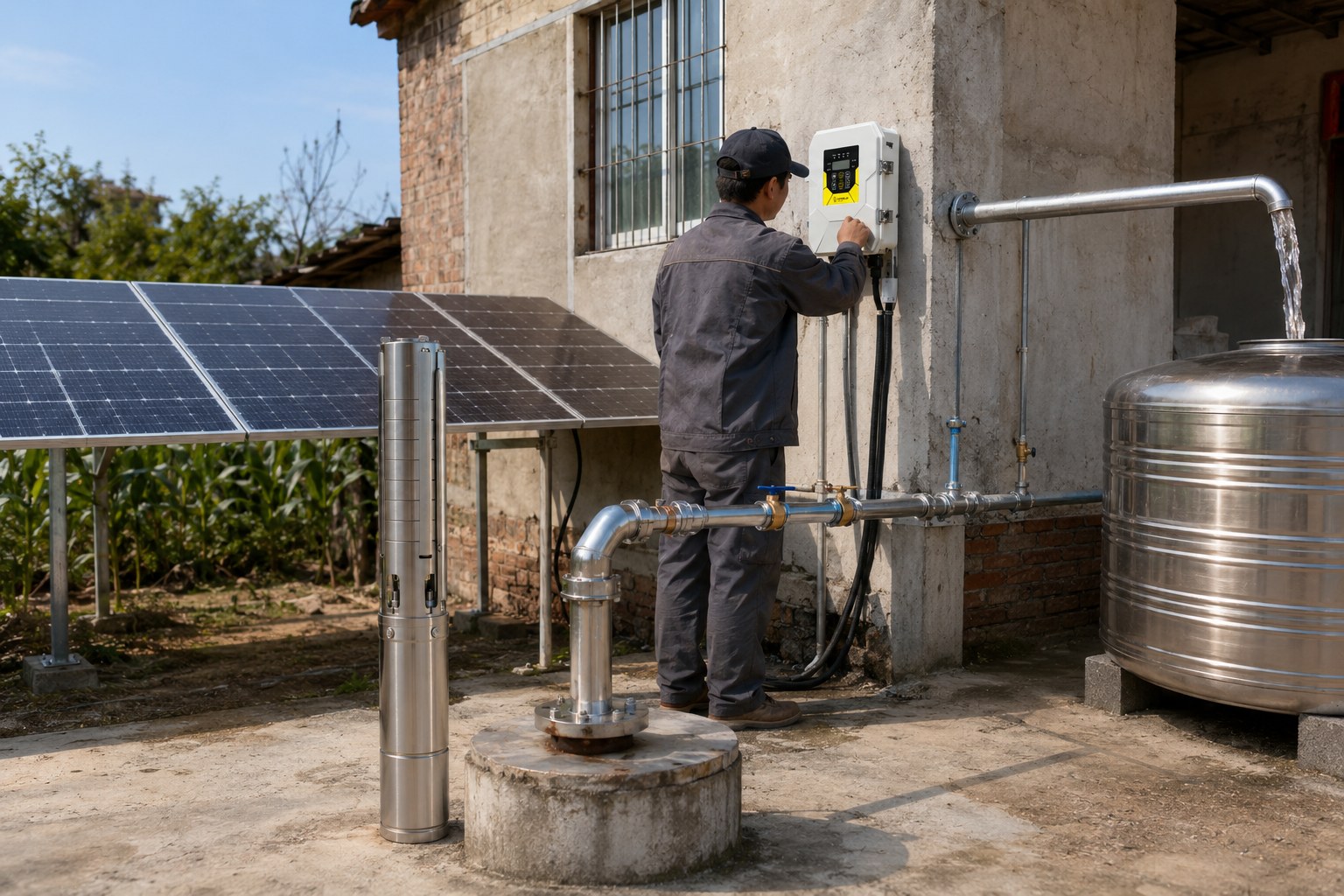
Solar pumps have become essential in off-grid regions. They use a high-efficiency BLDC motor and can be tailored for high head (screw pumps) or high flow (impeller pumps), providing reliable water for homes, livestock, and agriculture without electricity costs.
The global demand for sustainable water solutions is growing rapidly.
Solar water pumps are at the forefront of this movement.
They operate completely off-grid, making them perfect for rural homes, farms, and developing regions.
By harnessing the power of the sun, they provide a reliable water supply without the environmental impact or recurring cost of traditional electric pumps.
Modern solar pumps are not just a niche product.
They are a powerful and competitive solution for a wide range of domestic needs.
Let's explore the different types of solar pumps that are changing how we access water.
The Solar Screw Pump: High Head Specialist
When you need to draw water from very deep wells, the solar screw pump is an excellent choice.
This pump uses a stainless steel screw rotating inside a rubber stator.
This mechanism pushes water upwards through compression.
It is designed for low-flow, high-head applications.
This means it can lift water from extreme depths where other pumps might struggle.
Its ability to handle sandy or silty water makes it incredibly durable in harsh water conditions.
This resistance to sand is a major advantage in many regions of Africa and Latin America.
It is an ideal solution for domestic water supply and livestock watering in areas with scarce electricity.
The main limitation is its lower flow rate, making it less suitable for large-scale irrigation.
The Solar Plastic Impeller Pump: The High-Flow Workhorse
For applications requiring more water, the solar plastic impeller pump is the answer.
This is a multi-stage centrifugal pump designed to deliver high flow at a medium head.
It is equipped with durable, wear-resistant plastic impellers.
This design allows it to handle water with fine sand without sustaining significant damage.
Its high water output makes it perfect for farm irrigation, pasture water supply, and large home gardens.
These pumps are lightweight and more economical than their stainless steel counterparts.
This makes them a popular choice in Africa and the Americas for agricultural use.
However, their durability can be a concern in highly corrosive water or very deep wells.
The Solar Stainless Steel Impeller Pump: The Durability Champion
For the ultimate in durability and corrosion resistance, the solar stainless steel impeller pump is the premium choice.
This model features an SS304 stainless steel impeller and pump body.
It is specifically engineered for use in corrosive water environments.
This includes areas with acidic or alkaline water, or regions with alkaline soil like those found in parts of Australia and the Americas.
It delivers high flow rates and can handle medium-to-high head requirements.
This makes it a reliable choice for high-end homes, ranches, and any application where water quality is a challenge.
The trade-off is a higher initial cost and greater weight.
This positions it as a high-performance solution for niche markets that demand long-term reliability above all else.
| Solar Pump Type | Primary Function | Key Advantage | Best Application |
|---|---|---|---|
| Solar Screw Pump | Low Flow, High Head | High sand resistance | Deep domestic wells, livestock |
| Plastic Impeller Pump | High Flow, Medium Head | Economical, wear-resistant | Farm irrigation, gardens |
| Stainless Steel Impeller | High Flow, Medium-High Head | Superior corrosion resistance | Corrosive water, high-end homes |
The Core of Modern Pumps: The BLDC Permanent Magnet Motor
Pump efficiency can seem like a complex topic.
But an inefficient motor wastes your energy and money every single day.
The Brushless DC (BLDC) motor is the game-changer for modern pump performance and savings.
The BLDC permanent magnet motor is the heart of high-performance solar pumps. It achieves over 90% efficiency, is up to 47% smaller, and 39% lighter than traditional motors, drastically reducing solar panel requirements and operating costs.
The motor is the engine that drives your water pump.
Its efficiency determines not only your energy consumption but the overall performance and lifespan of the entire system.
While traditional AC motors have been the standard for years, they are being surpassed by a more advanced technology.
BLDC permanent magnet motors represent a major leap forward in pump design.
They provide the power and reliability needed for the most demanding applications while consuming significantly less energy.
Understanding the value of the motor is key to choosing a truly superior water pump system.
What Makes BLDC Motors Superior?
BLDC motors are a type of synchronous motor powered by direct current (DC) electricity.
Unlike their brushed counterparts, they rely on an electronic controller instead of physical brushes to switch the motor's phases.
This brushless design eliminates friction, reduces wear and tear, and significantly boosts efficiency.
The rotor is made of powerful permanent magnets, such as 40SH neodymium iron boron.
This creates a strong magnetic field, resulting in higher torque and power output from a much more compact design.
This combination of high efficiency and high power density is what makes BLDC motors the ideal choice for solar-powered applications.
Technical Advantages in Numbers
The performance gains offered by BLDC motors are not just marginal; they are substantial.
- Efficiency: BLDC motors regularly exceed 90% efficiency. Traditional AC motors often operate in the 60-75% range. This means much less solar energy is wasted as heat.
- Size and Weight: They are significantly more compact. A BLDC motor can be up to 47% smaller and 39% lighter than an AC motor with a comparable power output. This makes installation easier and less costly.
- Torque: They deliver high torque from a standstill and maintain it across a wide speed range, providing strong and consistent pumping power.
- Lifespan: With no brushes to wear out, BLDC motors are virtually maintenance-free and have a much longer operational lifespan.
Market Value for Distributors and End-Users
The strategic role of the BLDC motor cannot be overstated.
For an end-user, higher efficiency means you need fewer solar panels to run your pump.
This directly translates to lower initial system costs.
Over the pump's lifespan, the energy savings continue to accumulate.
For distributors, offering products with BLDC motors provides a clear competitive advantage.
It allows you to market a product that is demonstrably more efficient, durable, and cost-effective.
It solidifies a brand's position as a provider of high-quality, environmentally friendly water solutions.
When paired with an intelligent MPPT (Maximum Power Point Tracking) controller, the system maximizes every watt of available solar energy.
| Feature | BLDC Permanent Magnet Motor | Traditional AC Motor | Advantage |
|---|---|---|---|
| Efficiency | > 90% | 60-75% | Drastically lower energy use |
| Size | Up to 47% smaller | Larger and bulkier | Easier installation, lower shipping costs |
| Weight | Up to 39% lighter | Heavier | Easier to handle and install |
| Maintenance | Virtually maintenance-free | Requires brush replacement | Lower lifetime ownership cost |
| Lifespan | Longer service life | Shorter due to wear | Greater reliability and value |
How to Choose the Right Pump: A Sizing Guide
Choosing the wrong pump size is one of the most common and costly mistakes.
An improperly sized pump can lead to weak water pressure, high energy bills, or even premature pump failure.
Let's walk through how to correctly match pump capacity to your household's specific needs.
To size a pump correctly, calculate your peak water demand, which is typically 8-12 GPM for a standard home plus an extra 1 GPM per water-using fixture. You must also match this flow rate to your well's depth and the system's total dynamic head.
Proper pump sizing is a balancing act.
You need enough power to meet your home's water demand but not so much that you are wasting energy or damaging the pump.
This process involves more than just looking at horsepower.
It requires a careful calculation of your required flow rate, the pressure needed, and the total work the pump must do.
Taking the time to size your pump correctly is the single most important step in ensuring a reliable and efficient water system for your home.
Let's break down the key factors you need to consider.
Calculating Flow Rate (GPM)
Flow rate, measured in gallons per minute (GPM), is the volume of water your pump can deliver.
To determine your needs, you must estimate your household's peak water usage.
This is the maximum amount of water you might use at one time.
A simple way to do this is to count the number of water fixtures in your home (faucets, toilets, showers, etc.) and assign 1 GPM for each.
A typical family home requires a flow rate of about 8 to 12 GPM to operate smoothly.
Always ensure that the pump's flow rate does not exceed your well's recovery rate—the speed at which water refills the well.
| Fixture Type | Typical Flow Rate (GPM) |
|---|---|
| Toilet | 2.2 - 5.0 |
| Shower | 2.5 - 5.0 |
| Bathtub | 4.0 - 8.0 |
| Kitchen Faucet | 2.5 - 3.0 |
| Washing Machine | 4.0 - 5.0 |
Understanding Total Dynamic Head (TDH)
Total Dynamic Head (TDH) is the total equivalent height that water must be lifted, considering all sources of friction.
It is the most critical factor in determining the right pump size.
TDH is calculated by adding three components:
- Vertical Lift: The vertical distance from the water level in the well to the highest point of use in your home.
- Friction Loss: The pressure lost due to friction as water moves through pipes, bends, and valves. Longer pipe runs and smaller pipe diameters increase friction loss.
- Pressure Head: The desired water pressure at the faucet. To convert your desired PSI (pounds per square inch) to feet of head, multiply the PSI by 2.31. For a standard 50 PSI, this equals 115.5 feet of head.
Intelligent Controls for 24/7 Water
Even the best solar pump is limited by the availability of sunlight.
What happens on cloudy days or at night?
This is where advanced controllers make a huge difference.
Modern hybrid controllers are designed with dual power inputs.
You can connect both solar panels and an AC power source (like the grid or a generator) simultaneously.
The controller's smart logic automatically prioritizes solar power.
When sunlight is abundant, the pump runs entirely on solar energy.
If solar power is insufficient due to clouds, the controller seamlessly blends in AC power to maintain performance.
When there is no sunlight at all, it will automatically switch to the AC source.
This hybrid functionality ensures you have a worry-free water supply 24 hours a day while maximizing the use of free solar energy.
Conclusion
The best domestic pump is a complete system.
It combines the right pump type, a highly efficient motor, and intelligent controls to deliver a reliable, cost-effective, and sustainable water solution.
FAQs
What is the best residential well pump?
For most homes, a submersible pump from a reliable brand is best for deep wells. They are efficient and have a long lifespan of 10-15 years.
What is the most reliable water pump brand?
Brands like Grundfos and Franklin Electric are known for their reliability and engineering. They have a long history of making durable pumps that perform well for decades.
What kind of pump is used most often on residential wells?
Submersible pumps are the most common choice for residential wells, especially for depths over 100 feet. Their efficiency and durability make them the standard for modern installations.
Which water pump is best for a well?
For deep wells (over 90 ft), use a submersible pump. For shallow wells (under 25 ft), a jet pump is effective. Convertible jet pumps offer versatility for fluctuating water tables.
What size water pump do I need for my house?
A typical house needs a pump that can deliver 8-12 GPM. You should add 1 GPM for every major water-using fixture to determine your peak demand.
How long should a well pump last?
A quality submersible well pump should last between 10 and 15 years with proper installation and maintenance. Jet pumps may have a slightly shorter lifespan of 8-10 years.
Can I use a solar pump for my whole house?
Yes, a properly sized solar pump system with a hybrid controller can easily supply water for an entire house. This provides energy independence and a reliable 24/7 water supply.
Are more expensive water pumps worth it?
Often, yes. Higher-priced pumps typically use better materials, more efficient motors, and have longer warranties. This results in lower operating costs and a longer lifespan, saving you money over time.