Choosing the wrong well pump leads to low pressure, high energy bills, and premature failure.
You need to calculate your Total Dynamic Head (TDH) and required Gallons Per Minute (GPM).
For wells 200-400 feet deep, a 1 HP to 1.5 HP submersible pump is common, but a precise calculation is essential for efficiency and longevity.
Selecting the right deep well pump is more than just matching horsepower to well depth.
It is a critical calculation that balances your property's water demand against the physical realities of your well.
An incorrect choice can lead to a cascade of problems, from frustratingly low water pressure to catastrophic pump failure and even damage to the well itself.
For distributors and importers, understanding these nuances is key to providing customers with reliable, long-lasting solutions and building a reputation for expertise.
This guide will walk you through the essential factors, calculations, and technologies to ensure you can confidently size a deep well pump for any application.
Key Factors for Accurate Pump Sizing
Struggling with inconsistent water flow from a new pump installation?
This often stems from a miscalculation of the home's actual water demand.
To size a pump correctly, you must first determine the peak water usage in Gallons Per Minute (GPM).
This ensures the pump can handle simultaneous use of multiple fixtures without a drop in pressure.
A properly sized pump is the heart of a reliable water system.
Getting this first step wrong undermines the entire investment.
The goal is to find a pump that meets peak demand without being excessively oversized, a balance that requires a clear understanding of several interconnected variables.
For B2B partners, guiding end-users through this process demonstrates value and prevents costly post-installation support calls.
Calculating Your GPM Demand
The most straightforward method for estimating water demand is the fixture count method.
You count all the water-using fixtures in a home and assign a GPM value to each.
The sum represents the theoretical peak demand if every fixture were running at once.
A more practical approach is to estimate the number of fixtures likely to be used simultaneously during peak hours (e.g., morning showers, dishwasher, and a toilet flush).
A typical 3-bedroom, 2-bathroom home has around 10-12 fixtures.
It is unlikely all 12 will run at once.
A realistic peak demand for such a home is more likely in the 8-12 GPM range.
| Fixture Type | Average GPM |
|---|---|
| Kitchen/Bathroom Faucet | 1.0 - 1.5 |
| Shower | 2.0 - 2.5 |
| Toilet | 1.5 |
| Dishwasher | 1.5 |
| Washing Machine | 2.0 |
| Outdoor Spigot | 2.5 - 5.0 |
Understanding Well Yield vs. Pump Capacity
A critical, often overlooked factor is the well's yield rate.
This is the rate at which water naturally flows into the well from the surrounding aquifer, also measured in GPM.
Your pump's GPM capacity should never exceed the well's yield rate.
If a pump is sized for 15 GPM but the well only yields 10 GPM, the pump will draw down the water level faster than it can recover.
This condition, known as "over-pumping," can cause the pump to run dry, leading to overheating and rapid motor failure.
It also pulls excess sand and sediment into the system, which abrades pump components and can clog pipes.
A professional well yield test is the only way to know this number for sure and is a mandatory step for any new installation.
The Critical Role of Well Depth and Water Level
Well depth is just one part of the equation.
Three measurements are more important for pump sizing:
- Total Well Depth: The full depth of the drilled well. The pump is typically set 10-20 feet above the bottom.
- Static Water Level: The level water sits at in the well when the pump is off. This is the starting point for lift.
- Pumping Water Level: The level water drops to when the pump is running. This is the static water level minus the "drawdown."
The pump must lift water from the pumping water level, not the static level or the bottom of the well.
A well with a large drawdown requires a more powerful pump than a well of the same depth with a stable water level.
For example, a 400-foot well with a static water level at 100 feet and a 50-foot drawdown means the pump is actually lifting water from 150 feet, not 400 feet.
Matching Pump Horsepower to Total Dynamic Head (TDH)
Confused why a new, higher horsepower pump didn't fix your pressure issues?
Horsepower only measures lifting power, not the whole system's resistance.
The key to correct sizing is calculating Total Dynamic Head (TDH).
TDH is the total work the pump must do, combining vertical lift, friction from pipes, and the pressure you want at the tap.
Matching this TDH value to a pump's performance curve ensures optimal efficiency.
Horsepower is a common but often misleading metric when viewed in isolation.
A 1 HP pump designed for a shallow well is vastly different from a 1 HP pump designed for a 300-foot deep well.
The real work is in calculating the total resistance the pump must overcome.
This comprehensive figure, TDH, allows you to select a pump that operates in its most efficient range, saving energy and extending its service life significantly.
For distributors, teaching this concept to clients elevates the conversation from a simple HP number to a professional system design.
What is Total Dynamic Head (TDH)?
TDH is the most accurate measure of the work a pump needs to do.
It is calculated in feet and has three main components:
- Static Head (or Total Lift): This is the total vertical distance the water must be lifted. It's measured from the pumping water level in the well to the height of the pressure tank inlet.
- Friction Loss: As water moves through pipes, it encounters friction, which creates resistance. This loss is measured in "feet of head" and depends on the pipe's diameter, length, and material, as well as the flow rate (GPM). A higher GPM or smaller pipe diameter dramatically increases friction loss. For example, pushing 10 GPM through 100 feet of 1-inch pipe creates about 7.5 feet of friction loss, while a 1.25-inch pipe drops that loss to just 3 feet.
- Pressure Head: This is the pressure required at the destination, converted into feet of lift. Most residential systems use a pressure switch set to 40-60 PSI. To convert the cut-off pressure (60 PSI) to feet, you multiply by 2.31. So, 60 PSI is equivalent to 138.6 feet of head.
The formula is: TDH = Static Head + Friction Loss + Pressure Head
Step-by-Step TDH Calculation Example
Let's calculate the TDH for a typical deep well scenario:
- Pumping Water Level: 150 feet below ground.
- Pressure Tank Height: 5 feet above ground.
- Pipe: 200 feet of 1.25-inch pipe from pump to tank.
- Desired Flow Rate: 12 GPM.
- Desired Pressure: 60 PSI at cut-off.
- Calculate Static Head:
150 ft (below ground) + 5 ft (above ground) = 155 feet - Calculate Friction Loss:
Using a friction loss chart, 12 GPM in a 1.25-inch pipe creates about 4.4 feet of loss per 100 feet of pipe.
(200 ft / 100 ft) * 4.4 ft = 8.8 feet - Calculate Pressure Head:
60 PSI * 2.31 = 138.6 feet - Calculate Total Dynamic Head (TDH):
155 ft + 8.8 ft + 138.6 ft = 302.4 feet
You would then look for a pump that can efficiently deliver 12 GPM at a TDH of approximately 303 feet.
Horsepower (HP) vs. Performance
With the TDH and GPM known, you can now select the appropriate horsepower.
HP determines the pump's ability to move a certain volume of water against the calculated TDH.
The table below provides general guidelines, but you must always consult the specific pump's performance curve to find the "best efficiency point" (BEP).
| Pump HP | Typical TDH Range (feet) | Flow Rate (GPM) | Best For |
|---|---|---|---|
| 3/4 HP | 100 - 250 ft | 8 - 12 GPM | Medium depth wells (100-200 ft), average-sized homes. |
| 1 HP | 200 - 350 ft | 10 - 15 GPM | Deep wells (150-300 ft), larger homes or higher pressure needs. |
| 1.5 HP | 300 - 500 ft | 12 - 20 GPM | Very deep wells (250-450 ft), high demand, or long pipe runs. |
| 2 HP+ | 450+ ft | 20+ GPM | Extremely deep wells, agricultural irrigation, or commercial use. |
Choosing a pump that operates at its BEP for your calculated TDH/GPM point is far more important than just picking a horsepower number.
Operating away from the BEP leads to inefficiency, increased vibration, and a shorter operational lifespan.
The High Cost of Sizing Mistakes
Think a bigger pump is always better?
This common myth leads to "short cycling," which can destroy a pump motor in a fraction of its expected lifespan.
An oversized pump fills the pressure tank too quickly, forcing constant starts and stops.
Each startup draws 300-500% more electricity than normal operation, overheating the motor and drastically shortening its life from 10-15 years to as little as 2-3 years.
The consequences of improper pump sizing extend beyond simple inconvenience.
They represent significant, avoidable costs in terms of energy consumption, premature equipment replacement, and potential damage to the well itself.
An undersized pump is just as problematic, running constantly in a futile attempt to meet demand, leading to its own form of thermal breakdown.
For B2B suppliers, educating clients on these risks is a crucial part of the sales process, positioning you as a partner invested in their long-term success, not just a one-time sale.
The Dangers of an Oversized Pump
Beyond short cycling, an oversized pump introduces several other serious problems.
- Well Damage and Sand Production: A pump that draws water faster than the aquifer can replenish it creates turbulence at the well screen. This high-velocity flow pulls fine sand and sediment into the well. This abrasive material acts like sandpaper on the pump's internal impellers and check valves, accelerating wear. Over time, this sand can accumulate at the bottom of the well, reducing its effective depth and storage capacity. In severe cases, it can permanently damage the well formation.
- Higher Energy Costs: A 1.5 HP motor can draw over 50% more amperage than a 0.75 HP motor. If the smaller pump was the correct size, the oversized unit needlessly inflates electricity bills every hour it runs. Compounded by the increased run frequency from short cycling, this can add hundreds of dollars to annual operating costs.
- Pressure Tank Strain: The rapid pressure fluctuations caused by short cycling place excessive stress on the pressure tank's internal bladder, leading to premature failure of this critical component as well.
The Inefficiency of an Undersized Pump
The symptoms of an undersized pump are more immediately obvious to the end-user.
You will experience a noticeable drop in water pressure when more than one faucet is open.
The pump may run continuously for long periods without ever reaching the pressure switch's cut-off point.
This constant operation is just as damaging as short cycling.
Submersible motors are designed to be cooled by the flow of water past them.
When a pump runs at its maximum output for extended periods, it generates more heat than the water flow can dissipate.
This excess heat degrades the motor's internal windings and insulation, eventually causing an electrical short and complete motor failure, typically within 4-6 years instead of the expected 10-15.
Mitigation Strategies
If a system is already suffering from an oversized pump and immediate replacement isn't an option, there are a few mitigation strategies.
- Install a Larger Pressure Tank: A larger tank (e.g., 86 gallons instead of 20) takes longer to fill and empty, which extends the pump's run time and reduces the frequency of cycles.
- Use a Cycle Stop Valve (CSV): This mechanical valve is installed on the pump's discharge pipe. It senses when demand drops and automatically restricts the pump's output to match the flow being used, allowing the pump to run continuously at a lower output instead of cycling off.
- Upgrade to a Variable Frequency Drive (VFD): This is the most advanced solution. A VFD controller adjusts the motor's speed in real-time to match water demand, maintaining a constant pressure in the system. This completely eliminates short cycling and provides the most efficient operation possible.
Choosing the Right Pump Technology for the Application
Are you offering your clients the most efficient and reliable water solutions?
The pump itself is only half the story.
The motor that drives it is the true heart of the system.
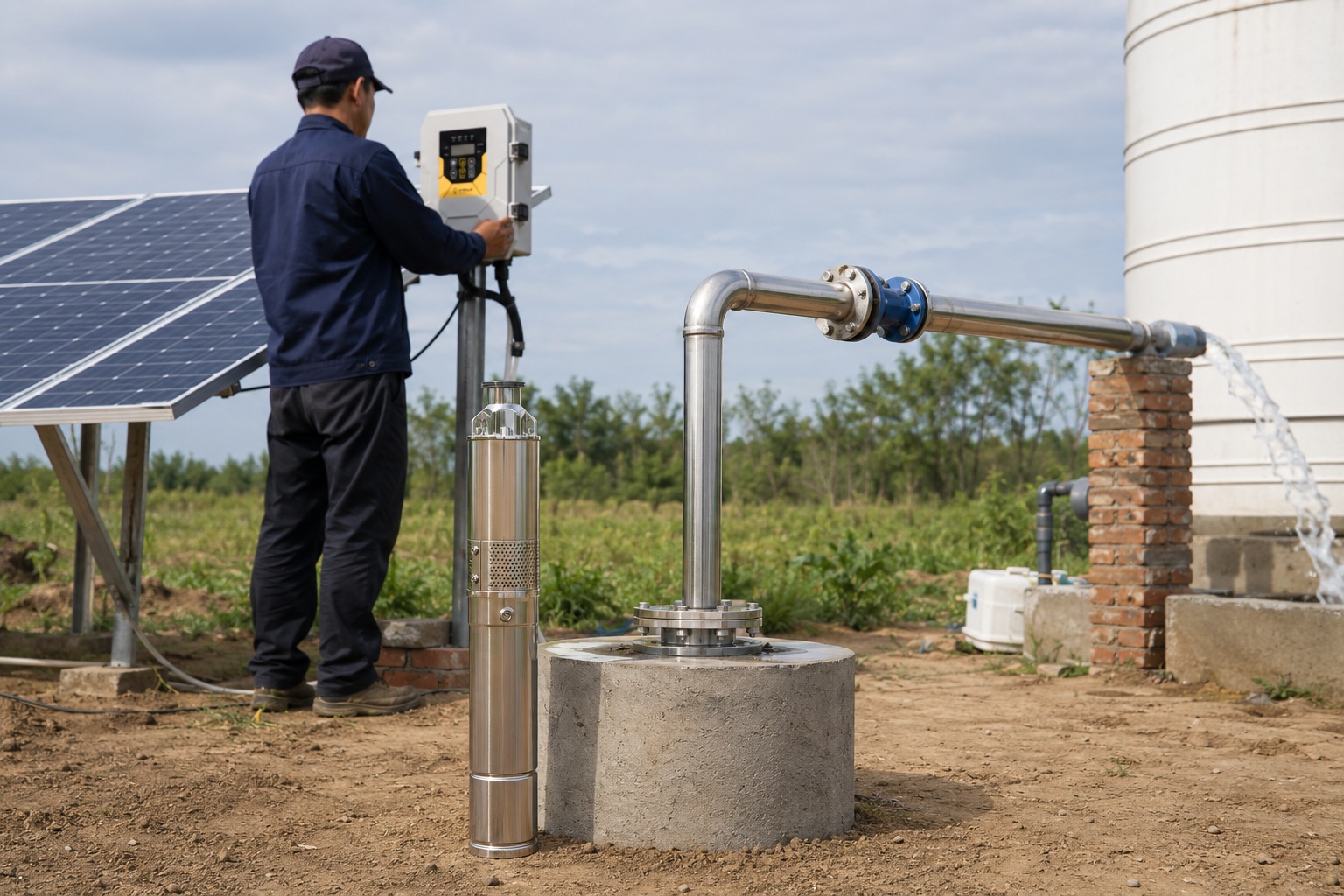
Modern solar deep well pumps are powered by high-efficiency Brushless DC (BLDC) permanent magnet motors.
These motors can exceed 90% efficiency, dramatically reducing the number of solar panels needed and lowering overall system cost, a key selling point for distributors.
A successful distributor doesn't just sell pumps; they provide complete water solutions.
This requires a product portfolio that can meet the diverse needs of the market, from deep well domestic water in Africa to high-flow irrigation in the Americas.
Understanding the specific strengths of different pump technologies—and the core motor technology that powers them all—allows you to build a competitive and flexible offering.
By focusing on the system's overall efficiency and application-specific benefits, you can position your brand as a leader in the sustainable water solutions market.
The Core of Modern Pumping: The BLDC Motor
The technological leap in modern solar pumps comes from the BLDC permanent magnet motor.
Unlike older AC or brushed DC motors, these are a game-changer.
- High Efficiency: With efficiencies often exceeding 90%, they convert more solar energy into water pumping power. This means a system might only need 4 solar panels instead of 6 to do the same work, a direct cost saving of 33% on panels.
- Powerful and Compact: Using high-strength neodymium iron boron magnets, these motors deliver high torque in a smaller package. They can be up to 47% smaller and 39% lighter than traditional motors of the same power, simplifying installation and reducing shipping costs.
- Long and Maintenance-Free Life: The brushless design eliminates the most common failure point in older motors—worn-out brushes. This results in a significantly longer service life with virtually no maintenance required.
This core technology is the engine that drives the entire product line's value proposition of efficiency and reliability.
Portfolio Strategy: Matching Pump Type to Need
No single pump is perfect for every situation.
A strategic portfolio includes different pump ends powered by the same core BLDC motor technology, allowing you to meet diverse market demands.
| Pump Type | Key Characteristic | Primary Application | Advantages | Limitations |
|---|---|---|---|---|
| Solar Screw Pump | Low Flow, High Head | Domestic water, livestock watering in deep wells (e.g., Africa, Latin America). | Excellent for very deep wells; highly resistant to sand; reliable in harsh water. | Limited flow rate; not suitable for large-scale irrigation. |
| Solar Plastic Impeller Pump | High Flow, Medium Head | Farm irrigation, pasture water supply, residential use in moderate-depth wells. | High water output; good resistance to fine sand; lightweight and economical. | Less durable in highly corrosive water or at extreme depths. |
| Solar Stainless Steel Impeller Pump | High Flow, Corrosion Resistance | Corrosive water (acidic/alkaline), high-end homes, ranches (e.g., Australia, parts of Americas). | Superior corrosion resistance; long service life; high reliability. | Higher initial cost and weight; targets a more premium market segment. |
The Future is Hybrid: AC/DC Systems
The biggest limitation of a pure solar pump is that it only works when the sun is shining.
To provide true 24/7 water security, hybrid AC/DC systems are essential.
An intelligent AC/DC controller is designed with inputs for both solar panels and an AC power source (grid or generator).
The controller automatically prioritizes solar power.
When solar input is sufficient, the system runs entirely on free energy from the sun.
If clouds appear or demand increases, the controller can blend AC power with the available solar power to maintain performance.
When there is no solar input at night, it automatically switches over to the AC source.
This ensures an uninterrupted water supply, making it a perfect solution for critical applications in homes, farms, and businesses, and a powerful upgrade to offer customers.
Conclusion
Correctly sizing a deep well pump is about balancing TDH and GPM.
This ensures reliable pressure, low energy costs, and a long-lasting system for any home, farm, or business.
FAQs
How do you calculate what size well pump I need?
Calculate Total Dynamic Head (TDH) by adding vertical lift, pipe friction, and desired pressure. Then, determine your peak Gallons Per Minute (GPM) demand based on household fixtures.
Will a bigger HP well pump increase water pressure?
Not necessarily. Horsepower provides lifting power. For better pressure, you often need to adjust the pressure tank, upgrade the pressure switch, or use a constant pressure (VFD) system.
What size well pump for a 200 ft well?
Typically a ¾ HP to 1 HP pump is suitable, but the final choice depends on the water level, required GPM, and a full TDH calculation for your specific system.
What size pump do I need to lift water 500 feet?
A well this deep usually requires a 1.5 HP to 2 HP submersible pump. The exact size depends on TDH, so a professional calculation is highly recommended for efficiency.
How many GPM is good for a well?
For a typical home, 8-12 GPM is sufficient. The pump's GPM should never exceed the well's natural yield rate to avoid damage from over-pumping.
What is the best horsepower for a well pump?
There is no single "best" horsepower. The best HP is the one that efficiently meets your calculated TDH and GPM needs without being oversized or undersized.
Is a 1/2 HP or 3/4 HP pump better?
It depends on the well depth. A ½ HP pump is for shallow wells (under 100 feet), while a ¾ HP is better for medium-depth wells (100-200 feet).