Struggling to keep your pond water clear and healthy?
The wrong pump might be the problem, leading to algae blooms and unhappy fish.
For a 1000-gallon pond, you need a pump with a flow rate of at least 1000 to 1500 gallons per hour (GPH).
This ensures the entire pond volume circulates 1 to 1.5 times every hour.
This rate is crucial for effective filtration, proper oxygenation, and maintaining a healthy environment for fish and plants.
Choosing the right pump is the single most important decision you will make for the health of your pond.
It's more than just picking a box off the shelf.
It's about creating a balanced ecosystem where your fish and plants can thrive.
This guide will walk you through every factor, from basic calculations to advanced concepts like Total Dynamic Head (TDH).
We will help you select the perfect pump with confidence.
Let's ensure your pond becomes a vibrant oasis, not a maintenance headache.
Why Pump Sizing is the Most Critical Decision for Your Pond
Is your pond water murky and lifeless despite your best efforts?
An incorrectly sized pump is often the hidden cause, failing to support the pond's ecosystem.
The right pump is the heart of your pond's life-support system.
It drives filtration, oxygenation, and waste removal.
An undersized pump leads to stagnant water and sick fish, while an oversized one can create stressful currents.
Proper sizing ensures a healthy, thriving aquatic environment.
A pond pump is not just an accessory.
It is the single most critical component in your entire setup.
Think of your pond as a life-support system for the creatures living within it.
In this system, the pump is the heart.
Every other piece of equipment depends on the constant movement of water that the pump provides.
Your filter cannot filter.
Your UV sterilizer cannot sterilize.
Your waterfall cannot fall.
Without a reliable pump pushing water through the loop, your pond quickly becomes a stagnant, unhealthy pool.
The difference between a thriving pond and one plagued with problems often comes down to the pump.
Ponds with crystal clear water and healthy fish almost always have a correctly sized, reliable pump.
Conversely, ponds with green water, sick fish, and frustrated owners almost always have a pump problem.
The pump might be undersized, failing, or poorly matched to the plumbing.
This is not an area where you should cut corners.
The Dangers of Incorrect Sizing
Choosing the wrong size pump has significant consequences.
It's a mistake that can cost you time, money, and even the lives of your fish.
An undersized pump is a recipe for disaster.
It fails to circulate the water effectively, leading to low oxygen levels and the buildup of harmful ammonia and nitrites.
This creates stagnant zones where debris accumulates and algae thrives.
An oversized pump, on the other hand, can be just as problematic.
It can create a turbulent, whirlpool-like environment.
This high flow can stress your fish, damage delicate aquatic plants, and stir up sediment from the bottom of the pond.
It also consumes far more electricity than necessary, leading to higher operating costs.
| Consequence | Undersized Pump (e.g., 500 GPH) | Correctly Sized Pump (1000-1500 GPH) | Oversized Pump (e.g., 3000+ GPH) |
|---|---|---|---|
| Water Quality | Poor. Stagnant zones, algae blooms, ammonia spikes. | Excellent. Clear, well-oxygenated water. | Can be good, but may stir up sediment. |
| Fish Health | Stressed, sick, high risk of death due to low O2. | Healthy and active. | Stressed from excessive current. |
| Filtration | Ineffective. Filter is "starved" of water. | Optimal. Filter operates at peak efficiency. | Overwhelmed. Water passes through too quickly. |
| Energy Cost | Low, but ineffective. | Moderate and efficient. | High and wasteful. |
| Overall Pond Health | Failing ecosystem. | Thriving, balanced ecosystem. | Unnatural, turbulent environment. |
Turnover Rate: The Golden Rule
To understand pump sizing, you must first understand the concept of "turnover rate."
This refers to how often the entire volume of your pond water passes through the pump and filtration system.
The standard rule of thumb is to turn over your pond's total volume at least once per hour.
For a 1000-gallon pond, this means you need a pump that can move 1000 gallons per hour (GPH).
However, this is just a starting point.
For ponds with a higher bioload, such as a koi pond, the recommendation increases significantly.
Heavily stocked koi ponds should aim for a turnover rate of 1.5 to 2 times per hour.
For your 1000-gallon pond, this would translate to a required flow rate of 1500 to 2000 GPH.
This higher rate is necessary to handle the larger amount of waste produced by koi and to ensure superior oxygenation.
Remember, this required GPH is the flow rate your pump delivers after accounting for all resistance in your system, a factor we will discuss next.
Calculating Your Pond's Needs: Beyond Just Gallons
Think your 1000-gallon pond just needs a 1000 GPH pump?
This common oversimplification ignores key factors, leading to an underpowered system and poor water quality.
Calculating the right pump size involves more than just your pond's 1000-gallon volume.
You must also consider the number of fish, the presence of plants, any water features like waterfalls, and the type of filtration system you use.
Each factor adds to the required flow.
A successful pond is a balanced system.
Your pump selection must reflect the specific demands of that system.
Simply matching the pump's GPH to your pond's gallonage is a flawed approach.
Let's break down the crucial factors you need to consider to get a truly accurate picture of your pump requirements.
Step 1: Start with Pond Volume
The first and most fundamental factor is the size of your pond.
You need to know the total volume of water it holds.
If you don't already know, you can calculate it by measuring the length, width, and average depth.
For a rectangular pond, the formula is:
Length (ft) x Width (ft) x Depth (ft) x 7.48 = Total Gallons
For a circular pond, the formula is:
Radius (ft) x Radius (ft) x 3.14 x Depth (ft) x 7.48 = Total Gallons
For our example, we are working with a 1000-gallon pond.
As a baseline, we need a pump that can circulate this entire volume at least once per hour, so our starting point is 1000 GPH.
Step 2: Factor in Your Fish Load
The number and size of fish in your pond dramatically impact the required pump size.
Fish produce waste, primarily ammonia, which is toxic.
A powerful pump and filter system is needed to process this waste and keep the water healthy.
More fish means more waste, which demands a higher circulation rate.
A good, though very general, rule of thumb is to add 10 gallons of pump capacity for every inch of fish in your pond.
This is a simplified guideline and should be used with caution, but it illustrates the point.
A 1000-gallon pond with a light fish load might be fine with a 1000 GPH pump.
However, if that same pond is heavily stocked with large koi, you will need to increase your flow rate to 1500 GPH or even 2000 GPH to handle the increased biological load.
Step 3: Account for Water Features
Do you plan to include a waterfall, fountain, or stream?
These beautiful features place additional demands on your pump.
The pump not only has to circulate the water but also has to lift it to the top of the feature.
This requires a more powerful pump to maintain adequate flow and pressure.
For waterfalls, a common guideline is to provide 100 to 150 GPH for every inch of waterfall width.
| Waterfall Width | Recommended Flow Rate (GPH) |
|---|---|
| 6 inches | 600 - 900 GPH |
| 12 inches | 1200 - 1800 GPH |
| 24 inches | 2400 - 3600 GPH |
If you have a 1000-gallon pond and want a 12-inch wide waterfall, you can see that the waterfall alone requires a pump of at least 1200 GPH.
This demand must be added to the basic circulation requirement, pushing your total need higher.
Understanding Total Dynamic Head (TDH): The Hidden Factor
Bought a pump rated for 2000 GPH but getting a mere trickle from your waterfall?
You likely ignored Total Dynamic Head (TDH), the single biggest reason for underperforming pumps.
Total Dynamic Head (TDH) is the total resistance your pump fights against.
It includes the vertical height it lifts water (static head) plus friction from pipes and filters.
Ignoring TDH is why many people buy pumps that are too weak for their setup.
Total Dynamic Head is the most misunderstood concept in pond pumping, yet it is the most critical for selecting the right pump.
The GPH rating on the pump's box is its maximum output under ideal conditions, essentially with zero resistance.
Your pond is not an ideal condition.
Your pump has to work against gravity, pipe friction, and filter pressure.
TDH is the measurement of all that combined resistance.
What is TDH? A Simple Analogy
Imagine you are watering your garden with a hose.
If you let the water flow out onto the ground right next to the spigot, it comes out with strong pressure.
Now, imagine you have to carry that hose up a ladder to water a second-story window box.
The water pressure at the end of the hose drops significantly.
This loss of pressure from lifting the water is "static head."
Next, imagine your hose is 200 feet long and has several kinks and tight bends.
The friction of the water rubbing against the inside of that long, winding hose reduces the flow even more.
This is "friction loss."
Finally, you add a spray nozzle to the end.
The nozzle itself creates back-pressure, further reducing the flow.
This is "pressure loss from equipment."
Total Dynamic Head is the sum of all these forces that your pump must overcome.
The Three Components of TDH
TDH is calculated by adding three key values together.
-
Static Head: This is the easiest part to measure. It is the vertical distance (in feet) from the surface of your pond water to the highest point the water is being pumped. For a waterfall, this is the height of the waterfall lip.
-
Friction Loss: This is the resistance created as water moves through your pipes and fittings. Longer pipe runs, smaller pipe diameters, and more elbows or bends all increase friction loss. Every 10 feet of flexible pipe can add roughly 1 foot of head. Each 90-degree elbow can add the equivalent of 2-5 feet of straight pipe.
-
Pressure Loss from Equipment: Every piece of equipment in your plumbing line, like a bead filter or a UV sterilizer, adds resistance. Manufacturers typically provide the head loss rating for their products. A pressurized bead filter, for example, can add 5 to 15 feet of head pressure.
How to Estimate TDH for Your 1000-Gallon Pond
Let's calculate a hypothetical TDH for a 1000-gallon pond with a waterfall.
- Static Head: Your waterfall is 3 feet tall. Static Head = 3 feet.
- Friction Loss: You are using 20 feet of 1.5-inch pipe, which has about 2 feet of head loss. You have two 90-degree elbows, adding another 2 feet of head loss (1 foot each). Friction Loss = 4 feet.
- Pressure Loss: Your pressurized filter adds 5 feet of head pressure. Pressure Loss = 5 feet.
Total Dynamic Head (TDH) = 3 ft + 4 ft + 5 ft = 12 feet.
This means you need a pump that can deliver your target GPH (e.g., 1500 GPH) while working against 12 feet of head pressure.
When you look at a pump's specifications, you must consult its "performance curve" or chart.
This chart will show you the actual GPH the pump delivers at various levels of TDH.
A pump advertised as 3000 GPH might only deliver 1500 GPH at 12 feet of head.
Always size your pump based on its performance at your calculated TDH.
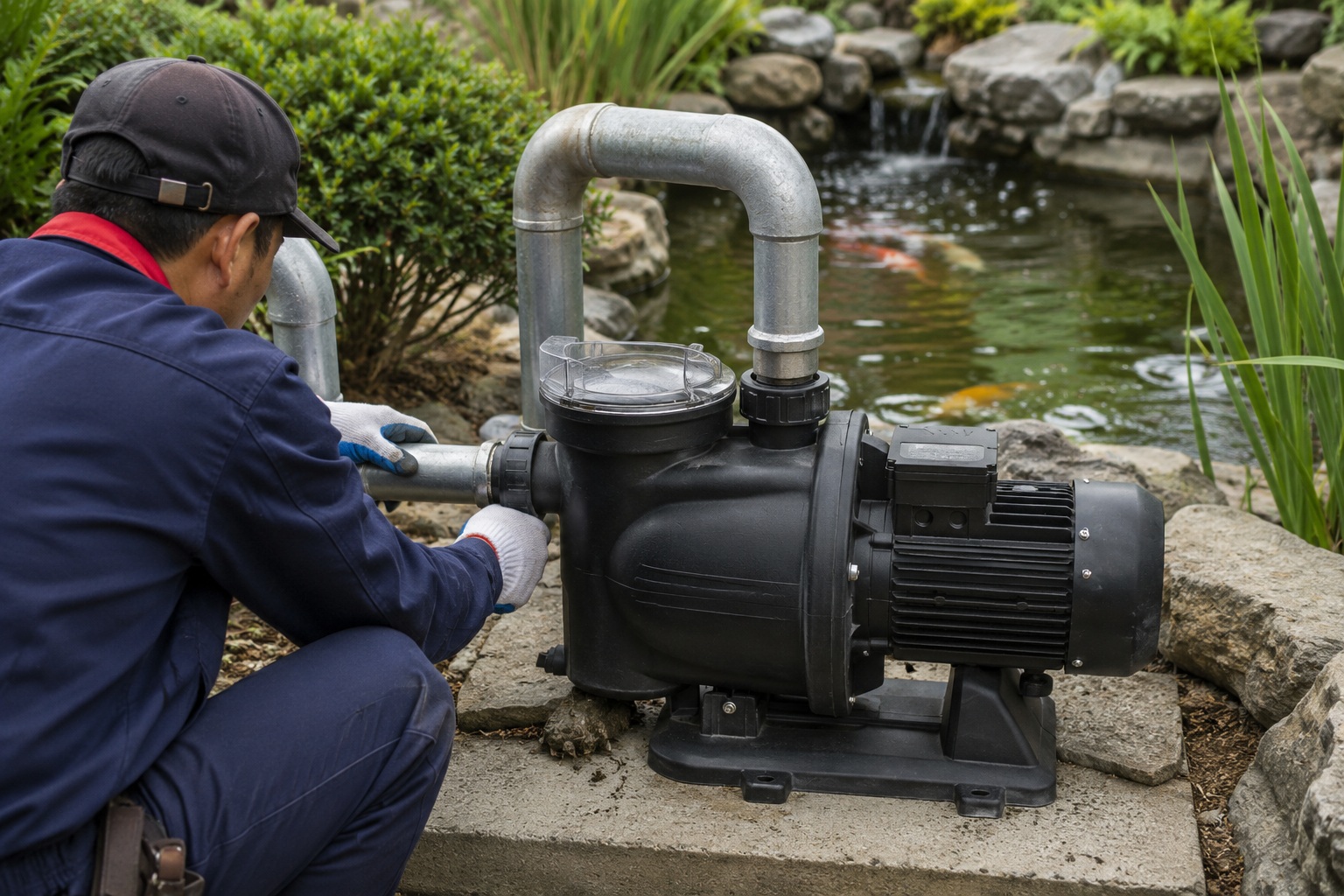
Submersible vs. External Pumps: Which is Right for a 1000-Gallon Pond?
Confused about whether to put your pump in the water or outside of it?
This choice impacts installation, maintenance, cost, and longevity, making it a crucial decision for your pond.
For a 1000-gallon pond, both submersible and external pumps are viable options.
Submersible pumps are easier to install and quieter.
External pumps offer a longer lifespan, better efficiency, and are easier to service, making them a better long-term investment for serious hobbyists.
This is the first major practical decision you will face.
Do you choose a pump that sits directly in the pond water (submersible) or one that is installed in a dry location outside the pond (external)?
Both types have their place, and the right choice for a 1000-gallon pond depends on your budget, setup, and long-term goals.
For ponds around the 1000-gallon mark, you are at a crossroads where either option can work well.
Let's break down the honest pros and cons of each to help you decide.
The Case for Submersible Pumps
Submersible pumps are often the go-to choice for beginners and for smaller ponds.
Their main advantage is simplicity.
Installation is as easy as dropping the pump into the deepest part of your pond, attaching the hose, and plugging it in.
Because they are underwater, they are virtually silent.
This makes them ideal for small garden ponds where mechanical noise would be disruptive.
They are also generally less expensive to purchase upfront compared to external pumps of similar capacity.
However, this convenience comes with trade-offs.
Maintenance requires you to pull the pump out of the water, which can be a cold, messy job.
Their lifespan is also shorter, typically 2 to 5 years, as the seals and bearings are constantly exposed to water.
The Case for External Pumps
For most dedicated koi ponds and for hobbyists who prioritize longevity and performance, an external pump is the superior choice.
These pumps are built for durability.
Because the motor stays dry and cool, they have a much longer typical lifespan of 5 to 15 years, or even more.
Servicing them is a breeze.
They sit in an accessible pump house or box, so you never have to get your hands wet to clean a pre-strainer or perform maintenance.
They are generally more energy-efficient, especially at higher flow rates, which can save you a significant amount of money on your electricity bill over the pump's lifetime.
The main downsides are a more complex installation, which requires plumbing through the pond liner, and a higher initial purchase price.
They also produce an audible hum, so they need to be housed in an enclosure to dampen the noise.
Feature Comparison Table
This table provides a clear, side-by-side comparison to help you weigh the options for your 1000-gallon pond.
| Factor | External Pump | Submersible Pump |
|---|---|---|
| Serviceability | Easy. Sits outside the pond. | Harder. Must be pulled from the water. |
| Lifespan | 5–15+ years. | 2–5 years. |
| Energy Efficiency | Generally superior, especially at higher GPH. | Good for lower GPH, less efficient at high volume. |
| Noise | Audible motor hum. | Very quiet. |
| Installation | More complex. Requires dry housing and plumbing. | Very simple. Drop in and plug in. |
| Initial Price | Higher ($350+). | Lower ($100+). |
| Best For | Serious hobbyists, koi ponds, long-term builds. | Beginners, small ponds, simple setups. |
For a 1000-gallon pond, a submersible pump is a great, cost-effective way to start.
If you are building a more permanent setup, especially with a bottom drain and a heavy fish load, investing in an external pump will pay off in the long run through easier maintenance and a longer service life.
Pump Types and Non-Negotiable Rules for Pond Keepers
Think all pumps are the same?
The technology inside your pump affects its performance, energy use, and cost, while two simple rules can save you from catastrophic fish loss.
Beyond submersible or external, pumps have different drive types like direct drive or magnetic drive.
For any serious pond, especially with fish, two rules are non-negotiable: always have a backup pump and always use a pre-strainer with an external pump.
Once you've decided between a submersible and an external pump, there are a few more details to consider.
Understanding the different ways pumps move water can help you fine-tune your selection for efficiency and performance.
More importantly, there are two foundational rules that every responsible pond owner must follow.
These rules are not about optimizing performance; they are about preventing disaster and protecting your investment in your fish.
Rule #1: Always Have a Backup Pump
This is the single most important piece of advice for any pond keeper.
You need two pumps.
This isn't about selling you more equipment.
It's about preventing the heartbreak of losing your entire fish collection because a single piece of hardware failed over a weekend.
Your pond is a life-support system.
When the pump stops, water circulation ceases.
Oxygen levels plummet, and toxic ammonia levels spike within hours.
Your fish are on a clock.
A quality backup pump is the cheapest insurance policy you will ever buy.
A single fish can be worth hundreds or thousands of dollars.
A backup pump costs a fraction of that.
There are a few ways to set this up:
- Dual Running: Two pumps running at the same time. If one fails, the other keeps the system alive.
- Primary + Standby: One main pump running, with a second one plumbed in and ready to be switched on instantly.
- Split-Function: One pump for filtration and another for a waterfall. If one fails, the other critical function continues.
Rule #2: Always Use a Pre-Strainer
This rule applies to every external pump, without exception.
A pre-strainer, also known as a leaf trap or pump basket, is a small housing that sits on the intake line just before the pump.
Its job is to catch leaves, string algae, pebbles, and other large debris before they can enter the pump.
Without a pre-strainer, this debris gets sucked directly into the pump's impeller.
This can jam the impeller, burn out the motor, and dramatically shorten the pump's life.
We have seen expensive pumps destroyed in a single season because the owner skipped a low-cost pre-strainer.
Cleaning a pre-strainer takes less than a minute and should be done weekly.
It is a tiny investment of time that protects a much larger investment in hardware.
A Quick Guide to Pump Drive Types
The motor and impeller technology inside a pump determines its characteristics.
| Pump Type | Best For | Key Feature |
|---|---|---|
| Direct Drive | High flow, high head pressure (bead filters, tall waterfalls). | The workhorse. Powerful but uses more energy. |
| Magnetic Drive | Low-head, clean water applications. | Energy efficient, no shaft seal to leak. Less powerful. |
| Variable Speed | Any system where energy savings and flow control are key. | Allows you to dial in the exact flow rate needed. Saves electricity. |
| Hybrid / ECO | Mid-range ponds seeking a balance of power and efficiency. | Combines features of direct and magnetic drive pumps. |
For a 1000-gallon pond, a magnetic drive or hybrid pump is often a great, energy-efficient choice, especially for submersible models.
If you opt for an external pump and want maximum control and long-term savings, a variable speed pump is an excellent investment.
Conclusion
Choosing the right pump for your 1000-gallon pond is simple when you follow the right steps.
Calculate your flow rate, account for TDH, and always have a backup.
FAQs
How many hours a day should a pond pump run?
A pond pump should run 24 hours a day, 7 days a week. Continuous circulation is essential for oxygenation and filtration to keep fish and the pond ecosystem healthy.
Can a pond pump be too big for a pond?
Yes. A pump that is too powerful can create excessive currents that stress fish, damage plants, and stir up debris, leading to a turbulent and unnatural environment.
What is the difference between a pond pump and a filter?
A pump circulates water, acting as the heart of the system. A filter cleans the water by removing debris and processing biological waste, acting as the kidneys.
Do I need a pump for a 1000 gallon pond?
Yes, absolutely. A pond of this size, especially with fish, requires a pump for circulation and oxygenation to prevent stagnation and maintain a healthy aquatic environment.
How much does it cost to run a 1000 gallon pond pump?
Costs vary by pump efficiency and local electricity rates. An energy-efficient pump (around 100 watts) running 24/7 might cost $10-$15 per month at average U.S. rates.
What happens if my pond pump is not strong enough?
An underpowered pump will fail to circulate water effectively. This leads to poor oxygenation, algae growth, the buildup of toxic ammonia, and ultimately, sick or dead fish.
Should a pond pump be on the bottom of the pond?
Submersible pumps are typically placed on the bottom, but it's best to elevate them slightly on a brick or stand. This prevents them from sucking up bottom sludge and debris.