Your pump suddenly stopped, or the water pressure dropped.
It’s a frustrating problem that can disrupt your entire operation, costing time and money.
When your pump isn't working, first check the power supply and circuit breaker. Then, listen for unusual noises, inspect for visible leaks, and ensure the intake is not clogged. These simple checks can often identify the root cause of the failure quickly.
Diagnosing a pump problem doesn't have to be a guessing game.
A systematic approach can help you pinpoint the issue efficiently.
This guide will walk you through the most common pump failures and provide step-by-step solutions.
By understanding the signs and symptoms, you can resolve many problems yourself and know when it's time to call a professional.
Let's explore the key things to check to get your pump back in service.
Pump Fails to Start
Your pump won't turn on, and work has ground to a halt.
This silence can be more alarming than a loud noise, signaling a complete power or motor failure.
A pump that fails to start is often due to electrical issues. Check the power source, fuses, and circuit breakers first. Ensure all wiring is secure and the motor isn't damaged or jammed.
A pump that refuses to start is one of the most common yet stressful pump issues.
The complete lack of response points directly to a few key areas, primarily the power supply or a seized motor.
Troubleshooting this issue requires a methodical check, starting with the simplest and most common causes before moving to more complex diagnostics.
Over 80% of "dead pump" scenarios are rooted in electrical problems that can often be resolved without dismantling the pump itself.
Let's break down how to diagnose and fix a non-starting pump.
Electrical System Diagnostics
The first step is always to confirm power is reaching the pump.
Use a multimeter to test the voltage at the pump's terminals.
The reading should be within ±10% of the motor's specified voltage.
A significant drop or complete lack of voltage indicates a problem upstream in the power supply.
Next, inspect the fuse or circuit breaker dedicated to the pump.
A blown fuse or a tripped breaker is a common culprit.
However, it's crucial to understand why it tripped.
It could be a one-time surge or a sign of a deeper issue, like a short in the motor wiring.
If the breaker trips again after resetting, do not force it; this indicates a persistent fault that needs investigation.
Motor and Component Checks
If the electrical supply is stable, the problem may lie within the pump's components.
Many motors use a starting capacitor to provide the initial torque needed to get started.
A faulty capacitor, which can degrade over time, will often result in a motor that hums but doesn't turn.
Replacing a capacitor is a relatively inexpensive fix that can save a motor.
Finally, consider a physical obstruction.
Debris, sediment, or a broken part can jam the impeller, preventing it from spinning.
With the power completely disconnected, try to turn the motor shaft by hand.
If it doesn't move freely, you'll need to disassemble the pump casing to find and clear the obstruction.
| Potential Cause | How to Fix |
|---|---|
| No Power | Check circuit breaker, fuses, and wiring. Ensure voltage is correct. |
| Starter Overheating | Allow the motor to cool, find the cause of the overload, and reset. |
| Faulty Capacitor | Listen for a humming sound. Test and replace the capacitor if needed. |
| Jammed Impeller | Disconnect power. Disassemble pump and clear any obstruction. |
| Damaged Motor | Inspect for physical damage or burn marks. Repair or replace the motor. |
Low Water Pressure
The water is flowing, but it's just a trickle.
Low pressure cripples productivity and indicates a significant inefficiency in your system.
Low water pressure often points to a clog, a leak, or a worn component. Inspect filters and intake screens, check pipes for leaks, and examine the impeller for damage or debris buildup.
Low water pressure is a frustrating issue that can manifest suddenly or decline gradually over time.
It signals that the pump is struggling to move water effectively through the system.
The causes can range from simple blockages to more serious internal wear.
Identifying the source of the pressure loss is key to restoring your system's performance.
A partially clogged filter, for instance, can reduce system efficiency by over 50%, dramatically impacting flow and pressure.
Let's explore how to trace and fix the causes of low pressure.
Identifying Blockages and Leaks
Start your inspection at the beginning of the system: the suction line.
A clogged intake strainer is a frequent cause of low pressure, as it starves the pump of water.
Similarly, check all filters in the system.
They should be cleaned or replaced as part of a regular maintenance schedule.
Leaks are another major contributor to pressure loss.
Carefully inspect all pipes, fittings, and connections for drips or water spray.
An air leak in the suction line is particularly problematic.
It allows air to be drawn into the pump, which leads to cavitation and a significant drop in performance.
This can be harder to spot than a water leak but is often accompanied by a noisy pump.
Inspecting for Internal Wear
If there are no obvious clogs or leaks, the issue may be internal to the pump.
The impeller is the heart of the pump, and any wear or damage to it will reduce its ability to generate pressure.
Open the pump casing and inspect the impeller vanes for erosion, corrosion, or damage from debris.
Also, check the clearance between the impeller and the pump casing or wear plates.
Over time, this gap can widen due to abrasive wear, allowing water to recirculate within the pump instead of being discharged.
This internal leakage directly results in lower output pressure.
Replacing a worn impeller or wear rings can often restore a pump's performance to factory specifications.
| Symptom | Potential Cause | Action to Take |
|---|---|---|
| Gradual Pressure Drop | Worn impeller/wear rings, or a slowly clogging filter. | Inspect internal components for wear and check filters. |
| Sudden Pressure Drop | Major clog in the line or a broken pipe/fitting. | Inspect the entire pipeline for blockages or visible breaks. |
| Fluctuating Pressure | Air leak in the suction line or a faulty pressure switch. | Check suction fittings for tightness and test the pressure switch. |
Pump Runs Continuously
The pump never stops running, burning electricity and risking a burnout.
This constant operation is a clear sign that the system can't reach its target pressure.
A continuously running pump is usually caused by a system leak, a faulty pressure switch, or an undersized pump. Check for any water leaks and inspect the pressure switch's settings and function.
A pump that runs without stopping is not only a drain on energy but also a sign of an unbalanced system.
This condition puts excessive wear on the motor, seals, and bearings, drastically shortening the pump's lifespan.
The pump is designed to run until the system reaches a specific "cut-out" pressure.
If it runs continuously, it means this pressure is never being met.
This points to three primary suspects: the system is losing pressure, the switch telling the pump to stop is broken, or the pump is simply not powerful enough for the job.
The Role of the Pressure Switch
The pressure switch is the brain of many pump systems.
It's a simple device that turns the pump on at a low "cut-in" pressure and off at a high "cut-out" pressure.
A common setting for a domestic well pump is 40/60 PSI, meaning the pump starts at 40 PSI and stops at 60 PSI.
If this switch fails, it can get stuck in the "on" position.
The contact points can weld together, or the diaphragm that senses pressure can fail.
You can test the switch by observing the system's pressure gauge as it runs.
If the pressure rises well above the cut-out setting and the pump doesn't stop, the switch is likely faulty and needs replacement.
System Leaks and Sizing Issues
The most common reason a pump won't shut off is a leak somewhere in the system.
Even a very small leak, like a dripping faucet or a pinhole in a pipe, can prevent the system from reaching its cut-out pressure.
This forces the pump to run constantly to compensate for the continuous loss of water.
Conduct a thorough inspection of your entire plumbing system for any signs of leaks.
Another possibility is that the pump is undersized for the application.
If the system's demand for water (flow rate) is greater than what the pump can supply, the pump will run endlessly in a futile attempt to meet the demand and build pressure.
This often happens when a system is expanded without upgrading the pump.
Noisy Pump Operation
Your pump is making a racket—grinding, rattling, or whining.
Strange noises are the pump's way of crying for help, signaling internal distress that needs immediate attention.
Noises often indicate cavitation (air in the system), debris in the impeller, or worn bearings. A high-pitched whine suggests cavitation, while rattling or grinding points to loose parts or bearing failure.
A healthy pump operates with a consistent, low hum.
Any new, loud, or unusual noise is a red flag that something is wrong internally.
Ignoring these audible warnings can lead to catastrophic failure.
Different sounds can point to different problems, so learning to diagnose them is a valuable skill.
Treating a noisy pump is like being a detective; the sound is your primary clue.
Whether it's a high-pitched scream or a low grumble, the noise tells a story about what's happening inside the machine.
Prompt action can often prevent a minor issue from turning into a major, expensive repair.
Diagnosing Sounds: Cavitation and Debris
One of the most common and destructive noises is a high-pitched whine or a sound like marbles or gravel rattling inside the pump.
This is the classic sign of cavitation.
Cavitation occurs when pressure in the suction line drops too low, causing tiny vapor bubbles to form in the liquid.
As these bubbles enter the high-pressure side of the pump, they implode violently, chipping away at the impeller and pump casing.
This is often caused by a clogged suction filter, a suction line that is too long or too small, or trying to lift water from too great a depth.
A louder, more distinct rattling or banging noise could indicate that a foreign object, like a stone or piece of wood, has entered the pump and is bouncing around the impeller.
Shut down the pump immediately to prevent the object from shattering the impeller or damaging the casing.
Mechanical Noises: Bearings and Alignment
A loud grinding, rumbling, or squealing noise often points to failing motor bearings.
Bearings allow the motor shaft to spin smoothly with minimal friction.
When they wear out, the metal-on-metal contact creates intense heat and noise.
Bearing failure is inevitable over time but can be accelerated by improper lubrication, contamination, or pump misalignment.
Continuing to run a pump with bad bearings can cause the rotor to contact the stator, destroying the motor.
Over 60% of premature motor failures are linked to bearing and lubrication issues.
| Noise | Potential Cause | What it Means |
|---|---|---|
| High-pitched whine/Gravel sound | Cavitation | Air bubbles are forming and imploding, causing severe damage. Check suction line. |
| Grinding or Rumbling | Worn Bearings | The motor bearings are failing and need immediate replacement to save the motor. |
| Rattling or Banging | Debris or Loose Impeller | A foreign object is inside the pump, or the impeller has come loose from the shaft. |
| Loud Humming | Jammed Motor/Bad Capacitor | The motor is trying to start but can't. It may be jammed or have a failed start capacitor. |
Water Pump Overheating
The pump is hot to the touch, and you can smell it.
Overheating is a critical warning sign that can lead to permanent motor damage and a costly replacement.
Overheating is commonly caused by the pump running dry, poor ventilation, a blocked impeller causing motor strain, or incorrect voltage. Immediately shut off the pump and diagnose the cause to prevent burnout.
A pump motor generates heat during normal operation, but it's designed to dissipate that heat effectively.
When a pump becomes excessively hot to the touch, it's a sign that it is generating more heat than it can get rid of.
This condition, known as overheating, can rapidly degrade the motor's internal insulation and lead to a complete burnout.
Identifying and correcting the root cause of overheating is essential to prevent permanent damage.
A motor's lifespan can be halved for every 10°C (18°F) increase in its operating temperature above its design limit.
Common Causes of Motor Overheating
The most damaging cause of overheating is dry running.
Pumps are designed to move liquid, and that liquid also serves as a crucial coolant and lubricant for the pump's internal components and seals.
Without water flowing through it, friction builds up incredibly fast, and temperatures can skyrocket, melting seals and warping parts in a matter of minutes.
Another common issue is improper voltage.
Both low and high voltage can cause a motor to overheat.
Low voltage forces the motor to draw more current (amps) to produce the required power, which generates excess heat.
A 10% drop in voltage can increase motor temperature by as much as 15%.
Poor ventilation is also a frequent culprit.
The cooling fins on the motor casing are designed to dissipate heat into the surrounding air.
If these fins become caked with dust, dirt, or debris, they can't do their job, and the motor's temperature will climb.
Mechanical and Environmental Strain
Mechanical strain is a significant factor in overheating.
If the impeller is partially blocked or the discharge pipe is restricted, the motor has to work much harder to push the water, drawing more current and generating more heat.
Similarly, running a pump far from its Best Efficiency Point (BEP) can lead to overload conditions.
The ambient temperature also plays a role.
Most motors are rated for operation in a specific temperature range, typically up to 40°C (104°F).
Operating a pump in a hot, enclosed space with poor air circulation can push the motor beyond its thermal limits, even if it's functioning perfectly otherwise.
Modern Solar Pump Solutions
What if your pump issues stem from an outdated, grid-dependent system?
Modern solutions offer efficiency and reliability, especially in remote, off-grid locations.
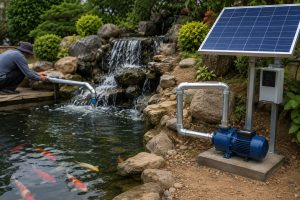
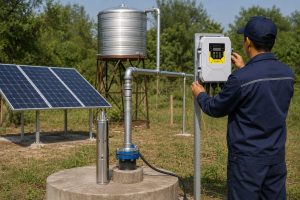
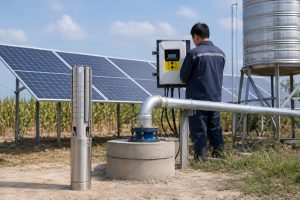
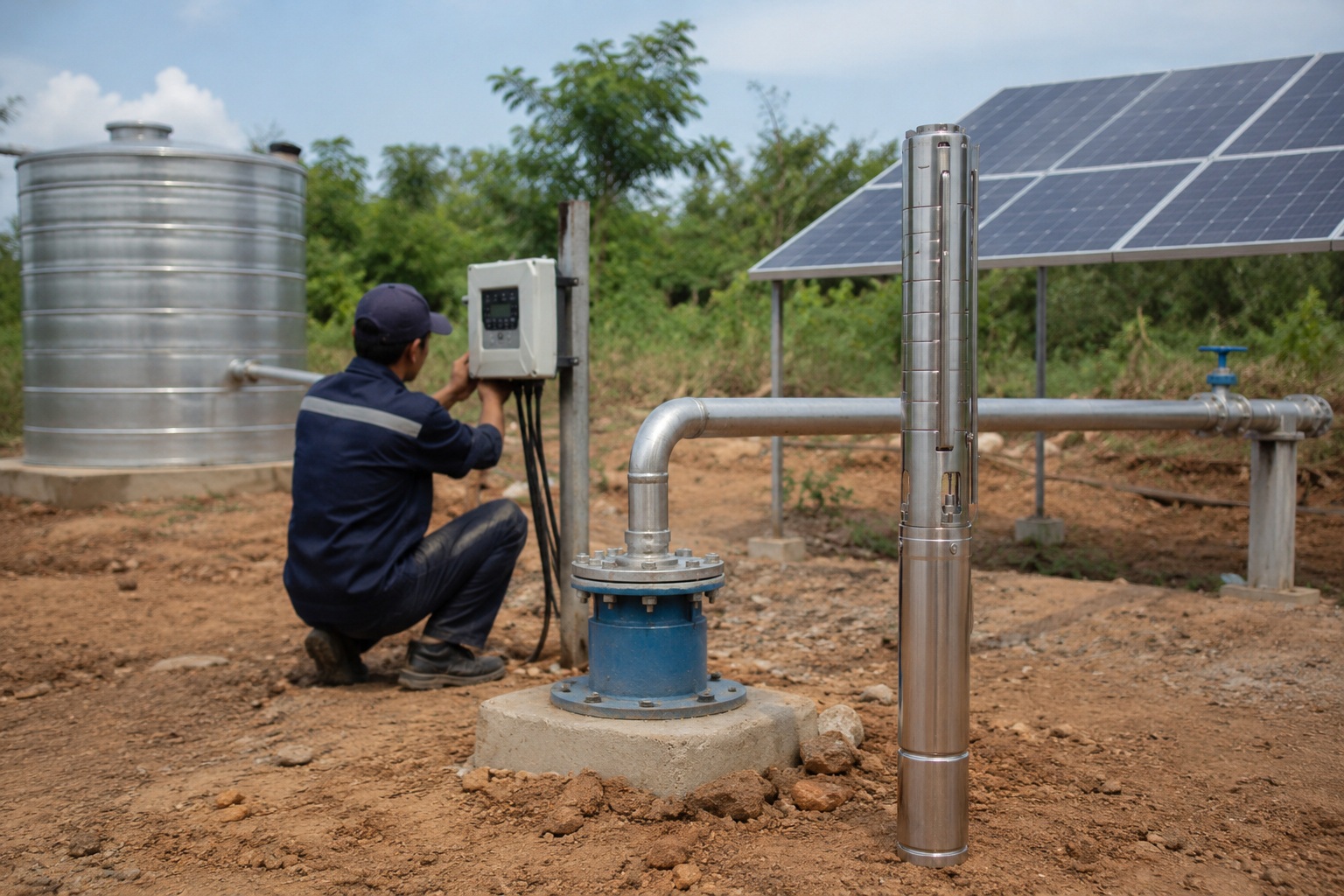
Solar-powered deep well pumps offer a competitive, grid-independent solution. Key types include screw pumps for high head, plastic impeller pumps for high flow, and stainless steel models for corrosion resistance, all powered by efficient motors.
For off-grid and rural areas, solar water pumps represent a leap forward in water management.
They eliminate reliance on unstable power grids and costly fossil fuels.
These systems are built around efficiency, combining specialized pump designs with advanced motor technology to maximize water output using only the power of the sun.
Understanding the different types of solar pumps and their core technology is key to selecting the right solution for any application, from a deep well on a remote ranch to large-scale irrigation.
This portfolio approach allows for tailored solutions that meet diverse global water needs.
Understanding Solar Pump Types
The choice of solar pump depends on the specific requirements of the well and the water demand.
- Solar Screw Pumps: These pumps are the ideal choice for deep wells where high lift (head) is required, but the flow rate can be low. They are highly resistant to sand and grit, making them durable in harsh water conditions common in Africa and Latin America.
| Solar Screw Pump | Performance |
|---|---|
| Flow Rate | 1 - 5 m³/h |
| Max Head | Up to 200 meters |
| Best For | Deep wells, domestic supply, livestock watering |
- Solar Plastic Impeller Pumps: As multi-stage centrifugal pumps, these are the workhorses for applications needing high flow at a medium head. Their wear-resistant impellers and economical price point make them perfect for farm irrigation and pasture water supply.
| Solar Plastic Impeller Pump | Performance |
|---|---|
| Flow Rate | 5 - 20 m³/h |
| Max Head | Up to 100 meters |
| Best For | Farm irrigation, high-volume water transfer |
- Solar Stainless Steel Impeller Pumps: This is the premium option, designed for longevity and reliability in corrosive water environments. The SS304 stainless steel construction resists acidic or alkaline conditions, making them ideal for specific regions in Australia and the Americas.
| Solar SS Impeller Pump | Performance |
|---|---|
| Flow Rate | 5 - 20 m³/h |
| Max Head | Up to 150 meters |
| Best For | Corrosive water, high-end homes, long-term reliability |
The Core of Efficiency: The Motor and Controller
The true innovation in these systems is the Brushless DC (BLDC) permanent magnet motor that drives them.
These motors achieve efficiencies of over 90%, a significant improvement over the 70-75% efficiency of standard AC motors.
This means more water is pumped per watt of solar power.
This high efficiency allows for a smaller solar panel array, reducing the system's overall cost and footprint.
The motor's compact design can be up to 47% smaller and 39% lighter than a comparable AC motor, which simplifies installation significantly.
This motor is paired with an intelligent MPPT (Maximum Power Point Tracking) controller.
The MPPT controller constantly optimizes the power drawn from the solar panels, boosting output by up to 30%.
It ensures the pump operates effectively even during periods of lower sunlight, like on cloudy days or early in the morning.
Advanced controllers can also offer hybrid functionality, automatically switching to AC grid or generator power when solar energy is unavailable, guaranteeing a worry-free water supply 24/7.
Conclusion
Regular checks prevent major failures.
Understanding your pump's signs of trouble, from noise to pressure drops, is key to saving time, money, and ensuring reliable operation.
Frequently Asked Questions
Why is my pump running but not pumping water?
This is often due to a loss of prime, a clog in the suction line, or a major air leak.
Ensure the pump is primed and the intake is clear.
What are the first signs of a pump failing?
Common early signs include unusual noises like grinding or whining, a gradual drop in water pressure, or the motor feeling excessively hot to the touch.
How do you get air out of a water pump?
To remove an airlock, you need to bleed the air from the system.
Open a bleed valve on the pump casing until a steady stream of water flows out.
What happens if a water pump runs without water?
Running a pump dry causes rapid overheating as water acts as a coolant.
This can destroy seals and warp internal components within minutes, leading to permanent damage.
Why does my water pump keep losing pressure?
Frequent pressure loss is typically caused by a leak in the system, a faulty check valve that allows water to flow backward, or a waterlogged pressure tank.
Can a water pump be repaired?
Yes, many common issues like worn seals, faulty capacitors, or clogged impellers are repairable.
However, for major issues like a burned-out motor, replacement is often more cost-effective.
How do you reset a water pump?
Most pumps are reset by turning off their dedicated circuit breaker for a minute and then turning it back on.
Some pumps have a red reset button on the motor.
How long should a water pump last?
A well-maintained water pump can last 8 to 15 years.
Lifespan depends heavily on usage, water quality, and the consistency of preventive maintenance.