Choosing the right pump feels overwhelming.
You see a 5 HP pump and think it must be powerful.
But what does that mean for your water flow?
Getting this decision wrong is a costly mistake.
A 5 HP pump’s GPM (Gallons Per Minute) is not a single number; it can range from as low as 15 GPM to over 80 GPM. The actual flow rate depends entirely on the pump’s design and the Total Dynamic Head (TDH)—the total resistance it must overcome.
This massive performance range reveals a critical truth.
Horsepower alone tells you very little about a pump's actual output.
It's like judging a car's capability only by its engine size without knowing if it's in a race car or a dump truck.
To truly understand how many GPM a 5 HP pump will deliver for you, we need to look beyond horsepower.
We must explore the relationship between power, flow, and the workload of your specific system.
This guide will walk you through the exact process professionals use to match a pump to a job, ensuring you get the performance you expect without wasting money or energy.
The Three Key Sizing Factors for Any Pump
Don't just pick a pump based on horsepower.
Three factors—demand, head, and well yield—must be perfectly balanced.
Ignoring even one of these can lead to system failure and costly replacements.
Proper pump sizing balances three things. First, calculate your peak water demand in Gallons Per Minute (GPM). Second, determine the Total Dynamic Head (TDH). Third, ensure the pump's flow rate does not exceed your well's recovery rate. Getting this balance right is crucial.
To select the right 5 HP pump, or any pump for that matter, you must become a detective.
You need to investigate the unique conditions of your well and the specific needs of your property.
Simply buying a pump off the shelf based on a single number is a recipe for disaster.
An undersized pump will run itself to death trying to keep up.
An oversized pump will destroy itself and potentially your well.
Let's break down the three non-negotiable factors our technicians evaluate for every single installation.
Water Demand (GPM): Sizing for Peak Usage
The first step is to calculate how much water you need during your busiest moment.
Think about a typical morning rush.
Perhaps two showers are running, a toilet flushes, and the dishwasher starts.
This "peak simultaneous demand" determines the minimum GPM your pump must deliver.
You are not sizing for average use; you are sizing for the worst-case scenario to avoid pressure drops.
Most 3-4 bedroom homes require 8-12 GPM.
Larger properties with irrigation or livestock can easily need 20-50+ GPM.
A simple way to estimate this is the fixture count method.
| Fixture | Typical Flow Rate (GPM) |
|---|---|
| Shower | 2.0 - 2.5 |
| Kitchen Faucet | 2.0 - 3.0 |
| Washing Machine | 3.0 - 5.0 |
| Outdoor Hose Bib | 3.0 - 5.0 |
| Toilet (Refilling) | 2.0 - 3.0 |
| Sprinkler Head | 2.0 - 4.0 |
Also, consider your future needs.
If you plan to add a bathroom or an irrigation system in the next five years, it's far cheaper to size the pump for that now than to replace it again later.
Total Dynamic Head (TDH): The Real Workload
Total Dynamic Head (TDH) is the single most important technical calculation for pump selection.
It represents the total amount of resistance the pump must push against to deliver water at the desired pressure.
It is measured in feet of head, where 1 PSI of pressure equals 2.31 feet of head.
TDH is the sum of four different factors:
- Pumping Water Level: This is the depth to the water while the pump is running. It is always deeper than the static (at rest) water level.
- Elevation Gain: The vertical height from the top of the well to your pressure tank or highest faucet. This is significant in hilly terrain.
- Pressure Requirement: Your desired house pressure converted to feet. A standard 50 PSI setting requires the pump to overcome an additional 115.5 feet of head (50 x 2.31).
- Friction Loss: Resistance caused by water moving through pipes. Longer pipes, smaller diameters, and more fittings all increase friction loss. This can add 10-20% to the total head calculation.
A shallow 200-foot well might have a TDH of 330 feet.
A deep 600-foot well on a hill could easily have a TDH over 700 feet.
This is why two 5 HP pumps can have vastly different GPM ratings—they are designed for different TDH ranges.
Well Recovery Rate: The Ultimate Limit
Your well's recovery rate is the hard ceiling for your pump's flow rate.
This is how quickly your well refills with water after pumping.
If your well only produces 5 GPM, installing a 20 GPM pump is a catastrophic mistake.
The pump will deliver 20 GPM for a few minutes, suck the well dry, and then the motor will burn out from running without water to cool it.
The pump's GPM must never exceed the well's sustainable yield.
Your well driller’s report should contain a pump test that specifies this rate.
In fractured rock geology, common in many arid regions, yields can change seasonally.
It is always wise to size conservatively based on the lowest expected production rate, not the rate measured after a rainy season.
Decoding Pump Performance: Beyond Horsepower
A pump’s spec sheet can be confusing.
The key isn't just the HP rating, but a graph called a performance curve.
This is where you find the real answers about a pump's capabilities.
A 5 HP pump's GPM is found on its performance curve. This graph plots flow rate (GPM) against Total Dynamic Head (feet). To find the GPM, locate your system's TDH on the vertical axis and see where it intersects the curve for the 5 HP model.
Relying on "rules of thumb" instead of performance curves is one of the most common mistakes in the industry.
Every reputable manufacturer, like Grundfos, Franklin Electric, or Pentair, publishes detailed performance curves for each pump model.
Your well professional should use these curves to prove that their recommended pump is the right choice for your specific TDH and GPM requirements.
Let's dive deeper into how to use this essential tool.
How to Read a Pump Performance Curve
A pump curve chart is simpler than it looks.
The vertical Y-axis shows the Total Head in feet.
The horizontal X-axis shows the Flow Rate in Gallons Per Minute (GPM).
The curve itself slopes down from left to right, showing the inverse relationship between head and flow.
As the total head (resistance) increases, the amount of water the pump can deliver decreases.
To use the chart:
- Calculate your TDH. This is the total resistance your pump will face.
- Find your TDH value on the vertical Y-axis.
- Draw a straight line horizontally from your TDH value until it hits the pump's performance curve.
- Drop a straight line down from that intersection point to the horizontal X-axis.
- Read the GPM value. This is the exact flow rate the pump will deliver at your specific TDH.
This GPM number must meet or slightly exceed your calculated peak water demand.
A Tale of Two 5 HP Pumps
To illustrate this, let's look at the performance of a typical 5 HP submersible pump model at different head pressures.
This demonstrates why asking "how many GPM for a 5 HP pump" has no single answer.
| System Condition | Total Dynamic Head (TDH) | Resulting Flow Rate (GPM) | Application |
|---|---|---|---|
| Scenario A | 200 feet | ~77 GPM | Shallow well, high-flow irrigation |
| Scenario B | 360 feet | ~55 GPM | Average depth residential well |
| Scenario C | 500 feet | ~32 GPM | Deep well on hilly terrain |
As you can see, the same 5 HP pump delivers dramatically different flow rates depending on the workload.
In Scenario A, it's a high-flow beast perfect for agriculture.
In Scenario C, its flow is reduced by over 58% as it works harder to lift water from a deep well.
This is why TDH is a more important number than horsepower.
The Critical Efficiency Zone
Most performance curves also show a "Best Efficiency Point" or BEP.
This is the range where the pump operates most efficiently, converting the most electricity into water movement.
Operating a pump far to the left (very high head, low flow) or far to the right (very low head, high flow) of its curve is highly inefficient.
It wastes electricity and puts immense stress on the pump's motor and bearings, shortening its lifespan.
A pump running at 60% efficiency uses significantly more power to deliver the same amount of water as one running at its BEP of 80%.
Proper sizing means selecting a pump where your operational point (your TDH and GPM requirement) falls squarely within this efficiency zone.
Matching the Pump Type to the Application
You know you need a 5 HP pump, but which type?
The water source and your needs dictate the best technology.
This choice ranges from standard pumps to advanced solar solutions.
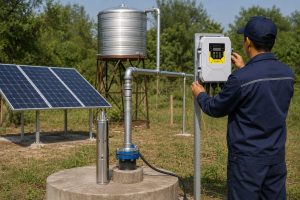
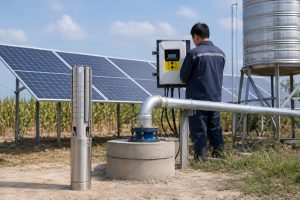
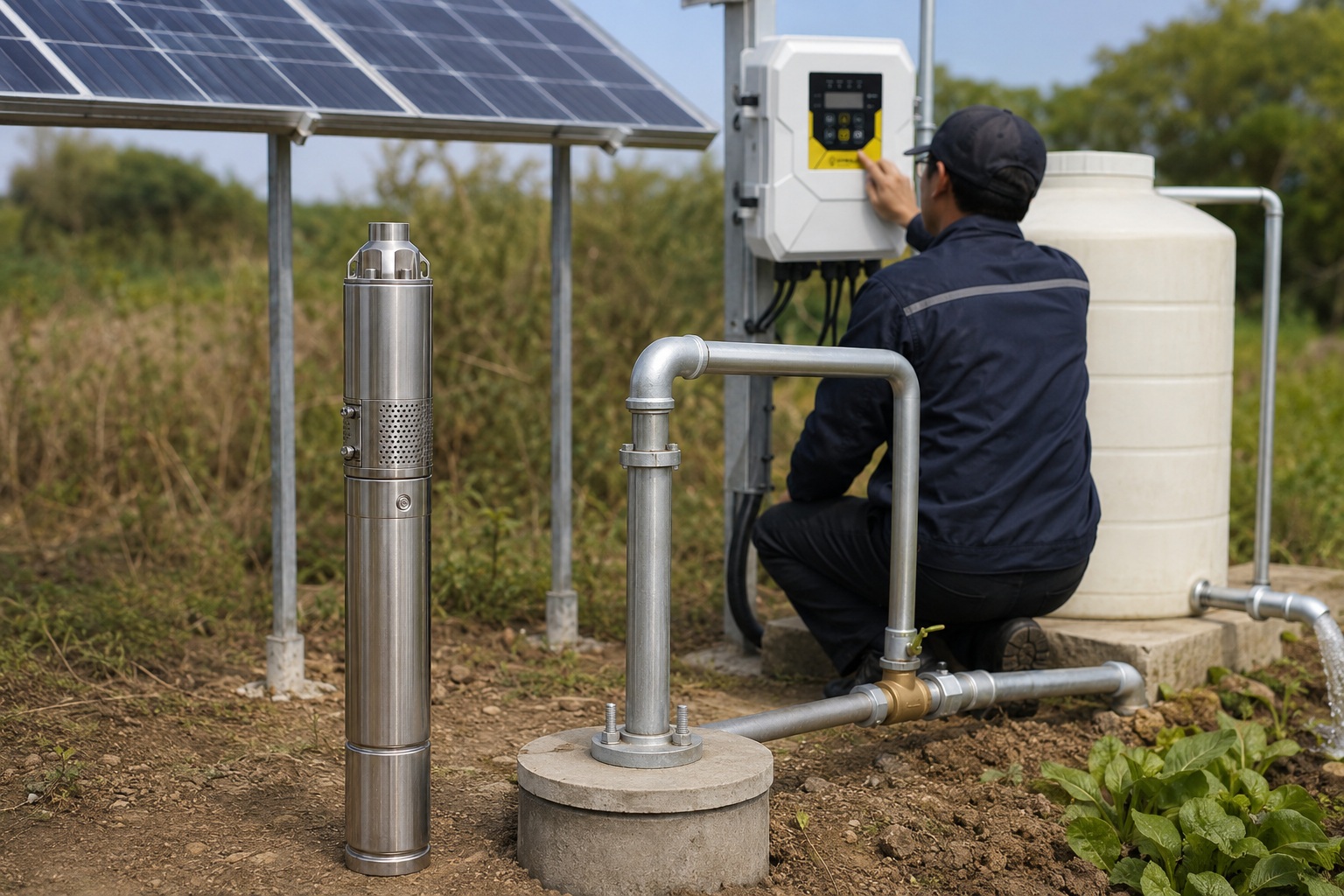
For a 5 HP system, choose the pump type based on your needs. A submersible centrifugal pump is common. For deep wells, a screw pump offers high head. For efficiency and off-grid use, consider a solar-powered pump with a high-efficiency BLDC motor.
The term "5 HP pump" is a broad category.
Within that category are several distinct technologies, each engineered for a different purpose.
Choosing the right type is just as important as choosing the right size.
A pump designed for a residential pool is completely different from one designed to lift water 800 feet out of the ground.
Let's explore the most common types you will encounter.
The Workhorse: Multi-Stage Centrifugal Pumps
This is the most common type of submersible well pump.
It uses a series of stacked impellers (stages) to build pressure and push water to the surface.
More stages mean the pump can handle a higher TDH.
Within this category, you have a key choice in materials.
-
Plastic Impeller Pumps: These models use durable, engineered composite plastics for the impellers. They offer excellent performance, high flow rates, and good resistance to abrasion from fine sand. They are an economical and lightweight choice, making them very popular for farm irrigation and general residential use in areas with good water quality. However, they may not be the best choice for very deep wells or highly corrosive water.
-
Stainless Steel Impeller Pumps: This is the premium option. The impellers, diffusers, and pump body are made from SS304 or SS316 stainless steel. This provides superior resistance to corrosion, abrasion, and wear. They are specifically designed for harsh environments, such as water with high acidity or alkalinity. While they come at a higher initial cost, their extreme durability and long service life make them a cost-effective investment for high-end homes, ranches, and any application where reliability is paramount.
The Deep-Well Specialist: Solar Screw Pumps
For applications with very high head requirements but low flow needs, the screw pump is an excellent solution.
Instead of impellers, it uses a helical stainless steel rotor turning inside a rubber stator.
This action pushes "pockets" of water upward, acting like an Archimedes' screw.
This design can generate immense pressure, making it ideal for extremely deep wells where centrifugal pumps struggle.
They are perfect for domestic water supply, livestock drinking troughs, and small-scale drip irrigation in remote, off-grid locations.
A major advantage is their exceptional resistance to sandy or silty water, which would quickly destroy a centrifugal pump.
The trade-off is that their flow rates are generally lower than centrifugal models of the same horsepower.
The Power Behind the Pump: The Motor Matters
The pump itself is only half of the equation.
The electric motor that drives it is the system's heart.
Modern, high-performance solar pump systems have largely abandoned traditional AC motors in favor of Brushless DC (BLDC) permanent magnet motors.
These motors represent a massive leap in technology.
- Extreme Efficiency: BLDC motors can achieve efficiencies over 90%, compared to 60-75% for many conventional motors.
- More Power, Less Size: They are significantly more compact and lightweight. A BLDC motor can be up to 47% smaller and 39% lighter than a traditional motor of the same power output.
- Market Value: This high efficiency directly translates to cost savings. A more efficient motor requires fewer solar panels to run, reducing the initial system cost by 15-25%. The simplified, maintenance-free design also ensures a longer service life and lower operating expenses.
The BLDC motor is the core driver of performance and competitiveness in modern water pump systems.
Variable Speed vs. Standard Pumps: A Modern Choice
Should your 5 HP pump run full-blast or adapt to your needs?
Variable speed technology offers huge savings and better performance.
But is it always the right choice for you?
A 5 HP standard pump runs at one speed (full power). A 5 HP variable speed pump adjusts its speed to match water demand, providing constant pressure and saving 30-50% on energy. This is a key consideration for efficiency and system longevity.
The choice between a single-speed (standard) pump and a variable speed drive (VFD) pump is one of the most significant decisions you'll make.
One is simple and robust; the other is intelligent and highly efficient.
Understanding the difference is key to building a system that meets your performance expectations and budget.
How Standard Pumps Work
A traditional well pump operates like a light switch.
It is either completely on or completely off.
A pressure switch in your system monitors the pressure in your pressure tank.
When the pressure drops to a pre-set low (e.g., 40 PSI), the switch slams on, and the 5 HP motor roars to life at full speed (typically 3450 RPM).
It pumps water furiously until the pressure hits the high setting (e.g., 60 PSI), then it shuts off abruptly.
This constant, high-current start-and-stop cycling creates significant mechanical stress on the motor and electrical components.
It also causes the pressure fluctuations you notice in the shower when someone else uses water.
The Advantages of Variable Frequency Drives (VFDs)
A VFD, or constant pressure system, is a game-changer.
Instead of an on/off switch, it's like a dimmer switch for your pump motor.
A controller monitors water demand in real-time and adjusts the motor's speed (its frequency) to precisely match the need.
- Constant Water Pressure: The VFD maintains a steady, constant pressure (e.g., 55 PSI) no matter how many faucets are open. No more pressure drops.
- Massive Energy Savings: The pump only runs as fast as necessary. According to pump affinity laws, reducing a pump's speed by just 25% reduces its energy consumption by nearly 58%. This can lead to electricity savings of 30-50%.
- Gentle Operation: The pump "soft starts" and ramps up gradually, eliminating the electrical and mechanical shock of a standard pump. This drastically reduces wear and tear, extending the life of the motor.
- System Protection: Many VFD controllers have built-in protections against dry-running, low voltage, and other potentially damaging conditions.
Hybrid Systems for 24/7 Water Security
For the ultimate in reliability, especially for off-grid solar applications, hybrid AC/DC systems are the ideal solution.
These advanced controllers have inputs for both DC power from solar panels and AC power from the grid or a generator.
The controller's logic is designed to prioritize solar power.
It will run the pump using free energy from the sun whenever possible.
If clouds roll in and solar power drops, the hybrid function can blend in AC power to maintain pump speed.
If there is no solar input at all, such as at night, it will automatically switch over to the AC source.
This ensures you have a worry-free water supply 24 hours a day while maximizing the use of renewable energy.
Wire Sizing: Don't Starve Your 5 HP Motor
You've chosen the perfect 5 HP pump.
But if you use the wrong wire, you could burn out the motor in months.
This is a common and incredibly costly mistake.
A 5 HP pump needs correctly sized electrical wire to prevent voltage drop. Undersized wire starves the motor of power, causing it to overheat and fail prematurely. For a 5 HP 230V motor, the required wire gauge increases with distance.
A 5 HP motor is a powerful electrical device that draws a significant amount of current, especially at startup.
Delivering that power efficiently over hundreds of feet of wire from your control panel down into the well is a critical engineering challenge.
Cutting corners on wire size is one of the most frequent causes of premature motor failure we encounter.
Why Voltage Drop Kills Motors
Every foot of electrical wire has a small amount of resistance.
As electricity flows through this resistance, the voltage "drops" along the length of the wire.
The longer the wire and the smaller its diameter (a higher gauge number), the greater the voltage drop.
Submersible pump motors are designed to operate within a tight voltage range, typically ±10% of their rated voltage (e.g., 207-253V for a 230V motor).
If the voltage at the motor drops below this range due to undersized wire, the motor must draw more amperage (current) to produce the required horsepower.
This increased amperage generates excessive heat in the motor windings, which breaks down the insulation and leads to a catastrophic motor burnout.
Wire Sizing Chart for a 5 HP Pump
You must always consult the specific motor manufacturer's wire sizing chart.
However, the following table gives a general guideline for a single-phase, 230V, 5 HP submersible motor to illustrate the principle.
| Distance from Service Panel to Motor | Minimum Required Copper Wire Size (AWG) |
|---|---|
| Up to 200 feet | 10 Gauge |
| Up to 325 feet | 8 Gauge |
| Up to 500 feet | 6 Gauge |
| Up to 800 feet | 4 Gauge |
Notice how quickly the required wire size increases.
Using 10-gauge wire for a 400-foot-deep well would be a fatal installation error.
The voltage drop would be too severe, and the motor would likely fail within a year.
Special Considerations for Rural Power
Properties in rural areas, often at the end of long utility distribution lines, can experience significant voltage fluctuations.
During hot summer afternoons when air conditioners are running, the incoming voltage at your meter might already be low.
In these situations, it is a wise investment to use wire that is one gauge larger than the minimum requirement.
This provides an extra buffer to ensure the motor receives adequate voltage even during periods of high grid demand.
For VFD systems, which contain sensitive electronics, a high-quality surge protector rated for pump applications is essential to protect the controller from lightning and power spikes.
Conclusion
A 5 HP pump's GPM is not a fixed number.
It's a dynamic value determined by a balance of TDH, demand, and well capacity.
Proper sizing ensures efficiency, longevity, and reliable water delivery for years to come.
FAQs
What is the difference between HP and GPM?
HP (Horsepower) measures the motor's power output. GPM (Gallons Per Minute) measures the volume of water the pump moves. HP provides the muscle, but GPM is the actual work done.
How many GPM does a 5hp submersible pump produce?
A 5 HP submersible pump can produce anywhere from 15 to over 80 GPM. The exact amount depends on the Total Dynamic Head (TDH), which includes well depth and pressure requirements.
How do I calculate the GPM I need?
Estimate your peak water demand by adding up the flow rates of all fixtures that might run simultaneously. A common method is to count your fixtures and multiply by 0.75 to 1.0.
Is a bigger pump always better?
Absolutely not. An oversized pump will short-cycle, waste electricity, pull sand into your well, and burn out quickly. The right-sized pump is always the best and most cost-effective choice.
How long should a 5 HP well pump last?
A correctly sized and installed 5 HP submersible pump should last 8-15 years. An improperly sized pump, either too large or too small, may fail in as little as 2-5 years.
What is Total Dynamic Head (TDH)?
TDH is the total resistance a pump works against. It is calculated by adding the pumping water level, elevation changes, friction loss in pipes, and the pressure you want at your house.
Can I run a 5 HP pump on solar?
Yes, a 5 HP pump can be run very effectively on a solar power system. Using a high-efficiency BLDC motor and an MPPT controller is crucial to minimize the number of solar panels needed.
How much does a 5hp well pump cost?
The cost of a 5 HP pump varies widely, from under a thousand to several thousand dollars. The price depends on the type (e.g., plastic vs. stainless steel), brand, and whether it includes a VFD controller.