A stagnant pond quickly becomes unhealthy.
You need the right pump to keep your water clear and fish happy, but choosing one is confusing.
Here is your guide.
For a 100-gallon pond, you need a pump with a flow rate of at least 50 to 150 gallons per hour (GPH). The exact size depends on whether you have fish and water features. A simple water garden needs 50 GPH, while a pond with fish requires 100-150 GPH.
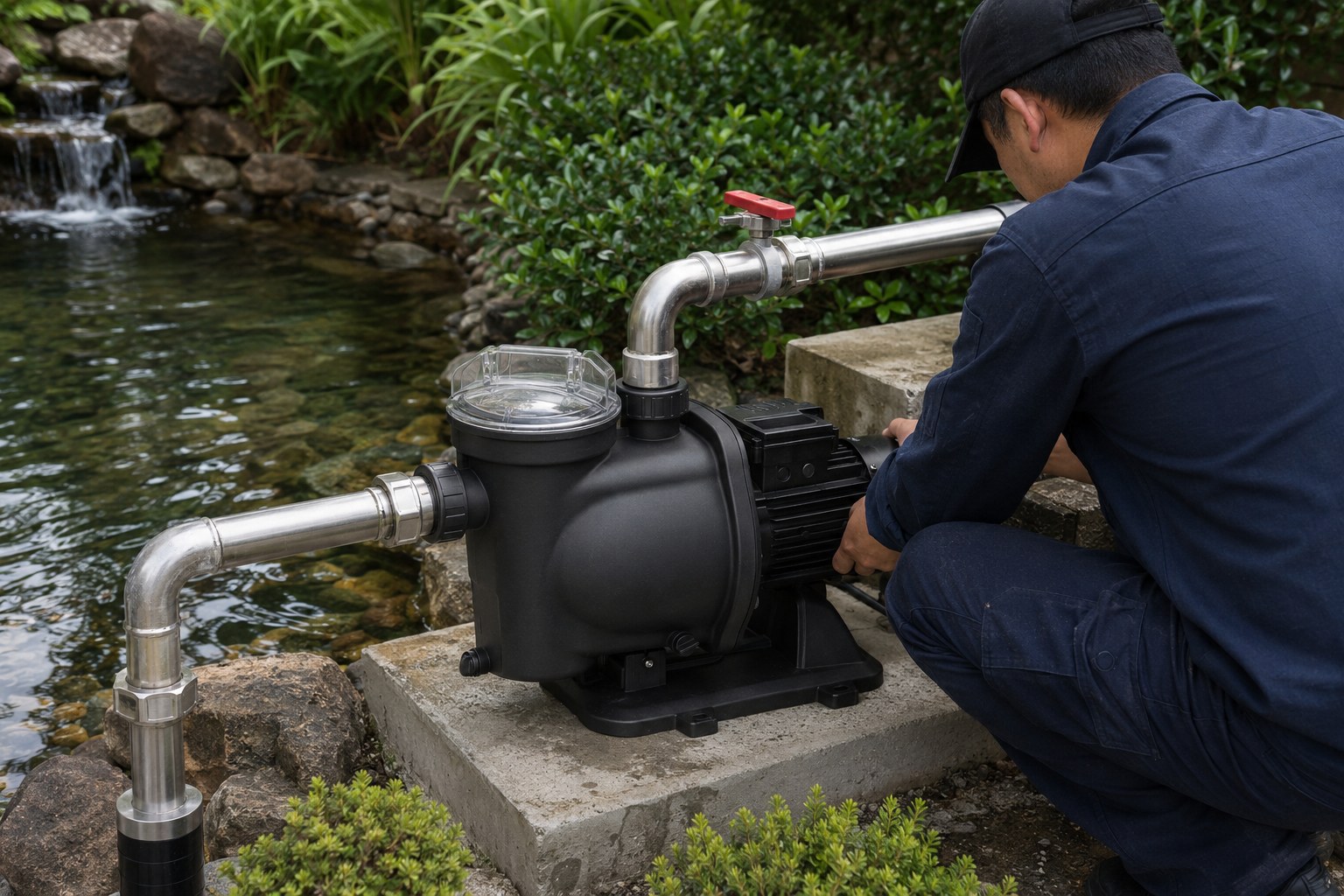
Choosing the right pump is the most critical decision for your pond's health.
It ensures clean water, happy fish, and a beautiful backyard feature.
A pump that is too small will fail to clean the water.
A pump that is too large will waste energy and stress your fish.
This guide will walk you through every factor to help you find the perfect pump, from basic calculations to advanced pump technology.
Let's make sure you get it right the first time.
What Size Fish Pond Pump Do I Need for My Pond?
Choosing a pump feels like a complex puzzle.
With so many models and ratings, it's easy to feel overwhelmed and make the wrong choice.
This can lead to poor water quality.
To size a fish pond pump, you must circulate the entire volume of your pond at least once every one to two hours. For a pond with fish, aim for one circulation per hour. For a pond without fish, once every two hours is sufficient.
Understanding the Core Calculation
The foundation of choosing a pump is understanding your pond's volume.
This single number dictates everything that follows.
A common mistake is guessing the volume, which almost always leads to an incorrectly sized pump.
Proper circulation is non-negotiable for a healthy aquatic ecosystem.
It prevents stratification, where layers of water with different temperatures and oxygen levels form.
It also powers your filtration system, which is the heart of a clean pond.
Without adequate flow, filters cannot remove waste effectively.
Calculating Your Pond's Needs
First, you must calculate your pond's volume in gallons.
The formula for a rectangular pond is simple.
Pond Volume (Gallons) = Length (ft) x Width (ft) x Depth (ft) x 7.48
For a 100-gallon pond, the volume is already known.
The next step is determining the required flow rate, measured in gallons per hour (GPH).
This is where your pond's inhabitants and features come into play.
The Rule of Thumb for Flow Rate
A basic rule helps establish a starting point.
You want to circulate the pond's total volume at a specific frequency.
- Ponds without fish: Circulate the total volume once every two hours. For a 100-gallon pond, this means you need a pump rated for at least 50 GPH (100 gallons / 2 hours).
- Ponds with fish (like goldfish): Circulate the total volume once every hour. For a 100-gallon pond, you need a 100 GPH pump.
- Ponds with heavy fish load (like Koi): These fish produce more waste and require more oxygen. You should circulate the water more than once per hour. A flow rate of 1.5 times the pond volume is a good target. For a 100-gallon pond, this would be 150 GPH.
| Pond Type | Recommended Circulation | Required GPH for 100-Gallon Pond |
|---|---|---|
| Water Garden (Plants only) | Once every 2 hours | 50 GPH |
| Lightly Stocked (Goldfish) | Once per hour | 100 GPH |
| Heavily Stocked (Koi) | 1.5 times per hour | 150 GPH |
This calculation gives you a baseline pump size.
However, other factors can increase the required GPH.
Factors to Consider When Choosing a Fish Pond Pump
Your basic GPH calculation is just the beginning.
Ignoring factors like waterfalls or filter placement can leave you with a weak, ineffective system.
You buy a pump thinking it's perfect, only to find your waterfall is just a trickle.
Key factors that increase your required pump size include head height, pipe friction, water features, and fish load. You must account for these elements to ensure your pump performs as expected and maintains a healthy pond environment.
Deconstructing Head Height and Friction Loss
Head height is the vertical distance the pump must push water.
It is measured from the surface of the pond to the highest point the water will reach.
This could be the top of a waterfall or the inlet of a filter.
Every foot of head height reduces your pump's actual flow rate.
Pump manufacturers provide charts showing the flow rate at different head heights.
For example, a pump rated for 500 GPH might only produce 250 GPH at a 5-foot head height.
Friction loss also reduces flow.
This occurs as water travels through pipes.
Longer pipes and more bends (elbows) create more friction.
Using a pipe diameter that is too small for your pump is a common mistake that severely restricts flow by up to 50%.
As a general rule, for every 10 feet of tubing, add 1 foot of head height to your calculation.
Planning for Water Features
Water features like waterfalls and fountains have specific flow requirements.
Aesthetics are just as important as function here.
A weak waterfall is disappointing.
A strong, sheeting waterfall requires significant flow.
- For a standard waterfall: Aim for approximately 100 GPH for every inch of waterfall width.
- Example: For a 6-inch wide waterfall on your 100-gallon pond, you would need an additional 600 GPH of flow.
This requirement is added to your circulation needs.
Suddenly, your 150 GPH pump for a Koi pond might need to be an 750 GPH pump to also power a small waterfall.
Adjusting for Fish and Climate
The number and size of your fish directly impact the pump you need.
More fish mean more waste and a higher demand for oxygen.
A good guideline is to add 10% to your pump's GPH for every 10 inches of fish in the pond.
Climate is another consideration.
In colder climates, you may need a pump that can run year-round to keep a hole open in the ice.
This prevents harmful gases from being trapped and ensures oxygen exchange.
In hot climates, warmer water holds less dissolved oxygen.
Increased circulation from a more powerful pump is essential to keep oxygen levels safe for fish, with a recommended 25% increase in GPH during peak summer months.
| Factor | Impact on Pump Size | Example for a 100-Gallon Pond |
|---|---|---|
| Head Height | Reduces effective GPH. | A 3-foot waterfall requires a pump that delivers target GPH at 3' of head. |
| Pipe Friction | Reduces effective GPH. | A 10-foot pipe run adds 1 foot to your effective head height calculation. |
| Waterfall | Adds a specific GPH requirement. | A 6" wide waterfall needs an extra ~600 GPH for a pleasing effect. |
| Fish Load | Increases circulation needs. | A pond with 20 inches of fish may need a 20% stronger pump. |
What Size Solar Pump Do I Need For My Pond?
You want an eco-friendly pond but worry about consistent power.
Traditional solar setups can be unreliable on cloudy days, potentially harming your pond's ecosystem.
This leaves you wondering if solar is a viable option for critical circulation.
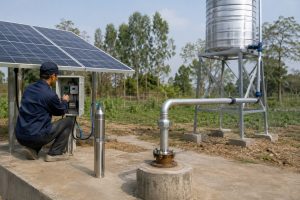
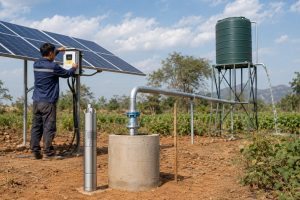
Sizing a solar pump for circulation follows the same GPH rules as a standard pump. However, you must pair it with a solar panel array and controller that can meet its power demands, even in less-than-ideal sunlight, by oversizing the panel array by 20-30%.
Circulation vs. Topping Off
It is crucial to distinguish between two uses for solar pumps in ponds.
One use is for circulation and filtration.
This requires constant, reliable power during daylight hours to keep water moving and oxygenated.
The pump size is determined by the GPH calculations we've already discussed.
For a 100-gallon pond with fish, you'd look for a solar-powered pump capable of delivering 100-150 GPH.
The second use is for topping off water lost to evaporation.
This is more common for large ponds and lakes.
The calculation here is based on water loss, not pond volume.
You determine daily evaporation in gallons and choose a system to replace it over 6-8 hours of peak sunlight.
For a small 100-gallon pond, a circulation pump is the primary concern.
The Power of Modern Solar Technology
Early solar pumps gave the technology a reputation for being weak and unreliable.
Modern systems have changed the game completely.
The core of this revolution is the high-efficiency Brushless DC (BLDC) motor.
These motors convert over 90% of the electrical energy into mechanical power.
This is a massive improvement over older motors that wasted 30-40% of their energy as heat.
This efficiency means you need fewer solar panels to achieve the same water flow.
It also means the pump can start earlier in the morning and run later in the evening.
Intelligent Maximum Power Point Tracking (MPPT) controllers are the brains of the system.
They constantly adjust the electrical load to extract the maximum possible power from the solar panels, regardless of the sunlight conditions.
An MPPT controller can boost a solar system's output by up to 30% compared to a simple controller.
Sizing Your Solar Array
To power a 100 GPH pump for your pond, you need to match it with the right solar panels.
The pump's wattage rating is your starting point.
Let's assume your 100 GPH pump requires 20 watts.
To ensure it runs well even on hazy days, you should oversize your solar panel array.
A good rule is to have a panel wattage that is 1.2 to 1.3 times the pump's wattage.
- Pump Power: 20 Watts
- Recommended Panel Size: 20W x 1.3 = 26 Watts (so a 30W panel would be ideal)
| Component | Function | Why It Matters for a Pond Pump |
|---|---|---|
| Solar Pump (BLDC) | Moves the water. | High-efficiency motor delivers more GPH per watt, essential for solar power. |
| Solar Panels | Generate DC electricity. | Must be sized to exceed the pump's power needs for consistent operation. |
| MPPT Controller | Optimizes power from panels. | Maximizes pump runtime and performance, especially on cloudy days. |
For ultimate reliability, hybrid AC/DC systems are available.
These systems prioritize solar power but can automatically switch to AC grid power when sunlight is insufficient.
This guarantees 24/7 circulation, providing the best of both worlds: sustainability and security.
The Right Pump Type for Your Needs
Not all pumps are created equal.
Choosing the wrong type for your water conditions can lead to premature failure and constant maintenance.
You might buy a pump that clogs easily with debris or corrodes in your specific water.
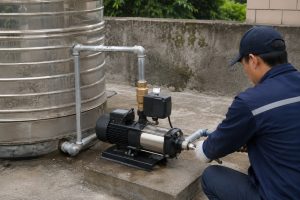
The primary types of pond pumps are direct drive and magnetic drive. For challenging environments, specialized solar pumps like screw, plastic impeller, and stainless steel impeller models offer solutions for high-head, high-flow, or corrosive water conditions.
Magnetic Drive vs. Direct Drive Pumps
For small ponds like a 100-gallon feature, you will most likely choose between two main types of conventional pumps.
-
Magnetic Drive Pumps: These pumps use magnets to spin the impeller. They are energy-efficient and generally have a longer lifespan because there are fewer moving parts and no oil seals to fail. They are best for clean water applications, as they cannot handle large solids. They are an excellent choice for a small, clean pond with a basic filter.
-
Direct Drive Pumps: In these pumps, the motor is directly connected to the impeller and sealed in an oil-filled housing. They are more powerful and can handle larger solids and higher head heights. They consume more energy but are necessary for ponds with waterfalls or those that might have leaves and other debris.
For a 100-gallon pond with just a few small fish, a magnetic drive pump is likely the most economical and efficient choice.
If you plan to add a waterfall, a direct drive pump's power is needed.
Specialized Solar Pumps for Tough Jobs
When moving beyond a simple backyard pond, the technology becomes more specialized.
This is especially true in off-grid solar applications where efficiency and durability are paramount.
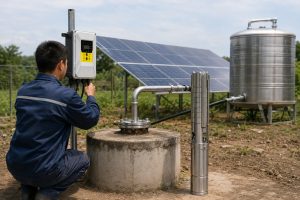
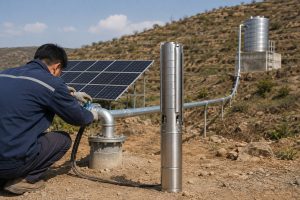
Three types of solar deep-well pumps dominate this market, each suited for a different task.
1. Solar Screw Pump
This pump uses a helical screw rotating inside a rubber stator.
It functions like an Archimedes' screw, pushing "pockets" of water upward.
This design provides low flow but can generate very high pressure, making it ideal for pushing water up from deep wells (high head).
It is also highly resistant to sand and sediment.
Its low flow makes it unsuitable for pond circulation but perfect for deep well water supply.
2. Solar Plastic Impeller Pump
This is a multi-stage centrifugal pump.
It uses a stack of impellers to move water.
This design delivers high flow rates at a medium head.
The use of durable, engineered plastic for the impellers makes them wear-resistant against fine sand.
This pump is lightweight and economical, making it a workhorse for farm irrigation and filling larger ponds.
3. Solar Stainless Steel Impeller Pump
This pump is structurally similar to the plastic impeller model but built for harsh conditions.
The impellers and pump housing are made from SS304 stainless steel.
This provides superior resistance to corrosion from acidic or alkaline water.
It is the premium choice for applications where water quality is poor or where maximum durability is required.
| Pump Type | Best For | Flow | Head | Key Advantage |
|---|---|---|---|---|
| Magnetic Drive | Small, clean ponds | Low-Medium | Low | High energy efficiency |
| Direct Drive | Ponds with waterfalls/debris | Medium-High | High | High power, handles solids |
| Solar Screw | Deep wells, high lift | Low | Very High | Sand resistance, high head |
| Solar Plastic Impeller | Farm irrigation, high volume | High | Medium | High flow, economical |
| Solar SS Impeller | Corrosive water | High | Medium-High | Extreme durability, corrosion-proof |
While you may only need a simple magnetic drive pump for a 100-gallon pond, understanding these other types shows how pump technology is adapted for every possible water challenge.
Conclusion
Choosing the right pump for your 100-gallon pond means balancing volume, fish load, and features.
A 100-150 GPH pump is a great start for a pond with fish.
FAQs
Do I need a pump for a 100 gallon pond?
Yes, a pump is essential for circulation and filtration to keep the water healthy, clear, and oxygenated, especially if you have fish or plants in your pond.
How many GPH for a small pond?
For a small pond under 500 gallons, aim for a pump that circulates the total water volume at least once every hour, so a 100-gallon pond needs 100 GPH.
Should I run my pond pump 24/7?
Yes, you should run your pond pump 24/7. Continuous circulation is crucial for maintaining oxygen levels and filtering waste, preventing the water from becoming stagnant and unhealthy.
Can a pond pump be too strong?
Yes, a pump can be too strong. Excessive flow can create turbulence that stresses fish, stirs up sediment, and can even empty a small pond quickly if there's a leak.
How do I know if my pond pump is strong enough?
Your pump is strong enough if the water is clear, there are no foul odors, and any water features like waterfalls have adequate flow. Test kits can confirm water quality.
What happens if my pond pump is too small?
A pump that is too small will not circulate or filter the water effectively. This leads to cloudy water, algae blooms, low oxygen levels, and an unhealthy environment for fish.
How do you calculate pump size for a waterfall?
To calculate pump size for a waterfall, plan for at least 100 gallons per hour (GPH) for every one inch of waterfall width to achieve a pleasant, visible flow.
How much does it cost to run a pond pump?
The cost depends on the pump's wattage and your local electricity rates. A small, efficient 20-watt pump running 24/7 might cost only a few dollars per month.