Struggling with low water pressure and confusing pump options?
Choosing the right pump feels overwhelming.
A better understanding starts with knowing horsepower isn't the only factor.
A 1/2 HP pump generally suits smaller homes with wells less than 150 feet deep. A 3/4 HP pump is better for average-sized homes, deeper wells, or higher water demands. However, the best choice truly depends on your required flow rate (GPM) and total dynamic head (TDH).
Choosing a well pump based on horsepower alone is a common mistake.
It's like picking a car engine without knowing the size of the car or where you'll be driving.
A 1/2 HP pump might be perfect for one home but completely inadequate for another.
The same is true for a 3/4 HP pump.
To make the right choice, you need to look beyond the horsepower rating.
You must consider your home's specific water needs, the characteristics of your well, and the total work the pump has to do.
This guide will walk you through a professional sizing process, ensuring you select a pump that is not just powerful enough, but perfectly matched to your system for years of efficient, reliable service.
How to Determine the Right Size Well Pump for Your Home
Your pump is oversized and your electricity bill is soaring.
You feel frustrated by the wasted money and energy.
Calculating your home's peak water demand first ensures you buy a pump that is efficient and cost-effective.
To size your pump, first calculate your home's peak water demand in gallons per minute (GPM). Count all your water fixtures and appliances, assigning about 1 GPM per fixture. A home with 10 fixtures likely needs a pump that can deliver at least 10 GPM.
Choosing the right well pump size is critical.
It ensures reliable water pressure and efficient operation.
A correctly sized pump delivers a steady flow without overworking or wasting energy.
The process starts with understanding your household's water demand.
This is measured in gallons per minute (GPM).
Most homes require a flow rate between 8 and 12 GPM.
The exact number depends on how many people, fixtures, and appliances use water at the same time.
Estimate Your Peak Water Demand
To get a clear picture of your needs, you need to do a quick audit of your home.
This simple calculation gives you a baseline for your pump's required flow rate.
- Count your fixtures: Make a list of every device that uses water. This includes faucets, showers, toilets, washing machines, dishwashers, and outdoor spigots.
- Assign GPM values: As a rule of thumb, each fixture is estimated to use a certain amount of water per minute.
- Add up the totals: This sum represents your home’s peak water demand if everything were running at once.
| Fixture Type | Average GPM |
|---|---|
| Kitchen/Bathroom Faucet | 1.0 - 1.5 |
| Shower | 2.0 - 2.5 |
| Toilet (per flush) | 1.5 - 2.0 |
| Dishwasher | 1.5 |
| Washing Machine | 2.0 |
| Outdoor Spigot | 2.5 - 5.0 |
For example, if your home has 15 total fixtures, you might estimate a peak need of 15 GPM.
For larger households or properties with irrigation, choosing a slightly higher flow rate, like 16 to 20 GPM, can prevent pressure drops.
Consider Your Well's Capacity
There is one crucial constraint on your pump size.
Your pump's capacity should never exceed your well's ability to replenish itself.
This is known as the "well yield."
A professional installer can perform a well yield test.
This test measures how many gallons your well can safely supply per minute.
If your well yields 10 GPM, installing a 15 GPM pump is a recipe for disaster.
The pump would draw water faster than the well can recover.
This can cause the pump to run dry, leading to overheating and serious damage.
Always match the pump's flow rate to be at or below the well's yield.
Why Horsepower Isn't the Whole Story
You think a higher horsepower pump means better pressure.
This leads you to buy a pump that's too powerful.
Now your pump cycles constantly, wasting energy and wearing out fast.
Horsepower is not a direct measure of flow or pressure. A 1/2 HP pump designed for high pressure may have less flow (5 GPM) than a 1/2 HP pump designed for high flow (10 GPM). Sizing should be based on the required GPM and Total Dynamic Head (TDH).
Many people fall into the trap of sizing a pump by horsepower alone.
You might see a 1/2 HP pump and a 3/4 HP pump and assume the latter is simply "better."
This is a critical misunderstanding.
Horsepower is a measure of the motor's work output, not the pump's performance characteristics.
Two pumps with the exact same horsepower can have vastly different performance.
Flow vs. Pressure: The Trade-off
Pump manufacturers design pumps for different jobs.
This is achieved by using different internal components, primarily the impellers.
A 1/2 HP, 5 GPM pump is a perfect example.
It has impellers designed to create a lot of pressure.
This allows it to lift water from very deep wells.
However, the trade-off is a lower volume of water.
In contrast, a 1/2 HP, 10 GPM pump has impellers designed for higher flow.
It can move more water, but it can't generate as much pressure.
It would not be able to lift water from the same depth as the 5 GPM model.
This is why specifying a pump by its "design point" is the professional standard.
Understanding the Design Point
The design point is the specific combination of flow and pressure a pump is built to achieve efficiently.
- Flow Rate (GPM): The quantity of water needed to supply your home.
- Total Dynamic Head (TDH): The total pressure the pump must create. This is measured in feet or PSI (1 PSI = 2.31 feet of head).
Your pump needs to produce enough pressure (head) to do three things:
- Lift the water from the well's water level to the surface.
- Push the water to your house, including any uphill elevation.
- Provide your desired water pressure at the tap (e.g., 50 PSI).
A pump that is more efficient can meet the design point with less power.
This means it might use a smaller horsepower motor than a less efficient competitor.
While the more efficient pump may cost 15-20% more upfront, its energy savings of 25% or more over its 7-10 year lifespan will easily pay for the initial difference.
Understanding Well Pump Types and Power Ratings
Your old pump failed and you need a new one.
You're unsure if you need a jet pump or a submersible pump.
Choosing the wrong type means poor performance and a short lifespan.
For wells less than 25 feet deep, a shallow well jet pump is used. For deeper wells (25 to 400+ feet), a submersible pump is required. Submersible pumps are more efficient, quieter, and last longer because they are cooled by the water they sit in.
There are two main categories of well pumps used for residential water systems.
The depth of your well is the primary factor in determining which type you need.
Each type is designed for a specific range of applications.
Shallow vs. Deep Well Pumps
Shallow well pumps are installed above ground, usually in a basement or well house.
They work by creating suction to pull water up from the well.
Because they rely on atmospheric pressure, their practical lift capability is limited to about 25 feet.
Deep well pumps, most of which are submersible, operate differently.
They are placed down inside the well casing, fully submerged below the water level.
Instead of pulling water, they use an electric motor to push water up the drop pipe.
This design is far more efficient for lifting water from depths of 25 feet all the way to 1,000 feet or more.
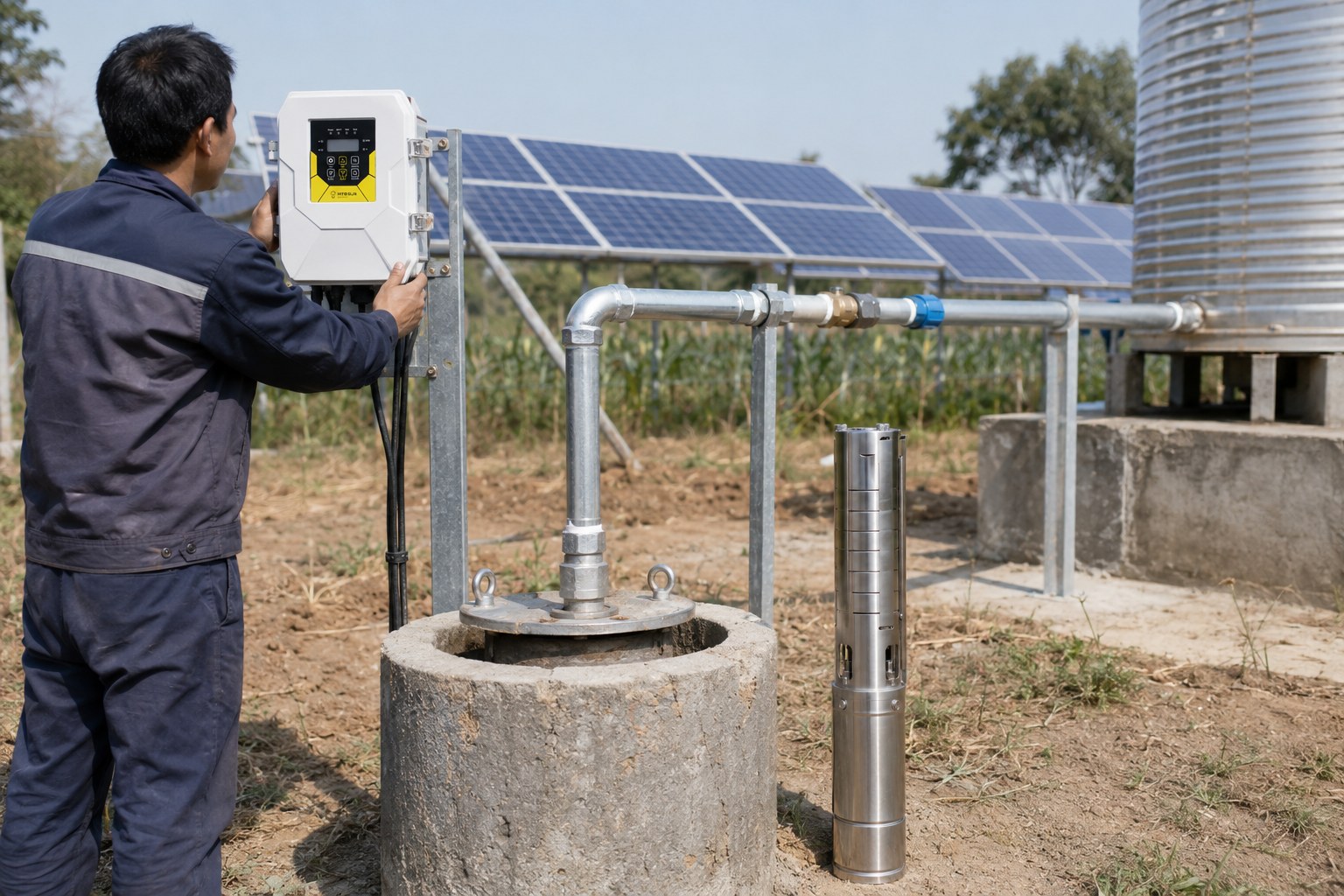
Modern Solutions: Solar-Powered Submersible Pumps
Today, sustainable technology has revolutionized water pumping.
Solar-powered deep well pumps have become a leading choice worldwide.
They operate independently of the power grid, offering a clean and cost-effective solution.
These pumps are powered by a high-efficiency brushless DC (BLDC) permanent magnet motor.
They come in several specialized designs to meet diverse needs.
| Pump Type | Best For | Flow | Head | Key Advantage |
|---|---|---|---|---|
| Solar Screw Pump | Deep wells, domestic use | Low | Very High | Excellent for deep wells and sandy water |
| Solar Plastic Impeller | Farms, irrigation | High | Medium | High volume and economical |
| Solar Stainless Steel | Corrosive water | High | Medium-High | Superior durability and corrosion resistance |
The Power Behind the Pump: The BLDC Motor
The core of these advanced pumps is the BLDC motor.
These motors achieve efficiencies exceeding 90%, a significant improvement over traditional AC motors.
Their compact design is up to 47% smaller and 39% lighter than conventional motors of similar power.
This high efficiency is not just a number.
It means the pump system requires up to 30% fewer solar panels to do the same amount of work.
This directly reduces the initial system cost and simplifies installation.
The motor's maintenance-free design and long service life further enhance its value, providing reliable power for years.
How to Select the Right Pump Using a Pump Curve
You have calculated your GPM and TDH.
You feel lost trying to match those numbers to a specific pump model.
Choosing incorrectly could mean your pump is either struggling or working inefficiently.
Once you know your design point (e.g., 15 GPM at 400 feet of TDH), you use a manufacturer's pump curve chart. You find the pump whose performance curve passes through your design point while operating within its best efficiency range.
After establishing your design point, the next step is to consult a pump curve.
This technical chart is the key to professional pump selection.
It graphically displays a pump's performance across a range of conditions.
Every centrifugal pump, including submersibles, has a unique curve.
The chart shows an inverse relationship: as the flow (GPM) from a pump increases, the pressure (head) it can produce decreases.
Calculating Your Total Dynamic Head (TDH)
Before you can use a pump curve, you must calculate your system's TDH.
This represents the total work the pump must do.
It is calculated for both a "best case" (high water level) and "worst case" (low water level) scenario.
The formula is:
TDH = Water Lift + Elevation Change + Friction Loss + Desired Pressure
Let's use an example:
- Pumping Water Level: 300 feet (the level of water in the well while the pump is running)
- Elevation Change: 50 feet (the house is on a hill 50 feet above the wellhead)
- Friction Loss: 35 feet (pressure lost to friction inside the pipes at your desired flow rate)
- Desired Pressure: 50 PSI (which equals 115 feet of head, since 1 PSI = 2.31 ft)
Worst Case TDH = 300' + 50' + 35' + 115' = 500 feet of TDH
Your design point is ~15 GPM at 500 feet of TDH.
Finding the Best Pump on the Curve
Now, you look at a manufacturer's pump curve chart.
You are looking for a pump that intersects your design point.
Crucially, you want this intersection to fall within the pump's "Best Efficiency Zone" (BEP).
This zone, often shaded on the chart, indicates the flow and pressure range where the pump operates most efficiently.
Let's say you are considering 2 HP, 3 HP, and 5 HP pumps for your design point of 15 GPM @ 500' TDH.
- A 2 HP pump might not even be able to produce 500 feet of head. It would fail to meet your needs.
- A 5 HP pump could easily meet the demand, but its curve might show that at 15 GPM, it is operating far to the left of its BEP. This means it's inefficient, wastes electricity, and is oversized for the job.
- A 3 HP pump might have a curve that passes directly through your design point, right in the middle of its BE-P. This is the optimal choice. It will deliver the required water efficiently and reliably, ensuring the longest service life and lowest operating cost.
This process demonstrates why "bigger is not better" is a critical rule in pump sizing.
Common Sizing Mistakes (and How to Avoid Them)
You've selected a pump that seemed powerful.
Now your lights dim every time the pump kicks on.
You realize you've made a costly sizing mistake.
The most common mistakes are oversizing, undersizing, and ignoring well yield. An oversized pump short-cycles and wastes energy. An undersized pump provides poor pressure. Ignoring well yield can run your well dry and destroy the pump. Always size based on data.
Selecting a well pump is about finding the right balance.
It's not just about power; it's about precision.
Choosing the wrong size can lead to a host of problems, from inefficiency and premature wear to complete system failure.
Avoiding these common pitfalls will save you headaches and money.
The Dangers of Oversizing and Undersizing
Oversizing the Pump: This is the most frequent mistake.
A pump that is too large for the system's needs will "short cycle."
It fills the pressure tank so quickly that it turns on and off constantly.
This frequent starting and stopping causes motor overheating, drastically increases energy bills by over 40%, and puts extreme wear on the pump, motor, and pressure tank.
Undersizing the Pump: A pump that cannot meet your home's peak flow rate will always disappoint.
You'll experience frustratingly low and inconsistent water pressure.
Wait times for water to reach fixtures will be long.
The pump's motor will run continuously, trying to keep up with demand, leading to overheating and premature failure.
Critical System Factors to Consider
Ignoring Well Yield: This is a fatal error for a pump system.
You must know your well's recovery rate.
If you install a 15 GPM pump in a well that only produces 8 GPM, the pump will eventually draw the water level down to the intake and begin sucking air.
This is called running dry, and it will destroy the pump's motor and impellers in short order.
Neglecting the Pressure Tank: Your pressure tank is a critical component that works with the pump.
If the tank is too small or has incorrect air pressure, even a perfectly sized pump will perform poorly.
A properly sized tank allows the pump to run for longer, more efficient cycles and provides a cushion of pressurized water, reducing short cycling.
| Problem | Possible Cause | Recommended Action |
|---|---|---|
| Low Pressure | Undersized pump; low pressure tank setting | Verify pump size; adjust pressure switch (e.g., to 40/60 PSI) |
| Pump Short Cycles | Oversized pump; waterlogged pressure tank | Add a larger pressure tank; replace faulty tank |
| No Water | Pump failure; well has run dry | Conduct well yield test; call a professional |
| High Electric Bill | Oversized pump; pump running constantly | Re-evaluate pump size against GPM/TDH needs |
Planning for All Conditions
A common oversight is failing to plan for non-ideal conditions.
In solar pump applications, what happens on cloudy days or at night?
Modern systems solve this with hybrid AC/DC controllers.
These smart controllers can be connected to solar panels and an AC power source (grid or generator) simultaneously.
The controller automatically prioritizes solar power.
When solar energy is insufficient, it seamlessly blends in AC power to maintain performance.
When there is no solar input, it switches fully to the AC source.
This ensures a reliable, 24/7 water supply, maximizing energy savings without sacrificing convenience.
Conclusion
Correctly sizing your well pump is key to a reliable and efficient water system.
Focus on flow rate (GPM) and total head (TDH), not just horsepower.
This ensures optimal performance, lower energy costs, and a longer-lasting investment.
FAQs
Can I replace a 1/2 HP with a 3/4 HP well pump?
Yes, but only if your system's demand (GPM and TDH) and well yield support the upgrade. An unnecessary upgrade will increase energy costs and may cause short cycling.
How many GPM does a 3/4 HP well pump produce?
A 3/4 HP pump can produce anywhere from 5 to 25 GPM. Its actual output depends entirely on its design and the total head it is working against.
How deep can a 1/2 HP pump pull water from?
A 1/2 HP pump can be designed for high pressure to pull from over 300 feet, or for high flow in wells less than 100 feet deep.
Will a bigger HP well pump increase water pressure?
Not necessarily. Pressure is a function of the pump's design and the system's TDH. Adjusting your pressure tank or switch is often a better way to increase pressure.
What is the most common residential well pump size?
The most common sizes are 1/2 HP, 3/4 HP, and 1 HP. The 3/4 HP is a popular choice for average-sized homes with wells between 100 and 200 feet deep.
How do you calculate what size well pump I need?
Estimate your peak water use by counting fixtures (1 GPM each). Then calculate your Total Dynamic Head. Use these two numbers (GPM and TDH) to select a pump.
What happens if my well pump is too small?
An undersized pump will result in low water pressure, especially when multiple fixtures are used. It will also run constantly, leading to overheating and premature failure.
What is the difference between a 1/2 HP and 1 HP well pump?
A 1 HP motor has more power than a 1/2 HP motor. This allows it to pump a higher volume of water, lift water from a greater depth, or both.