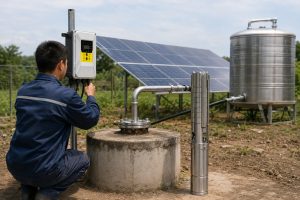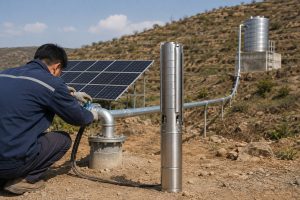
Struggling with high electricity bills from your pool pump?
You're not alone.
This energy-guzzler can be tamed, saving you money and reducing your carbon footprint.
Yes, you can absolutely convert your pool pump to solar.
The most effective way is by replacing your conventional AC pump with a dedicated DC solar pump system.
This approach maximizes energy efficiency, drastically reduces operating costs, and offers greater reliability, especially in off-grid areas.
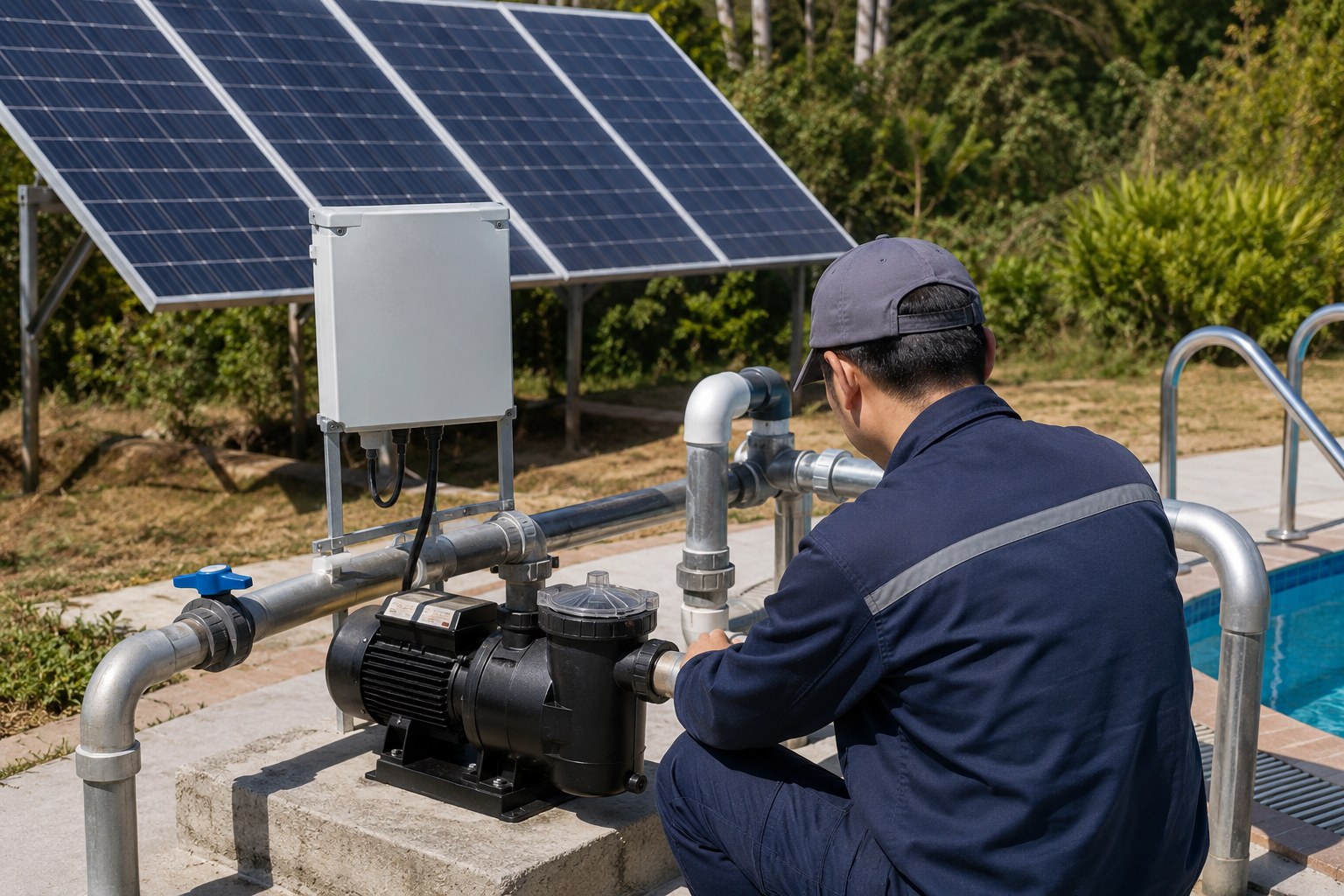
Switching to solar is more than just an eco-friendly choice; it's a strategic investment in energy independence and long-term savings.
But the world of solar pumps is diverse, with different technologies designed for specific needs, from small-scale domestic use to large-scale agricultural irrigation.
Understanding these differences is the key to unlocking the full potential of solar water pumping for your business or project.
This guide will walk you through the critical factors and pump types, helping you build a competitive product portfolio that meets a wide range of customer demands.
What Key Factors Determine the Right Solar Pump?
Choosing a pump seems simple, but the wrong choice leads to poor performance and wasted investment.
You need a pump that perfectly matches the site's unique conditions.
To choose the right solar pump, you must accurately calculate the total water volume, the required flow rate (LPH/GPH), and the total dynamic head (TDH).
These three factors are non-negotiable for designing an efficient and effective solar-powered water system that performs reliably.
Selecting the optimal solar pump requires a technical approach rather than guesswork.
It's a process of balancing physics, environmental conditions, and application needs.
Distributors who master these calculations can provide superior solutions and build customer trust.
Let's break down the essential components you need to analyze for any project.
Calculating Pond or Tank Volume
First, you need to know the total volume of water you're dealing with.
This is the foundation for all other calculations.
For a rectangular pond or tank, the formula is straightforward:
- Volume (in Liters) = Length (m) x Width (m) x Depth (m) x 1000
A good rule of thumb is that the pump should be able to circulate the entire volume of water at least once every two hours for a lightly stocked pond or pool.
For heavily stocked ponds or applications requiring high turnover, you should aim to circulate the full volume every hour.
This turnover rate directly informs the required flow rate of your pump.
Determining Required Flow Rate
The flow rate, measured in Gallons Per Hour (GPH) or Liters Per Hour (LPH), dictates how much water the pump moves in a set time.
It's not just about pond volume.
Consider these factors:
- Fish and Plants: More biological load requires more circulation and oxygenation. A common guideline is to add 10 gallons of pump capacity for every inch of fish.
- Water Features: Waterfalls and fountains need a stronger flow to look good. A waterfall generally requires 1.5 liters per minute (90 LPH) for every centimeter of its width.
- Filtration Systems: Your pump must be powerful enough to push water through the entire filtration system without a significant drop in pressure.
Understanding Total Dynamic Head (TDH)
This is often the most misunderstood factor.
Head height is the vertical distance the pump must lift the water.
But TDH also includes friction loss from pipes.
The longer the pipe run and the more bends (elbows) it has, the higher the friction loss.
Every pump has a performance curve that shows its flow rate at different head heights.
A pump might be rated for 3,000 GPH, but at a 10-foot head height, its actual flow could drop to 1,500 GPH or less.
Always check the pump's performance chart to ensure it delivers the required flow at your calculated TDH.
| Factor | Calculation Guideline | Why It's Important |
|---|---|---|
| Pond Volume | Length x Width x Depth x 1000 (Liters) | Determines the baseline circulation requirement. |
| Flow Rate (LPH) | Circulate volume every 1-2 hours. | Ensures proper filtration, oxygenation, and aesthetics. |
| Head Height | Vertical Lift + Friction Loss | Pump performance drops significantly with height; under-sizing leads to system failure. |
When is a Solar Screw Pump the Best Choice?
Do your customers need to pump water from very deep wells but don't require massive volume?
Traditional pumps struggle with high lift, becoming inefficient and prone to failure.
A solar screw pump is the ideal choice for low-flow, high-head applications like deep well domestic water supply and livestock watering.
Its unique progressing cavity design allows it to generate immense pressure, efficiently lifting water from depths where other pumps fail, even with high sand content.
The solar screw pump, also known as a progressing cavity pump, is a specialist tool for challenging environments.
Its design is fundamentally different from centrifugal pumps, giving it a unique set of strengths and weaknesses.
For distributors, understanding its niche is key to satisfying customers in regions with deep water tables, such as parts of Africa, Latin America, and arid agricultural zones.
Let's explore its mechanics, applications, and performance profile in more detail.
Core Mechanism: The Progressing Cavity
The heart of the pump is a single helix-shaped stainless steel rotor that turns inside a double helix rubber stator.
As the rotor turns, it forms a series of sealed cavities that "progress" from the pump's inlet to its outlet.
This action pushes the water through compression, generating very high pressure (head) but at a relatively low flow rate.
This mechanism is highly efficient for lifting water vertically.
Technical Advantages and Applications
The screw pump's design gives it several key advantages:
- High Head Capability: These pumps excel at lifting water from depths exceeding 100 meters, where centrifugal pumps become inefficient.
- Excellent Sand Resistance: The rubber stator and screw design can handle water with a higher concentration of sand and silt (up to 5% by volume) without rapid wear, a critical feature in many well water sources.
- Primary Applications: They are perfectly suited for domestic water supply in rural homes, drip irrigation for small-scale farming, and providing drinking water for livestock troughs far from a power grid.
Performance Limitations and Market Position
While powerful, the screw pump is not a universal solution.
Its main limitation is a lower flow rate compared to impeller pumps of a similar power rating.
It's not designed for flood irrigation or filling large reservoirs quickly.
The rubber stator is a wearable component that will eventually need replacement, though high-quality materials can ensure a service life of several years.
For end-users, this means a reliable water supply from a deep well with minimal solar panels.
For distributors, it's a problem-solving product for a specific, high-value market segment.
| Feature | Solar Screw Pump | Solar Centrifugal Pump |
|---|---|---|
| Best For | High Head, Low Flow | Low Head, High Flow |
| Max Head | Often > 150 meters | Typically < 100 meters |
| Sand Resistance | Very High (up to 5% solids) | Moderate to Low |
| Typical Application | Deep Wells, Livestock, Drip Irrigation | Surface Pumping, Farm Irrigation |
Why Choose a Solar Plastic Impeller Pump for High Flow?
Need to move a lot of water for farm irrigation or filling a stock pond without breaking the bank?
High-volume pumping often means high cost and complex equipment.
Solar plastic impeller pumps are the answer for high-flow, medium-head applications where cost-effectiveness and wear resistance are priorities.
This multi-stage centrifugal pump uses durable, engineered plastic impellers to deliver impressive water output, making it perfect for agriculture and general water transfer.
When the goal is moving a large volume of water efficiently, the centrifugal pump is king.
The solar plastic impeller model brings this high-flow capability to the off-grid market in an economical and lightweight package.
It is the workhorse of solar pumping, widely used across Africa, the Americas, and Asia for farm irrigation, pasture management, and residential water supply.
Its design represents a balance of performance, durability, and cost that appeals to a broad customer base.
High-Flow Centrifugal Design
This pump works by using a motor to spin a series of impellers.
Each impeller acts as a stage, gathering water at its center and accelerating it outward using centrifugal force.
The water then moves to the next stage, where its pressure is boosted further.
By stacking multiple impellers, the pump can achieve a respectable medium head while prioritizing a high flow rate.
The use of engineered plastic for the impellers is a key design choice.
Cost-Benefit and Wear Resistance
Modern engineered plastics, like Noryl or polycarbonate, offer several advantages:
- Excellent Wear Resistance: These materials are surprisingly durable and show excellent resistance to abrasion from fine sand, often outperforming softer metals in such conditions.
- Cost-Effectiveness: Plastic impellers are less expensive to manufacture than their stainless steel counterparts, which significantly lowers the overall cost of the pump.
- Lightweight: The reduced weight makes the pump easier to transport, install, and service, a major benefit for remote installations.
This combination makes the plastic impeller pump an economically attractive option with a strong performance profile.
Durability and Limitations
While highly effective, it's important to understand the limitations.
These pumps are not ideal for very deep wells where a screw pump would be better.
They are also not suited for highly corrosive water (very high or low pH), where stainless steel is required.
However, for a vast range of applications—from irrigating a 5-hectare farm to supplying water for a herd of 200 cattle—the solar plastic impeller pump provides an unbeatable combination of high water output and value.
It's the go-to solution for customers who need to move water in bulk.
| Feature | Plastic Impeller Pump | Stainless Steel Impeller Pump |
|---|---|---|
| Primary Advantage | High Flow, Low Cost, Wear-Resistant | High Flow, Corrosion-Resistant, Durable |
| Cost | $ | $$$ |
| Best For | General irrigation, water with fine sand | Corrosive water (acidic/alkaline) |
| Weight | Lighter | Heavier |
| Lifespan | Good (in suitable conditions) | Excellent (in most conditions) |
What Makes Stainless Steel Impeller Pumps a Premium Solution?
Are your clients dealing with corrosive water that destroys standard pumps?
Aggressive water conditions with high acidity or alkalinity can lead to rapid equipment failure and costly replacements.
Solar stainless steel impeller pumps are the premium solution for high-flow applications in corrosive water environments.
Utilizing SS304 or higher-grade stainless steel for all wetted parts, these pumps offer unmatched corrosion resistance, ensuring a long service life and high reliability.
For the high-end market or projects in areas with known water quality issues, the stainless steel impeller pump is the definitive choice.
This pump takes the high-flow, multi-stage centrifugal design and builds it with materials that can withstand the harshest conditions.
It is the pump of choice for applications in alkaline soil regions like Australia, coastal areas with saltwater intrusion risk, and high-end residential or commercial projects where long-term reliability is the primary concern.
Unmatched Corrosion Resistance
The key to this pump's performance is its material composition.
SS304 stainless steel is an alloy containing chromium and nickel, which form a passive, non-reactive layer on the surface of the steel.
This layer protects the underlying metal from reacting with acidic or alkaline substances in the water.
This makes the pump ideal for:
- Regions with alkaline soils.
- Areas with industrial water runoff.
- Coastal regions where saltwater contamination is possible.
- Any application where water pH is outside the neutral range of 6.5-8.5.
Long-Term Investment Value
While the initial purchase price of a stainless steel pump is higher than a plastic impeller model, its total cost of ownership is often lower in the right application.
Its superior durability means a much longer service life and fewer replacements.
For a critical application like providing water to a high-value ranch or an exclusive residential community, the reliability and peace of mind offered by a stainless steel pump justify the premium.
It's an investment in uninterrupted operation.
Comparing with Plastic Impellers
The choice between plastic and stainless steel is a classic engineering trade-off.
A plastic impeller might be more resistant to fine, abrasive sand, while a stainless steel impeller is vastly superior against chemical corrosion.
Weight is also a factor; stainless steel pumps are significantly heavier, which can impact installation logistics.
Offering both options allows a distributor to provide a tailored solution.
The plastic impeller pump is the versatile volume seller, while the stainless steel model is the high-margin solution for discerning clients and challenging environments.
| Material | Key Advantage | Ideal Water Condition | Relative Cost |
|---|---|---|---|
| Engineered Plastic | Abrasion resistance (fine sand) | Neutral pH, low corrosivity | $ |
| SS304 Stainless Steel | Corrosion resistance (acid/alkali) | pH outside 6.5-8.5, high salinity | $$$ |
| SS316 Stainless Steel | Superior corrosion resistance | High chloride/saline environments | $$$$ |
What Is the Core Technology Driving Solar Pump Efficiency?
Why do some solar pumps produce more water with fewer solar panels?
The secret isn't just the pump itself; it's the motor that drives it.
The core technology is the Brushless DC (BLDC) permanent magnet motor, which achieves over 90% electrical efficiency.
This advanced motor is the powerhouse behind modern solar pumps, converting solar energy into pumping power with minimal loss, directly reducing system costs and boosting performance.
The motor is the heart of any pump system.
In the world of solar pumping, the switch from traditional AC or brushed DC motors to BLDC permanent magnet synchronous motors has been a revolution.
This technological leap is the primary reason solar water pumping is now a viable and competitive solution globally.
For a distributor, understanding and marketing the benefits of the motor is just as important as marketing the pump.
The Efficiency Advantage: BLDC vs. Traditional Motors
A motor's job is to convert electrical energy into rotational mechanical energy.
How efficiently it does this is critical.
- Traditional AC Induction Motors: These are common and cheap but have efficiencies around 60-70%. The 30-40% of energy lost turns into waste heat.
- Brushed DC Motors: These are simpler but the physical brushes wear out, create dust, and limit efficiency to around 75-80%.
- BLDC Permanent Magnet Motors: By using powerful permanent magnets (like 40SH Neodymium Iron Boron) on the rotor and an electronic controller to switch the electromagnets, these motors eliminate friction from brushes. This results in efficiencies consistently above 90%.
Impact on Total System Cost
This 15-20% efficiency gain is massive.
It means a pump with a BLDC motor requires 15-20% fewer solar panels to do the same amount of work as a pump with an older motor technology.
Given that solar panels can account for 50% or more of the initial system cost, this directly translates into a significantly cheaper system for the end-user.
The motor's compact design (up to 47% smaller and 39% lighter) also reduces shipping and installation costs.
Reliability, Lifespan, and Market Value
With no brushes to wear out, BLDC motors are virtually maintenance-free and have a much longer operational lifespan.
The high torque they produce, even at low speeds, is perfect for solar applications where power availability fluctuates throughout the day.
As a distributor, emphasizing the superior motor technology is a powerful sales tool.
It's not just a pump; it's a highly efficient, integrated system designed for a long, maintenance-free life.
It positions the product as a technologically advanced, high-value solution.
| Motor Type | Efficiency | Maintenance | Lifespan | Solar System Cost |
|---|---|---|---|---|
| AC Induction | 60-70% | Low | Long | High |
| Brushed DC | 75-80% | High (Brush Replacement) | Medium | Medium |
| BLDC Permanent Magnet | >90% | Very Low (Maintenance-Free) | Very Long | Low |
How Do Smart Controllers Maximize Solar Pump Performance?
What happens on cloudy days or when you need water at night?
A solar pump is only as good as its power source, and a simple connection is often not enough.
Smart controllers using Maximum Power Point Tracking (MPPT) and AC/DC hybrid logic maximize performance by constantly optimizing power from the panels and providing 24/7 water security.
These controllers are the brain of the system, ensuring you get the most water possible from every sunbeam.
The final piece of the modern solar pump system is the controller.
This electronic device sits between the solar panels and the pump motor, playing a critical role in both performance and protection.
Early solar pump systems often connected panels directly to the motor, resulting in poor performance in anything but perfect sunlight.
The introduction of intelligent controllers has unlocked the true potential of solar pumping, making it a reliable and versatile technology.
Understanding MPPT: Squeezing Every Watt
Solar panels have a complex relationship between voltage and current that changes with sunlight intensity and temperature.
There is a single point on this curve—the Maximum Power Point—where the panel produces the most power.
An MPPT controller is a DC-to-DC converter that constantly analyzes the panel's output and adjusts the electrical load to keep the panel operating at this ideal point.
This can boost the total water pumped per day by up to 30% compared to a system without MPPT, especially during early morning, late afternoon, and cloudy conditions.
The 24/7 Solution: AC/DC Hybrid Controllers
The biggest limitation of a pure solar system is that it doesn't work at night.
Hybrid controllers solve this problem by including a second power input for an AC source, such as the utility grid or a generator.
The controller's logic is designed to prioritize solar:
- Full Sun: The pump runs entirely on solar power.
- Low Sun (Clouds): The controller can blend solar and AC power, using every available watt of free solar energy before supplementing with the grid.
- No Sun (Night): The controller automatically switches to the AC power source, ensuring the pump can run 24/7 if needed.
This provides complete water security without compromising the savings from solar energy.
System Protection and Integration
Beyond power optimization, smart controllers provide crucial protection for the pump motor.
They monitor for conditions like overheating, running dry (without water), and voltage surges, automatically shutting the pump down before damage can occur.
For distributors, offering a sophisticated controller as part of the package adds immense value.
It transforms a simple pump into a complete, intelligent, and self-protecting water management system, which is a powerful selling proposition for both residential and commercial clients.
Conclusion
Choosing the right solar pump system means matching the pump, motor, and controller to the specific need.
This ensures maximum efficiency, long-term reliability, and the best return on investment.
FAQs
How many solar panels does it take to run a pool pump?
Typically, a 1.5 HP pool pump requires about 2,000 to 3,000 watts, which translates to six to nine 330W solar panels, depending on your location's sun exposure.
Is it worth it to convert a pool pump to solar?
Yes, for most homeowners. The initial cost can be recouped in 2-4 years through electricity savings, and the system increases your home's value and energy independence.
Can you run a 240v pool pump on solar?
Yes, but it requires a solar system with a compatible inverter to convert the DC power from the panels to 240v AC. A native DC solar pump is often more efficient.
How long do solar pool pumps last?
A quality solar pool pump system can last 10-15 years. The BLDC motor is very durable, and the solar panels often have a 25-year power output warranty.
Can a solar pump run without a battery?
Yes, most modern solar pump systems are designed to run directly from solar panels during the day without batteries, which simplifies the system and reduces cost and maintenance.
What size solar pump do I need for my pool?
Your pump should be able to circulate the entire volume of your pool in an 8-hour period. Calculate your pool's volume in gallons and divide by 8 to get the required GPH flow rate.
Do solar pumps work on cloudy days?
Yes, but at a reduced flow rate. The MPPT controller helps maximize output in low-light conditions, but performance is directly related to the amount of sunlight received.
What is the main benefit of a BLDC motor in a solar pump?
The main benefit is its high efficiency (over 90%), which means it requires fewer solar panels to run. This lowers the total system cost and improves performance.