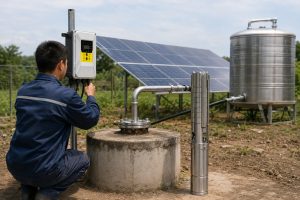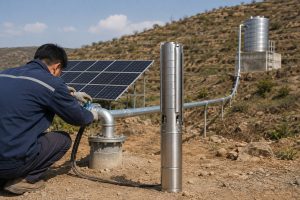
Running a pool pump racks up high electricity bills.
This constant, significant expense drains your budget while increasing your carbon footprint, a problem that only gets worse with rising energy costs.
Yes, a solar panel system can absolutely power a pool pump.
You can either install a dedicated off-grid system with a DC pump or use a larger, grid-tied solar array to power your existing AC pump.
Both methods dramatically cut or even eliminate your pump's running costs.
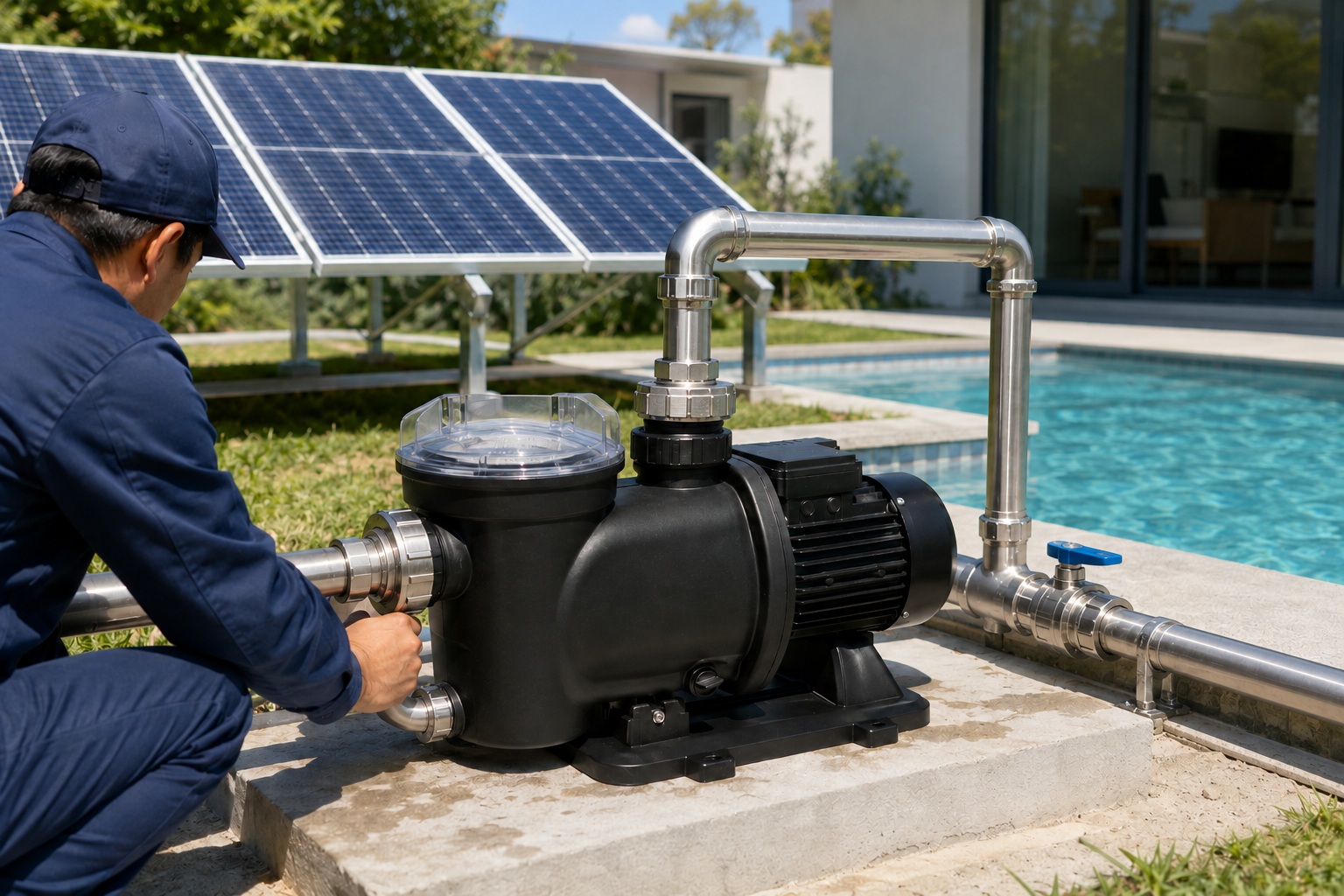
Switching your pool pump to solar power is one of the smartest upgrades a pool owner can make.
It's not just about saving money; it's about gaining energy independence and embracing a more sustainable lifestyle.
But there are two primary ways to achieve this, each with its own costs, benefits, and technical considerations.
Understanding these options, how to properly size your system, and what defines a quality setup is the first step.
This guide will walk you through everything you need to know to make an informed decision, turning your costly pool into an efficient, sun-powered oasis.
How Many Solar Panels to Run a Pool Pump?
Sizing a solar system seems complex.
A miscalculation can lead to an underperforming pump or, conversely, a system that is oversized and overpriced.
This section breaks down the simple math needed for an accurate estimate.
First, calculate your pump's daily energy use in kilowatt-hours (kWh) by multiplying its wattage by its daily run time.
Next, divide this number by your area's peak sun hours.
Finally, add 15% for efficiency losses and divide by your chosen panel's wattage.
To accurately determine the number of solar panels you need, a few key pieces of information are required.
This process isn't guesswork; it's a straightforward calculation based on your specific equipment and location.
By following a step-by-step approach, you can confidently size a solar array that will meet your pool pump's energy demands, ensuring reliable operation without relying on the expensive electrical grid.
Let's break down each step in detail.
Step 1: Calculate Your Pool Pump's Energy Needs
The first step is to determine exactly how much energy your pump consumes.
Pool pump power is often rated in horsepower (HP), but for energy calculations, we need to convert this to watts.
One horsepower is equivalent to approximately 746 watts.
So, a 1.5 HP pump consumes about 1,119 watts (1.5 x 746).
Next, you must identify how many hours your pump runs each day.
This typically ranges from 6 to 8 hours, depending on the pool size, usage, and climate.
To find the daily energy consumption in watt-hours, you multiply the pump's wattage by its daily run time.
For example, a 1.5 HP (1,119 W) pump running for 8 hours uses 8,952 watt-hours, or about 8.95 kilowatt-hours (kWh) per day.
This daily kWh figure is the foundational number for all subsequent calculations.
| Pump Size (HP) | Power (Watts) | Daily Energy (kWh) |
|---|---|---|
| 1 HP | 746 W | 5.97 kWh |
| 1.5 HP | 1,119 W | 8.95 kWh |
| 2 HP | 1,492 W | 11.94 kWh |
| 3 HP | 2,238 W | 17.90 kWh |
Step 2: Factor in Your Location's Peak Sun Hours
Solar panels don't produce their maximum rated power all day.
The concept of "peak sun hours" standardizes solar irradiance, representing the number of hours per day when the sun's intensity averages 1,000 watts per square meter.
This is not the same as total daylight hours.
A location might have 12 hours of daylight but only 5 peak sun hours.
This value varies significantly based on geographic location and time of year.
For example, sunny regions like Arizona may average over 5.75 peak sun hours, while northern states might receive less than 4.
You can find precise data for your specific area from resources like the National Renewable Energy Laboratory (NREL).
For our calculation, let's assume a location with an average of 5 peak sun hours.
Step 3: Sizing the System and Accounting for Losses
Now, you can calculate the required size of your solar system.
Divide your pump's daily energy consumption (in kWh) by the peak sun hours.
Using our 1.5 HP pump example: 8.95 kWh / 5 peak sun hours = 1.79 kW.
This means you need a solar array that can produce 1.79 kW of power during those peak hours.
However, no solar system is 100% efficient.
Energy is lost due to factors like wiring, panel temperature, dirt, and inverter inefficiency.
It is standard practice to add a buffer of at least 15% to account for these system losses.
So, the adjusted system size becomes: 1.79 kW * 1.15 = 2.06 kW.
Finally, to find the number of panels, divide the adjusted system size (in watts) by the wattage of a single solar panel.
Using common 400-watt panels: 2,060 watts / 400 watts/panel = 5.15 panels.
Since you can't install a fraction of a panel, you would need to round up to 6 panels.
What Are the Options for Solar Pool Pumping?
You want to switch to solar, but which path is right?
The choice between a dedicated DC pump and a grid-tied system can be confusing, impacting cost and performance.
Making the wrong choice can lead to inefficiency or unexpected expenses.
Your two main options are a dedicated off-grid DC solar pump system or powering your existing AC pump with a whole-home grid-tied solar array.
The DC option offers energy independence for the pump, while the grid-tied option provides more overall system flexibility.
When deciding to power a pool pump with solar energy, you are faced with a fundamental choice in system architecture.
Each approach has distinct advantages and is suited to different scenarios, budgets, and long-term goals.
One path offers a targeted, standalone solution for your pool, while the other integrates the pool's energy needs into a comprehensive home energy system.
Furthermore, emerging hybrid technologies are creating a third option that combines the benefits of both.
Let's explore these three configurations to determine which is the best fit for your needs.
Option 1: The Dedicated DC Solar Pump System
This is a completely off-grid solution.
In this setup, a set of solar panels is wired directly to a specialized DC (Direct Current) pool pump through a controller.
This system operates independently from your home's electrical supply and the utility grid.
When the sun shines on the panels, they generate DC electricity that powers the pump.
Pros:
- Zero Grid Cost: You will never pay for electricity to run your pump.
- Grid Independence: You do not need permission from your utility company to install it.
- Simplicity: It is a straightforward system with fewer components than a whole-home setup.
- Scalability: It doesn't impact the size limitations on a grid-tied home solar system.
Cons:
- Requires New Pump: You must replace your existing AC pump with a DC model.
- Wasted Energy: Any excess solar power generated when the pump is off or running at low speed is lost.
- No Grid Backup: The pump will not run at night or on very overcast days without a battery, which adds significant cost.
Option 2: The Integrated Grid-Tied AC System
This is the most common approach for homeowners already investing in a whole-home solar system.
A large solar array is installed on your roof and connected to the grid.
This system powers your entire house, including your existing AC (Alternating Current) pool pump.
You simply set your pump's timer to run during peak daylight hours to maximize the use of solar energy.
Pros:
- Use Existing Pump: There is no need to buy a new, specialized pump.
- Maximum Efficiency: All solar power is used. If the pump isn't running, the energy powers other appliances or is exported to the grid for credit.
- Reliability: The grid acts as a backup, so your pump can run anytime, day or night.
Cons:
- Grid Reliance: On heavily overcast days, your pump will draw power from the grid, incurring costs.
- Requires Large System: You need a sufficiently large solar system (often 6kW or more) to cover both your home's and your pump's energy needs.
- Higher Upfront Cost: A whole-home solar system is a much larger initial investment than a small, dedicated array.
A Third Way: The AC/DC Hybrid Solution
A third, increasingly popular option combines the best of both worlds.
Hybrid systems use a sophisticated controller that can accept power from both DC solar panels and an AC grid source simultaneously.
The system is intelligent, always prioritizing free solar energy first.
When sunlight diminishes, it seamlessly supplements with or switches over to grid power to ensure the pump operates at the required speed.
This guarantees uninterrupted filtration without wasting solar potential.
This approach provides the energy savings of a DC system with the 24/7 reliability of a grid-tied one, making it a powerful solution for those who demand both performance and efficiency.
What Makes a Good Solar Pool Pump System?
Not all solar pumps are created equal.
Many low-cost imported models fail quickly, giving the technology a bad reputation and leaving customers frustrated.
Understanding the core components is the key to investing in a reliable, long-lasting system instead of a cheap one that will need a costly replacement.
A high-quality system is defined by three things: a durable, high-efficiency motor; an intelligent controller to manage power flow and protect the motor; and a robust pump end matched to your specific pool's filtration needs for flow and pressure.
The long-term success of a solar pool pump hinges on the quality and synergy of its three main components.
A cheap system might work initially, but it will likely fail prematurely due to inferior materials and poor engineering.
A well-built system, on the other hand, is an investment that provides decades of trouble-free, cost-free operation.
By focusing on the motor, the controller, and the pump end, you can distinguish a premium product from a disposable one.
Let's examine why each of these elements is critical for performance and longevity.
The Heart of the System: The BLDC Motor
The motor is the most critical component.
The best solar pumps use a Brushless DC (BLDC) permanent magnet motor.
These are vastly superior to older, cheaper brushed motors.
A brushed motor typically has a lifespan of only 2,000 to 5,000 hours.
In contrast, a high-quality BLDC motor is designed to last for 20,000 to 30,000 hours, offering a lifespan that is 6 to 10 times longer.
Furthermore, BLDC motors are exceptionally efficient, with many models converting over 90% of electrical energy into mechanical force.
This high efficiency means they require significantly fewer solar panels to achieve the same water flow as a less efficient motor.
A more efficient motor can reduce the required solar array size by over 40%, directly lowering the total system cost and making installation easier.
The Brains: The MPPT Controller
If the motor is the heart, the controller is the brain.
A quality system includes an intelligent controller with Maximum Power Point Tracking (MPPT).
MPPT technology constantly optimizes the voltage and current from the solar panels to extract the maximum amount of power available under any light condition.
On a cloudy day, instead of simply shutting off, an MPPT controller will slow the pump down, allowing it to continue filtering water at a reduced speed.
This is a crucial distinction.
Cheap controllers lack this intelligence and will cause the pump to cycle on and off rapidly as clouds pass, putting immense stress on the motor and leading to premature failure.
Advanced controllers also provide vital protection features, such as dry-run protection (shutting off the pump if there's no water), over-voltage protection, and thermal regulation to prevent overheating.
The Muscle: The Pump End
The pump end, or "wet end," is the part that physically moves the water.
Its design and material construction are vital for durability and performance.
- Plastic Impeller Pumps: These are a cost-effective choice for standard chlorine or freshwater pools. They are designed for high flow rates, ensuring proper water circulation and filtration.
- Stainless Steel Impeller Pumps: This is the premium option, essential for saltwater pools or pools with aggressive water chemistry. The stainless steel construction offers superior resistance to corrosion and abrasion, ensuring a much longer service life and justifying its higher initial cost.
The right choice depends on your pool's specific environment.
Using a plastic impeller in a saltwater pool will lead to rapid degradation, while a stainless steel impeller ensures years of reliable service in the same conditions.
What is the Financial Payback on a Solar Pool Pump?
The upfront cost of a solar pump system can seem daunting.
Many pool owners hesitate, wondering if the investment is truly worth it.
Calculating the return on investment (ROI) removes the guesswork and clearly reveals the powerful long-term savings that make this upgrade financially compelling.
The payback period for a solar pool pump system is typically between 3 to 5 years, depending on local electricity rates and sun exposure.
This is calculated by dividing the total initial investment by the annual electricity cost savings.
After payback, the energy is virtually free.
Evaluating the financial viability of a solar pool pump is a simple matter of comparing the one-time investment to the ongoing expense you are eliminating.
Your annual savings are directly tied to your local electricity cost and your pump's energy consumption.
The higher your electricity rates, the faster your payback period will be.
Once the initial investment is recouped, the system continues to generate free energy for the 25+ year lifespan of the solar panels, resulting in thousands of dollars in pure profit.
Calculating Your Annual Savings
First, determine your current annual cost to run your pool pump.
Use the daily kWh consumption you calculated earlier and multiply it by your electricity rate (found on your utility bill).
Then, multiply that daily cost by the number of days you run your pump each year.
Annual Savings = (Daily Pump kWh) × (Cost per kWh) × (Days of Operation)
The table below illustrates how quickly costs can add up, especially in regions with high electricity prices.
These are the direct savings you will realize each year after switching to solar.
| Pump Size (1.5 HP) | Daily kWh (8hr) | Annual Cost @ $0.15/kWh | Annual Cost @ $0.25/kWh | Annual Cost @ $0.40/kWh |
|---|---|---|---|---|
| Annual Operation | 8.95 kWh | $490 | $817 | $1,307 |
Estimating the Initial Investment
The initial investment for a dedicated DC solar pump system includes the solar panels, the DC pump itself, the controller, wiring, and mounting hardware.
While prices vary based on quality and size, a complete system can typically be sourced for between $800 and $2,000.
For a DIY installation, these would be your primary costs.
Professional installation will add to this total but ensures the system is set up correctly and safely.
This one-time cost replaces a recurring and ever-increasing electricity bill.
Determining Your Return on Investment (ROI)
The payback period is calculated with a simple formula:
Payback Period (Years) = Total Initial Investment / Annual Electricity Savings
Let's use a realistic example.
Assume a total system cost of $1,500 and an annual electricity saving of $490 (based on the $0.15/kWh rate).
$1,500 / $490/year = 3.06 years
In this scenario, the system pays for itself in just over 3 years.
For the next 20+ years, that $490 you were giving to the utility company stays in your pocket every single year.
If your electricity rate is higher, like $0.25/kWh, your annual savings are $817, and the payback period drops to less than 2 years.
Conclusion
Switching to solar is a viable, financially smart way to power your pool pump.
The key to success is a properly sized system built with high-quality components for long-term reliability and savings.
FAQs
Can I run my existing pool pump on solar panels?
Yes, by installing a grid-tied solar system for your home.
This system generates electricity that your existing AC pump can use during peak sun hours.
How long do solar pool pumps last?
A quality DC brushless solar pump can last 20,000-30,000 hours.
The solar panels themselves are typically warrantied to produce power for 25 years or more.
Do solar pool pumps work on cloudy days?
Yes, they operate at a reduced speed on cloudy days.
Hybrid systems can automatically use grid power to maintain full operation when sunlight is insufficient.
Are solar pool pumps powerful enough?
Absolutely.
Modern DC solar pumps are available in various horsepower ratings and are designed to be just as powerful as their traditional AC counterparts.
Is a solar pool pump worth it?
For most pool owners, yes.
The investment typically pays for itself in 3-5 years through electricity savings and then provides virtually free energy for decades.
How much does it cost to install solar for a pool pump?
A complete, dedicated DC solar pump system can cost between $800 and $2,000.
Powering an AC pump is part of a larger whole-home solar investment.
Do I need a battery for a solar pool pump?
No, a battery is not necessary for most setups.
The pump is designed to run when the sun is out, which is when filtration is most needed.
Can solar panels heat my pool?
This article discusses solar electric (PV) panels for pumps.
Solar thermal panels are a different technology specifically designed to heat pool water directly.