Running a pool pump spikes your energy bill every summer.
This constant drain on electricity feels wasteful and expensive, but solar power offers a clean, cost-effective solution for your pool.
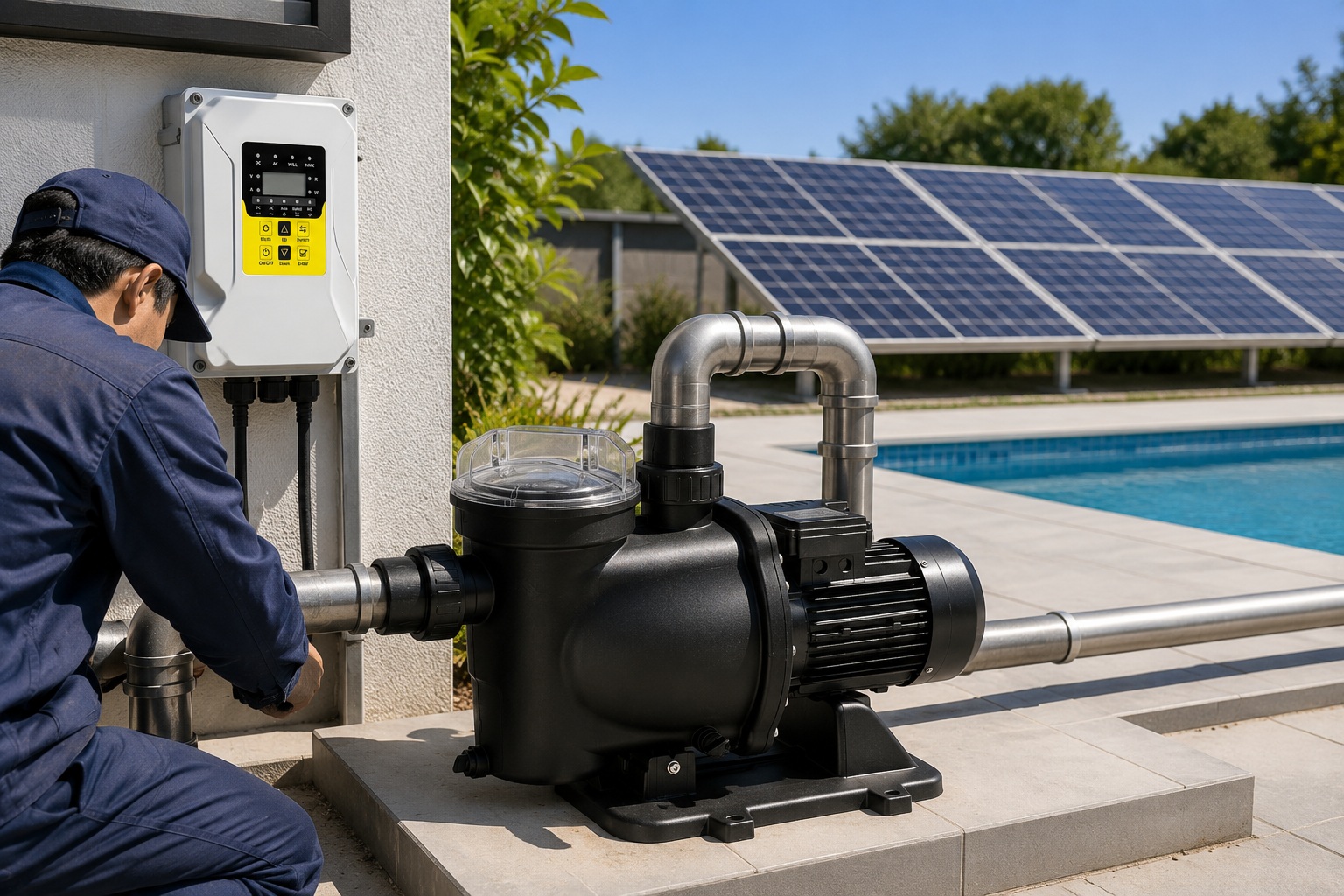
Typically, you'll need two to four solar panels to run a pool pump. A standard 1 HP pump (~750 watts) requires about 1,000 to 1,500 watts of solar panels to ensure consistent operation. This usually means three or four 400-watt panels.
The exact number of panels isn't a simple guess.
It depends on several critical factors.
These include your pump's power consumption, your geographic location, and the amount of daily sunlight you receive.
Understanding these details is the key to designing a system that works efficiently without costing you a fortune.
Let's dive deeper into how to calculate your specific needs.
Understanding Your Pool Pump's Energy Needs
Want to switch to solar but don't know where to start?
Your pump's power rating is the most important piece of the puzzle.
Ignoring it can lead to an undersized and useless system.
First, check your pump's label for its horsepower (HP) or wattage (W). A 1 HP pump consumes about 750 watts, while a 1.5 HP model can draw over 1,100 watts. This number directly determines how many solar panels you need.
To correctly size your solar array, you must first become an expert on your own equipment.
The power your pool pump consumes is the foundation of your entire calculation.
Without this number, any estimate is just a wild guess.
How to Read Your Pump's Label
Every pool pump has a specification plate or sticker.
This label contains vital information.
You will find details like horsepower (HP), voltage (V), and amperage (A).
Some labels may list the power consumption directly in watts (W).
If not, you can easily calculate it.
The formula is: Watts = Volts × Amps.
However, the horsepower rating is the most common starting point.
One mechanical horsepower is equivalent to approximately 746 watts.
So, a 1 HP pump uses roughly 746 watts of power.
A 2 HP pump will consume around 1,492 watts.
This figure represents the pump's power draw when it is running at full speed.
Single-Speed vs. Variable-Speed (VS) Pumps
The type of pump you own makes a massive difference in energy consumption.
Traditional single-speed pumps are energy hogs.
They run at one high speed, consuming maximum power all the time.
A modern variable-speed (VS) pump is far more efficient.
These pumps allow you to adjust the motor's speed.
For simple filtration, a VS pump can run at a very low speed.
At this low speed, it might only use 100 to 200 watts.
This is a reduction in energy use of over 80% compared to a single-speed pump.
This dramatic difference directly impacts your solar needs.
A VS pump requires a much smaller and less expensive solar panel array to operate effectively.
Comparing Pump Energy Consumption
Let's look at the data to see the difference clearly.
The table below compares the estimated energy usage for different pump types and sizes.
This data assumes the pump runs for 8 hours per day.
| Pump Type | Horsepower (HP) | Estimated Watts (W) | Daily Energy Use (kWh) |
|---|---|---|---|
| Single-Speed | 1.0 HP | 750 W | 6.0 kWh |
| Single-Speed | 1.5 HP | 1,100 W | 8.8 kWh |
| Single-Speed | 2.0 HP | 1,500 W | 12.0 kWh |
| Variable-Speed (Low) | N/A | 150 W | 1.2 kWh |
| Variable-Speed (Med) | N/A | 500 W | 4.0 kWh |
| Variable-Speed (High) | N/A | 1,200 W | 9.6 kWh |
As you can see, running a VS pump at a low speed for filtration can reduce your daily energy consumption by up to 80-90%.
This makes it an ideal partner for a solar power system.
Calculating the Right Number of Solar Panels
Guessing your solar panel needs is a recipe for failure.
You could end up with a weak pump or, worse, a burned-out motor.
A simple calculation can save you from these costly mistakes.
As a rule, your solar panel array's wattage should be 125% to 150% of your pump's wattage. For a 750W pump, aim for at least 938W of panels (e.g., three 350W panels). This buffer accounts for clouds and efficiency losses.
Getting the math right is essential for a system that performs reliably day after day.
It ensures your pump has enough power to run effectively, even when the sun isn't shining perfectly.
Let's break down the process into simple, manageable steps.
The "Peak Sun Hours" Factor
A common mistake is confusing "daylight hours" with "peak sun hours."
Solar panels produce their maximum rated power only under ideal conditions.
"Peak sun hours" refers to the number of hours per day when the sun's intensity is strong enough to generate that peak power.
This number varies significantly by location.
A desert location like Phoenix, Arizona, might get 6-7 peak sun hours per day.
A location in the Pacific Northwest, like Seattle, might only get 3-4 peak sun hours.
You need to know your area's average peak sun hours to accurately size your system.
Online solar maps and calculators can provide this data for your specific zip code.
Using the wrong number will lead to an undersized system that fails to meet your pump's daily energy needs.
A Step-by-Step Calculation
Here is a straightforward method to determine your required solar array size.
-
Find Your Pump's Daily Energy Need (in Watt-hours):
- First, determine your pump's wattage. Let's use a 1 HP pump, which is 750 watts.
- Next, decide how many hours you need to run it daily. A common run time is 8 hours.
- Multiply these numbers: 750 Watts × 8 Hours = 6,000 Watt-hours (Wh).
-
Determine Your Required Solar Array Size (in Watts):
- Find the average peak sun hours for your location. Let's assume you get 5 peak sun hours per day.
- Divide your daily energy need by your peak sun hours: 6,000 Wh / 5 hours = 1,200 Watts.
This means you need a solar array capable of producing 1,200 watts.
You could achieve this with three 400-watt panels or four 300-watt panels.
It's always wise to add a buffer of 25% to account for cloudy days, panel degradation, and other inefficiencies.
So, 1,200W x 1.25 = 1,500W.
In this case, four 400-watt panels (1,600W) would be an excellent choice.
Example Solar Array Calculations
This table shows sample calculations for different scenarios.
| Pump Size | Daily Run Time | Daily Energy Need (Wh) | Peak Sun Hours | Required Array Size (Watts) | Recommended Array Size (+25%) |
|---|---|---|---|---|---|
| 0.75 HP (560W) | 6 Hours | 3,360 Wh | 4 | 840 W | 1,050 W |
| 1.0 HP (750W) | 8 Hours | 6,000 Wh | 5 | 1,200 W | 1,500 W |
| 1.5 HP (1100W) | 8 Hours | 8,800 Wh | 6 | 1,467 W | 1,834 W |
This data illustrates how pump size, run time, and location all play a crucial role.
What’s the Payback? A Real-World Cost Analysis
Is a solar pump system a smart investment or just an expensive hobby?
The initial cost can be intimidating.
But the long-term savings might completely change your perspective.
A typical solar pool pump system can pay for itself in just 3 to 5 years. With an initial investment of around $900 to $1,500 and annual electricity savings of $250 to $400, the return on investment (ROI) is very compelling.
To understand the true value, we need to crunch the numbers.
Let's break down the initial costs and compare them to the ongoing savings from eliminating a major electricity expense.
The financial case for going solar is stronger than many people think.
Breakdown of Initial Investment
The total cost will vary, but we can use a real-world example to create a budget.
One recent DIY installation of a DC solar pump system included the following costs:
- Two 400-watt PV panels: $440
- 500-watt DC Pool Pump: $341
- Cabling for PV: $25
- Circuit Shutoff/Timer: $75
The Total Initial Investment for this system was $881.
This does not include smaller incidental costs like mounting hardware or plumbing fittings.
However, it provides a realistic baseline for a complete system capable of running a small-to-medium-sized pool pump.
For a larger system, costs could range from $1,200 to $2,000.
Calculating Your Annual Savings
The savings come directly from your electricity bill.
To calculate them, we compare the cost of running the old AC pump to the new solar-powered one.
Let's analyze the energy use of a typical 1 HP AC pump (750 watts).
- Daily Energy Consumption: 0.75 kW × 7 hours/day = 5.25 kWh
- Daily Cost: 5.25 kWh × $0.13/kWh (U.S. average) = $0.68
- Annual Cost: $0.68 × 365 days = $248.20
With a direct-drive solar pump, the electricity cost is $0.
Therefore, your annual savings are approximately $248.
In areas with higher electricity rates, like California or the Northeast, annual savings could easily exceed $400 or $500.
The Payback Period Formula
The payback period is how long it takes for your savings to equal your initial investment.
The formula is simple: Total Investment / Annual Savings = Payback in Years.
Using our example numbers:
$881 / $248 = 3.55 years
After just three and a half years, the system has paid for itself.
From that point on, all the energy it produces is pure profit.
Given that solar panels are warrantied for 20-25 years, the long-term financial benefit is substantial.
The brushless DC pump motor itself has a potential lifespan of 20,000 hours, or about 8-10 years of seasonal use.
Avoiding Common Pitfalls: The "Cycling Glitch" and Poor Support
Your new solar pump is installed, but it keeps turning on and off.
This frequent "cycling" on partly cloudy days can destroy your motor in months.
It's a critical flaw in many systems.
Many imported solar pumps have a "cycling glitch," where they rapidly switch on and off in low light, causing extreme motor stress. Look for systems with soft-start technology or add a timer to prevent operation during inconsistent sunlight.
Many early adopters of solar pool pumps have posted negative reviews online.
They often complain about pumps failing after just a few months.
The reason for these failures is often a technical oversight in the pump's control system.
Understanding this problem is key to ensuring your investment lasts.
What Causes the Cycling Glitch?
This technical glitch is a major design flaw.
It happens because the pump's controller reacts instantly to sunlight variations.
When a cloud passes, the voltage from the panels drops.
The controller, sensing low power, shuts the pump off completely.
A few seconds later, the sun returns, the voltage spikes, and the controller turns the pump back on.
On a day with scattered clouds, this on-off-on-off cycle can repeat hundreds of times.
This rapid starting and stopping puts immense stress on the DC motor's components.
It can lead to premature failure, turning a 20,000-hour motor into a 200-hour motor.
A properly designed system should have a buffer or a "soft-start" function that ramps power up and down gradually.
The DIY Workaround
There is a simple, effective workaround for this problem.
You can install a digital timer between the solar panels and the pump controller.
The goal is to prevent the pump from running during times of day when sunlight is weak or inconsistent.
This is typically in the early morning and late afternoon.
By setting the timer to only allow power through during peak sun hours (e.g., 10 AM to 4 PM), you can avoid the cycling issue.
The timer simply cuts off all power to the controller when the sun is low in the sky.
It's not a perfect solution, as you lose some potential run time.
However, it is far better than allowing the pump to destroy itself.
The Importance of Good Documentation and Support
Another major complaint about many imported solar pumps is the lack of support.
Installation manuals are often poorly translated and difficult to understand.
They may contain confusing diagrams and offer little to no troubleshooting advice.
Getting a real person on the phone for technical help is often impossible.
One reviewer of a $1,000 solar pump noted the documentation was "horrible or non-existing."
This lack of support puts all the risk on you, the buyer.
If something goes wrong, you are on your own.
When choosing a system, consider the reputation of the seller and the availability of clear instructions and customer support.
AC/DC Hybrid Systems: The Best of Both Worlds?
You love the idea of solar, but what about cloudy days or running the pump at night?
A purely solar system can leave your pool green and unusable.
There is a more reliable and flexible solution.
AC/DC hybrid solar pump systems offer the ultimate flexibility. They prioritize free solar power when available but automatically switch to grid (AC) power during cloudy weather or at night. This ensures your pool stays clean 24/7.
This technology eliminates the biggest drawback of a "solar-only" system: its dependence on perfect weather.
A hybrid system gives you all the benefits of solar energy savings without sacrificing the reliability of the grid.
It provides true peace of mind for any pool owner.
How Hybrid Controllers Work
The brain of the system is the intelligent hybrid controller.
This device is designed with two separate power inputs.
One input connects to your solar panels (DC power).
The other input connects to your standard home electrical supply (AC power).
The controller's software constantly monitors the power coming from the solar panels.
When there is sufficient sunlight, it will run the pump entirely on free DC solar power.
If clouds roll in and solar power drops, the controller can automatically switch over to AC grid power.
This transition is seamless and ensures the pump never stops running when it needs to.
Some advanced controllers can even blend power, using all available solar power and supplementing it with just enough AC power to keep the pump running at the desired speed.
Benefits of a Hybrid System
A hybrid system offers several key advantages over a DC-only setup.
- Uninterrupted Reliability: Your pool filtration is guaranteed to run for its full cycle, regardless of the weather or time of day. This is crucial for maintaining water clarity and hygiene.
- Maximized Energy Savings: The system is programmed to always prioritize solar power. It only uses expensive grid electricity as a last resort, ensuring you save as much money as possible.
- Total Convenience: The entire process is automated. There is no need for you to manually switch power sources or worry about your pump's performance.
- 24/7 Operation: If you need to run your pump overnight or for an extra-long "shock" cycle, the hybrid system makes it possible without any special setup.
System Comparison: Pure DC vs. AC/DC Hybrid
This table highlights the key differences between the two approaches.
| Feature | Pure DC Solar System | AC/DC Hybrid System |
|---|---|---|
| Reliability | Low. Operates only in strong sunlight. | High. Guarantees operation 24/7. |
| Operating Cost | $0 (when running). | Very low. Uses grid power only when needed. |
| Upfront Cost | Lower. Simpler controller. | Higher. More complex controller. |
| Flexibility | Poor. Cannot run at night or on cloudy days. | Excellent. Full flexibility for any situation. |
| Complexity | Simple installation. | Slightly more complex wiring. |
For pool owners who demand consistent performance and peace of mind, the slightly higher upfront cost of a hybrid system is an excellent investment.
Conclusion
Calculating your solar needs involves understanding your pump, location, and usage.
With a payback period of 3-5 years, the investment is financially sound.
By avoiding pitfalls and considering a hybrid system, you can enjoy a clean pool powered by the sun.
FAQs
Can a solar pool pump run at night?
Not without a battery bank or an AC/DC hybrid controller.
Standard DC solar pumps run directly off the sun and shut off when it gets dark.
How long do solar pool pumps last?
A quality brushless DC motor can last over 20,000 hours.
The system's overall lifespan depends on the quality of the controller and electronics.
Is a solar pool pump powerful enough?
Yes, modern solar pumps are available in various horsepower ratings.
They can match the flow rates and power of traditional AC pumps for effective filtration.
Can I run my existing AC pool pump with solar panels?
Yes, but you need a solar inverter to convert the DC power from the panels to AC power for the pump.
This adds significant cost and complexity to the system.
Do solar pool pumps work on cloudy days?
They will run at a reduced speed on overcast days.
However, intermittent clouds can cause a harmful "cycling" effect if the controller is not well-designed.
What size solar panel do I need for a 1.5 HP pool pump?
A 1.5 HP pump uses about 1,100 watts.
You would need at least a 1,500 to 1,800-watt solar array, typically four or five 400-watt panels.
What happens if you oversize solar panels for a pump?
This is generally safe and beneficial.
The pump's MPPT controller will only draw the power it needs, and the extra capacity improves performance on cloudy days.