Your pond is a tranquil oasis, but choosing the wrong equipment can turn it into a turbulent problem.
An oversized pump can create too much flow, stressing fish and plants, wasting electricity, and overwhelming your filtration system.
The key is to match the pump’s power and flow rate to your pond's specific volume and features for a healthy, balanced ecosystem.
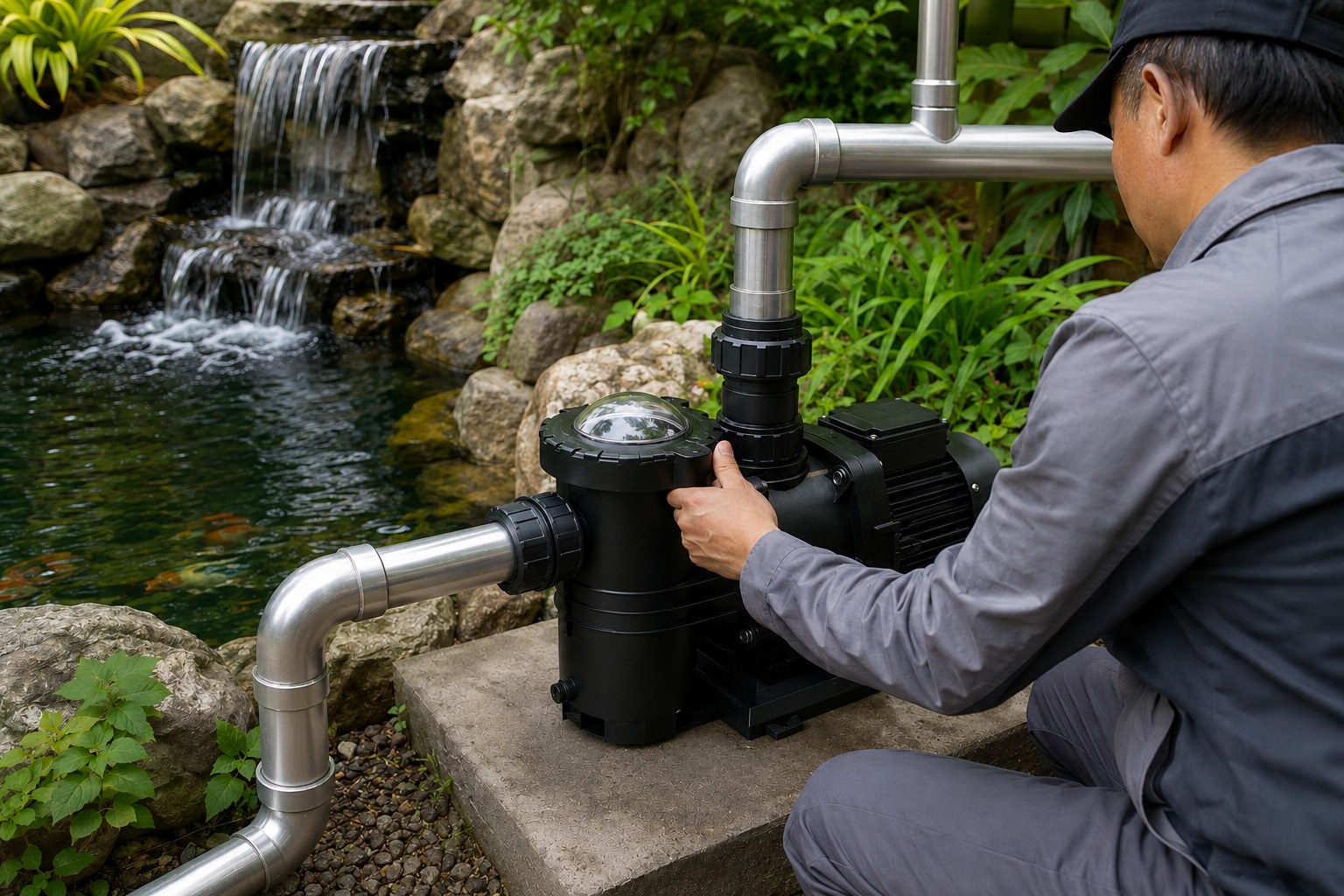
Getting the pump size right is the single most important decision for your pond's health.
It seems simple, but it’s a balance.
Too small, and your water stagnates.
Too big, and you create a whirlpool.
This guide will walk you through every factor, from basic calculations to advanced pump technologies, ensuring you make the perfect choice for your water garden, farm, or home water system.
We will cover the essential calculations for any pond and then explore how modern pump technology, especially in the solar-powered sector, offers solutions that are not only perfectly sized but also incredibly efficient and sustainable.
Factors to Consider When Choosing a Fish Pond Pump
Choosing a pump can feel like a guessing game with so many numbers and specifications.
Making the wrong choice can lead to a murky, unhealthy pond and wasted money on electricity.
Let's demystify the process by breaking down the key factors.
The most critical factors are your pond's volume, the number and size of your fish, the desired flow rate, and any water features like waterfalls or fountains.
Considering these elements together ensures you select a pump that is both effective and efficient.
How to Calculate Pond Volume
The first step is always to determine how much water your pond holds.
This figure, known as the pond volume, is the foundation for all other calculations.
You can calculate it with a simple formula.
For a rectangular or square pond, measure the length, width, and average depth in meters.
Then, use this formula:
Volume (Litres) = Length (m) x Width (m) x Depth (m) x 1000
For a circular pond, the formula is:
Volume (Litres) = Radius (m) x Radius (m) x 3.14 x Depth (m) x 1000
If your pond is an irregular shape, you can estimate by averaging the length and width.
Accuracy here prevents you from buying a pump that is either too weak or unnecessarily powerful.
An error of just 20% in your volume calculation can lead to a pump that is significantly mismatched for your needs.
Understanding Flow Rate (GPH/LPH)
Flow rate measures how much water a pump can move in a set amount of time.
It is typically expressed in Gallons Per Hour (GPH) or Litres Per Hour (LPH).
This is perhaps the most important specification on a pump.
A common rule of thumb is to choose a pump that can circulate the entire volume of your pond at least once every two hours.
This means the pump's flow rate should be half of your pond's total volume.
| Pond Condition | Recommended Circulation Frequency | Example (for a 4,000 Litre Pond) |
|---|---|---|
| Lightly Stocked (few plants/small fish) | Once every 2 hours | 2,000 LPH Pump |
| Heavily Stocked (many fish, especially Koi) | Once every hour | 4,000 LPH Pump |
For ponds with large, messy fish like koi, circulating the water once per hour is a much better target.
This increased circulation helps the filtration system keep up with the higher biological load, ensuring the water remains clear and healthy.
The Impact of Fish Load and Water Features
The contents of your pond heavily influence your pump choice.
More fish produce more waste, which requires more filtration and oxygenation.
A good guideline is to increase your pump's required flow rate by about 10% for every 10 inches of fish in your pond.
Water features like waterfalls and fountains also place additional demand on your pump.
The height the water must be lifted is called "head height."
A pump's flow rate decreases as the head height increases.
For example, a pump rated at 4,000 LPH at zero head height might only produce 2,500 LPH when it has to push water up 1 meter.
Always check the pump's performance chart, which shows its flow rate at various head heights.
For waterfalls, a general rule is to provide 100-150 litres per hour for every 1 cm of waterfall width for a pleasant-looking cascade.
- Waterfall Width: 30 cm
- Required Flow: 30 cm x 150 LPH = 4,500 LPH
You must add this requirement to your basic circulation requirement to find the total flow rate needed.
Putting it All Together: Real Life Examples
You have the formulas, but applying them to a real pond can still feel abstract.
Choosing incorrectly at this stage can mean going back to the store or living with a suboptimal pond.
Let's ground these concepts in some practical, real-world scenarios.
For a small, 1,900-litre pond with a few goldfish, a pump with a 950 LPH flow rate is a good starting point.
However, if you have a 7,500-litre koi pond with a 1-meter-high waterfall, you will need a much more powerful pump, likely in the 11,000 LPH range or higher.
Sizing for Different Pond Types
The "right size" is not a single number but a range that depends on your specific setup.
A simple decorative pond has very different needs than a thriving koi ecosystem.
Let's break down the pump requirements for various common pond sizes and types.
This provides a clearer starting point for your selection process.
The table below gives recommended flow rates based on pond volume and usage.
Remember to always factor in additional demand from head height and filtration systems.
| Recommended Pump Flow Rate by Pond Size (in Litres) | Pond Size (Litres) | Lightly Stocked (LPH) | Heavily Stocked / Koi (LPH) | Add for 1m Waterfall (LPH) |
|---|---|---|---|---|
| < 1,900 Litres | 500 - 950 | 950 - 1,900 | +1,000 - 2,000 | |
| 1,900 - 3,800 Litres | 950 - 1,900 | 1,900 - 3,800 | +2,000 - 4,000 | |
| 3,800 - 7,600 Litres | 1,900 - 3,800 | 3,800 - 7,600 | +4,000 - 6,000 | |
| 7,600 - 19,000 Litres | 3,800 - 9,500 | 7,600 - 19,000 | +6,000 - 10,000 | |
| > 19,000 Litres | 9,500+ | 19,000+ | +10,000+ |
Don't Forget Friction Loss
Another factor often overlooked by beginners is friction loss.
As water travels through pipes, the friction between the water and the pipe walls slows it down.
The longer the pipe and the more bends or fittings it has, the greater the friction loss.
This effect further reduces your pump's effective flow rate.
Using a pipe diameter that is too small for your pump is a common mistake that can drastically reduce performance.
For example, a pump with a 1.5-inch outlet will lose over 50% of its flow if you connect it to a 1-inch pipe over a 10-meter distance.
As a rule, always use the largest diameter pipe that your pump outlet will accommodate.
For very long pipe runs (over 15 meters), consider choosing the next size up in pumps to compensate for the inevitable friction loss.
This ensures the water flow at the destination (like your waterfall or filter) is as strong as you planned.
Beyond the Basics: Advanced Pump Technologies for Modern Needs
You've picked the right size, but what about the high electricity bills and reliance on the power grid?
The ongoing cost and environmental impact of running a pump 24/7 can be a significant drawback.
Modern technology offers a powerful, sustainable, and cost-effective alternative.
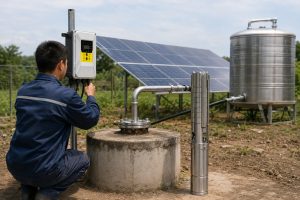
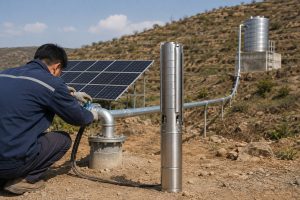
Solar water pumps provide a revolutionary solution for water circulation.
They operate completely off-grid, eliminate energy costs, and are built for extreme reliability.
Powered by ultra-efficient motors, they represent the future of water management for ponds, farms, and homes alike.
The Heart of the Pump: The BLDC Motor
The true innovation behind modern solar pumps is the motor that drives them.
Unlike conventional AC pumps, these systems use a Brushless DC (BLDC) permanent magnet motor.
This technology is a massive leap forward in efficiency.
A standard AC motor may only convert 50-60% of electricity into pumping power.
In contrast, a BLDC motor can achieve efficiencies of over 90%.
This means it can do the same amount of work using almost 40% less energy.
This superior efficiency is achieved by using powerful rare-earth magnets (like 40SH neodymium iron boron) in the rotor, eliminating the energy loss associated with traditional brushes.
The design is also far more compact.
A BLDC motor can be up to 47% smaller and 39% lighter than a conventional motor with the same power output.
This makes installation easier and reduces material costs.
The Brains of the Operation: The MPPT Controller
A powerful motor is only useful if it gets the right amount of power.
Solar panels produce a variable amount of electricity that changes with the intensity of the sun.
An intelligent Maximum Power Point Tracking (MPPT) controller acts as the brain of the solar pump system.
The MPPT controller constantly adjusts the electrical load to find the perfect balance between voltage and current.
This allows it to extract the maximum amount of power from the solar panels at any given moment.
Compared to a system without an MPPT controller, this technology can boost the total water pumped per day by up to 30%.
It ensures the pump starts earlier in the morning, runs faster in full sun, and continues to operate longer into the evening, making the most of every ray of sunlight.
Choosing the Right Solar Pump Type
Not all solar pumps are created equal.
The internal design of the pump is just as important as the motor that drives it.
Choosing the wrong type of pump end can lead to poor performance, premature wear, and a system that fails to meet your needs.
It's vital to understand the three primary designs and match them to your specific application.
Solar pumps are generally available in three main configurations: solar screw pumps for deep wells, solar plastic impeller pumps for high flow, and solar stainless steel impeller pumps for harsh water conditions.
Matching the pump type to your water source and intended use is the final step in designing a perfect system.
The Deep Well Specialist: Solar Screw Pumps
When you need to lift water from extreme depths, a solar screw pump is the ideal choice.
This design, also known as a progressing cavity pump, uses a helical stainless steel rotor rotating inside a rubber stator.
As the rotor turns, it forms sealed cavities that move water upwards through compression.
This mechanism generates a very high head (lifting pressure) but provides a lower flow rate.
It is perfect for applications like domestic water supply from deep boreholes, livestock watering in remote pastures, and small-scale drip irrigation.
A major advantage of the screw pump is its exceptional resistance to sand and silt.
It can handle water with a much higher solids content than centrifugal pumps, making it highly durable in harsh well conditions common in Africa and Latin America.
The High-Volume Workhorse: Solar Plastic Impeller Pumps
For applications requiring high volumes of water, like farm irrigation or filling large tanks, a solar plastic impeller pump is the go-to solution.
This is a multi-stage centrifugal pump.
It uses a series of impellers and diffusers stacked on top of each other to build pressure and flow.
The impellers are made from durable, wear-resistant engineered plastics.
This makes the pump lightweight, economical, and remarkably effective at handling water with fine sand without wearing out quickly.
These pumps deliver high flow rates at a medium head, making them ideal for drawing water from rivers, dams, and moderately deep wells.
Their high output and cost-effectiveness have made them widely popular for agriculture and community water supply across the Americas and Africa.
The Premium Durability Option: Solar Stainless Steel Impeller Pumps
When dealing with corrosive water or when maximum longevity is required, the solar stainless steel impeller pump is the premium choice.
In this model, the impellers, diffusers, and pump body are all constructed from high-grade SS304 or SS316 stainless steel.
This construction provides superior resistance to corrosion from acidic or alkaline water.
It is the perfect solution for applications in coastal regions with saltwater intrusion, areas with alkaline soil, or for high-end homes and ranches where reliability is paramount.
While the initial cost is higher, the extended service life and high reliability in aggressive water environments offer significant long-term value.
This pump combines high flow rates with medium-to-high head capabilities, making it a versatile and incredibly durable option.
| Solar Pump Application Guide | Pump Type | Primary Application | Flow Rate | Head | Key Advantage |
|---|---|---|---|---|---|
| Solar Screw Pump | Deep Well Water Supply | Low | Very High | Excellent sand resistance | |
| Solar Plastic Impeller Pump | Farm Irrigation, High Volume | High | Medium | Economical and wear-resistant | |
| Solar Stainless Steel Impeller Pump | Corrosive Water Environments | High | Medium-High | Maximum durability and corrosion resistance |
Hybrid Systems: The Best of Both Worlds
Solar power is fantastic, but what happens on cloudy days or at night?
Your need for water doesn't stop when the sun goes down, which can be a major challenge for off-grid systems.
A hybrid system elegantly solves this problem, giving you an uninterrupted water supply, 24/7.
Modern AC/DC hybrid controllers offer a complete, worry-free solution.
They are designed to automatically prioritize free solar energy whenever it is available but can seamlessly switch to or blend with an AC power source (like the grid or a generator) when solar is insufficient.
How Hybrid AC/DC Controllers Work
The intelligence of a hybrid system lies in its controller, which features dual power inputs.
You can have both your solar panels and an AC power source connected simultaneously.
The controller's software is programmed to always use solar power first.
When the sun is shining brightly, the pump runs 100% on free solar energy.
The controller constantly monitors the power available from the solar panels.
If the solar input drops due to clouds, the controller can activate its hybrid function.
Instead of switching completely to AC power, it will supplement the weak solar power with just enough AC power to meet the pump's demand.
This maximizes your use of free energy and can reduce grid consumption by over 40% compared to a system that just switches between one source or the other.
When there is no solar input at all, such as at night, the controller automatically switches over to the AC source to ensure the pump continues to run.
The Benefits of 24/7 Operation
This hybrid capability unlocks a new level of reliability for water systems.
For agricultural users, it means irrigation schedules can be met without fail, protecting crop yields regardless of the weather.
For domestic households, it guarantees consistent water pressure for showers and appliances day and night.
For livestock operations, it provides a constant and reliable source of drinking water, which is critical for animal health and productivity.
The system operates automatically, requiring no manual switching.
It provides the best of both worlds: the cost savings and environmental benefits of solar, combined with the 24/7 reliability of a grid-connected pump.
Conclusion
Sizing a pump correctly is the first step toward a healthy pond.
But true efficiency and reliability come from embracing modern technologies like BLDC motors, MPPT controllers, and versatile hybrid systems.
Frequently Asked Questions
What happens if my pond pump is too big?
An oversized pump creates excessive water turbulence, which stresses fish and can uproot plants. It also wastes electricity and can overwhelm your filter, causing it to bypass dirty water.
Should a pond pump run 24/7?
Yes, it is highly recommended. Continuous circulation is vital for maintaining high oxygen levels and allowing the filtration system to constantly remove waste, keeping the pond ecosystem healthy.
How often should I circulate my pond water?
A good rule is to circulate the entire pond volume at least once every two hours. For ponds with a heavy fish load like koi, circulating the water once every hour is better.
Can I use a waterfall pump for a filter?
Yes, you can. Just ensure the pump's flow rate does not exceed the maximum flow rate specified for your filter, and that it provides enough power to lift the water to the waterfall's height.
How do I calculate the GPH/LPH I need?
Start by calculating your pond's total volume. A basic flow rate would be half your pond's volume per hour. Then, add more flow to account for waterfalls and high fish loads.
What is "head height"?
Head height is the vertical distance from the surface of the pond to the highest point the pump needs to push water, such as the top of a waterfall or the inlet of a filter.
Does pipe size matter for a pond pump?
Yes, it is very important. Using a pipe that is too narrow for your pump's flow rate will create friction and significantly reduce the amount of water that actually gets moved.
Can a solar pump work on cloudy days?
Yes, solar pumps can operate in overcast conditions, but their flow rate will be reduced. A hybrid AC/DC system solves this by automatically supplementing with grid power when needed.