Worried your beautiful pond is turning into a green, smelly swamp?
A pump might be the lifesaver you need for a healthy, vibrant water garden.
For most backyard ponds, especially those with fish or water features, a pump is essential. It circulates, aerates, and helps filter the water. This process prevents stagnation, kills harmful bacteria, and ensures a healthy, oxygen-rich environment for all aquatic life to thrive.
While a pump is almost always a necessity, understanding precisely why it's so important is the first step.
Knowing its role helps you appreciate its value and choose the right system for your specific needs.
Let's dive into the core benefits a pump provides and explore why it's considered the heart of any thriving pond ecosystem.
Why is a Pond Pump So Important?
Is stagnant water ruining your pond's appeal and harming your fish?
Proper water movement is the only solution, and a pump is the engine that drives it.
A pond pump is vital for both water circulation and aeration. It prevents algae buildup, removes toxins, and delivers life-giving oxygen. These functions are essential for the survival and well-being of your fish and the beneficial bacteria that keep the pond clean.
The Critical Role of Water Circulation
Stagnant water is a pond's worst enemy.
Without movement, the water becomes a breeding ground for problems.
The most visible issue is algae.
Algae thrive in still, nutrient-rich water, quickly turning your pond an unpleasant shade of green.
This not only looks bad but also smells foul.
Beyond aesthetics, stagnant water encourages the growth of anaerobic bacteria.
These bacteria produce toxic compounds like hydrogen sulfide, which can be lethal to fish and plants.
A pump forces the water to circulate continuously.
This constant motion prevents algae from taking hold and disrupts the environment where harmful bacteria flourish.
It also ensures that nutrients are evenly distributed throughout the pond, making them available to your plants rather than just feeding an algae bloom.
Boosting Oxygen with Aeration
Just like us, fish need oxygen to breathe.
A pond's oxygen level is one of the most critical factors for aquatic health.
In a still pond, oxygen exchange only happens at the surface, and this process is slow.
A pump dramatically increases aeration in two ways.
First, it pulls water from the bottom and pushes it to the surface, creating a constant cycle.
Second, the surface agitation it creates—whether through a simple outlet, a fountain, or a waterfall—massively increases the surface area where water meets air.
This process, known as gas exchange, allows carbon dioxide to escape and fresh oxygen to dissolve into the water.
This is especially crucial in ponds with a high fish load.
More fish means a higher demand for oxygen.
Without a pump, oxygen levels can plummet, especially overnight or during hot weather, leading to stressed or even dead fish.
Aeration also supports the "good guys": the beneficial aerobic bacteria that break down fish waste and other organic debris.
These helpful microbes need oxygen to do their job effectively.
The Power of Filtration
A pump is rarely a standalone device; it's part of a system.
Its most important partner is a pond filter.
The pump's job is to push or pull water through the filter unit.
Without the pump, the filter is just a useless box.
This combination is what truly keeps your water sparkling clear and healthy.
Filters typically provide three types of filtration, all powered by the pump:
- Mechanical Filtration: A sponge or pad physically traps debris like leaves, fish waste, and uneaten food. The pump ensures all the water, and the debris within it, passes through this trap.
- Biological Filtration: This is where beneficial bacteria live on special media. The pump delivers a constant supply of oxygen-rich water to these bacteria, which then convert toxic ammonia from fish waste into much less harmful nitrates. This cycle is essential for preventing fish death from ammonia poisoning.
- UV Filtration (or Clarification): Many modern filter systems include an ultraviolet lamp. The pump pushes water past this UV light, which kills the single-celled algae that cause green water. A pump and UV clarifier combo is the fastest way to fix a green pond.
| Benefit of a Pump | Impact on Pond Health | Improvement Percentage |
|---|---|---|
| Circulation | Prevents algae, eliminates foul odors, and distributes nutrients. | Up to 90% reduction in algae |
| Aeration | Increases dissolved oxygen levels for fish and beneficial bacteria. | Boosts oxygen levels by 50-200% |
| Filtration | Removes physical debris and converts toxic ammonia. | Up to 99% removal of harmful toxins |
| Aesthetics | Powers waterfalls and fountains for visual and auditory appeal. | 100% required for active features |
What Size Pond Pump Do I Need?
Confused by terms like GPH, head height, and flow rate?
Choosing the wrong pump size is an expensive mistake that leads to poor performance or stressed fish.
To size a pump correctly, first calculate your pond's volume in gallons. A good rule of thumb is to choose a pump that can circulate at least half the pond's volume every hour. For a 1,000-gallon pond, you need a pump with a flow rate of at least 500 GPH (gallons per hour).
Calculating Your Pond's Volume
Before you can choose a pump, you need to know how much water you're trying to move.
Getting an accurate volume is the most important first step.
For square or rectangular ponds, the calculation is straightforward.
For irregular shapes, take average measurements.
Use this simple formula:
Average Length (ft) x Average Width (ft) x Average Depth (ft) x 7.5 = Pond Volume in Gallons
For example, a pond that is 10 feet long, 8 feet wide, and has an average depth of 2 feet would be:
10 x 8 x 2 x 7.5 = 1,200 gallons.
Based on the 50% per hour rule, this 1,200-gallon pond would need a pump with a flow rate of at least 600 GPH.
Factoring in Fish, Plants, and Sunlight
The 50% rule is just a starting point.
Several other factors can increase your pump size requirements.
- Fish Load: Fish produce waste (ammonia), which requires more filtration and aeration. If your pond is heavily stocked with fish like koi, you should aim to circulate the entire pond volume every hour. For our 1,200-gallon example, this means upgrading to a 1,200 GPH pump.
- Sunlight: A pond in full sun will be warmer and more prone to algae growth. Increased circulation from a more powerful pump can help mitigate these effects.
- Plants: While plants help oxygenate the water, a very dense population can impede water flow, sometimes requiring a slightly stronger pump to ensure all areas are circulated.
Do You Have a Waterfall or Fountain?
If you plan to add a waterfall or fountain, your calculations become more complex.
You now have to consider "head height."
Head height is the vertical distance from the pond's surface to the point where the water is discharged (e.g., the top of the waterfall).
Pumps lose power the higher they have to push water.
A pump rated for 1,000 GPH might only produce 500 GPH at a head height of 5 feet.
You must check the manufacturer's performance chart, which shows the flow rate at different head heights.
As a general rule for waterfalls:
- A gentle trickle: 50 GPH per inch of waterfall width.
- An average flow: 100 GPH per inch of waterfall width.
- A strong, sheeting flow: 200 GPH per inch of waterfall width.
So, for a 12-inch wide waterfall with an average flow, you'd need a pump that delivers 1,200 GPH at the height of the waterfall.
| Pond Volume (Gallons) | Use Case | Recommended Flow Rate (GPH) |
|---|---|---|
| Up to 500 | Simple circulation, few fish | 250 - 500 GPH |
| 500 - 1,500 | Lightly stocked, small filter | 750 - 1,500 GPH |
| 1,500 - 3,000 | Heavily stocked or small waterfall | 2,000 - 4,000 GPH |
| Over 3,000 | Large waterfall or high fish load | 4,000+ GPH |
What are the Different Types of Pond Pumps?
Submersible, external, magnetic drive, direct drive—the options can be overwhelming.
How do you pick the right technology for your pond and your wallet?
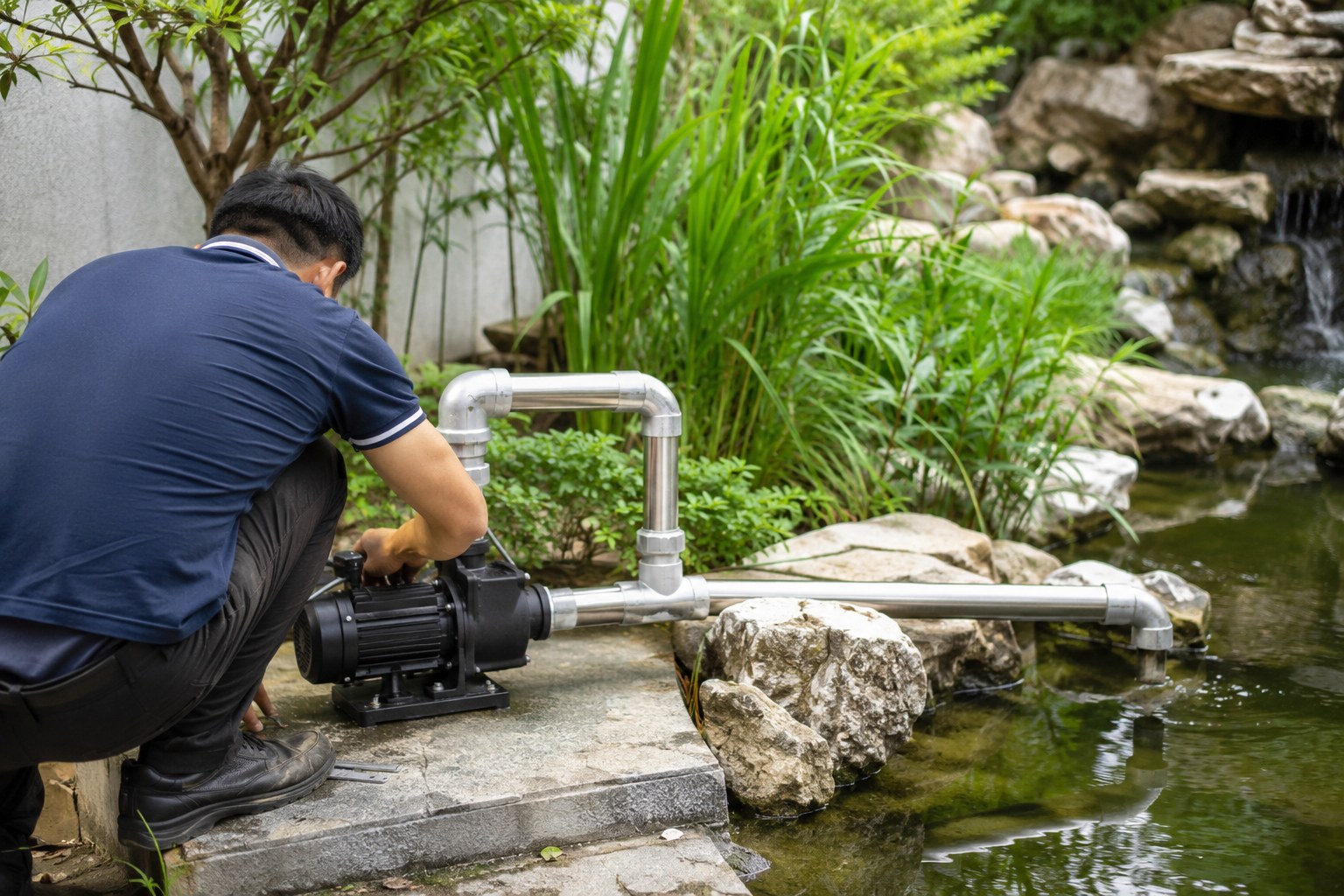
The two main types are submersible and external pumps. Submersibles are placed inside the pond, are quiet, and are ideal for smaller ponds. Externals sit outside the pond, are more powerful and efficient, and are better suited for large ponds or high-flow features.
Submersible Pumps: The Popular Choice
Submersible pumps are designed to operate while fully submerged in water.
They are typically placed in the deepest part of the pond or inside a skimmer box.
This is the most common type of pump for small-to-medium-sized backyard ponds.
Pros:
- Easy Installation: Simply place it in the water, connect the hose, and plug it in.
- Quiet Operation: Because it's underwater, the motor noise is almost completely muffled.
- Hidden from View: No need to find a place to hide a pump outside the pond.
Cons:
- Maintenance Access: Cleaning or servicing the pump requires you to reach into the pond to retrieve it.
- Potentially Higher Energy Use: For moving large volumes of water, they can be less efficient than external pumps.
- Oil-filled Models: Older or cheaper models may use oil for cooling. If a seal breaks, this oil can leak and be fatal to fish. Always choose a modern, oil-free design for a fish pond.
External Pumps: The Powerhouse
External pumps are "out-of-pond" pumps.
They are installed in a dry, protected location near the pond and draw water through plumbing.
These are the go-to choice for large ponds (over 1,500 gallons), demanding waterfalls, or serious hobbyists who prioritize efficiency and ease of maintenance.
Pros:
- High Efficiency: They are much more energy-efficient when moving large volumes of water, saving significant money on electricity over time.
- Easy Maintenance: The pump is easily accessible for service without disturbing the pond.
- Long Lifespan: They are typically built for durability and can last for many years.
Cons:
- Complex Installation: They require more complex plumbing, including check valves and priming.
- Noise: They are not as quiet as submersible pumps and may need to be housed in a sound-dampening box.
- Higher Initial Cost: The upfront purchase price is generally higher.
Inside the Pump: Magnetic vs. Direct Drive
The pump's motor technology also plays a huge role in its performance, efficiency, and safety.
Magnetic Drive Pumps:
These pumps use a magnet on the impeller that is spun by a magnetic field from the motor. There is no direct connection and no seals to wear out.
- Advantages: They are incredibly energy-efficient, often using 50-80% less electricity than direct-drive pumps. With no oil seals, they are 100% fish-safe. They require very little maintenance.
- Disadvantages: They are not good at lifting water to great heights (low head pressure), making them unsuitable for tall waterfalls.
Direct Drive Pumps:
These pumps use a traditional motor where an electrical current directly turns a shaft connected to the impeller.
- Advantages: They are powerful and can generate significant head pressure, making them the best choice for high waterfalls and fountains.
- Disadvantages: They are less energy-efficient. Some models use oil-filled motors with seals that can potentially fail and contaminate the pond. However, many newer "hybrid" drive pumps offer the power of direct drive with the safety and efficiency of magnetic drive technology.
| Pump Type | Best For | Pros | Cons |
|---|---|---|---|
| Submersible | Small-medium ponds (<1,500 gal) | Quiet, Easy to install, Hidden | Higher energy cost, Harder to access |
| External | Large ponds (>1,500 gal), waterfalls | Very efficient, Long life, Easy maintenance | Noisy, Complex installation, Higher cost |
| Magnetic Drive | General circulation, low-head features | Extremely efficient, Fish-safe, Low maintenance | Limited lifting power (head height) |
| Direct Drive | High waterfalls, fountains | High lifting power (head height) | Higher energy cost, Potential for oil leaks |
Are There More Efficient and Modern Pump Options?
Are high electricity bills from running your pond pump 24/7 a major concern?
Modern technology offers smarter, more sustainable, and cost-effective solutions.
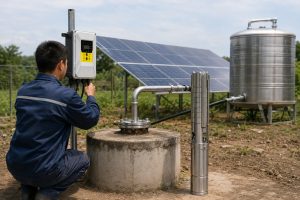
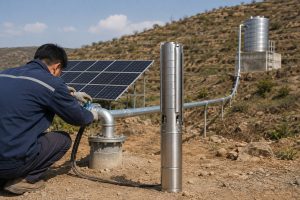
Yes, solar-powered pumps are an excellent modern alternative. They operate completely off-grid, can reduce electricity costs to zero, and are environmentally friendly, making them a very smart long-term investment for any pond owner, especially in sunny climates.
The Rise of Solar Pond Pumps
Solar technology is no longer just for small, decorative fountains.
Modern solar pump systems are powerful enough to run filtration and large waterfalls for a variety of pond sizes.
They work by connecting a high-efficiency pump directly to one or more solar panels via an intelligent controller.
The system operates whenever the sun is shining, providing free, eco-friendly circulation and aeration.
With the growing global demand for clean energy solutions, solar pumps have become a mainstream choice for pond owners seeking to reduce their carbon footprint and their utility bills.
The Power Behind the Pump: BLDC Motors
The biggest breakthrough in solar pump technology is the motor.
The most advanced solar pumps utilize a Brushless DC (BLDC) permanent magnet motor.
This is vastly superior to the standard AC motors found in many traditional pumps.
BLDC motor efficiency can exceed 90%, compared to 40-50% for many conventional pumps.
This incredible efficiency has several key benefits:
- Less Power Required: A BLDC motor can produce the same water flow using significantly less power.
- Fewer Solar Panels: Because less power is needed, you can run the system with a smaller, less expensive solar panel array.
- Longer Lifespan: With no brushes to wear out, these motors are virtually maintenance-free and have a much longer operational life.
- Compact & Lightweight: These motors are often up to 45% smaller and 40% lighter than traditional motors of similar power, making installation easier.
Choosing the Right Solar Pump Mechanism
Just like conventional pumps, solar pumps come with different mechanisms tailored for different jobs.
- Solar Impeller Pumps: These are the most common type for ponds. They use a multi-stage impeller (often made of durable plastic or corrosion-resistant stainless steel) to move a high volume of water at a medium pressure. This makes them perfect for general circulation, running filters, and powering small-to-medium waterfalls.
- Solar Screw Pumps: This design uses a helical screw rotating inside a rubber stator. It's a "positive displacement" pump, meaning it excels at moving water to very high heads (tall waterfalls) but at a lower flow rate. It is also highly resistant to sand or debris.
Never Lose Power: AC/DC Hybrid Systems
A common concern with solar is "What happens at night or on cloudy days?"
The most advanced solution is an AC/DC hybrid controller.
This intelligent device allows you to connect both your solar panels and your home's AC grid power to the pump at the same time.
The controller will prioritize using free solar energy whenever it's available.
If the sunlight fades, it can automatically blend in AC power or switch over completely to ensure the pump runs 24/7.
This gives you the best of both worlds: maximum energy savings from solar without ever compromising the health of your pond.
You get worry-free, around-the-clock water circulation.
| Solar Pump Tech | Best Application | Key Advantage |
|---|---|---|
| BLDC Motor | Core of all modern solar pumps | Over 90% efficiency, long life, requires fewer solar panels. |
| Impeller Mechanism | General circulation, filtration | High flow rate for a healthy pond ecosystem. |
| Screw Mechanism | Very tall waterfalls, high-lift needs | Excellent head height, handles debris and sand well. |
| AC/DC Hybrid Controller | Ponds requiring 24/7 operation | Uninterrupted performance, maximizes solar savings. |
When Might You NOT Need a Pond Pump?
Want a truly natural pond with minimal human intervention?
While uncommon, there are a few specific situations where you might be able to skip the pump entirely.
You might not need a pump for a small, shallow, fishless decorative pond or a purpose-built "wildlife pond." These rely on a large surface area, an abundance of aquatic plants, and natural ecological processes for oxygenation and cleaning.
The Self-Sustaining Wildlife Pond
A wildlife pond is designed from the ground up to be a balanced, self-sustaining ecosystem with minimal human intervention.
Success depends on several key factors.
It must have a very large surface area relative to its volume to maximize natural oxygen exchange.
A significant portion of the pond (at least 50-70%) must be filled with a diverse range of aquatic plants.
Submerged plants (like hornwort) release oxygen directly into the water.
Floating plants (like water lilies) provide shade to keep the water cool and limit algae.
Marginal plants (like irises) help absorb excess nutrients from the water.
These ponds are not suitable for keeping ornamental fish like koi or goldfish, as their waste would overwhelm the natural system.
The goal is to attract native wildlife like frogs, dragonflies, and birds.
The look is beautifully wild and natural, not the manicured, clear water of a typical garden pond.
Small, Fish-Free Water Features
A very small, "in-container" water garden with just a few plants and no fish might survive without a pump.
However, even in these cases, the water will be completely still.
This makes it an ideal breeding ground for mosquitoes.
It will also require very frequent manual cleaning and partial water changes to prevent the buildup of sludge and foul odors.
While technically possible, adding a tiny solar-powered bubbler or fountain pump is far easier and results in a much healthier and more pleasant feature.
The Risks of Going Pumpless
For over 95% of backyard pond owners, trying to go without a pump is a recipe for disaster.
If you have fish, a pump is not optional—it is a mandatory piece of life-support equipment.
Without a pump, your pond is at high risk for:
- Low Oxygen Levels: Leading to stressed, sick, or dead fish.
- Algae Blooms: Turning the water into a green, murky soup.
- Sludge Buildup: Organic debris will settle and rot, producing foul odors.
- Mosquito Infestations: Stagnant water is a perfect habitat for mosquito larvae.
For the vast majority of ponds, a pump is not an expense; it is insurance for the health of your aquatic pets and the beauty of your garden.
Conclusion
A pump is the single most important investment for a clean and healthy pond.
It is the heart of the ecosystem, ensuring a safe, beautiful, and thriving home for fish.
FAQs
Can a pond survive without a pump?
Yes, but only if it is a large, natural wildlife pond with many plants and no fish. Most garden ponds with fish cannot survive without a pump for aeration.
Do pond pumps use a lot of electricity?
It varies. Modern energy-efficient pumps, especially magnetic drive or solar models with BLDC motors, use significantly less power than older, less advanced pumps.
How long should a pond pump run per day?
For any pond containing fish, the pump must run 24 hours a day, 7 days a week to ensure constant circulation and life-sustaining oxygenation.
Will a pump clear a green pond?
A pump helps by circulating water, but it will not clear green water by itself. You need a pump combined with a filter system that includes a UV clarifier.
Can you have a waterfall without a pump?
No, a waterfall effect requires a pump to continuously lift water from the pond basin to the top of the feature to create the cascading flow.
What happens if I turn my pond pump off at night?
This is very risky for fish. Oxygen levels naturally drop overnight, and without the pump's aeration, fish can suffocate, especially in warm weather or crowded ponds.
Do small ponds need a pump?
Even small ponds benefit greatly from a pump. Water quality can decline very quickly in smaller volumes, making a pump essential for preventing stagnation and algae.
Is a solar pond pump powerful enough?
Absolutely. Modern solar pumps equipped with high-efficiency BLDC motors can power everything from small fountains to large filters and waterfalls, often matching grid-powered performance.