Struggling to find a clear price for a 1 hp water pump?
The cost varies widely, from under $300 for a basic model to over $1,500 for a complete solar system.
Price depends on the pump type, motor efficiency, and whether it's part of a larger system.
The label "1 hp" tells you the motor's power, but it doesn't tell you the whole story about cost or performance.
A cheap pump might be a bargain upfront but could cost you more in electricity bills or fail to meet your water needs.
On the other hand, the most expensive pump might be overkill for your situation.
To find the true cost, you need to look beyond the horsepower and understand the technology inside the pump, the job it's designed to do, and the long-term operating expenses.
This guide will break down the factors that influence the price, helping you choose the right pump for both your needs and your budget.
What Determines the Price of a 1 HP Water Pump?
Confused by the wide range of pump prices?
A cheap pump might not work for your well, and an expensive one could be an unnecessary expense.
Let's break down the key factors that really determine the cost.
The price of a 1 hp water pump is mainly set by three things.
First is the pump type, like a shallow well pump or a submersible pump.
Second is the motor technology, such as a standard AC motor or a high-efficiency DC motor.
Third is the material, like cast iron, plastic, or stainless steel.
The Impact of Pump Type and Application
The pump's design is directly tied to its job.
A shallow well jet pump, like the one in the example document costing around $290, is designed to pull water from sources less than 25 feet deep.
It's great for residential water supply from a cistern or shallow well.
In contrast, a submersible pump is placed directly in the water source, allowing it to push water from much deeper wells.
Within submersible pumps, there are further specializations.
A solar screw pump uses a rotating screw to push water.
This design creates very high pressure, making it perfect for lifting water from extremely deep wells, even over 500 feet.
However, it delivers a lower volume of water (low flow).
A centrifugal pump uses a spinning impeller to move water.
These pumps deliver a much higher volume of water (high flow) but at a lower pressure, making them ideal for irrigation or filling large tanks quickly.
The complexity and purpose of the pump design are primary drivers of its cost.
Motor Technology: AC vs. High-Efficiency BLDC
The motor is the heart of the pump, and its technology dramatically affects both the initial price and long-term operating cost.
Standard AC (Alternating Current) motors are common in pumps that plug into a wall outlet.
They are a mature technology and are generally less expensive to manufacture.
However, their efficiency is typically only 60-75%.
This means that up to 40% of the electricity they use is wasted as heat, not used for pumping water.
Modern solar pumps use advanced BLDC (Brushless Direct Current) permanent magnet motors.
These motors have an efficiency of over 90%.
This incredible efficiency means they convert almost all the energy they receive into pumping power.
While the technology is more advanced and can increase the initial cost of the pump, it has a massive financial benefit.
A more efficient motor requires significantly less power to do the same amount of work, directly reducing the number of solar panels needed and saving hundreds of dollars on the total system cost.
Build Quality and Material Choices
The materials used to build a pump determine its durability, lifespan, and suitability for different water conditions.
This choice directly impacts the price.
- Cast Iron: This is a common, durable, and relatively inexpensive material for pump housings. It offers good strength but can be susceptible to rust over time, especially in acidic water.
- Plastic (Noryl/Polycarbonate): High-strength engineered plastics are often used for impellers. They are lightweight, corrosion-proof, and highly resistant to abrasion from sand. This makes them a cost-effective and durable choice for many applications.
- Stainless Steel: This is the premium material for pumps. It is used for both housings and impellers. Stainless steel offers superior resistance to corrosion, abrasion, and harsh water chemistry (acidic or alkaline). Pumps made from stainless steel last longer but come at a higher price point.
The table below shows how these factors influence the final cost.
| Cost Factor | Basic (e.g., AC Jet Pump) | Mid-Range (e.g., Plastic Solar) | Premium (e.g., S.S. Solar) |
|---|---|---|---|
| Pump Type | Shallow Well Jet | Submersible Centrifugal | Submersible Centrifugal/Screw |
| Motor Tech | Standard AC (60-75% Eff.) | High-Efficiency BLDC (>90% Eff.) | High-Efficiency BLDC (>90% Eff.) |
| Materials | Cast Iron Housing, Plastic Impeller | Plastic Impeller, S.S. Parts | Full Stainless Steel Construction |
| Price Range | $250 - $400 | $500 - $900 (Pump only) | $700 - $1200+ (Pump only) |
How Does a 1 HP AC Pump Compare to a Solar Pump?
Thinking of going solar for your water needs?
The upfront cost of a solar pump system can seem high compared to a standard AC pump.
But is that the whole story?
Let's compare them side-by-side.
A basic 1 hp AC pump might cost around $300.
A complete 1 hp solar pump kit will be more expensive initially.
However, the solar pump has zero ongoing electricity costs.
This makes it far more cost-effective over its lifespan, especially in off-grid or rural areas.
Upfront Cost Breakdown
The initial investment for an AC pump and a solar pump are very different.
An AC pump system is simple.
You buy the pump unit, which might cost between $250 and $400 for a 1 HP model.
You then connect it to your existing electrical grid.
The primary cost is the pump itself.
A solar pump system is more comprehensive.
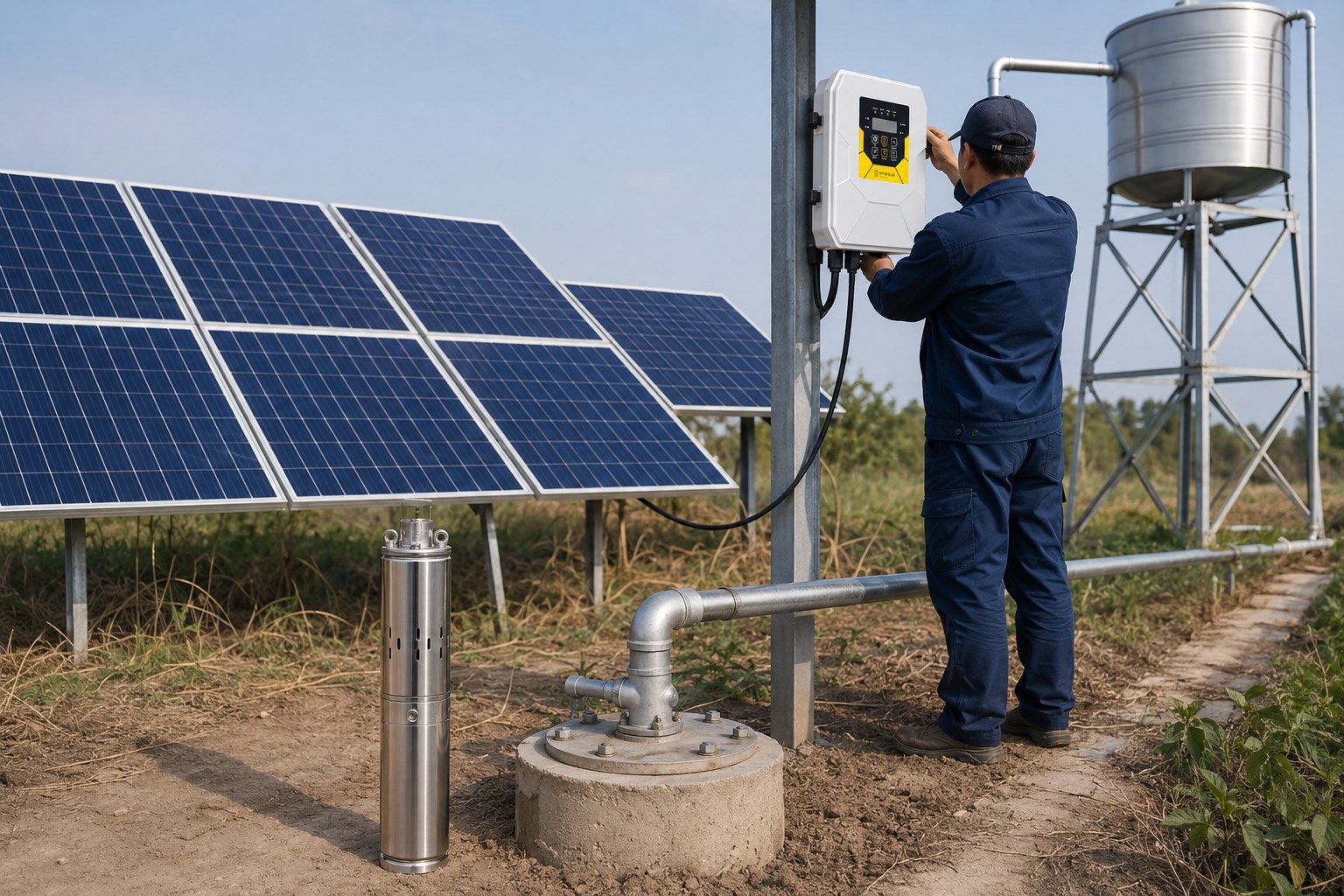
The cost includes not just the pump, but also the high-efficiency BLDC motor, an intelligent controller (like an MPPT), and the solar panels to power it all.
A complete 1 HP solar pump kit can range from $1,000 to over $2,000, depending on the pump type and the number of panels required.
While this is a higher initial barrier, it is a one-time investment for years of free energy.
Operating Cost Analysis
This is where solar pumps truly shine.
Let's analyze the cost of running a 1 HP pump.
A 1 HP motor is theoretically 746 watts.
However, due to real-world inefficiencies, a standard 1 HP AC motor can actually draw 1200 watts or more.
If your electricity costs $0.15 per kilowatt-hour (kWh), running this pump for 6 hours a day would cost:
1.2 kW 6 hours $0.15/kWh = $1.08 per day
Over a year, that's nearly $400 in electricity bills just for one pump.
The operating cost for a solar pump is $0.
It runs entirely on free energy from the sun.
There are no monthly electricity bills.
This turns a recurring expense into a one-time capital investment.
The Long-Term Value Proposition
When you compare the total cost of ownership, the picture becomes clear.
Let's assume the AC pump costs $300 upfront and $400 per year to run.
Let's assume the solar pump system costs $1,800 upfront and $0 per year to run.
The initial cost difference is $1,500.
At $400 per year in electricity savings, the solar pump system pays for itself in under four years.
($1800 - $300) / $400/year = 3.75 years
After that, you get free water for the remaining life of the system, which can be over 10 years.
The AC pump will continue to cost you money every single year.
| Feature | 1 HP AC Pump | 1 HP Solar Pump System |
|---|---|---|
| Initial Cost | Low ($250 - $400) | High ($1,000 - $2,000+) |
| Energy Cost | High (e.g., ~$400/year) | Zero ($0) |
| Power Source | Grid Electricity | Solar Panels |
| 5-Year Total Cost | $2,300 ($300 + 5*$400) | $1,800 |
| Grid Dependency | 100% Dependent | 100% Independent |
Why Are There Different Types of 1 HP Solar Pumps?
Not all solar pumps are created equal.
Choosing the wrong type for your well means poor performance and wasted money.
Let's match the right pump to the right job.
Solar pumps are specialized tools.
A screw pump provides high pressure for deep wells but delivers a low volume of water.
A centrifugal pump with plastic or stainless steel impellers delivers high volume for irrigation.
The right choice depends entirely on your specific water needs.
The Specialist: Solar Screw Pumps
Think of the solar screw pump as a specialist for depth.
This pump doesn't use an impeller.
Instead, it uses a helical stainless steel screw that rotates inside a rubber stator.
This action creates sealed cavities that move water upward, generating very high pressure.
Key Features:
- Low Flow, High Head: These pumps are not designed for high volume. Instead, they excel at lifting water from very deep sources, often exceeding 500-600 feet.
- Sand Resistance: The screw design is naturally more resistant to sand and sediment than many centrifugal pumps, making it ideal for newly drilled or sandy wells.
- Applications: Perfect for domestic water supply in homes with deep wells, livestock watering in remote pastures, and small-scale drip irrigation where high pressure is needed.
This pump solves the problem of getting water from very deep, low-yield wells where a high-flow pump would be ineffective.
The Workhorse: Solar Plastic Impeller Pumps
This is the high-volume workhorse of the solar pump world.
It is a multi-stage centrifugal pump.
This means it has multiple impellers stacked on top of each other.
Each stage adds pressure, while the overall design is optimized for moving a large volume of water.
Key Features:
- High Flow, Medium Head: These pumps are designed to deliver the maximum amount of water for applications like farm irrigation, filling large storage tanks, and pasture water supply.
- Wear-Resistant: The impellers are made from durable, engineered plastics that offer excellent resistance to wear from fine sand.
- Economical: Plastic impeller pumps are generally the most cost-effective option for high-flow applications, providing a great balance of performance and price.
For anyone needing to move a lot of water for agriculture or large-scale water supply, this is often the best choice.
The Premium Choice: Solar Stainless Steel Impeller Pumps
This model is the premium, high-durability option.
It functions as a multi-stage centrifugal pump, similar to the plastic impeller version, but with a critical difference.
Both the impellers and the pump housing are made from high-grade stainless steel (like SS304 or SS316).
Key Features:
- Corrosion Resistance: This is the pump's main advantage. It is specifically designed for use in harsh water environments, such as water that is acidic, alkaline, or has high salinity.
- Long Service Life: Stainless steel is extremely durable and resistant to wear, giving these pumps a very long operational life even in tough conditions.
- High Reliability: Ideal for critical applications, high-end homes, or commercial ranches where reliability is paramount and water quality is poor.
While they have a higher initial cost, stainless steel impeller pumps provide peace of mind and longevity in environments where other pumps would quickly fail.
| Pump Type | Best For | Flow Rate | Head (Pressure) | Key Advantage | Target Market |
|---|---|---|---|---|---|
| Solar Screw Pump | Very deep wells, home use | Low | Very High | Sand resistance, extreme lift | Africa, Latin America |
| Solar Plastic Impeller | Farm irrigation, high volume | High | Medium | Economical, wear-resistant | Africa, Americas |
| S.S. Impeller Pump | Corrosive water, premium homes | High | Medium-High | Durability, corrosion-proof | Australia, high-end ranches |
The Hidden Engine: Why the Motor Matters More Than the Pump
Focusing only on the pump itself is a common and costly mistake.
The motor is the true heart of the system.
Its efficiency dictates your real-world performance and costs.
Let's look under the hood.
Modern solar pumps use highly efficient BLDC motors, which are over 90% efficient.
Standard AC motors are often only 60-75% efficient.
This huge difference in efficiency means a BLDC motor requires far fewer solar panels, saving you significant money on the total system.
Understanding Power: HP vs. Real-World Wattage
The term "1 HP" is a rating of output power, equivalent to 746 watts.
However, no motor is 100% efficient.
The motor must draw more "input" power to produce 1 HP of "output" power.
A standard AC motor with 70% efficiency needs to draw over 1,000 watts to deliver 746 watts of work.
(746 Watts / 0.70 Efficiency = 1065 Watts)
In contrast, a BLDC motor with 92% efficiency needs to draw only about 810 watts.
(746 Watts / 0.92 Efficiency = 811 Watts)
That 250-watt difference is energy that you must supply and pay for, either in electricity bills or in extra solar panels.
The BLDC Motor Advantage
A BLDC (Brushless Direct Current) permanent magnet motor is a technological leap forward.
- Efficiency over 90%: This is the most critical advantage. Less energy is wasted as heat, meaning more of the sun's power is converted into water flow.
- Compact & Lightweight: Because they are more efficient, BLDC motors can be designed to be much smaller and lighter. They can be up to 47% smaller and 39% lighter than traditional motors of the same power rating. This makes installation easier and cheaper.
- High Torque & Maintenance-Free: These motors provide strong power even at low speeds. Because they are brushless, there are no brushes to wear out and replace, making them virtually maintenance-free.
This superior technology is the engine that drives the performance and cost-effectiveness of modern solar pump systems.
The Financial Impact of High Efficiency
The efficiency of the motor has a direct and significant impact on the total cost of a solar pump system.
The primary cost of a solar water system is often the solar panels themselves.
Let's revisit our example.
The inefficient AC motor needed over 1,000 watts of power.
The efficient BLDC motor needed only 811 watts.
This means you would need to buy roughly 20-25% more solar panels to power the less efficient motor.
At a typical cost of $0.50 to $1.00 per watt for solar panels, that 250-watt difference translates into a direct saving of $125 to $250 on the initial system purchase.
Over the life of the system, a more efficient motor simply provides more water for every bit of sunlight it receives.
| Feature | Standard AC/DC Motor | High-Efficiency BLDC Motor |
|---|---|---|
| Typical Efficiency | 60-75% | >90% |
| Power Draw (Input) | ~1100 Watts for 1HP Output | ~810 Watts for 1HP Output |
| Size & Weight | Standard | Up to 40% Smaller & Lighter |
| Maintenance | Requires Brush Replacement | Maintenance-Free |
| Impact on System Cost | Requires 20-30% More Solar Panels | Reduces Solar Panel Cost |
Beyond the Pump: The Role of Intelligent Controllers
You have the perfect pump and an efficient motor.
But what happens on a cloudy day, or when you need water at night?
Without a smart controller, your system is inefficient and unreliable.
Intelligent controllers are the brains of the operation.
An MPPT controller can boost daily water output by up to 30% by maximizing solar energy use.
Advanced AC/DC hybrid controllers provide 24/7 water security by automatically switching to a backup power source when sunlight is gone.
What is MPPT (Maximum Power Point Tracking)?
Solar panels are sensitive.
Their power output changes constantly with the angle of the sun, clouds, and temperature.
An MPPT (Maximum Power Point Tracking) controller is a smart electronic device that sits between the solar panels and the pump motor.
It constantly monitors the voltage and current from the solar panels and adjusts the electrical load to find the "maximum power point."
This ensures the motor is always receiving the most power possible at any given moment.
On a perfect sunny day, this might provide a small boost.
But on cloudy days, or in the early morning and late afternoon, an MPPT controller can increase the total water pumped by 20-30%.
It makes the system work longer and harder, maximizing the return on your solar panel investment.
The Game-Changer: AC/DC Hybrid Controllers
For applications that require water 24/7, a hybrid controller is essential.
It provides ultimate reliability by creating a system with two power inputs.
You can connect both your solar panels (DC power) and your home's grid power or a generator (AC power) to the controller at the same time.
The controller's logic is designed to be as efficient as possible:
- Solar Priority: It will always use the free solar power first.
- Hybrid Blending: If solar power is low (e.g., on a very cloudy day), it can blend in a small amount of AC power to supplement the solar energy, keeping the pump running smoothly while still using as much free energy as possible.
- Automatic Switchover: When there is no solar power available (e.g., at night), the controller automatically switches to the AC power source to ensure you have uninterrupted water access.
This technology eliminates the need to buy two separate pumps (one solar, one AC) for a single well.
It gives you the cost savings of solar with the 24/7 reliability of the grid.
Why This Matters for Cost and Reliability
Intelligent controllers are not just an accessory; they are a core component that defines the system's value.
An MPPT controller effectively makes your solar array 20-30% larger on average, without the cost of extra panels.
It ensures you get water on days when a simpler system would have already stopped working.
An AC/DC hybrid controller provides total water security.
It's critical for households that cannot risk being without water, or for agricultural operations where livestock must have water available at all times.
It removes the "what if" from a solar-powered system, providing a robust, flexible, and completely reliable water solution.
Conclusion
The true cost of a 1 hp pump is not its price tag.
It is determined by the entire system—the pump type, motor efficiency, and controller—which defines its long-term value and reliability.
FAQs
How many solar panels does a 1hp pump need?
This depends on motor efficiency, but a 1HP pump typically requires 1,000 to 1,500 watts of solar panels. A more efficient motor needs fewer panels.
Can a 1hp pump run on a generator?
Yes, an AC pump can run on a properly sized generator. A solar pump with an AC/DC hybrid controller can also use a generator as a backup power source.
What is the difference between head and flow?
Head is the vertical height a pump can lift water, measured in feet or meters. Flow is the volume of water it moves, measured in gallons or liters per minute.
How long do solar water pumps last?
A quality solar pump system with a brushless motor can last for over 10 years. The solar panels themselves often have a warranty of 20-25 years.
Is a 1 HP pump enough for irrigation?
It can be. Success depends on the pump's flow rate. A 1HP high-flow centrifugal pump is often suitable for small to medium-sized irrigation projects.
What does submersible mean?
A submersible pump is a pump that is designed to be fully submerged in water. It pushes water to the surface, which is more efficient than pulling it.
Why is my water pressure low with a new pump?
Low pressure could be due to a mismatch between the pump type and well depth. A pump with a low head rating won't produce good pressure from a deep well.
Do solar pumps work on cloudy days?
Yes, but at a reduced rate. A system with an MPPT controller will perform significantly better in low-light conditions than one without.