Struggling with high water bills or an unreliable supply?
Finding an affordable pump that doesn't compromise on quality is a real challenge.
A cheap pump today can mean expensive repairs tomorrow.
The cheapest water pump to operate long-term is often a solar-powered pump, despite a higher initial cost.
For upfront price, small 12V DC diaphragm pumps are the least expensive, with some models starting as low as $29.
However, the total cost of ownership is what truly matters for your budget.
Choosing a water pump isn't just about the sticker price.
The "cheapest" pump might cost you more in electricity, maintenance, and replacement parts down the line.
To make a truly cost-effective decision, you need to understand the different types of pumps and their long-term value.
Let's explore the options to find the best pump for your needs and budget, from basic residential use to large-scale agriculture.
We will look at upfront costs, running costs, and which applications they suit best.
Residential Pumps: Balancing Cost and Performance
Need a reliable water supply at home without breaking the bank?
You worry about low water pressure and high electricity bills.
A cheap, inefficient pump can be a noisy and expensive nightmare.
For residential use, a small shallow well jet pump or a utility pump offers the lowest initial purchase price, often under $300.
These pumps are great for boosting pressure or small water transfer tasks, providing a simple, budget-friendly solution for homeowners.
When selecting a residential pump, the primary goal is to find a reliable unit that handles daily water needs without generating high electricity bills.
The initial cost is tempting, but it's only one part of the equation.
Modern pumps are designed for performance, energy efficiency, and long-lasting use.
They are the silent guardians of your home's water pressure.
They provide drinking water, nurture gardens, fill pools, and support entire plumbing systems.
A good pump ensures a dependable water supply for all domestic needs.
Let's break down the most common and cost-effective options for your home.
Understanding Jet Pumps
Jet pumps are a popular and affordable choice for residential wells.
They are installed above ground, making them easy to access for maintenance.
They work by creating a vacuum to draw water up from the source.
There are two main types: shallow well and convertible.
A shallow well jet pump is ideal for water depths of 25 feet or less and can be purchased for as little as $299.
A convertible jet pump can be configured for either shallow or deep wells, offering more flexibility for a slightly higher price, around $479.
These pumps are workhorses for many rural homes.
When to Choose a Utility Pump
Utility pumps are the multi-tools of the water pump world.
They are typically portable, inexpensive, and designed for temporary jobs.
This includes draining a flooded basement, emptying a water heater, or transferring water from a rain barrel.
A basic 12V water transfer pump can cost around $109.
While not designed for permanent installation as a primary water source, their low cost and versatility make them an extremely cheap option for specific tasks.
Their low price point makes them a must-have for emergency situations.
Comparing Residential Pump Costs
To make an informed choice, it helps to see the numbers side-by-side.
The upfront cost is just the beginning.
Consider the power consumption and expected lifespan.
An energy-efficient model might save you 20-30% on your electricity bill each year, quickly offsetting a higher initial price.
Here's a look at how common residential pumps stack up.
| Pump Type | Average Price Range | Best For | Key Consideration |
|---|---|---|---|
| Shallow Well Jet Pump | $250 - $400 | Wells up to 25 ft deep | Low initial cost, easy maintenance |
| Convertible Jet Pump | $400 - $600 | Wells up to 90 ft deep | More versatile, slightly higher cost |
| Utility Transfer Pump | $100 - $200 | Draining, water transfer | Not for permanent installation |
| Booster Pump | $200 - $500 | Increasing low water pressure | Solves pressure issues in existing systems |
Agricultural Pumps: Investing for Higher Yields
Are you an farmer worried about inconsistent water for your crops?
Unreliable irrigation can devastate your productivity and profits.
Finding a cost-effective pump that can handle the demands of agriculture is crucial.
For agricultural needs, gas-powered semi-trash pumps or electric cast iron irrigation pumps offer a balance of power and affordability, with prices ranging from $300 to $600.
They provide the high flow rates needed for irrigation, making them a cost-effective choice for small to medium-sized farms.
In agriculture, water is everything.
A reliable irrigation system pump can be the difference between a thriving crop and a failed season.
These pumps are the vital conduits that ensure a consistent water supply.
They enrich crop growth and maximize yields.
Unlike residential pumps, agricultural pumps are judged by their power, flow rate, and durability under tough conditions.
The initial cost is an investment in productivity.
Let's examine the most economical choices for keeping your fields and gardens thriving.
Centrifugal Pumps for Surface Water
Surface centrifugal pumps are a popular pick for farms and rural properties.
They sit above the water source, like a pond or creek, and draw water up through a suction pipe.
These pumps are relatively simple to install and maintain.
An electric 2 HP cast iron irrigation pump, capable of moving 70 gallons per minute (GPM), can be found for around $419.
This makes them a great value for moving large volumes of water over moderate distances.
Their straightforward design contributes to a longer service life and lower repair costs.
The Power of Gas-Powered Pumps
When you need to move a lot of water quickly and don't have access to electricity, a gas-powered pump is the answer.
These pumps offer incredible mobility and power.
A 7 HP gas-powered semi-trash pump can move an impressive 220 GPM.
It can be purchased for about $319.
This makes it one of the cheapest options on a per-gallon-pumped basis.
They are ideal for large-scale irrigation, dewatering fields, or as a backup when the power goes out.
The trade-off is the ongoing cost of fuel and engine maintenance.
Comparing Agricultural Pump Power and Price
Choosing the right farm pump means matching the pump’s capabilities to your land's needs.
Horsepower (HP) and Gallons Per Minute (GPM) are the key metrics.
More horsepower generally means a higher flow rate and the ability to push water further or higher.
However, a bigger pump also means a higher initial cost and, for electric models, higher energy consumption.
Here is how some common agricultural options compare.
| Pump Type | Power | Flow Rate (GPM) | Average Price | Best For |
|---|---|---|---|---|
| Electric Irrigation Pump | 1 HP | ~56 GPM | $379 | Small plots, consistent power source |
| Electric Irrigation Pump | 2 HP | ~70 GPM | $419 | Medium fields, higher water needs |
| Gas-Powered Semi-Trash Pump | 7 HP | ~220 GPM | $319 | Large areas, no electricity, mobility |
| Convertible Jet Pump | 1 HP | ~17 GPM | $479 | Drawing from deeper wells for irrigation |
Solar Pumps: The Cheapest Long-Term Solution?
Tired of being dependent on an unstable power grid and rising electricity costs?
Off-grid water access seems expensive and complicated.
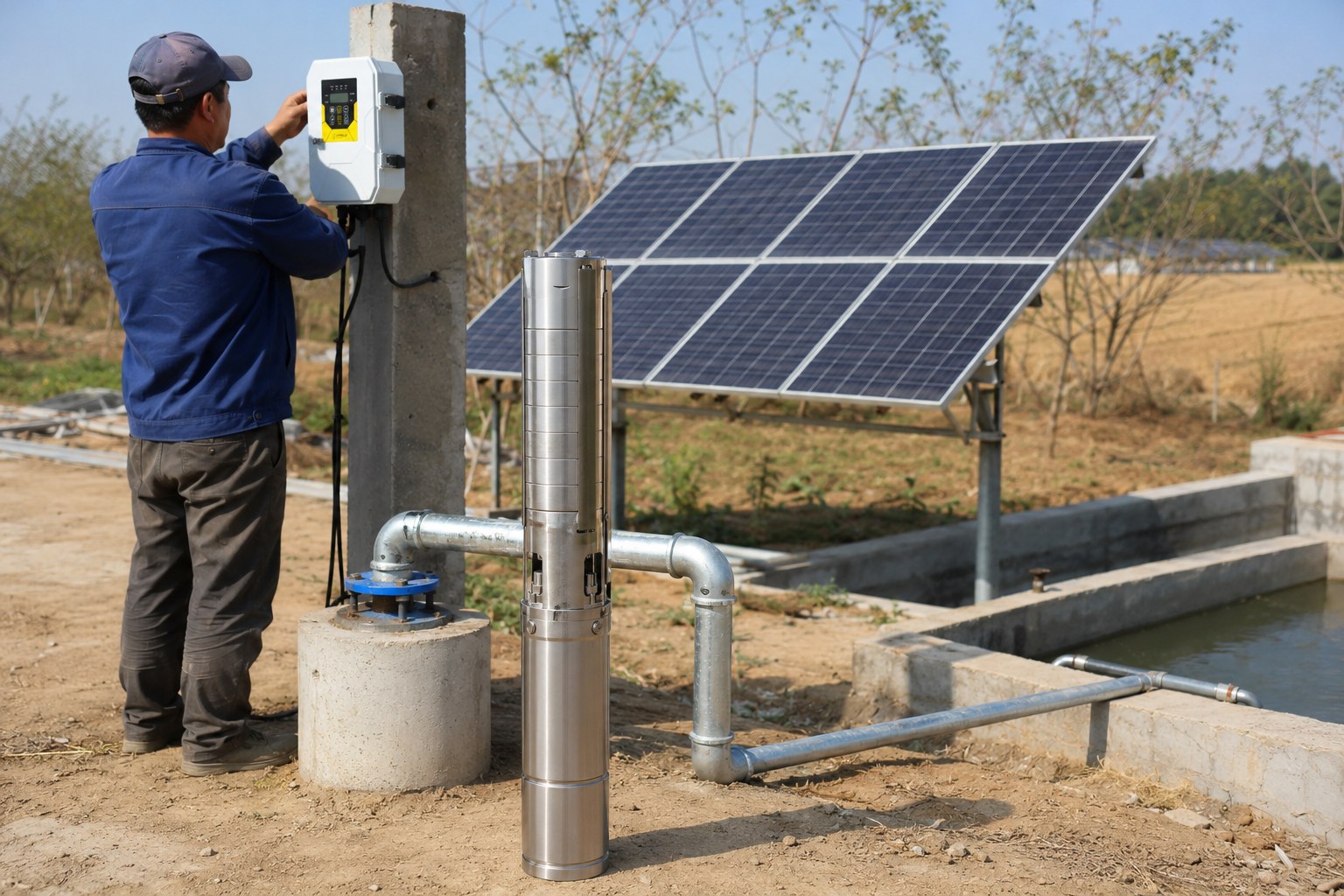
Solar pumps offer a path to water independence and zero running costs.
While solar water pumps have a higher upfront cost, they are often the cheapest long-term solution.
With no electricity bills and minimal maintenance, the total cost of ownership can be 50-70% lower than traditional pumps over their lifespan, offering a return on investment in just 2-3 years.
With the growing global demand for clean energy, solar water pumps are becoming essential.
They are widely used in Africa, the Americas, Australia, and Asia for their sustainability and cost-effectiveness.
They operate independently of the power grid, making them ideal for rural and remote areas.
While the initial investment is higher than for a conventional pump, the long-term savings are significant.
There are no fuel costs and no monthly electricity bills.
Let's dive into the types of solar pumps that offer the best value.
The Powerhouse: BLDC Permanent Magnet Motor
The heart of any modern solar pump is its motor.
High-efficiency Brushless DC (BLDC) permanent magnet motors are the core technology driving the best systems.
These motors achieve efficiencies exceeding 90%, which is a major leap from traditional AC motors.
The rotor is made of high-grade 40SH neodymium iron boron magnets, providing strong torque in a compact design.
Technically, this results in a motor that is 47% smaller and 39% lighter than its predecessors.
For the user, this high efficiency means you need fewer solar panels to run the pump, reducing the total system cost by up to 25%.
It also simplifies installation and extends the motor's maintenance-free service life.
Solar Screw Pump: High Head, Low Flow
The solar screw pump is a specialized type of progressing cavity pump.
It uses a stainless steel screw rotating inside a rubber stator.
This action pushes water upwards through compression.
This design is perfect for applications requiring a high head (lifting water from deep wells) but with a low flow rate.
It's an ideal choice for domestic water supply and livestock watering in electricity-scarce regions.
One of its biggest advantages is its high resistance to sand, allowing it to operate reliably in harsh water conditions where other pumps would quickly fail.
Solar Impeller Pumps: High Flow for Agriculture and More
For applications needing higher flow rates, like farm irrigation or filling large tanks, solar centrifugal pumps with impellers are the go-to solution.
They come in two main varieties.
Solar Plastic Impeller Pump: This multi-stage pump uses a durable, wear-resistant plastic impeller.
It delivers high flow at a medium head.
This makes it an excellent, economical choice for farm irrigation and pasture water supply.
Its lightweight design and resistance to fine sand have made it popular in Africa and the Americas.
Solar Stainless Steel Impeller Pump: This is the premium option.
It features an SS304 stainless steel impeller and pump body.
This pump is built for corrosive water environments, such as areas with acidic or alkaline water.
It offers high flow and a long service life, making it perfect for high-end homes and ranches in regions like Australia and parts of the Americas.
| Solar Pump Type | Key Feature | Best Application | Advantage | Limitation |
|---|---|---|---|---|
| Solar Screw Pump | High Head, Low Flow | Deep wells, livestock | Excellent sand resistance | Limited flow rate |
| Plastic Impeller Pump | High Flow, Medium Head | Farm irrigation, general use | Economical, lightweight | Less durable in corrosive water |
| Stainless Steel Impeller Pump | High Flow, High Durability | Corrosive water, high-end use | Superior corrosion resistance, long life | Higher initial cost and weight |
Furthermore, advanced systems can include an AC/DC hybrid controller.
This allows the pump to be powered by solar panels during the day and automatically switch to an AC power source (grid or generator) at night or on cloudy days, ensuring a worry-free water supply 24/7.
Key Features: What Determines a Pump's True Cost?
Confused by technical specs like suction capacity and voltage range?
Choosing the wrong features can lead to a pump that fails quickly or doesn't perform.
Understanding these details is key to finding a truly economical pump.
Beyond price, look for features like high suction capacity, wide voltage operation, and easy maintenance.
These attributes ensure the pump performs reliably under various conditions, reducing downtime and repair costs, which significantly lowers the total cost of ownership over its lifetime.
A pump's sticker price is a poor indicator of its long-term cost.
Two pumps with the same horsepower and price tag can have vastly different operating costs and lifespans.
The true cost is revealed in the engineering and build quality.
Certain features directly contribute to a pump's efficiency, durability, and ease of use.
These are the factors that save you money over months and years of operation.
Ignoring them can turn a "cheap" pump into an expensive problem.
Let's explore the critical features that define a cost-effective water pump.
High Suction Capacity: Getting Every Drop
Suction capacity refers to a pump's ability to lift water from a source below it.
A pump with high suction capacity can draw water from deeper wells or from sources further away.
This is especially important for centrifugal pumps that are not submersible.
If a pump struggles to create enough suction, it will run inefficiently, use more energy, and be prone to losing its prime.
A pump that loses its prime stops working and can be damaged if it runs dry.
Investing in a pump with a strong, reliable suction lift ensures consistent performance and protects the motor from premature failure, saving you from costly replacements.
Wide Voltage Operation: A Must for Unstable Grids
In many rural or developing areas, the electrical grid is not stable.
Voltage can fluctuate significantly, dropping low or spiking high.
Standard motors are designed to operate within a narrow voltage range.
When voltage is too low, the motor can overheat.
When it's too high, it can burn out.
A pump with a wide voltage operation feature is designed to handle these fluctuations safely.
It protects the motor from damage, ensuring the pump continues to work reliably.
This feature is a form of insurance that prevents costly repairs and extends the pump's life, making it a far cheaper option in the long run for anyone with an unstable power supply.
Easy Maintenance: Saving Time and Money
Every pump will eventually require maintenance.
The "cheapest" pump can become very expensive if it is difficult to service.
Look for designs that allow for easy access to key components like the impeller, seals, and motor.
Pumps that are easy to maintain reduce downtime and labor costs.
For example, a pump with a back pull-out design allows the motor and impeller to be removed for service without disturbing the pipework.
This can turn a day-long repair job into an hour-long task.
Features that simplify maintenance directly contribute to a lower total cost of ownership, making the pump more economical over its entire service life.
Conclusion
The "cheapest" pump depends entirely on your needs and time frame.
For long-term savings, energy independence, and off-grid reliability, solar pumps are the unmatched economical choice.
Always consider the total cost of ownership, including energy and maintenance, not just the initial price tag.
FAQs
What is the most economical water pump?
The most economical pump long-term is a solar water pump due to zero energy costs. For upfront cost, a small utility or diaphragm pump is cheapest.
How much does a simple water pump cost?
A very simple water pump, like a 12V DC utility pump for small transfer jobs, can cost as little as $29 to $100.
Are solar water pumps worth it?
Yes, solar pumps are worth it in most off-grid or high-sunshine areas. The return on investment is often achieved in 2-3 years through eliminated electricity bills.
What type of pump is most efficient?
Pumps with modern BLDC permanent magnet motors are the most efficient, often exceeding 90% efficiency. This significantly reduces the power needed to run them.
How long does a cheap water pump last?
A very cheap, low-quality water pump may only last one to two years with regular use, while a well-built, slightly more expensive model can last over a decade.
Can I pump water without electricity?
Yes, you can pump water without grid electricity using a solar-powered pump, a gas-powered pump, or a manual hand pump.
What is the best pump for a deep well?
For deep wells, a submersible pump or a solar screw pump is best. They are designed to push water up from great depths effectively.
How do I choose a pump for my house?
For a house, consider your water source (well or city), required pressure, and flow rate. A jet pump or submersible well pump is common for wells.