Your well pump sits hundreds of feet underground, a critical lifeline for your home or farm.
Choosing the wrong one means costly repairs and water shortages.
A wise choice ensures a reliable water supply for decades.
The best submersible pump is not a single brand, but a complete system perfectly matched to your specific needs. It depends on your well's depth, water quality, and power source. For off-grid applications, solar-powered pumps with high-efficiency brushless DC motors are often the superior choice for reliability and long-term value.
Finding the "best" pump isn't about chasing the highest price tag or the most features.
It's about understanding the core components that deliver water efficiently and reliably, day after day.
This guide breaks down the essential factors, from pump mechanics to motor technology, helping you build the perfect water solution for your property.
Let's dive into what truly makes a submersible pump great.
How Submersible Well Pumps Work and The Specs That Matter
A submersible pump feels complex, sitting deep within your well.
Its failure can disrupt your entire water supply, leading to unexpected costs.
Understanding its core specifications empowers you to make a smart, long-lasting investment.
A submersible pump operates fully submerged, pushing water to the surface rather than pulling it. Key specs to consider are Gallons Per Minute (GPM) for flow, Total Dynamic Head (TDH) for lift height, motor horsepower for power, and material construction for durability against sand or corrosion.
To select the right submersible pump, you must first grasp the language of water movement.
These specifications are not just numbers on a data sheet; they are the critical determinants of your system's performance, efficiency, and lifespan.
A pump that is perfectly sized for your well and usage patterns will operate flawlessly for 15 to 20 years.
An incorrectly sized pump might fail in less than five.
Let's break down these essential metrics so you can choose with confidence.
Total Dynamic Head (TDH): The Vertical Challenge
Total Dynamic Head, or TDH, is the total pressure the pump must overcome to deliver water.
It's one of the most crucial factors in pump sizing.
It is calculated by adding the vertical lift (the distance from the pumping water level to the highest outlet) and the friction loss caused by water moving through pipes, valves, and fittings.
Residential systems typically have a TDH between 80 and 400 feet.
Underestimating TDH results in low water pressure and insufficient flow.
Overestimating it can lead to an oversized, inefficient pump that short-cycles and wears out prematurely.
Accurate measurement is key to a long-lasting system.
Gallons Per Minute (GPM): Matching Flow to Your Demand
Gallons Per Minute (GPM) measures the volume of water the pump can deliver.
This figure must match your household's or farm's peak water demand.
A typical home requires between 5 and 20 GPM.
To calculate your needs, consider all water-using fixtures.
- A standard bathroom might use 5 GPM.
- A kitchen and laundry together could demand another 5 GPM.
- Outdoor irrigation systems add significantly to the total.
It's wise to add a 20% buffer to your calculated peak demand.
This ensures the pump can handle simultaneous uses without a drop in pressure.
However, your pump's GPM should never exceed your well's yield rate, as this can drain the well and damage the pump.
Motor and Material: The Heart and Armor
The motor is the heart of the pump, providing the power to push water.
Residential pumps typically use motors from ½ to 1½ horsepower (HP).
The choice between a 2-wire and 3-wire motor also matters.
A 2-wire motor is simpler, with its starting components sealed inside the underwater motor housing.
A 3-wire system places the starting components in a control box above ground, making troubleshooting and repairs significantly easier and less costly.
The pump's construction material is its armor.
For wells with sandy, gritty, or mineral-heavy water, investing in superior materials is non-negotiable.
Pumps with stainless steel casings and specialty thermoplastic or stainless steel impellers offer far greater resistance to abrasion and corrosion, directly translating to a longer service life.
| Specification | Typical Residential Range | Importance |
|---|---|---|
| GPM | 5 - 20 GPM | Determines water volume delivered; must meet peak demand. |
| TDH | 80 - 400 feet | Total height and friction pump must overcome; affects pressure. |
| Horsepower | 0.5 - 1.5 HP | Provides the power to meet GPM and TDH requirements. |
| Materials | Stainless Steel, Thermoplastic | Crucial for longevity in abrasive or corrosive water. |
Why Solar Pumps Are Becoming the Global Standard
You need a reliable water source in a remote area with no grid access.
Traditional generators are noisy, require constant refueling, and pollute the environment.
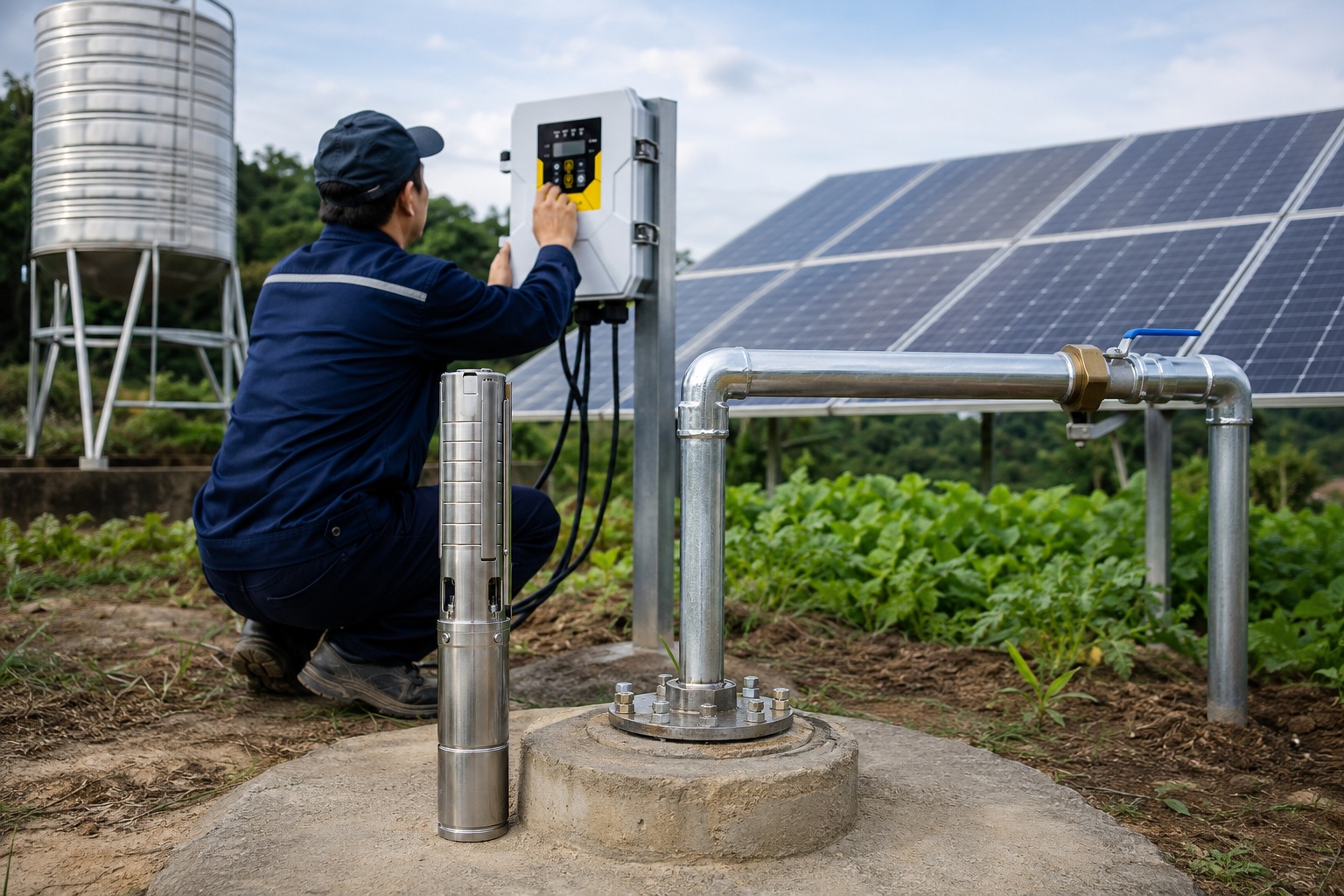
Solar pumps offer a silent, clean, and cost-effective solution that works anywhere the sun shines.
The global demand for submersible pumps is projected to reach over $30 billion by 2034, driven by the need for sustainable water management. Solar pumps are at the forefront of this trend, offering grid-independence, zero running costs, and environmental benefits that make them ideal for modern applications.
As the world pivots toward clean energy, solar water pump technology has matured into a powerful and reliable solution.
These systems are no longer a niche product for eco-enthusiasts.
They are essential infrastructure for agriculture, livestock, and domestic water supply in regions across Africa, the Americas, Australia, and Asia.
The core of this revolution is a combination of advanced pump design and hyper-efficient motor technology.
Let's explore the market trends and the powerful motor driving this change.
The Market Outlook for Sustainable Water Solutions
The data speaks for itself.
The global submersible pump market is experiencing explosive growth.
Industry research reports a market valuation of over $17 billion in 2025, with projections soaring past $30 billion by 2034.
This isn't just a number; it represents a global shift in how we manage water.
The Asia-Pacific region is a major driver, accounting for nearly 40% of the market share and tracking a compound annual growth rate (CAGR) of 11.44%.
This growth is fueled by rising needs for effective water management in agriculture and developing municipal infrastructure.
End-users, distributors, and project managers increasingly view high-quality submersible pumps not as disposable equipment, but as long-term assets.
This rising expectation for quality and sustainability puts solar-powered systems directly in the spotlight.
The Power Behind the Pump: The BLDC Motor
The true hero of the modern solar pump is the Brushless DC (BLDC) permanent magnet motor.
This is the core technology that makes solar water pumping not just possible, but highly competitive.
Unlike traditional AC motors, BLDC motors are engineered for maximum efficiency.
These motors regularly achieve efficiencies exceeding 90%.
The rotor is constructed from high-grade 40SH neodymium iron boron magnets, delivering powerful torque in a compact form.
This advanced design results in a motor that is up to 47% smaller and 39% lighter than a conventional motor of equivalent power.
For end-users, this translates into significant real-world benefits.
The high efficiency means the pump system requires fewer solar panels to operate, reducing the initial investment by 15-25%.
The smaller size and lighter weight simplify transportation and installation, especially in remote locations.
Finally, the brushless design eliminates the most common failure point in traditional motors, offering a maintenance-free, long-service-life solution.
| Feature | BLDC Permanent Magnet Motor | Traditional AC Motor |
|---|---|---|
| Efficiency | > 90% | 65-75% |
| Power Source | DC (Ideal for Solar) | AC (Requires Inverter for Solar) |
| Maintenance | None (Brushless) | Requires brush replacement |
| Size & Weight | Compact & Lightweight | Larger & Heavier |
| Lifespan | Long (15+ years) | Shorter |
A Competitive Portfolio: Matching the Pump to the Application
Your water needs are unique, but the market offers a confusing array of pump types.
Choosing the wrong model means you either get insufficient water or pay for performance you don't need.
Understanding the three main solar pump types allows you to build a perfect, cost-effective system.
A competitive solar pump portfolio includes three main types: the solar screw pump for low flow and high head, the plastic impeller pump for high flow and general use, and the stainless steel impeller pump for durability in corrosive water. Each is powered by the same efficient BLDC motor.
There is no single "best" pump, only the best pump for a specific job.
A well-designed product portfolio addresses a wide spectrum of water challenges, from providing drinking water for a single home to irrigating an entire farm.
By pairing different pump end designs with a universal high-efficiency motor, manufacturers can offer tailored solutions that are both effective and economical.
This strategy empowers distributors to meet diverse market demands and gives end-users a reliable water supply optimized for their environment.
Let's examine how each pump type fits into this versatile system.
The Solar Screw Pump: For Low Flow and High Head
The solar screw pump, also known as a progressive cavity pump, is a specialist for deep wells.
It operates using a single helical stainless steel rotor that turns inside a flexible rubber stator.
This action creates sealed cavities that move water upward through compression.
The result is a pump that delivers a relatively low flow rate but can achieve a very high head, or lifting height.
This makes it the ideal choice for domestic water supply and livestock watering in areas with deep water tables, such as parts of Africa and Latin America.
A key advantage is its exceptional resistance to sand and grit.
The gentle pushing action is far less susceptible to wear from abrasives than the high-speed spinning of centrifugal impellers.
Its primary limitation is flow rate, making it unsuitable for large-scale irrigation.
The Solar Plastic Impeller Pump: For High Flow and Wear Resistance
This is the workhorse of the solar pump world.
It is a multi-stage centrifugal pump equipped with durable, wear-resistant plastic impellers.
It is designed to deliver a high flow rate at a medium head.
This makes it perfectly suited for applications like farm irrigation, pasture water supply, and filling residential water tanks where volume is the priority.
Its lightweight construction and economical price point make it a popular choice across Africa and the Americas.
The engineered plastic impellers offer excellent resistance to fine sand, outperforming many lower-grade metal impellers in abrasive conditions.
However, its durability may be compromised in highly corrosive water or at extreme well depths where pressure and stress are higher.
The Solar Stainless Steel Impeller Pump: For Premium Quality and Corrosion Resistance
When durability is paramount, the stainless steel impeller pump is the answer.
This premium model features impellers, diffusers, and a pump body all constructed from SS304 or higher-grade stainless steel.
It is specifically designed to operate in challenging water conditions.
This includes acidic or alkaline water, which would quickly degrade lesser materials.
It's the go-to solution for geothermal applications, coastal areas with saltwater intrusion, and regions with alkaline soils, such as parts of Australia and the Americas.
While offering similar high-flow, medium-to-high head performance as the plastic impeller model, its primary advantage is its superior corrosion resistance and extended service life.
This premium construction comes at a higher initial cost and weight, positioning it for high-end residential, critical infrastructure, and specialized agricultural markets.
| Pump Type | Flow Rate | Head | Sand Resistance | Best For |
|---|---|---|---|---|
| Solar Screw Pump | Low | Very High | Excellent | Deep domestic wells, livestock watering |
| Plastic Impeller Pump | High | Medium | Good | Farm irrigation, high-volume needs |
| Stainless Steel Impeller Pump | High | Medium-High | Good | Corrosive water, premium applications |
The Hidden Cost of "Budget" Pumps vs. Long-Term Value
You're tempted by a pump that costs hundreds of dollars less upfront.
But that "deal" turns into a nightmare when the pump fails in just five years.
You're now facing a $2,000 labor bill for replacement, erasing all initial savings.
The true cost of a pump is not its purchase price but its total cost of ownership over 20 years. A cheap $400 pump that fails every 5 years can cost over $7,000 in replacements and labor, while a quality $1,200 pump lasting 20 years costs only $2,700 total.
Experienced well owners and contractors understand a fundamental truth: you get what you pay for.
Budget pumps, often found at big-box hardware stores, achieve their low price point by cutting corners.
They use lower-grade materials, less precise manufacturing, and cheaper motor components.
While they may work fine initially, they are not built for the demanding, 24/7 environment 200 feet underground.
The real savings come from investing in quality, reliability, and efficiency from day one.
Let's do the math and see why a premium pump is almost always the cheaper option in the long run.
Calculating the 20-Year Cost
The math is simple but powerful.
Consider a typical 300-foot well, where the labor cost to pull and replace a pump is around $1,500.
Scenario 1: The "Budget" Pump
- Pump Price: $400
- Expected Lifespan: 5 years
- Labor Cost per Replacement: $1,500
- Over a 20-year period, you will replace this pump four times.
- Total Cost = (4 x $400 pump) + (4 x $1,500 labor) = $1,600 + $6,000 = $7,600
Scenario 2: The "Quality" Pump
- Pump Price: $1,200
- Expected Lifespan: 20 years
- Labor Cost for Installation: $1,500
- Over a 20-year period, you will install this pump once.
- Total Cost = (1 x $1,200 pump) + (1 x $1,500 labor) = $2,700
In this common scenario, the "expensive" quality pump saves you nearly $5,000 over two decades.
The deeper your well, the higher the labor cost, and the greater the savings from choosing a reliable pump.
Energy Efficiency's Impact on Your Wallet
Beyond replacement costs, energy consumption is a major factor in a pump's total cost of ownership.
This is especially true for solar-powered systems.
A high-efficiency pump does more work with less power.
Premium European-engineered pumps and modern BLDC-powered solar pumps can achieve operating efficiencies of 70-80% or even higher.
Standard or budget pumps often operate in the 65-70% range, and their efficiency degrades faster over time.
While a 10% efficiency difference may seem small, it has a huge impact on a solar-powered system.
A more efficient pump requires up to 25% fewer solar panels to achieve the same water output.
This directly reduces the system's upfront cost and complexity.
Over the pump's lifetime, this efficiency translates into more water delivered per day and better performance on cloudy days.
The Importance of Serviceability
Finally, consider what happens when a component does fail.
With high-quality systems, individual parts are often replaceable.
For example, a 3-wire motor design keeps the control box and start capacitor above ground.
If a capacitor fails, it's a simple, inexpensive fix.
On a 2-wire budget pump, the same failure requires pulling the entire pump from the well.
Likewise, top-tier manufacturers maintain extensive distribution networks, ensuring that replacement parts are readily available.
With obscure or budget brands, finding a specific part years down the line can be impossible, forcing a full system replacement.
Choosing a brand known for good technical support and parts availability is a crucial part of ensuring long-term value.
Maximizing Uptime with Intelligent Pump Controllers
Your solar pump works great on a sunny day, but what about clouds or at night?
Without an intelligent system, your water supply is at the mercy of the weather.
You need a solution that ensures water is available 24/7, regardless of conditions.
Modern pump systems use intelligent controllers to maximize efficiency and protect the equipment. An MPPT controller boosts solar energy utilization by up to 30%, while advanced AC/DC hybrid controllers guarantee a 24/7 water supply by automatically switching between solar and grid power.
The submersible pump and motor are only two-thirds of a complete, modern water system.
The third, and arguably most important, component is the brains of the operation: the pump controller.
An intelligent controller transforms a simple pump into a smart, self-regulating, and self-protecting water delivery machine.
It optimizes energy use, safeguards the motor from damage, and provides the flexibility to ensure you have water whenever you need it.
Let's look at the key technologies that make this possible.
The Role of the MPPT Controller
For any solar-powered system, a Maximum Power Point Tracking (MPPT) controller is essential.
Solar panels have a non-linear output that varies with sunlight intensity and temperature.
An MPPT controller is a sophisticated DC-to-DC converter that continuously monitors the panel's voltage and current.
It adjusts the electrical load to pinpoint the "maximum power point"—the ideal combination of voltage and current that yields the highest possible power output at any given moment.
A system with an MPPT controller can harvest 25-30% more energy from the same solar array compared to a system without one.
This means the pump can start earlier in the morning, run later in the evening, and perform better during overcast conditions, significantly increasing your daily water yield.
The Future is Hybrid: AC/DC Solutions
The ultimate solution for reliability is a hybrid AC/DC controller.
This technology eliminates the main limitation of solar power: its dependence on sunlight.
A hybrid controller is designed with two power inputs, allowing you to connect both solar panels and an AC power source (like the grid or a generator) simultaneously.
The controller's internal logic is programmed to prioritize solar power.
When the sun is shining, the pump runs entirely on free solar energy.
If clouds roll in and photovoltaic input drops, the controller automatically supplements the solar power with just enough AC power to maintain pump operation, maximizing the use of available solar energy.
When there is no solar input at all, such as at night, the controller seamlessly switches over to the AC source.
This ensures a worry-free, uninterrupted water supply 24 hours a day.
Built-in System Protections
A great controller also acts as a dedicated bodyguard for your pump and motor.
It integrates a suite of protection features that prevent the most common causes of premature pump failure.
- Dry-Run Protection: The controller monitors power consumption or uses water level sensors to detect when the well's water level drops too low. It automatically shuts off the pump to prevent it from running dry, which would quickly destroy the motor.
- Soft-Start: Instead of slamming the motor with full power instantly, the controller gradually ramps up the motor speed. This reduces mechanical stress on the pump and electrical stress on the motor windings, extending the life of both.
- Over-Temperature and Overload Protection: The controller monitors motor temperature and electrical current. If it detects a problem, like a jam or excessive load, it shuts the system down before permanent damage can occur.
Conclusion
The best pump is a complete system: the right pump type for the job, powered by an efficient motor, and managed by an intelligent controller for ultimate reliability and value.
Frequently Asked Questions
What is the most reliable submersible well pump brand?
Reliability comes from premium engineering, not just a brand name. Top-tier pumps use superior materials like stainless steel and high-efficiency motors, offering lifespans of 15-25 years, far exceeding budget brands.
How long do submersible well pumps last by brand?
Premium pumps can last 15-25 years. Mid-range models typically last 10-15 years, while budget brands often fail in just 5-8 years, especially in wells with sand or minerals.
Is a more expensive well pump worth it?
Yes. A more expensive, higher-quality pump saves thousands over its lifetime by avoiding multiple costly replacements and consuming less energy. The total cost of ownership is much lower.
What horsepower well pump do I need?
This depends on your required flow rate (GPM) and total lift height (TDH). Most residential homes are well-served by a ½ to 1½ horsepower pump.
What is the difference between a 2-wire and 3-wire submersible pump?
A 3-wire pump has its starting components in a control box above ground, making repairs easier. A 2-wire pump's components are sealed inside the motor, requiring the pump to be pulled for service.
Can a submersible pump run on solar power?
Absolutely. Modern solar pumps use highly efficient brushless DC (BLDC) motors and MPPT controllers to provide reliable, off-grid water solutions for homes, farms, and livestock worldwide.
How many solar panels does it take to run a well pump?
The number depends on the pump's power (HP or Watts), the well depth, and your location's daily sunlight. A typical ½ HP residential solar pump might require 4 to 6 panels (around 1.2-1.8 kW).
What maintenance does a submersible well pump require?
High-quality submersible pumps are designed to be virtually maintenance-free. Systems with brushless motors and intelligent controllers that protect against dry running and overload require the least attention.