Struggling to find a reliable water pump for your well?
You need a dependable solution, but the market is flooded with options, making it hard to choose.
The best submersible pump isn’t a specific brand, but a category: one that perfectly matches your well’s depth, water needs, and power source. A 5-star rating comes from pairing a high-efficiency motor with the right pump type (screw, plastic impeller, or stainless steel) for optimal performance and longevity.
Finding the "perfect" pump can feel overwhelming.
However, a 5-star experience is achievable when you understand the core components that define a high-quality system.
It's less about a brand name and more about a precise match between technology and application.
This guide will break down the essential factors, from pump mechanics to motor efficiency, so you can identify a truly top-rated solution for your customers or your own property.
Let's dive into what makes a submersible pump worthy of five stars.
What is a Submersible Pump and How Does It Work?
Your customers complain about noisy, inefficient surface pumps.
They need a quiet, powerful, and reliable way to get water from their deep wells.
A submersible pump is a device placed completely inside a liquid, like a well. It works by pushing water to the surface, rather than pulling it. This design makes it quieter, more efficient for deep applications, and prevents common issues like cavitation that plague surface pumps.
To truly grasp why submersible pumps are superior for many applications, we need to look under the hood.
Unlike surface pumps that fight against gravity and atmospheric pressure to suction water up, a submersible pump uses a more direct and efficient method.
It uses its submerged position to its advantage.
How The Pushing Mechanism Works
A submersible pump operates on a simple yet powerful principle.
Water first enters the pump through an intake screen, often called a foot valve.
This screen filters out large debris that could damage the internal components.
From there, the water flows into the pump's core, where it encounters a series of impellers.
An impeller is a rotor with fixed blades, connected to the motor via a shaft.
As the motor spins the shaft, the impellers rotate at high speed.
The rotating blades transfer kinetic energy to the water, significantly increasing its velocity.
From Speed to Pressure
After leaving the impeller, the high-speed water enters a stationary component called a diffuser.
The diffuser is cleverly designed to slow the water down.
According to the principles of fluid dynamics, as the water's velocity decreases, its pressure energy must increase.
This conversion process is the key to the pump's power.
It effectively transforms the motor's rotational energy into the high pressure needed to lift water hundreds of feet to the surface.
This process can be repeated through multiple stages (a stack of impellers and diffusers) to achieve even higher pressures for very deep wells.
| Component | Function | Benefit |
|---|---|---|
| Foot Valve | Initial water intake and filtration | Protects internal parts from debris. |
| Impeller | Rotates to increase water speed | Converts motor energy into kinetic energy. |
| Diffuser | Slows water to build pressure | Converts kinetic energy into pressure energy. |
| Motor | Powers the rotation of the impeller | The engine of the entire pump system. |
This multi-stage design is why submersible pumps are the go-to solution for deep well applications, easily outperforming jet pumps and other surface-level technologies.
They are inherently self-priming because they are already submerged in water, eliminating a common and frustrating failure point of surface pumps.
Understanding the Key Specifications for a Top-Rated Pump
Choosing a pump based on brand alone leads to costly mistakes.
A mismatched pump will either underperform or burn itself out, leading to unhappy customers.
To find a top-rated pump, focus on three key specs: Flow Rate (GPM) to meet demand, Total Dynamic Head (TDH) to overcome elevation and friction, and Motor Efficiency to minimize operating costs. A high-efficiency motor can reduce energy needs by over 30%, a crucial factor in solar applications.
A 5-star pump isn't just about build quality; it's about performance tailored to a specific job.
Understanding the numbers on a spec sheet is the first step toward selecting a pump that will operate efficiently and reliably for years.
These specifications are the language of water movement, and learning to speak it will empower you to make an expert choice.
Flow Rate (Gallons Per Minute - GPM)
Flow rate is the volume of water the pump can move in a given amount of time.
It's the most straightforward measure of a pump's output.
Calculating the required GPM is critical.
A typical home might require 10-15 GPM for daily use, but this can increase significantly with irrigation systems or livestock operations.
Underestimating GPM leads to weak water pressure and an inability to run multiple fixtures at once.
Overestimating is also a problem, as an oversized pump will cycle on and off too frequently (short-cycling), leading to premature motor burnout.
| Application | Typical GPM Requirement |
|---|---|
| Small Home (1-2 bathrooms) | 8-12 GPM |
| Large Home (3+ bathrooms) | 15-25 GPM |
| Small-Scale Irrigation | 5-10 GPM per zone |
| Livestock Watering | 2-5 GPM per trough |
Total Dynamic Head (TDH)
TDH is the total equivalent height that water must be lifted, considering both the vertical distance and the friction loss from pipes and fittings.
It is the measure of total pressure the pump must overcome.
TDH is calculated by adding the vertical lift (from the water level in the well to the highest outlet) to the friction loss.
Friction loss depends on the pipe diameter, length, and the number of bends or valves.
Failing to correctly calculate TDH is a common cause of pump failure.
If the TDH is higher than the pump's capacity, the pump will struggle to deliver water, operate inefficiently, and ultimately fail.
Motor Power and Efficiency
The motor is the heart of the submersible pump.
Its horsepower (HP) determines its raw strength, but its efficiency determines its running cost.
Traditional AC motors have efficiencies around 60-75%.
However, modern solar pumps utilize advanced Brushless DC (BLDC) permanent magnet motors.
These motors boast efficiencies exceeding 90%.
This leap in efficiency is transformative.
A high-efficiency BLDC motor can reduce the number of solar panels required by 25-40%, dramatically lowering the initial system cost.
The rotor is made of high-grade neodymium iron boron, making the motor about 47% more compact and 39% lighter than a traditional motor of the same power output.
This makes installation easier and reduces shipping costs, a significant benefit for distributors.
A Look at Different Types of Submersible Pumps
Customers have diverse needs, from deep wells to large farms.
Offering a one-size-fits-all pump solution limits your market and fails to provide the best value.
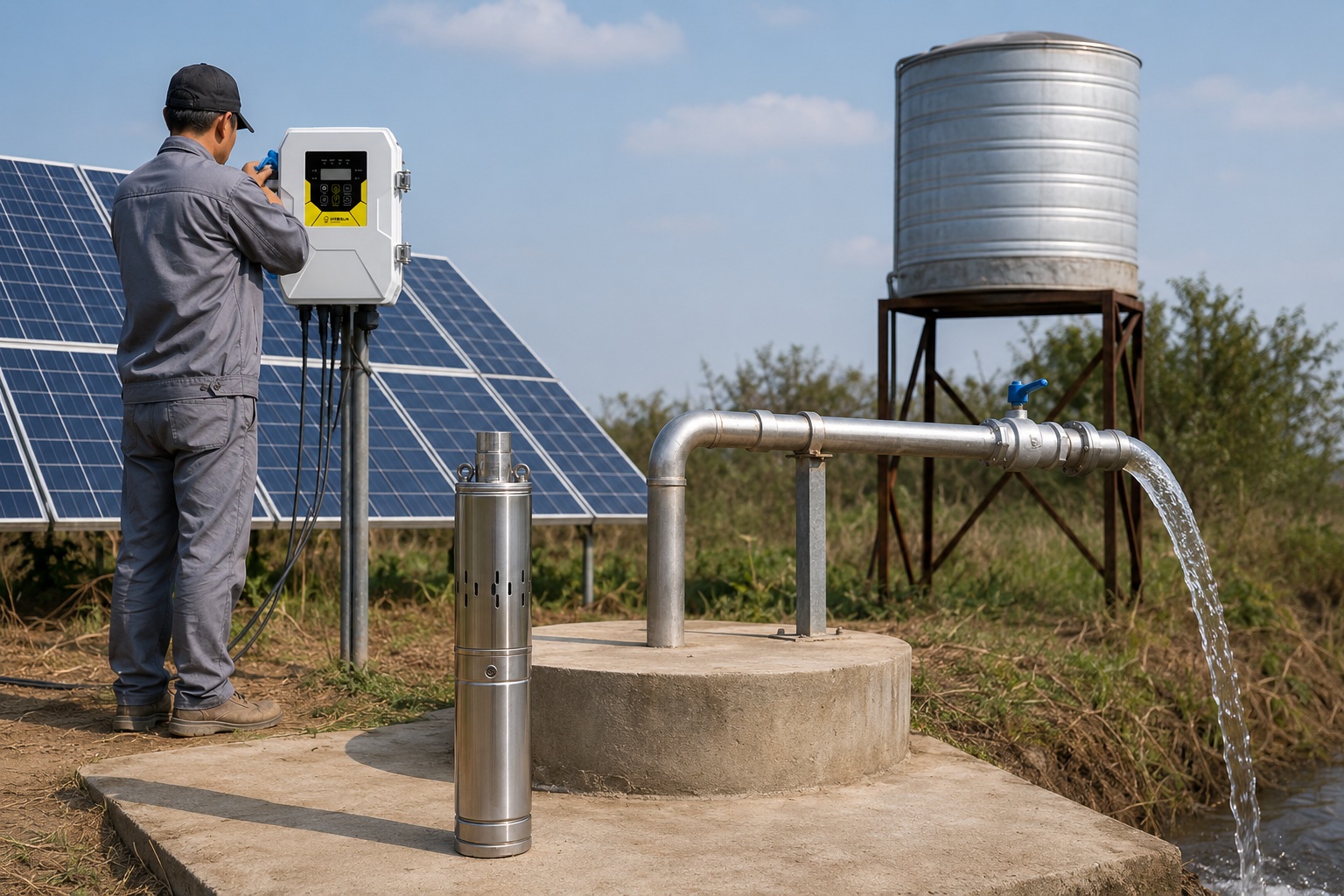
A successful product line includes specialized pumps. Solar screw pumps offer high head for deep wells. Plastic impeller pumps provide high flow for irrigation. Stainless steel impeller pumps ensure durability in corrosive water. This portfolio covers over 95% of off-grid water needs.
The key to a 5-star rating is not finding a single "best" pump, but understanding which pump type is best for a specific scenario.
With the rise of sustainable agriculture and off-grid living, solar-powered deep well pumps have emerged as a critical technology.
Let's explore the three core types that form a comprehensive and competitive product portfolio.
The Solar Screw Pump: For High Head, Low Flow Needs
This pump type is a workhorse for deep wells.
It uses a positive displacement mechanism, where a helical stainless steel rotor (the "screw") turns inside a flexible rubber stator.
This action creates sealed cavities of water that are pushed progressively up towards the outlet.
This design is less about speed and more about power.
It generates immense pressure, allowing it to lift water from extreme depths where other pumps would fail.
Its main advantage is its ability to deliver a consistent, albeit low, flow rate against a very high head.
It is also highly resistant to sand and sediment, as the screw mechanism can handle abrasive particles better than delicate impellers.
This makes it ideal for newly drilled wells or areas with challenging water quality.
| Feature | Solar Screw Pump |
|---|---|
| Mechanism | Positive Displacement (Screw) |
| Best For | High Head, Low Flow |
| Max Head | Up to 600+ feet |
| Max Flow | ~5-10 GPM |
| Sand Resistance | Excellent |
| Primary Use | Deep domestic wells, livestock drinking |
The Solar Plastic Impeller Pump: For High Flow and General Use
This is a multi-stage centrifugal pump.
It uses a series of rotating impellers made from durable, wear-resistant engineering plastic.
Each impeller-and-diffuser stage adds pressure to the water, but the design is optimized to move a large volume of water.
This pump is the go-to choice for applications requiring high flow rates at moderate depths, such as farm irrigation, pasture water supply, and filling storage tanks.
The use of plastic impellers makes the pump lightweight and more economical than its stainless steel counterpart.
Modern engineering plastics offer excellent resistance to fine sand and abrasion, providing a long service life in most water conditions.
It represents a perfect balance of performance and cost-effectiveness for a wide range of agricultural and residential uses.
The Solar Stainless Steel Impeller Pump: For Durability and Special Conditions
This pump is the premium option in the centrifugal pump category.
It functions similarly to the plastic impeller model but uses impellers, diffusers, and a pump body constructed from high-grade SS304 or SS316 stainless steel.
This construction gives it superior resistance to corrosion.
It is specifically designed for use in harsh water environments, such as those with acidic or alkaline pH levels, high salinity, or other corrosive elements.
While it comes at a higher initial cost and weight, its longevity and reliability in these challenging conditions are unmatched.
This makes it the best choice for coastal regions, areas with alkaline soil, or high-end properties where water quality is a concern and long-term durability is the top priority.
| Pump Type | Best Use Case | Material | Key Advantage |
|---|---|---|---|
| Screw Pump | Deep Wells (>300 ft) | Stainless Steel Screw | High Head & Sand Resistance |
| Plastic Impeller | Farm Irrigation | Engineering Plastic | High Flow & Cost-Effective |
| Stainless Impeller | Corrosive Water | SS304/SS316 Steel | Corrosion Resistance & Durability |
The Engine Driving Performance: Why the Motor Matters Most
Your customers see a pump, but they don't see the engine inside.
Focusing only on the pump's "wet end" means ignoring 50% of the performance equation.
The heart of a 5-star solar pump is its motor. A high-efficiency Brushless DC (BLDC) permanent magnet motor, with an efficiency over 90%, is the core of the system. It reduces solar panel costs by up to 40%, simplifies installation, and ensures a longer, maintenance-free service life.
In the world of solar pumping, the motor is not just a component; it is the strategic center of the entire system.
The pump's wet end (screws or impellers) determines the type of work it can do, but the motor determines how efficiently and reliably it does that work.
Understanding the motor's value is crucial for any distributor aiming to offer a genuinely superior product.
What is a BLDC Permanent Magnet Motor?
A Brushless DC (BLDC) motor is a leap forward from older brushed DC or standard AC motors.
Instead of using friction-creating brushes to transfer power, it uses an electronic controller.
The "permanent magnet" part is also key.
The rotor is constructed with powerful, high-grade rare-earth magnets (like 40SH neodymium iron boron).
This design eliminates energy losses associated with electromagnets used in other motor types.
The result is a motor that is incredibly efficient, compact, and reliable.
The Technical Edge: Efficiency and Power
The numbers speak for themselves.
A typical AC motor might achieve 75% efficiency on a good day, meaning 25% of the energy is wasted as heat.
A BLDC permanent magnet motor consistently operates at over 90% efficiency.
This 15%+ efficiency gain has a massive ripple effect across the entire solar-powered system.
| Motor Type | Typical Efficiency | Key Feature | Weakness |
|---|---|---|---|
| Standard AC Motor | 60-75% | Widely available | Inefficient, heavy |
| Brushed DC Motor | 75-80% | Simple controls | Brushes wear out, maintenance |
| BLDC Motor | >90% | Highly efficient, long life | Requires electronic controller |
This higher efficiency means the motor can produce the same power while consuming significantly less energy.
This directly translates to needing fewer solar panels to run the pump.
For an end-user, this can mean a 25-40% reduction in the upfront cost of the solar array, which is often the most expensive part of the installation.
Furthermore, these motors are designed to be 47% smaller and 39% lighter than traditional motors of equivalent power.
This makes them easier and cheaper to ship, handle, and install.
The Strategic Advantage for Your Business
For a distributor, offering pumps with BLDC motors is a powerful competitive advantage.
You are not just selling a pump; you are selling a more cost-effective, reliable, and technologically advanced system.
You can market the benefits of lower initial costs (fewer panels), zero maintenance (no brushes to replace), and a longer service life.
The motor is the core technology that enables a brand to build a reputation for efficiency, durability, and environmental friendliness.
It is the silent hero that gives a submersible pump its 5-star rating.
How to Choose the Right Submersible Pump for Your Needs
Customers are confused by technical specs and risk buying the wrong pump.
This leads to returns, complaints, and damage to your reputation as a reliable supplier.
Guide your customers through a simple 4-step process: 1) Calculate water demand (GPM), 2) Determine total lift and friction (TDH), 3) Assess water quality to choose the right material, and 4) Consider a hybrid AC/DC power system for 24/7 reliability.
Selecting the right submersible pump is a methodical process, not a guessing game.
By breaking it down into logical steps, you can ensure that the chosen pump is not just a good pump, but the right pump for the job.
This systematic approach empowers you to advise your customers with confidence and helps them make an investment that will pay off for years to come.
Step 1: Calculate Your Water Demand (GPM)
The first step is to quantify the need.
This involves creating a water usage budget.
List all fixtures and applications that will draw water simultaneously during peak use.
A home's peak demand is typically in the morning when showers, toilets, and kitchen sinks might be used at the same time.
For agricultural use, it's about how many acres need irrigation or how many head of livestock need water.
Add up the GPM requirements for this peak scenario, then add a 20% buffer to ensure the system is never strained.
This final number is your target flow rate.
Step 2: Determine Your Total Dynamic Head (TDH)
This is the most technical, yet most critical, step.
First, measure the static water level in the well (the level when the pump is off).
Then, measure the pumping water level (the level after the pump has been running for an hour).
The vertical lift is the distance from the pumping water level to the highest point of use (e.g., a storage tank or a second-floor shower).
Next, calculate friction loss.
This depends on the flow rate, pipe diameter, and total pipe length, including all bends and fittings.
Online calculators or charts from pipe manufacturers are essential for this calculation.
TDH = Vertical Lift + Friction Loss.
Once you have your target GPM and TDH, you can consult a pump's performance curve to see if it's a good match.
You want your operating point to fall within the pump's Best Efficiency Point (BEP) range, typically between 70% and 120% of the central BEP.
Step 3: Assess Your Water Quality
Water is not always pure H₂O.
It can contain sand, silt, or have a pH that is acidic or alkaline.
A water quality test is a small investment that can save you from a costly pump failure.
If the water is sandy, a screw pump or a pump with high-quality abrasion-resistant impellers is necessary.
If the water is corrosive (low or high pH), a pump with a stainless steel body and impellers (SS304 or even SS316) is the only long-term solution.
Choosing a pump without considering water quality is like building a house without checking the foundation.
Step 4: Consider the Power Source and Control System
For solar pumps, the power source is the sun.
But what happens on cloudy days or at night?
This is where advanced controllers become invaluable.
A standard MPPT (Maximum Power Point Tracking) controller optimizes the output from the solar panels to the motor.
A more advanced hybrid AC/DC controller offers the ultimate in reliability.
This system can be connected to both solar panels and an AC power source (grid or generator) simultaneously.
The controller will prioritize solar power, automatically blending in or switching to AC power when sunlight is insufficient.
This ensures a worry-free, 24/7 water supply, making it an excellent selling point for critical applications.
| Step | Action | Why It's Important |
|---|---|---|
| 1. Demand | Calculate peak GPM + 20% buffer. | Prevents low pressure and short-cycling. |
| 2. TDH | Calculate vertical lift + friction loss. | Ensures the pump can deliver water efficiently. |
| 3. Water Quality | Test for sand and corrosiveness. | Determines the required pump materials for longevity. |
| 4. Power | Choose a controller (MPPT or Hybrid). | Maximizes energy use and ensures 24/7 reliability. |
Conclusion
A 5-star pump matches high-efficiency motor technology with the correct pump type for your specific head, flow, and water quality needs, ensuring optimal performance and long-term value.
FAQs
What is the best horsepower for a submersible pump?
Most homes need a pump between ½ to 1½ HP. The right choice depends on your well's depth and your water demand, not just horsepower alone.
How long do submersible well pumps last?
A quality submersible pump can last 8 to 15 years. Longevity depends heavily on correct sizing, water quality, and consistent power supply, with some models lasting over 20 years.
Can a submersible pump run dry?
No, running dry will quickly destroy a submersible pump. Many modern pumps, especially solar models, include built-in dry-run protection to automatically shut off the motor when water levels are too low.
How deep should a submersible pump be?
The pump should be submerged at least 10-20 feet below the lowest expected water level (the pumping water level), but at least 5-10 feet above the bottom of the well to avoid sucking up sediment.
Are 2-wire or 3-wire submersible pumps better?
A 3-wire pump is generally better for serviceability. Its starting components are in a control box above ground, making troubleshooting and repairs easier and cheaper than a 2-wire pump with sealed internal components.
What maintenance does a solar submersible pump require?
Solar pumps with BLDC motors are virtually maintenance-free as they have no brushes to wear out. Periodic cleaning of solar panels is the main maintenance task required to ensure optimal performance.
How many solar panels do I need for a submersible pump?
This depends on the pump's power (wattage) and your location's daily sunlight hours. A high-efficiency pump will require fewer panels, significantly reducing the total system cost. Always consult a sizing calculator.
Can I use a solar pump with my existing AC power?
Yes, by using a hybrid AC/DC controller. This device allows the pump to run on solar power when available and automatically switch to AC grid or generator power when it's cloudy or dark.