Struggling to find a reliable pump?
The wrong choice leads to costly downtime and repairs, jeopardizing your entire operation.
The "best" pump isn't about a single brand. It's about matching technology to your need. Global leaders like Grundfos and Wilo excel in industrial applications, while specialized solar pumps are best for off-grid water solutions, focusing on motor efficiency and pump type (screw vs. impeller).
While giant corporations dominate headlines, the true answer is more complex.
It depends on your specific needs, from large-scale industrial processing to providing water in remote, off-grid locations.
Understanding the strengths of different manufacturers and technologies is the key.
Let's explore what truly defines the best pump for you.
What Defines the Top Pump Manufacturers in 2026?
Choosing a pump manufacturer feels overwhelming.
You need reliability, but how do you measure it against innovation and cost?
Top manufacturers are defined by more than just sales figures. Key indicators include a global service network, extensive manufacturing experience, strict adherence to international certifications (like CE, CSA, TÜV), and a deep specialization in specific applications, from industrial slurry to residential water supply.
Selecting a pump manufacturer is a long-term strategic decision, not just a one-time purchase.
The right partner provides a product that works and support that ensures it continues to work for years.
When evaluating potential suppliers, it's crucial to look beyond the price tag and assess the foundational pillars that signify a top-tier company.
These criteria separate the market leaders from the rest, ensuring you receive value, reliability, and peace of mind.
Product Reliability and Manufacturing Experience
A manufacturer's history is a testament to its staying power.
Companies with decades of experience have navigated countless technological shifts and economic cycles.
This longevity often translates into refined manufacturing processes, robust quality control systems, and a deep understanding of material science.
For instance, a pump manufacturer with over 35 years of export experience has likely perfected its supply chain and quality assurance to meet diverse international standards.
Reliability is proven through rigorous testing.
Top manufacturers subject their pumps to extreme conditions, such as:
- 144+ hours of salt spray testing to ensure corrosion resistance.
- 1000+ hours of UV resistance testing for components exposed to sunlight.
- Durability testing that simulates years of continuous operation.
This commitment to quality ensures the pump you buy today will perform reliably for its entire service life.
Global Service Network and Certifications
A great product is only useful if it's supported.
A strong global service network means you have access to spare parts, technical support, and expert advice, no matter where your project is located.
For distributors, this is a critical factor, as it ensures they can support their own customers effectively.
International certifications are non-negotiable proof of quality and safety.
They are independent verifications that a product meets specific, stringent standards.
| Certification | Region/Focus | What It Guarantees |
|---|---|---|
| CE | European Union | Product meets EU safety, health, and environmental protection requirements. |
| CSA | North America | Product has been tested and meets applicable safety and performance standards. |
| TÜV | Germany/Global | Signifies safety, quality, and reliability, often for industrial equipment. |
| RoHS | European Union | Restricts the use of specific hazardous materials in electrical products. |
When a manufacturer holds multiple certifications, it demonstrates a commitment to global best practices and broad market compliance.
Application Specialization
The best manufacturers know they can't be everything to everyone.
They focus on specific applications and engineer their products to excel in those niches.
A company specializing in heavy-duty slurry pumps for mining will have different expertise than one focusing on high-efficiency circulator pumps for residential HVAC systems.
Understanding a manufacturer's specialization helps you find a true expert.
If you need a pump for agricultural irrigation in an off-grid location, a specialist in solar water pumps will offer a more suitable and efficient solution than a general industrial supplier.
This focus drives innovation and results in products that are perfectly tailored to their intended use.
A Look at the Global Leaders: The Titans of Industry
Big names dominate the pump market.
But are their products always the best fit for every single job?
Industry titans like Grundfos (Denmark), Wilo (Germany), and Franklin Electric (USA) are renowned for their advanced engineering, energy efficiency, and vast product ranges. They lead in areas like HVAC, municipal water supply, and groundwater pumping, setting global standards for quality and innovation.
The global pump industry is spearheaded by a handful of companies that have built their reputations over decades, some for over a century.
These manufacturers are not just producers; they are innovators, setting the technological and sustainability standards that the rest of the industry follows.
Their massive R&D budgets, global manufacturing footprints, and extensive distribution networks give them a significant competitive advantage.
Let's examine some of these titans and understand what makes them leaders.
European Powerhouses: Grundfos and Wilo
Europe is home to some of the oldest and most respected pump manufacturers in the world.
Grundfos, founded in Denmark in 1945, is arguably the largest pump manufacturer globally, producing over 16 million pump units annually.
They are pioneers in energy-efficient technologies and intelligent water solutions, particularly famous for their circulator pumps in HVAC systems and their powerful submersible pumps for groundwater.
Wilo, a German company with roots dating back to 1872, is another giant.
Wilo excels in creating smart pump systems that integrate digital monitoring and building automation.
Their focus on high-efficiency solutions for building services, water management, and industrial applications has made them a go-to choice for engineers focused on sustainability and operational savings.
American Innovators: Franklin Electric and Xylem
The United States has also produced major players in the pump industry.
Franklin Electric, founded in 1944, is a leader in groundwater and fuel transfer systems.
They revolutionized deep well pumping with their development of reliable submersible motors, a technology that remains a core part of their business.
Their products are known for their ruggedness and are a staple in residential, agricultural, and municipal water systems.
Xylem, a more recent but powerful entity formed in 2011, operates some of the most well-known brands in the water world, including Goulds Water Technology and Flygt.
Xylem focuses on the entire water cycle, from transport and treatment to analysis.
They are at the forefront of integrating IoT and data analytics into water management, offering "smart water" solutions that optimize performance and reduce waste.
Comparing the Titans
While these companies compete, they each have distinct areas of strength.
Choosing between them often depends on the specific application and regional support available.
| Company | Country | Key Strength | Primary Applications |
|---|---|---|---|
| Grundfos | Denmark | Energy-efficient smart pumps, circulators | HVAC, Municipal Water, Industrial |
| Wilo | Germany | High-efficiency systems, building automation | Building Services, Water Management |
| Franklin Electric | USA | Submersible motors, groundwater systems | Groundwater, Agricultural Irrigation |
| Xylem | USA | Complete water technology solutions, IoT | Wastewater, Dewatering, Treatment |
| KSB | Germany | High-performance centrifugal pumps, valves | Industrial, Energy Sector, Water Transport |
| Flowserve | USA | Heavy-duty pumps for extreme conditions | Oil & Gas, Power Generation, Chemical |
These titans drive the industry forward, but their scale means their solutions are often geared toward large infrastructure projects or established markets.
This has created an opportunity for more specialized manufacturers to thrive by addressing needs that the giants may overlook.
The Rise of Specialized Solutions: Meeting Diverse Water Needs
What if your water source is deep, sandy, or off-grid?
A standard industrial pump won't work for you.
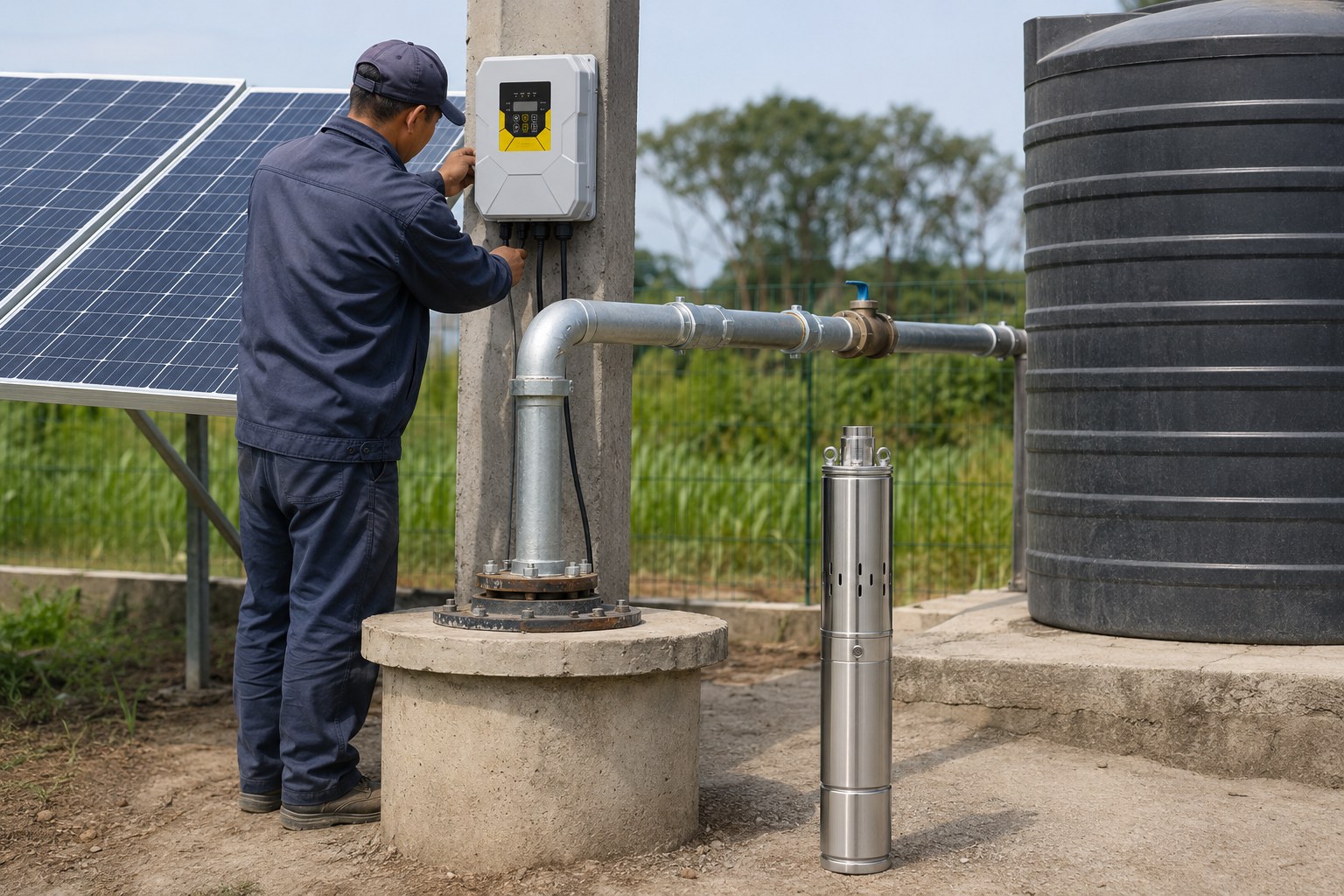
The future is specialized. For off-grid areas, solar deep well pumps are the solution. They are categorized by mechanism: solar screw pumps for high head, plastic impeller pumps for high flow and wear resistance, and stainless steel impeller pumps for corrosive water conditions, each meeting a specific need.
While global giants cater to massive industrial and municipal needs, a new generation of challenges demands specialized solutions.
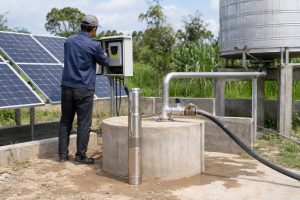
With growing demand for sustainable water access in off-grid regions across Africa, the Americas, and Asia, solar water pumps have emerged as a critical technology.
They operate independently of any power grid, offering a clean, cost-effective, and reliable water source.
The "best" pump here is not a single brand, but the right technology for the specific well and water conditions.
The Solar Screw Pump: Low Flow, High Head Champion
For very deep wells where water needs to be lifted a great distance, the solar screw pump is often the ideal choice.
This pump doesn't use impellers.
Instead, it uses a single stainless steel helical rotor (the screw) rotating inside a rubber stator.
This action creates sealed cavities that move progressively up the pump, pushing the water ahead of them.
This mechanism is highly efficient at creating pressure, allowing it to achieve a very high head (lifting height) even with a low flow rate.
| Feature | Specification | Application/Benefit |
|---|---|---|
| Mechanism | Progressive Cavity (Screw) | Generates high pressure efficiently. |
| Key Advantage | High Sand Resistance | Can handle water with a higher concentration of sand and silt without damage. |
| Best For | Deep wells (>100 meters) | Ideal for domestic water supply and livestock watering from deep aquifers. |
| Limitation | Low Flow Rate | Not suitable for applications requiring large volumes of water quickly, like large-scale irrigation. |
The Solar Plastic Impeller Pump: High Flow, High Value
When the goal is to move a large volume of water for applications like farm irrigation or filling a large tank, a multi-stage centrifugal pump is the answer.
The solar plastic impeller pump is a popular, cost-effective variant.
It uses a series of impellers made from durable, engineered plastics.
As water enters the pump, each impeller adds speed and pressure, pushing the water to the next stage.
The use of high-quality plastic impellers provides excellent wear resistance against fine sand and makes the pump lightweight and more affordable.
| Feature | Specification | Application/Benefit |
|---|---|---|
| Mechanism | Multi-stage Centrifugal | Delivers high flow rates at a medium head. |
| Key Advantage | High Water Output & Value | Provides the most water volume for its cost, ideal for irrigation. |
| Best For | Farm & Pasture Irrigation | Excellent for moving water from wells or reservoirs to crops and livestock. |
| Limitation | Lower Corrosion Resistance | Not ideal for highly acidic or alkaline water conditions compared to stainless steel. |
The Solar Stainless Steel Impeller Pump: The Premium Durability Choice
In environments where water is corrosive or when maximum durability is required, the solar stainless steel impeller pump is the top-tier option.
This pump functions similarly to the plastic impeller model but uses impellers, diffusers, and a pump body made from high-grade SS304 or SS316 stainless steel.
This construction provides superior resistance to corrosion from acidic or alkaline water, as well as abrasion from silt.
It is the most reliable choice for long-term installations in harsh water environments or for high-end residential applications where quality is paramount.
| Feature | Specification | Application/Benefit |
|---|---|---|
| Mechanism | Multi-stage Centrifugal | Delivers high flow and medium-to-high head with maximum durability. |
| Key Advantage | Superior Corrosion Resistance | Unmatched longevity in corrosive water, ensuring a long and stable service life. |
| Best For | Special Water Conditions | Essential for alkaline soils (common in Australia) or acidic water sources. |
| Limitation | Higher Initial Cost | The premium materials and construction result in a higher price point. |
The Unseen Hero: Why the Motor is the Heart of the System
You focus on the pump, but the motor is draining your budget.
An inefficient motor wastes energy and money daily.
The true game-changer in modern pumps, especially solar models, is the high-efficiency BLDC permanent magnet motor. With efficiencies exceeding 90%, these motors reduce the number of solar panels needed by up to 30%, drastically cutting initial costs and simplifying installation.
In any pump system, the pump head itself—the part that moves the water—is only half the story.
The motor is the engine that drives everything.
An inefficient motor not only wastes energy but also generates excess heat, reducing its own lifespan and potentially damaging other components.
In the world of solar pumping, where every watt of power is precious, motor efficiency is paramount.
This is where the Brushless DC (BLDC) permanent magnet motor has completely changed the game.
What Makes BLDC Motors Superior?
Traditional DC motors use carbon brushes to transmit power to the rotor, which are a point of friction, wear, and energy loss.
BLDC motors eliminate these brushes.
Instead, they use an electronic controller to switch the motor's phases, creating a rotating magnetic field that pulls the rotor around.
The rotor itself is made of high-strength permanent magnets, typically Neodymium Iron Boron (NdFeB), which create a powerful magnetic field without needing any electrical power.
This design results in several major advantages:
- Higher Efficiency: With no friction from brushes, efficiencies can exceed 90%, compared to 60-75% for brushed motors.
- Longer Lifespan: No brushes to wear out means the motor's life is limited only by its bearings, often exceeding 25,000 hours.
- Less Heat: Higher efficiency means less energy is wasted as heat, allowing the motor to run cooler and more reliably.
- Higher Torque: BLDC motors provide high torque from a standstill, which is crucial for starting a pump under load.
The Real-World Impact of High Motor Efficiency
A more efficient motor doesn't just save a little energy; it transforms the entire system's economics and practicality, especially for solar applications.
Consider the direct financial and logistical benefits:
| Motor Feature | Technical Advantage | Impact on Solar Pump System |
|---|---|---|
| Efficiency > 90% | Converts more electrical power into mechanical work. | Reduces solar panel requirement by up to 30%. This drastically lowers the initial system cost. |
| Compact & Lightweight | Higher power density means more power from a smaller size. Can be 47% smaller and 39% lighter than equivalent motors. | Simplifies installation and reduces shipping costs. One person can often install the pump without heavy equipment. |
| Maintenance-Free | No brushes to inspect or replace. | Lowers total cost of ownership. Critical for pumps installed in remote or hard-to-reach wells. |
| High Starting Torque | Delivers instant power to overcome inertia and water pressure. | Ensures reliable pump startup even in low-light conditions at the beginning and end of the day. |
Ultimately, the motor is the strategic core of the pump.
A high-quality pump head paired with a cheap, inefficient motor will result in a poor-performing, unreliable system.
Conversely, a top-tier BLDC motor elevates the performance of any pump head, ensuring you get the most water for every watt of energy produced.
Beyond the Pump: Smart Control and Hybrid Solutions
Your solar pump is great—until a cloud appears.
A lack of sun means a lack of water, disrupting your life.
Modern systems solve this with intelligent MPPT controllers that maximize solar energy by over 25%. For 24/7 reliability, AC/DC hybrid controllers automatically switch between solar and grid/generator power, ensuring an uninterrupted water supply, day or night, rain or shine.
A complete pumping solution is more than just a pump and motor.
The controller is the brain of the operation, managing the flow of power and protecting the system from damage.
In solar pumping, the controller plays an even more critical role by optimizing the variable power produced by solar panels and providing options for backup power.
A great pump system is one that you can install and forget, confident that it will deliver water whenever you need it.
Maximizing Every Ray of Sunshine: The Role of MPPT
Solar panels have an optimal operating point (a specific voltage and current) where they produce the maximum amount of power.
This "Maximum Power Point" changes constantly with sunlight intensity and temperature.
A simple controller connects the panels directly to the motor, which is rarely an optimal match.
An MPPT (Maximum Power Point Tracking) controller is a sophisticated DC-to-DC converter that constantly monitors the solar panels.
It adjusts its input to match the panels' maximum power point, then converts the output to the ideal voltage and current for the motor.
This intelligent matching can boost the energy harvested from your solar panels by 25-30% compared to systems without MPPT.
This means the pump can start earlier in the morning, run later in the evening, and maintain better performance under cloudy skies.
Ensuring 24/7 Water: The AC/DC Hybrid Advantage
The biggest limitation of a pure solar pump is that it only works when the sun is shining.
This is a problem for applications that require water at night or on consecutive rainy days.
The solution is an AC/DC hybrid controller.
This advanced controller is designed with two simultaneous power inputs: one for DC power from the solar panels and one for AC power from the electrical grid or a backup generator.
The system's logic is designed for maximum efficiency and convenience:
- Solar Priority: When the sun is shining, the controller will always prioritize and use the free power from the solar panels.
- Hybrid Function: If the sunlight is weak (e.g., during cloudy weather), but the pump needs more power, the controller can blend AC power with the available DC solar power. This maximizes the use of solar energy while ensuring the pump runs at the required speed.
- Automatic Switchover: When there is no solar input (e.g., at night or during heavy storms), the controller will automatically and seamlessly switch to the AC power source to keep the water flowing.
- No Manual Intervention: The controller handles all of this automatically. There are no switches to flip or settings to change.
This hybrid capability transforms a solar pump from a daytime-only device into a 24/7, all-weather, worry-free water supply solution.
It provides the environmental and cost benefits of solar with the absolute reliability of the grid.
Conclusion
The best pump isn't from one brand.
It's a system where an efficient motor, the right pump type, and smart controls work together to perfectly match your specific water needs.
FAQs
What is the most reliable water pump brand?
Reliability depends on the application. Grundfos is a top choice for industrial use, while Franklin Electric is renowned for groundwater systems. For off-grid use, specialized solar pump brands are most reliable.
What is the best type of pump for home use?
For boosting city water pressure, a variable speed drive (VSD) booster pump is best. For well water, a submersible pump matched to the well's depth and flow rate is ideal.
Are more expensive pumps better?
Often, yes. A higher price usually reflects better materials (like stainless steel vs. plastic), a more efficient motor (BLDC vs. brushed), and a longer warranty, leading to lower long-term costs.
What is the best pump for a deep well?
For very deep wells, a solar screw pump provides the high head needed. For moderate to deep wells requiring higher flow, a multi-stage stainless steel submersible pump is the best choice.
How long should a quality water pump last?
A well-maintained, high-quality pump can last 8 to 15 years or more. Factors include water quality, usage frequency, and motor quality. BLDC motors often have a lifespan exceeding 25,000 hours.
What is the most energy-efficient water pump?
Pumps using a high-efficiency BLDC permanent magnet motor paired with an MPPT controller are the most energy-efficient, especially in solar applications, converting over 90% of electrical energy into water movement.
Which brand of submersible pump is best?
Top brands like Grundfos, Franklin Electric, and Xylem (Goulds) are excellent. However, the "best" brand is one that offers the right pump type and robust local support for your specific needs.
How do top pump brands compare on price?
European and American brands like Grundfos or Franklin Electric typically have a higher price point. Asian manufacturers often offer a more competitive price with comparable quality, focusing on high-value features.