Struggling to find a reliable water source without access to the grid?
Powering a pump can be expensive and unsustainable.
Solar water pumps offer a powerful, independent, and cost-effective solution.
The "strongest" pump is not a single model but the one perfectly matched to your needs.
It depends on finding the right technology—like a solar screw or impeller pump—for your specific water depth, required flow rate, and water quality to ensure maximum, efficient power.
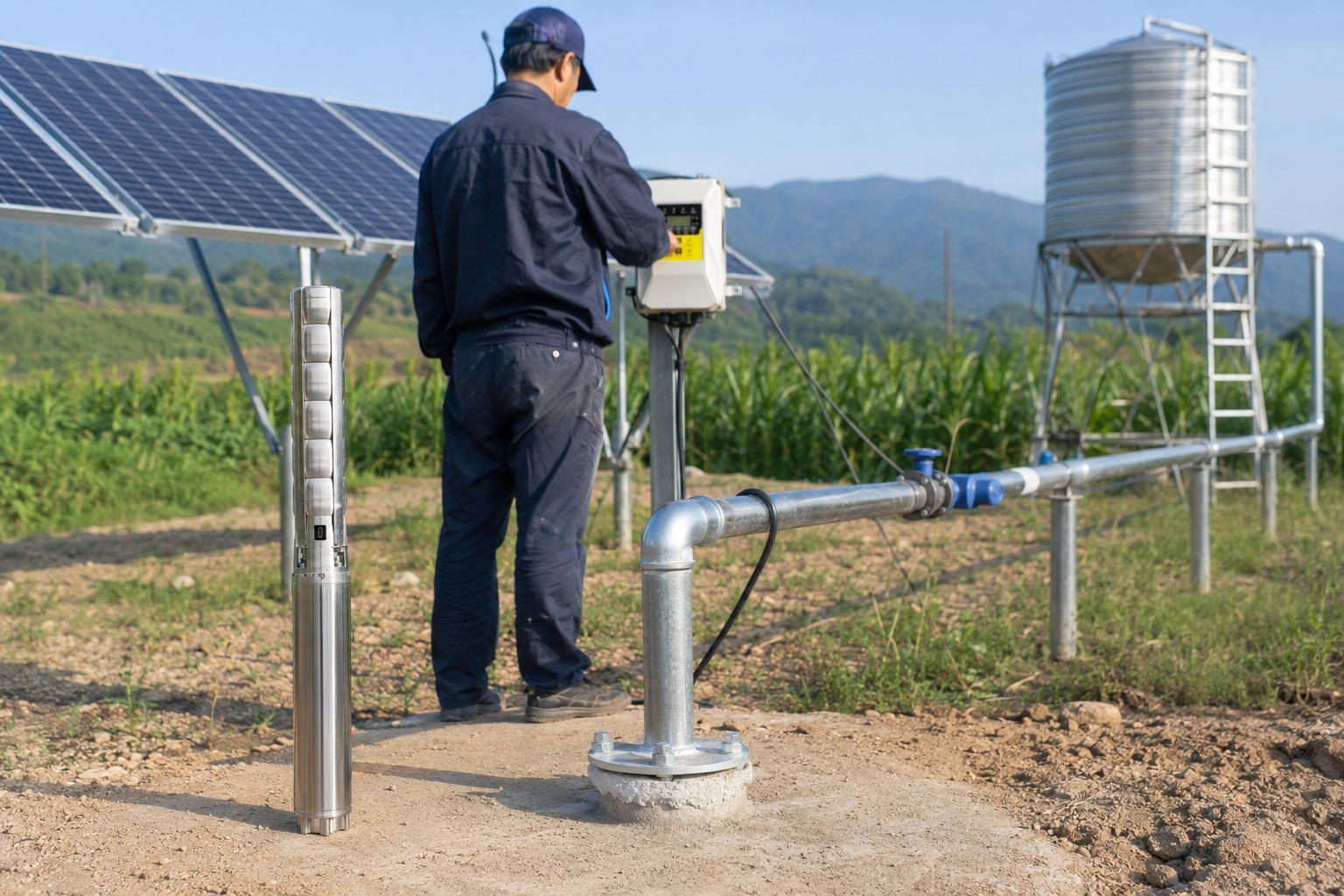
Defining strength in a water pump goes beyond simple horsepower.
The truly strongest pump is the one that performs its specific job with the highest efficiency and reliability.
A pump that excels at lifting water 200 meters from a deep well might be weak for irrigating a large field, and vice versa.
This guide explores the different types of powerful solar pumps.
We will break down which technology is the "strongest" for various applications.
From deep well domestic water supply to large-scale farm irrigation, understanding the differences is key to choosing the right powerhouse for your needs.
What is a Solar Screw Pump?
Do you need to get water from an extremely deep well?
Conventional pumps often fail when faced with a high head.
A solar screw pump delivers the immense lifting force required for deep water access.
A solar screw pump, or progressive cavity pump, is a positive displacement pump ideal for low-flow, high-head situations.
It uses a stainless steel helical screw rotating inside a rubber stator to push water upwards, making it perfect for deep wells where lifting height is critical.
A solar screw pump is a specialized tool designed for a very specific challenge: depth.
Its strength lies not in the volume of water it moves, but in the incredible height it can lift that water from.
This makes it an indispensable solution in regions with deep water tables and limited access to electricity, such as parts of Africa and Latin America.
Understanding its mechanics and performance characteristics reveals why it's the strongest choice for high-head applications.
How a Screw Pump Works
The core of the pump is its unique mechanism.
A single helical metal rotor (the screw) turns inside a double helical elastomeric sleeve (the stator).
As the rotor turns, it creates a series of sealed cavities that progress from the pump's inlet to its outlet.
Water is trapped in these cavities and pushed steadily upwards.
This method is a form of positive displacement, meaning it moves a fixed amount of fluid with each rotation, generating powerful pressure to overcome the force of gravity from great depths.
Key Performance Metrics
The defining feature of a screw pump is its performance curve.
It provides a relatively constant, low flow rate regardless of the head (depth), up to its maximum pressure limit.
For example, a typical solar screw pump might deliver 1,000 liters per hour, whether it's lifting water from 50 meters or 150 meters.
In contrast, a centrifugal pump's flow rate would drop dramatically as the head increases.
This consistency makes screw pumps highly predictable and reliable for deep well water supply.
| Pump Type | Typical Max Head | Typical Flow Rate | Sand Resistance |
|---|---|---|---|
| Solar Screw Pump | 150-200 meters | Low (e.g., 1-3 m³/hr) | Excellent |
| Solar Impeller Pump | 50-100 meters | High (e.g., 5-15 m³/hr) | Good to Moderate |
Ideal Applications
The screw pump's characteristics make it perfect for several key scenarios.
- Deep Well Domestic Water: It is the top choice for supplying water to homes and small communities from wells deeper than 80-100 meters.
- Livestock Watering: In arid regions, it can reliably lift water from deep boreholes to troughs for cattle, sheep, and other animals.
- Small-Scale Drip Irrigation: While not suitable for flood irrigation, its steady flow is perfect for targeted drip systems where pressure is more important than volume.
Advantages and Limitations
The primary advantage is its exceptional ability to handle deep wells and high head.
It is also highly resistant to sand and grit, as the rubber stator can tolerate abrasive particles far better than the tight tolerances of an impeller pump.
However, its main limitation is the low flow rate.
This makes it unsuitable for applications requiring large volumes of water quickly, such as irrigating large commercial farms.
Why Choose a Solar Plastic Impeller Pump?
Do you need to move a large volume of water for your farm?
Low-flow pumps simply won't provide the coverage you need.
Solar plastic impeller pumps are designed to deliver the high flow rates essential for agriculture.
Choose a solar plastic impeller pump for high-flow, medium-head applications like farm irrigation or garden watering.
Its multi-stage centrifugal design uses durable plastic impellers to deliver significant water volume efficiently and economically, making it a lightweight and wear-resistant workhorse.
When the goal is to move as much water as possible, the solar plastic impeller pump is the strongest contender.
This pump operates on the principle of centrifugal force, using a series of rotating impellers to propel water outwards and upwards.
It is engineered for efficiency in terms of volume, making it the go-to choice for farm irrigation, pasture water supply, and filling reservoirs.
Its popularity in agricultural heartlands across Africa and the Americas is a testament to its practical strength and economic value.
The Centrifugal Force Principle
Unlike the positive displacement of a screw pump, an impeller pump is a multi-stage centrifugal pump.
Water enters the pump at the center of a spinning impeller.
The rotating vanes of the impeller fling the water outwards at high velocity, converting rotational energy into kinetic energy.
A diffuser casing then converts this kinetic energy into pressure, forcing the water up the pipe.
By stacking multiple impellers in series, the pump can achieve a higher head, with each stage adding more pressure.
Performance: High Flow and Wear Resistance
The standout feature of this pump is its ability to produce a high flow rate at a medium head.
For example, a 4-inch plastic impeller model might deliver 15,000 liters per hour (15 m³/hr) at a 40-meter head.
This is over ten times the volume of a typical screw pump.
The impellers are often made from high-strength, engineered plastics like PPO (Polyphenylene Oxide), which offers excellent resistance to wear from fine sand.
This makes the pump durable in common well conditions without the high cost of stainless steel.
| Feature | Solar Plastic Impeller Pump | Solar Stainless Steel Impeller Pump |
|---|---|---|
| Primary Use | High-volume irrigation, general use | Corrosive water, premium applications |
| Material Cost | Lower | Higher |
| Weight | Lighter (easier installation) | Heavier |
| Corrosion Resistance | Moderate | Excellent |
| Fine Sand Resistance | Excellent | Good |
Where It Shines: Key Applications
This pump's design makes it ideal for moving water in bulk.
- Farm Irrigation: Its high flow rate is perfect for sprinklers, flood irrigation, and rapidly watering large tracts of land.
- Pasture Water Supply: It can quickly fill large tanks and reservoirs for livestock in ranching areas.
- Community Water Systems: Suitable for supplying water to villages or small communities from moderately deep wells where demand is high.
Balancing Cost and Durability
The plastic impeller pump strikes an excellent balance between performance, durability, and cost.
It is significantly more affordable than its stainless steel counterpart, and its lightweight nature reduces installation complexity and expense.
However, its limitation lies in its durability in highly corrosive water.
In water with high levels of acidity or alkalinity, the plastic components will degrade over time, making a stainless steel model a better long-term investment for those specific conditions.
When is a Solar Stainless Steel Impeller Pump Necessary?
Is your water source acidic or corrosive?
Standard pumps will quickly rust and fail, leading to costly replacements.
A stainless steel impeller pump provides the ultimate durability required to survive in harsh water environments.
A solar stainless steel impeller pump is necessary when dealing with corrosive water, such as acidic or alkaline sources.
Its full SS304 stainless steel construction ensures superior corrosion resistance and a long service life, making it the premium choice for challenging water conditions and high-end applications
For applications where longevity and reliability are paramount, especially in aggressive water, the stainless steel impeller pump is the strongest choice.
This pump is not just a tool; it's a long-term investment in water security.
It functions similarly to the plastic impeller model but is constructed from premium materials designed to withstand chemical attack.
This makes it essential for specific geographical regions with problematic water and for users who demand the highest level of durability from their equipment.
The Power of SS304 Stainless Steel
The key to this pump's strength is its material composition.
Both the impellers and the pump body are constructed from SS304 stainless steel.
This grade of steel contains high levels of chromium and nickel, which form a passive, non-reactive layer on the surface.
This layer protects the underlying metal from rust and corrosion, even when submerged in water with a low or high pH.
This material integrity ensures the pump maintains its performance and structural soundness for years, with a service life often 2 to 3 times longer than plastic models in the same harsh conditions.
Performance in Harsh Environments
While it delivers similar high-flow, medium-to-high head performance as a plastic impeller pump, its true value is revealed over time.
In alkaline soils found in parts of Australia or acidic water in certain American regions, a plastic impeller pump might fail within 2-3 years.
A stainless steel model, however, can be expected to operate reliably for 7-10 years or more, drastically reducing the total cost of ownership.
| Parameter | Plastic Impeller Pump | Stainless Steel Impeller Pump |
|---|---|---|
| Initial Cost | ~$300-$500 | ~$600-$900 |
| Lifespan (Corrosive Water) | 2-3 years | 7-10+ years |
| 10-Year Cost (inc. replacements) | ~$900-$2,000+ | ~$600-$900 |
| Best For | Neutral pH, sandy water | Low/High pH, corrosive water |
Niche Markets and High-End Applications
The stainless steel pump is targeted at specific, demanding markets.
- Regions with Problematic Water: Essential for areas known for acidic or alkaline groundwater.
- High-End Homes and Ranches: Owners who prioritize reliability and are willing to invest in top-tier equipment to avoid future maintenance issues.
- Industrial or Mining Applications: Used for dewatering or water supply where water quality can be chemically aggressive.
Investment vs. Expense
The primary limitation of the stainless steel impeller pump is its higher initial cost and weight.
However, for the right application, this is not an expense but a strategic investment.
By preventing frequent pump failures and the associated costs of replacement labor and downtime, the pump pays for itself over its extended service life.
It represents the strongest option for anyone who cannot afford to have their water supply interrupted.
What is the Core Powering these Pumps?
A great pump is useless without an efficient motor.
Inefficient motors waste precious solar energy, requiring more panels and increasing costs.
A high-efficiency BLDC motor is the game-changing heart of modern solar water pumps.
The core power source is a high-efficiency Brushless DC (BLDC) permanent magnet motor.
With an operational efficiency exceeding 90%, it delivers more pumping power from less solar energy.
This reduces the number of solar panels needed, lowers operating costs, and ensures maximum performance.
The motor is the engine that drives the entire solar pump system.
The "strength" of any pump—whether it's a screw or impeller model—is ultimately determined by the efficiency and power of its motor.
The adoption of Brushless DC (BLDC) permanent magnet synchronous motor technology has revolutionized the solar pumping industry.
This advanced motor design is the key to unlocking the full potential of solar energy for water pumping, making systems more powerful, compact, and cost-effective than ever before.
Unpacking BLDC Technology
Unlike traditional DC motors with brushes that wear out, a BLDC motor uses an electronic controller to switch the direction of the current in the motor windings.
This creates a rotating magnetic field that turns the rotor.
The absence of brushes eliminates friction, wear, and energy loss, making the motor dramatically more efficient and completely maintenance-free.
The rotor itself is constructed with powerful permanent magnets, typically made from high-grade Neodymium Iron Boron (NdFeB), to generate strong torque.
Efficiency by the Numbers
The performance gains from BLDC technology are substantial.
- High Efficiency: BLDC motors consistently achieve efficiencies of over 90%, compared to 60-75% for older brushed DC or AC induction motors. This means at least 15-30% more water is pumped using the same amount of solar power.
- Compact Design: This efficiency allows for a much smaller and lighter motor. A BLDC motor can be up to 47% smaller and 39% lighter than a traditional motor with the same power output. This simplifies installation, especially in deep wells, and reduces shipping costs.
| Motor Type | Efficiency | Lifespan | Maintenance | Size/Weight |
|---|---|---|---|---|
| BLDC Permanent Magnet | >90% | Long (25,000+ hrs) | None | Compact & Light |
| Brushed DC Motor | 75-80% | Moderate | Brush Replacement | Moderate |
| AC Induction Motor | 60-70% (at this scale) | Long | None | Bulky & Heavy |
The Financial Impact of High Efficiency
The strategic value of a high-efficiency motor is enormous.
Since the motor requires less power to do the same amount of work, the size and number of solar panels needed for the system can be reduced by up to 25%.
Solar panels are a major component of the system's total cost, so this directly translates to significant upfront savings for the end user.
Over the long term, less strain on the components and a maintenance-free design contribute to a lower total cost of ownership and a more reliable water supply.
This motor is the common denominator that makes the entire portfolio of solar pumps competitive and effective.
How Can I Get Water 24/7?
Solar pumps are fantastic, but what happens on cloudy days or at night?
Your water needs don't pause when the sun goes down.
Hybrid AC/DC systems provide a constant, uninterrupted water supply, ensuring you have water whenever you need it.
You can get water 24/7 by using a hybrid AC/DC solar pump system.
These systems feature an intelligent controller that can accept power from both solar panels (DC) and the grid or a generator (AC), automatically switching between them to ensure continuous operation.
The ultimate definition of a "strong" water system is one that is always available.
While solar power offers incredible autonomy, its primary limitation is its dependence on sunlight.
For critical applications where a 24-hour water supply is non-negotiable, a hybrid AC/DC system provides the perfect solution.
This technology bridges the gap between solar independence and round-the-clock reliability, creating a truly robust and worry-free water pumping setup.
The Logic of the Hybrid Controller
The brain of the system is the hybrid pump controller.
This sophisticated device is designed with two separate power inputs: one for the DC power from solar panels and one for AC power from the electrical grid or a backup generator.
The controller's internal logic constantly monitors the availability of solar power.
Its primary directive is to use free solar energy whenever it is sufficient to run the pump.
This prioritizes the most cost-effective power source automatically, without requiring any manual intervention from the user.
How Automatic Switching Works
The process is seamless.
- Sufficient Sunlight: When the solar panels are producing enough power, the controller directs this DC electricity straight to the pump's BLDC motor. The AC input remains on standby. Some advanced controllers can even blend AC power with insufficient solar power to maximize the use of free energy.
- Low Sunlight: As clouds move in or as dusk approaches, the solar power output drops. When it falls below the threshold needed to run the pump, the controller instantly and automatically switches over to the AC power source.
- No Sunlight: At night or on heavily overcast days, the controller relies exclusively on the AC input, ensuring the pump can run at full capacity whenever needed. When the sun returns, it automatically switches back to solar.
Key Scenarios for Hybrid Use
A hybrid system is the strongest choice for situations where water cannot fail.
- Critical Domestic Water: For homes relying on a well, a hybrid system guarantees water for drinking, cooking, and sanitation 24/7, regardless of the weather.
- 24-Hour Livestock Watering: Animals need constant access to water. A hybrid system ensures troughs and tanks are always full, protecting the health of the herd.
- Time-Sensitive Irrigation: Some agricultural processes, like protecting crops from a sudden frost, may require running sprinklers at night. A hybrid system makes this possible.
The Benefit of Uninterrupted Supply
The main advantage is peace of mind.
A hybrid AC/DC system removes all anxiety about water availability.
It offers the best of both worlds: the cost savings and environmental benefits of solar power, combined with the absolute reliability of a grid or generator backup.
This makes it the most resilient and powerful water supply solution for any off-grid or semi-grid location.
Conclusion
The "strongest" pump is a complete system.
It combines the right pump type for the job, a high-efficiency motor, and smart controls, creating a reliable and cost-effective water solution.
FAQs
What is the most powerful water pump for a house?
For a house with a deep well, a solar screw pump is most powerful for lifting water. For high water usage from a shallower well, a solar impeller pump is better.
What pump can lift water the highest?
Progressive cavity pumps, also known as screw pumps, are designed to lift water the highest. They excel in high-head, low-flow applications, making them ideal for very deep wells.
How do I choose a deep well pump?
First, measure your well's depth (total head) and required flow rate (Liters per Minute). For deep wells (>80m) with low flow needs, choose a screw pump. For shallower wells with high flow needs, choose an impeller pump.
How many solar panels does it take to run a water pump?
This depends on the pump's power rating and your location. A small 250W pump might need two 150W panels, while a 1500W pump might require six 330W panels.
Can a solar pump work at night?
A standard solar pump cannot work at night. However, a hybrid AC/DC system can automatically switch to grid or generator power to run the pump 24/7.
What is the difference between a submersible and a surface pump?
A submersible pump is placed down inside the well, submerged in water, and pushes water up. A surface pump sits on the ground and pulls water up from a shallow source.
How long do solar water pumps last?
A quality solar pump system can last 15-20 years. The BLDC motor is very durable, while solar panels are often warrantied for 25 years. The pump itself may need servicing or replacement depending on water quality.
Are solar water pumps worth it?
Yes, for off-grid locations, they are highly worth it. They have very low running costs, are environmentally friendly, and provide water independence without relying on expensive fuel or an unstable grid.