Struggling to find a water pump that delivers on its promises?
The market is flooded with options, making the right choice feel impossible and risky for your business.
The "best" water pump brand isn't about a single name.
It's the one that combines proven reliability, high-efficiency motor technology, and durable materials perfectly matched to your specific application—whether for deep wells, high flow irrigation, or residential boosting.
This ensures long-term value over brand hype.
Choosing a pump is a major investment.
A mistake can lead to high energy bills, frequent maintenance, and costly downtime.
But how do you look past the marketing and identify true quality?
It starts with understanding the core components that separate an average pump from a world-class performer.
Let's break down what truly defines the best pump brands and the technology that powers them.
What Defines Premium Performance?
Are you paying for a brand name or genuine performance?
High upfront costs don't always guarantee superior efficiency, leaving you with buyer's remorse and inflated operating expenses.
Premium performance comes from superior engineering, not a logo.
It’s defined by measurable factors like motor efficiency (often exceeding 90%), durable materials like stainless steel that resist corrosion, and smart technology that reduces energy consumption by up to 80%.
These elements deliver lower lifetime costs.
The heart of any premium water pump is its motor.
Many leading brands build their reputation on the back of exceptional motor technology.
The most significant advancement in recent years is the Brushless DC (BLDC) permanent magnet motor.
This technology is the core driver of efficiency and reliability.
The Powerhouse: BLDC Motors
Unlike traditional motors, BLDC motors utilize powerful permanent magnets on the rotor.
This design eliminates the energy loss associated with energizing rotor windings.
The result is a dramatic leap in performance.
- Exceptional Efficiency: BLDC motors regularly achieve efficiencies exceeding 90%.
- This is a substantial improvement over the 60-75% efficiency typical of standard AC or brushed DC motors.
- This efficiency gain directly translates into lower energy consumption.
- Reduced Operating Costs: For solar applications, this high efficiency means the pump can operate effectively with up to 30% fewer solar panels.
- This significantly lowers the initial system cost and simplifies installation.
- For grid-powered pumps, it means a noticeable reduction in electricity bills over the pump's lifespan.
Smart Technology: Variable Frequency Drives (VFD)
Premium performance is also about intelligent control.
Variable Frequency Drive (VFD) technology allows a pump to adjust its motor speed in real-time based on water demand.
This is a stark contrast to traditional pumps that run at full speed every time they switch on.
A pump with VFD technology can maintain constant, unwavering water pressure whether one faucet is open or ten.
This prevents annoying pressure fluctuations and eliminates "water hammer," a damaging shockwave that can stress pipes and fittings.
By precisely matching motor speed to demand, a VFD can reduce energy consumption by as much as 80% in certain applications.
The table below illustrates the clear advantages of these modern technologies.
| Feature | Standard Motor/Control | Premium BLDC Motor/VFD | Performance Gain |
|---|---|---|---|
| Motor Efficiency | 60-75% | > 90% | +20-30% Efficiency |
| Energy Use | High (fixed speed) | Low (variable speed) | Up to 80% Savings |
| Pressure Control | Fluctuates | Constant & Stable | Improved User Experience |
| Lifespan | Shorter (high stress) | Longer (reduced wear) | +30-50% Service Life |
Ultimately, premium performance is a measurable outcome of superior technology.
It’s found in pumps that integrate high-efficiency BLDC motors and intelligent VFD controls to deliver powerful, reliable, and cost-effective operation for years to come.
Why Is All-Around Reliability the Leader?
Worried about pump failures in remote locations?
Unreliable pumps cause service nightmares, damage your reputation, and lead to lost revenue, especially in critical agricultural or residential systems.
Industry-leading reliability is achieved through robust motor design, quality-controlled manufacturing, and the use of appropriate materials for the application.
A reliable pump isn't just one that works; it's one that performs consistently for 15-25 years with minimal maintenance, ensuring peace of mind.
Reliability isn't a single feature.
It's the result of designing a pump specifically for its intended environment and application.
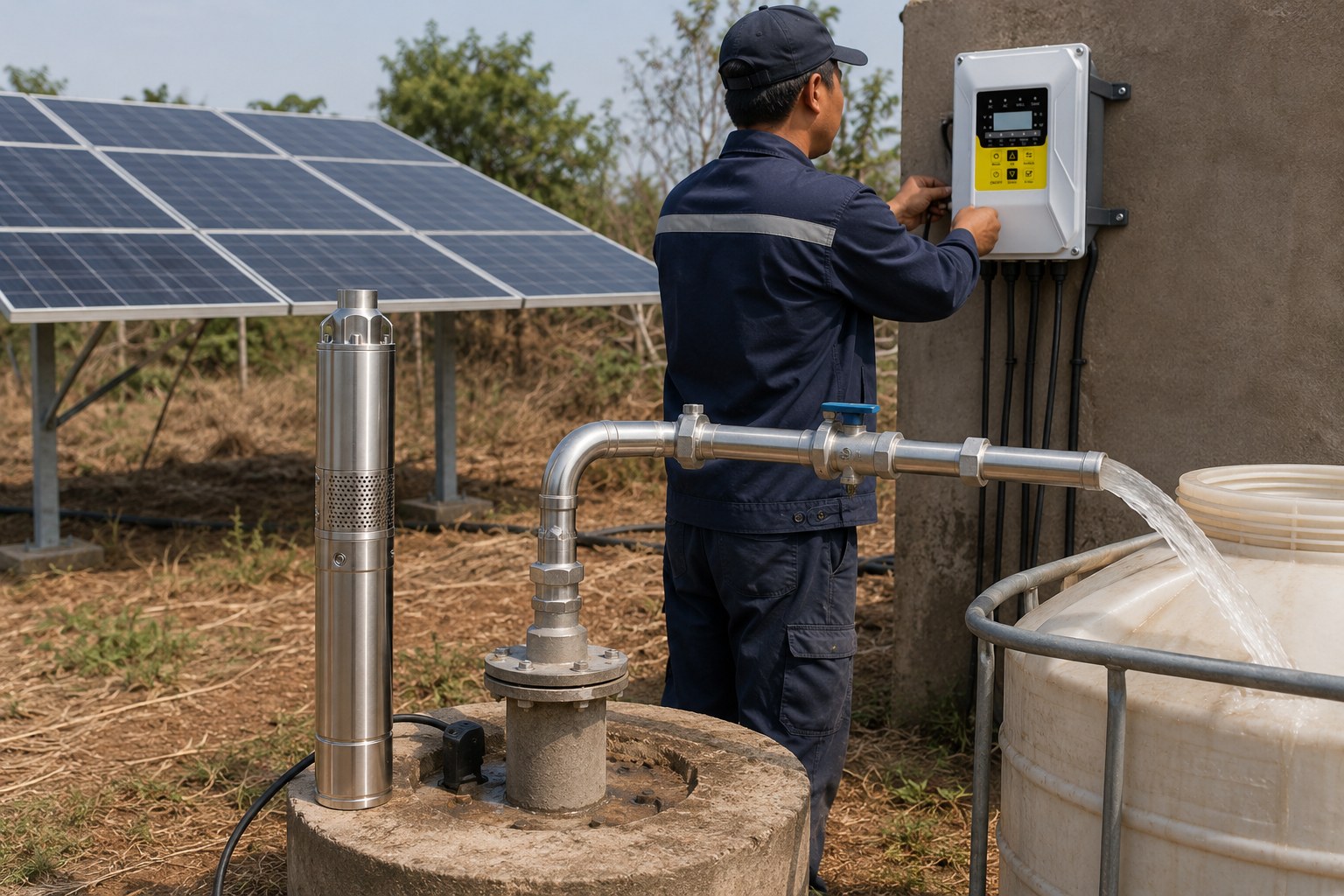
For off-grid and rural areas, particularly in Africa, the Americas, and Australia, solar deep well pumps are the lifeline for homes, livestock, and farms.
True reliability here means choosing the right pump type for the well's specific conditions.
The three most competitive solar deep well pumps demonstrate this principle perfectly.
Solar Screw Pump: The Deep Well Specialist
This pump type is engineered for low-flow, high-head applications.
It uses a stainless steel screw rotating within a rubber stator.
This mechanism pushes water upwards through compression, allowing it to draw water from very deep wells where other pumps might struggle.
- Key Advantage: Its design makes it highly resistant to sand and sediment.
- It can handle abrasive water conditions that would quickly destroy other pump types.
- Best Application: Ideal for domestic water supply and livestock watering in regions with deep water tables, such as parts of Africa and Latin America.
- It provides a consistent water source even from depths exceeding 200 meters.
Solar Plastic Impeller Pump: The High-Flow Workhorse
For applications requiring more water volume, like farm irrigation or filling large tanks, the multi-stage centrifugal pump is the answer.
This model uses a series of durable, wear-resistant plastic impellers.
It's designed to deliver high flow rates at a medium head.
- Key Advantage: It offers an excellent balance of high water output and resistance to fine sand.
- Its lightweight construction also makes it a more economical choice.
- Best Application: Perfectly suited for farm irrigation, pasture water supply, and residential gardens.
- This pump is widely used across the Americas and Africa for its practical, high-volume performance.
Solar Stainless Steel Impeller Pump: The Durability Champion
In environments with corrosive water, reliability demands superior materials.
This premium model features impellers and a pump body constructed from SS304 stainless steel.
It is specifically designed to withstand acidic or alkaline water conditions.
- Key Advantage: It offers exceptional corrosion resistance, ensuring a long service life and high reliability in harsh water.
- Best Application: Essential for regions with alkaline soil and water, such as parts of Australia and the Americas.
- It's also the top choice for high-end homes and ranches where water quality and long-term durability are non-negotiable.
The choice between these pumps directly impacts the system's reliability, as shown below.
| Pump Type | Primary Use Case | Flow Rate | Head (Lift) | Sand Resistance |
|---|---|---|---|---|
| Screw Pump | Deep Well (Home/Livestock) | Low | Very High | Excellent |
| Plastic Impeller | Farm Irrigation | High | Medium | Good |
| SS Impeller | Corrosive Water | High | Med-High | Moderate |
Choosing the most reliable pump means matching the pump's core design—screw, plastic impeller, or stainless steel impeller—to the specific demands of the well and water.
This application-focused approach is what separates the leading solutions from the rest.
When is Heavy-Duty, High Flow Necessary?
Does your irrigation system struggle to meet demand?
Underpowered pumps for large properties or farms result in poor water coverage, stressed crops, and inefficient operations.
Heavy-duty, high-flow pumps are essential for agriculture, large estates, and commercial applications.
These pumps are built with rugged components to handle continuous operation and deliver the high gallons per minute (GPM) needed for demanding tasks, ensuring productivity and system effectiveness.
High-flow capability is crucial for applications where large volumes of water need to be moved quickly and efficiently.
This is particularly true for agriculture, where crop health depends on consistent and adequate watering.
The best pump for these scenarios is typically a multi-stage centrifugal model, but the choice of impeller material—plastic or stainless steel—is critical.
Plastic Impeller Pumps for General Agriculture
For most agricultural uses where the water is relatively clean and non-corrosive, the high-flow plastic impeller pump is a fantastic choice.
The impellers are made from engineered polymers that are both durable and lightweight.
This allows the pump to achieve high rotational speeds efficiently, generating significant water volume.
- Performance: These pumps can deliver flow rates from 20 GPM to over 100 GPM, depending on the size and number of stages.
- This is ideal for sprinkler systems, drip irrigation, and flood irrigation on small to medium-sized farms.
- Cost-Effectiveness: The use of plastic impellers makes these pumps more affordable upfront, providing an excellent return on investment for many farmers.
Stainless Steel Impeller Pumps for Demanding Environments
When the water source contains corrosive elements or the system requires even greater durability for continuous, 24/7 operation, the stainless steel impeller pump is the superior choice.
The SS304 stainless steel construction provides robust resistance to wear, abrasion, and chemical corrosion.
- Durability: Stainless steel impellers maintain their shape and efficiency far longer than plastic in harsh conditions, ensuring consistent high-flow performance over the pump's entire lifespan.
- Application: They are the go-to solution for large-scale agricultural operations, industrial water transfer, and community water supply projects.
Ensuring 24/7 Operation with Hybrid Controllers
For critical high-flow applications like agriculture, waiting for the sun is not an option.
This is where advanced AC/DC hybrid controllers become essential.
These intelligent devices ensure uninterrupted water supply.
- Automatic Switching: The controller can be connected to both solar panels and an AC power source (grid or generator) simultaneously.
- It prioritizes solar power when available, maximizing energy savings.
- When sunlight is insufficient, like on cloudy days or at night, it automatically switches to the AC source to keep the pump running.
- Hybrid Function: Some advanced controllers can even blend power, using available solar energy and supplementing it with just enough AC power to meet demand.
- This maximizes the use of free solar energy while guaranteeing the required flow rate.
This combination of a high-flow pump and a hybrid controller creates a truly robust and reliable water system for any heavy-duty application.
What is The Value of Quality Construction?
Tired of replacing pumps every few years?
Choosing budget options based on price alone often leads to premature failure from corrosion or wear, costing you more in the long run.
Quality construction provides the best long-term value.
It means using materials like SS304 stainless steel for corrosion resistance and designing components to withstand specific challenges like sandy water or high mineral content.
This focus on durability significantly extends a pump's service life.
The true value of a water pump is measured not by its initial price, but by its total cost of ownership over a decade or more.
Quality construction is the single most important factor in lowering that total cost.
It directly impacts the pump's lifespan, maintenance needs, and consistent performance.
The choice of materials is at the forefront of quality construction.
The Role of Stainless Steel
While standard pumps may use cast iron or plastic components, premium pumps increasingly rely on stainless steel.
SS304 is a specific grade that offers an excellent balance of corrosion resistance, durability, and value.
- Corrosion Resistance: In regions with alkaline or slightly acidic water, like parts of Australia or the Americas, standard cast iron pumps can corrode and fail in just a few years.
- An SS304 pump body and impeller can extend the pump's lifespan by over 50% in these same conditions.
- Purity and Hygiene: Stainless steel is non-reactive, making it the ideal material for pumping potable (drinking) water.
- It doesn't leach minerals or rust into the water supply, ensuring it remains clean and safe.
Design for Specific Challenges
Quality construction goes beyond just materials; it's about thoughtful design.
Different environments pose unique challenges, and a well-built pump is designed to overcome them.
- Sand Resistance: In wells with high sand content, a pump's internal design is critical.
- The solar screw pump, with its unique progressing cavity design, is inherently built to handle abrasive particles.
- Some centrifugal pumps use "floating impellers" that can move slightly to allow sand to pass through without causing a jam or significant wear.
- Heat Dissipation: The motor is the hardest-working part of the pump.
- Quality pumps feature motor housings designed for efficient heat dissipation, often using oil-filled designs or materials with high thermal conductivity.
- This prevents the motor from overheating, which is a leading cause of premature failure, and extends its operational life significantly.
Investing in quality construction means investing in a pump that is purpose-built to survive its environment.
This focus on durable materials and intelligent design is what ensures a pump will provide reliable, maintenance-free service year after year, delivering far greater value than any low-cost alternative.
Why Do Smart Pumps with IoT Integration Matter?
Can't monitor or control your pumps remotely?
This lack of oversight can lead to undetected failures, wasted energy, and inefficient water management, costing you time and money.
Smart pumps with IoT integration are game-changers for modern water management.
They allow for remote monitoring, predictive maintenance, and automatic adjustments to flow and pressure.
This technology, including intelligent MPPT controllers, maximizes efficiency and gives you complete control over your water system from anywhere.
The term "smart pump" refers to a pumping system that uses intelligent controllers to optimize performance, save energy, and provide users with greater control.
This is a defining feature of the best modern water pumps, especially in the solar-powered sector.
The brain behind the smart solar pump is the Maximum Power Point Tracking (MPPT) controller.
The Genius of MPPT Controllers
Solar panels do not produce a constant voltage; their output changes with the intensity of the sunlight.
An MPPT controller is an electronic DC-to-DC converter that constantly monitors the solar panel's output.
It adjusts the electrical load to find the "maximum power point"—the perfect balance of voltage and current that extracts the absolute most power from the panels at any given moment.
- Efficiency Boost: A quality MPPT controller can boost the energy harvest from solar panels by up to 30% compared to simpler controllers.
- This means the pump can start earlier in the morning, run later in the evening, and perform better on overcast days.
- System Protection: The controller also provides critical protection for the pump motor.
- It manages issues like over-voltage, under-voltage, and overheating, safeguarding the system from damage and extending its lifespan.
IoT and Remote Management
The "smartest" pump systems take this a step further by integrating IoT (Internet of Things) capabilities.
This allows the controller to communicate data to a user's smartphone or computer.
From anywhere in the world, a user can:
- Monitor Performance: Check real-time data such as water flow rate, motor speed, and power consumption.
- Receive Alerts: Get instant notifications for any system faults, such as a dry well or a motor issue.
- Control the System: Remotely turn the pump on or off.
This level of control and oversight is invaluable for managing water systems on large farms, remote properties, or critical infrastructure.
It transforms maintenance from a reactive, costly process into a proactive, efficient one.
By combining a high-efficiency pump and motor with an intelligent MPPT controller and IoT features, you create a fully optimized water management solution that is not only powerful and reliable but also incredibly efficient and easy to manage.
Conclusion
The best brand is not a name, but a promise.
It is a promise of efficiency from a superior motor, reliability from application-specific design, and durability from quality construction.
FAQs
What is the most reliable type of water pump?
Submersible pumps are generally the most reliable for wells, as they are protected from the elements and push water up, which is more efficient than pulling it.
How do I choose the right size water pump for my house?
Calculate your home's peak water demand in gallons per minute (GPM) and the required pressure (PSI).
A professional can help you match these needs to the right pump model.
Are more expensive water pumps worth it?
Yes, a higher price often reflects better materials, a more efficient motor, and longer-lasting construction.
This reduces lifetime costs for energy and repairs, making it a better value.
How long should a good quality water pump last?
A well-maintained, high-quality submersible pump from a top manufacturer can last 15 to 25 years.
Lifespan depends heavily on water quality and proper installation.
What motor is best for a water pump?
Brushless DC (BLDC) permanent magnet motors are the best.
They are over 90% efficient, highly reliable, and reduce energy consumption, especially in solar pump applications.
Can a solar pump work at night?
A standard solar pump cannot.
However, systems with an AC/DC hybrid controller can automatically switch to grid or generator power at night or on cloudy days, ensuring 24/7 operation.
Which is better, a submersible or jet pump?
For wells deeper than 25 feet, a submersible pump is far better.
It is more efficient, quieter, and can handle much greater depths than a jet pump.