Struggling with rising fuel costs for your water pump?
You feel the pain of unreliable grid power and expensive gas, making farm irrigation a constant headache.
**A complete solar well pump system typically costs between $2,000 and $8,000.
The final price depends on the pump type, well depth, and required daily water volume.
For example, a shallow well system for a small garden may cost around $2,500, while a deep well system for large-scale livestock watering could exceed $7,000.
This one-time investment eliminates future fuel expenses entirely.**
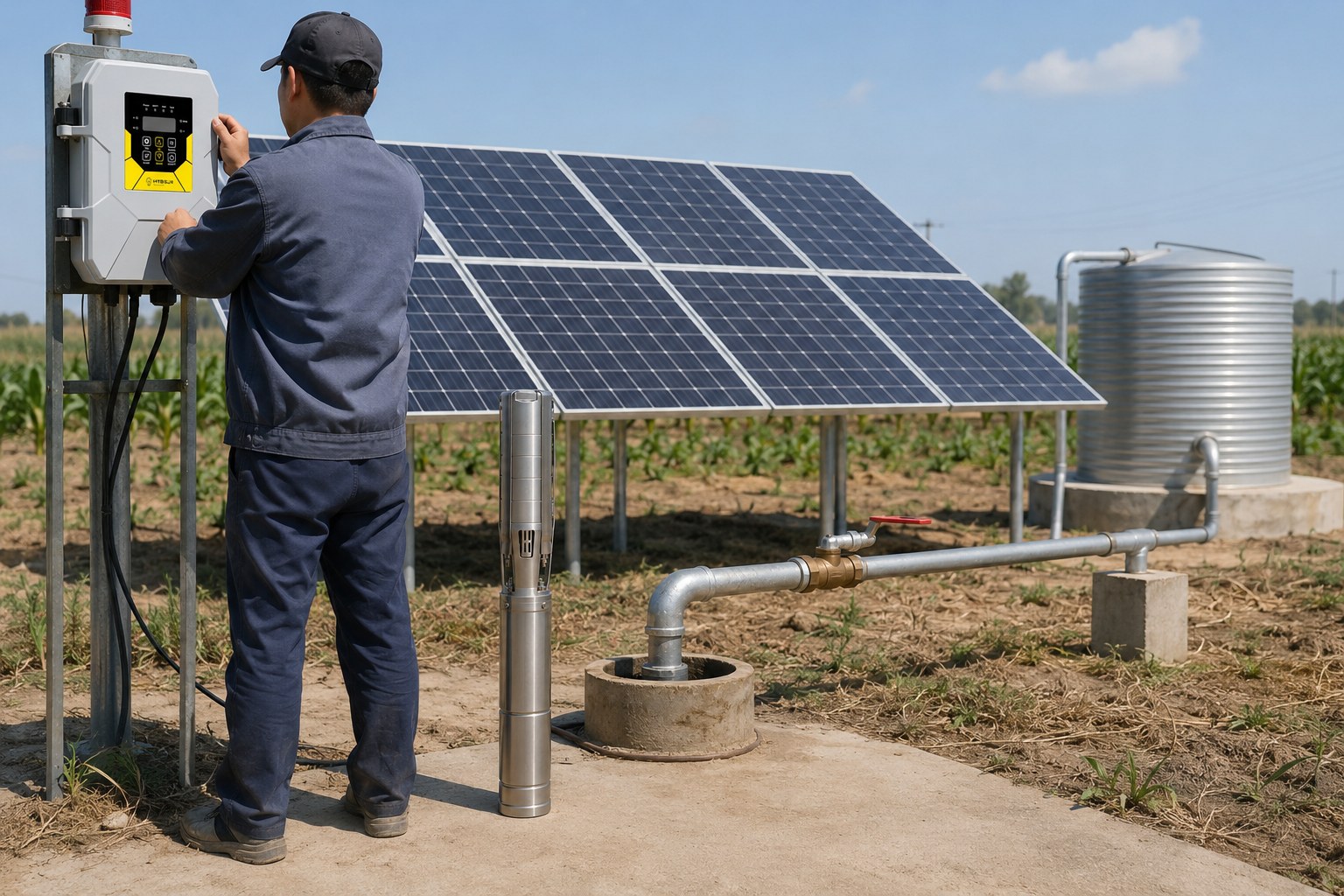
Understanding the total cost of a solar well pump means looking beyond the initial price tag.
It involves weighing the upfront expense against the significant long-term savings on fuel and maintenance.
Let's break down the real factors that determine the value and cost of switching to solar-powered water, so you can make the best choice for your farm, ranch, or home.
The High Upfront Cost: A Barrier or a Smart Investment?
Facing a large initial bill for a new pump can feel daunting.
Many farmers hesitate at the upfront cost, wondering if it's truly worth the immediate financial stretch.
**The initial cost of a solar water pump system is its biggest disadvantage, as you must purchase the pump, controller, and solar panels all at once.
This can range from $2,000 for a basic kit to over $10,000 for a high-performance deep-well setup, which can be a significant barrier for some.
However, this one-time purchase unlocks decades of free energy.**
The upfront cost is more than just a number; it's a collection of components each with its own price point.
A complete system kit, which users on farming forums often price between $2,000 and $3,000 for a DIY setup, typically includes the pump, a controller, and solar panels.
What you're really paying for is a specific level of performance tailored to your unique needs.
The final bill is heavily influenced by your well's depth, the distance the water needs to travel, and the total volume of water you need each day.
Pump Type Determines Price and Performance
The pump itself is a major cost driver.
Different pump designs are engineered for specific conditions, and their materials and complexity directly impact the price.
- Solar Screw Pumps: These are ideal for deep wells where high pressure (head) is needed but a large volume of water (flow) is not.
They use a simple, robust screw mechanism.
This design makes them highly resistant to sand and sediment, which is a common issue in many wells.
They are often the go-to choice for domestic water supply and livestock in arid regions. - Solar Plastic Impeller Pumps: These are centrifugal pumps designed for high flow rates at a lower head.
They are an economical choice for shallower wells, perfect for farm irrigation and filling troughs where you need to move a lot of water quickly.
Their durable plastic impellers offer good resistance to fine sand. - Solar Stainless Steel Impeller Pumps: This is the premium option.
Built with SS304 stainless steel, these pumps offer maximum durability and corrosion resistance.
They are essential for areas with acidic or alkaline water that would quickly degrade other pumps.
While they have the highest upfront cost, their long service life makes them a cost-effective choice for harsh water environments.
| Pump Type | Typical Application | Key Advantage | Relative Cost |
|---|---|---|---|
| Screw Pump | Deep wells, low flow, high head | High sand resistance | Medium |
| Plastic Impeller | Shallow wells, high flow | Economical, lightweight | Low |
| SS Impeller | Corrosive water, high flow | Maximum durability | High |
The Brains of the Operation: Motor and Controller
The heart of every modern solar pump is a high-efficiency Brushless DC (BLDC) permanent magnet motor.
These motors can achieve efficiencies over 90%, compared to the 60-70% efficiency of standard AC motors.
This higher efficiency means the motor requires up to 30% fewer solar panels to do the same amount of work, directly reducing the overall system cost.
The intelligent MPPT (Maximum Power Point Tracking) controller acts as the brain, maximizing the energy harvested from the panels throughout the day, further optimizing performance and value.
So, while the initial price seems high, you are investing in a technologically advanced, highly efficient system designed to save you money from day one.
The Long-Term Savings: Are There Really Zero Fuel Costs?
Tired of the endless trips to the gas station?
The constant need to buy fuel for a generator pump eats into your profits and time, creating a frustrating cycle of expenses.
**Yes, a major advantage of solar water pumps is the complete elimination of fuel costs.
Once the system is installed, the sun provides all the energy needed to pump your water for free.
This is a stark contrast to fossil fuel pumps, where ever-rising fuel prices represent a significant and ongoing operational expense.**
The promise of "zero fuel costs" is not an exaggeration; it is the fundamental economic benefit of solar power.
Let's put this into perspective with real numbers.
A gas-powered pump might have a lower initial cost, perhaps around $500.
However, if it consumes just $5 worth of gasoline per day, the annual fuel cost is $1,825.
Over a ten-year period, you would spend over $18,250 on fuel alone, not to mention maintenance and eventual replacement of the engine.
Total Cost of Ownership: Solar vs. Gas
In contrast, a solar pump system might cost $3,000 upfront.
But with zero fuel costs, the total expenditure after ten years is still just $3,000.
As one forum user noted, "The amount of gas adds up fast."
This simple calculation reveals a shocking truth: a gas pump can cost over six times more than a solar pump over a decade.
The savings become apparent very quickly, often within the first or second year.
This rapid return on investment is why so many ranchers and farmers who make the switch consider it one of the best decisions they've made.
| Cost Component | Gas-Powered Pump (10-Year Estimate) | Solar-Powered Pump (10-Year Estimate) |
|---|---|---|
| Upfront Cost | $500 | $3,000 |
| Fuel Cost | $18,250 ($5/day) | $0 |
| Major Maintenance | $1,000+ (Engine servicing, repairs) | $100 (Minor parts, panel cleaning) |
| Total 10-Year Cost | $19,750+ | $3,100 |
Beating Inflation
The financial argument for solar becomes even stronger when you consider market trends.
The price of fossil fuels is volatile and has been on a long-term upward trend.
Conversely, the cost of solar technology has been steadily falling for over a decade.
This means that the "disadvantage" of high upfront costs for solar is shrinking every year, while the "disadvantage" of high fuel costs for gas pumps is only getting worse.
By investing in a solar pump, you are not just buying a piece of equipment; you are locking in your future water costs and insulating your operation from fuel price inflation.
It's a strategic move towards financial resilience and predictability.
Performance in the Dark: What Happens When the Sun Doesn't Shine?
You worry that a solar pump will fail you on cloudy days.
The thought of your crops or livestock going without water during a string of overcast weather is a major concern.
**While it's true that solar pumps don't operate at night, this is easily managed with planning.
The most common and recommended solution is to pump water into a storage tank during peak sun hours.
This ensures you have a reliable water supply available 24/7, delivered by simple gravity feed, regardless of the weather.**
The idea that a solar pump is useless without bright sun is a common misconception.
Modern systems are surprisingly effective even on overcast days.
High-quality solar panels can still generate a significant amount of power from ambient light, allowing the pump to operate, just at a slower rate.
One user in a farming forum confirmed this, stating their system "does pump on overcast and rainy days, just a lot slower."
However, for true 24/hour water security, there are two primary strategies.
The Best Solution: Store Water, Not Power
The most reliable and cost-effective method is to use a water storage tank.
The concept is simple: use the free, powerful energy during the sunniest part of the day to pump a surplus of water into a large tank.
A 5,000-gallon tank, for instance, can provide water for 100 cows for several days.
This stored water can then be gravity-fed to your troughs or irrigation lines whenever you need it, day or night, rain or shine.
This approach avoids the main pitfalls of battery storage.
While batteries can power a pump at night, they are expensive, have short lifespans of only 2-3 years, and add a layer of complexity and maintenance to the system.
Storing water is cheaper, more reliable, and lasts indefinitely.
The Hybrid Option: For Ultimate Peace of Mind
For applications where a constant, on-demand water flow is critical and a tank isn't practical, a hybrid system is the answer.
Advanced AC/DC controllers offer the ultimate flexibility.
These controllers can be connected to both your solar panels and an AC power source (either the grid or a generator) simultaneously.
The system is smart.
It will always prioritize using the free solar energy first.
If a cloud passes over and solar power drops, the controller will automatically blend in just enough AC power to maintain pump performance.
When the sun sets, it can switch over to AC power completely.
This ensures you have uninterrupted water access 24/7 without having to manually switch power sources, giving you the best of both worlds: the cost savings of solar and the all-weather reliability of the grid.
The Labor Equation: Is It Really Less Work?
You're already busy with a thousand tasks on the farm.
The last thing you need is another piece of equipment that demands constant attention, repairs, and maintenance.
**Yes, solar pumps significantly reduce labor and maintenance compared to both fossil fuel pumps and windmills.
You will no longer need to haul fuel from town or perform frequent engine servicing.
The maintenance for a solar pump is minimal, usually just involves keeping the solar panels clean to ensure maximum energy production.**
The reduction in labor is one of the most celebrated benefits among solar pump owners.
Think of the time saved.
No more emergency trips to the gas station because the generator ran dry.
No more hours spent tinkering with a fussy engine.
No more dangerous climbs up a windmill tower for service.
As one rancher put it, the best part is "No hauling fuel, no climbing windmills!"
This saved time and energy can be reinvested into more productive activities on your farm.
Designed for Durability and Easy Repairs
Solar pump systems are engineered for long life and minimal failure.
The core of the system, the BLDC motor, has no brushes to wear out, making it virtually maintenance-free with a lifespan often exceeding 10 years.
This is a stark contrast to gas engines, which require regular oil changes, spark plug replacements, and other servicing.
Furthermore, many solar pumps, especially surface pumps, are designed for easy on-farm repairs.
They can often be maintained with a basic toolkit, unlike complex engines that may require a specialist.
A good warranty is also a key indicator of a low-maintenance product.
Many top-tier manufacturers offer warranties up to 10 years, providing a decade of worry-free irrigation.
What Maintenance Is Required?
The primary maintenance task for a solar pump system is incredibly simple: keep the solar panels clean.
Dust, pollen, and bird droppings can accumulate on the panels, reducing their efficiency by up to 20-30%.
A quick wipe-down with a soft cloth and some water every few months is usually all it takes to restore them to peak performance.
This task is far less demanding than the daily and weekly checks required for a generator.
By drastically cutting down on refueling, repairs, and routine servicing, a solar pump frees up your most valuable resource: your time.
The Green Choice: Good for Your Wallet and Your Land?
You care about the health of your land and the environment.
The pollution and noise from a gas generator can feel out of place on a farm, potentially harming your soil and disturbing the peace.
**Absolutely.
Solar water pumps are an environmentally friendly solution that uses clean, renewable energy.
They produce zero harmful emissions, which keeps the air on your farm clean.
They also eliminate the risk of fuel and oil spills, which can contaminate your soil and groundwater, protecting the long-term health of your land.**
Choosing a solar water pump is a powerful statement about your commitment to sustainable agriculture.
Unlike fossil fuel pumps that spew pollutants into the atmosphere, solar pumps operate silently and cleanly.
This not only reduces your farm's carbon footprint but also creates a healthier environment for your family, your livestock, and your crops.
The absence of engine noise also contributes to a more peaceful and natural farm setting.
Supporting a Resilient Future
Agriculture is on the front lines of climate change.
As rainfall becomes more unpredictable and droughts become more common, having a reliable, off-grid water source is more critical than ever.
Solar irrigation is not just a tool for today; it's a key strategy for adapting to a changing climate.
By harnessing the sun, you ensure your ability to grow crops and water livestock even during the driest seasons.
This technology empowers you to build a more resilient and self-sufficient operation.
Furthermore, bringing water to arid areas can have a profound positive impact on the local ecosystem.
A reliable water source can help regenerate pastures and provide drinking water for local wildlife, allowing plants and animals to flourish in areas where they previously could not.
By making this choice, you are not only securing your own water supply but also contributing to the ecological health of your region.
It's a solution that aligns economic sense with environmental stewardship.
Conclusion
While the initial cost is higher, solar pumps are the cheaper, more reliable, and sustainable choice in the long run.
They offer freedom from fuel costs and a secure water future.
FAQs
Can a solar pump run without a battery?
Yes, most systems are designed to run directly from solar panels during the day.
They pump water into a storage tank, providing access to water 24/7 without needing a battery.
How long does a solar well pump last?
A quality pump motor can last 10-20 years, and the solar panels often have a performance warranty of 25 years.
This makes the system a very durable, long-term investment.
How deep can a solar pump pull water from?
This varies by model.
High-flow centrifugal pumps are for shallow wells, while specialized high-head screw pumps can efficiently pull water from depths of over 400 feet or more.
How many solar panels are needed for a well pump?
It depends on the pump's power and your well's depth.
A small system might need only two panels, while a deep well system could require six or more to ensure adequate power.
Do solar pumps work on cloudy days?
Yes, they continue to operate on cloudy days, though at a reduced flow rate.
Systems are typically designed with enough power to account for several days of overcast weather.
Is a solar well pump worth it?
For most off-grid or rural applications, yes.
The elimination of fuel costs means the system often pays for itself within 2-4 years, making it a financially smart and reliable investment.
What is the best solar pump for a deep well?
A solar screw pump is generally the best choice for deep wells.
It is designed to generate the high pressure (head) needed to lift water from great depths efficiently.
Can I run my solar pump on a generator?
Yes, if you have a hybrid AC/DC controller.
This allows the system to automatically switch to a generator or grid power when there is not enough sunlight, ensuring a constant water supply.