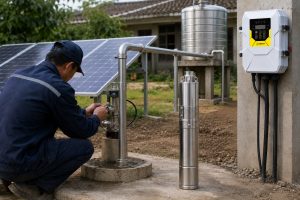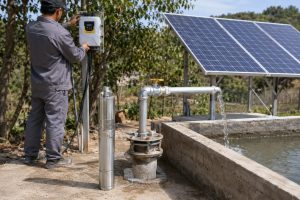
Connecting a solar panel to a pump seems straightforward, but a simple wire connection often leads to failure.
You need more than just a direct wire.
A proper connection uses a system with a controller to manage power, protect the pump motor, and ensure optimal, long-lasting performance, even in low light.
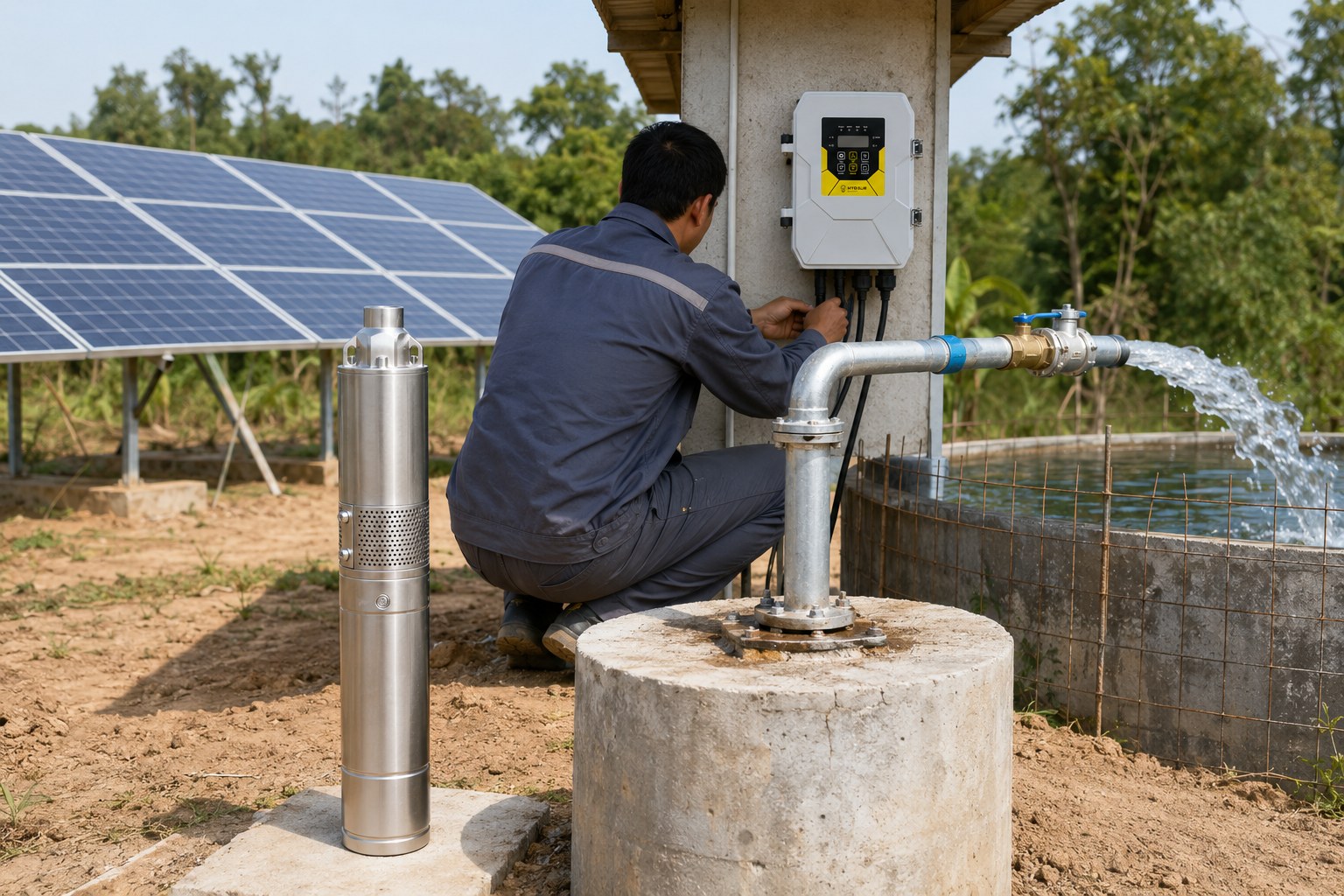
Understanding how these systems connect is crucial for anyone looking to harness solar power for water.
It's the difference between a reliable water source and a costly mistake.
This guide will break down the essential components, the correct connection methods, and the advanced technologies that make modern solar pumps so effective.
Let's explore how to do it right.
What Are the Necessary Components for a Solar Pumping System?
You think a solar pump system is just a panel and a pump.
But this assumption leads to system failure and wasted money.
What are the critical parts you are missing?
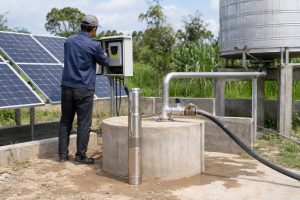
A complete solar pumping system includes solar panels, a pump controller (often with MPPT), the water pump motor, and sometimes an inverter and water tank.
These parts work together to ensure a reliable and efficient water supply.
A solar pump system is more than the sum of its parts.
Each component plays a specific, vital role.
Without a full understanding of these roles, you risk inefficiency and damage to your investment.
The goal is to create a balanced ecosystem where power generation, management, and water delivery are perfectly synchronized.
The Role of Solar Panels (PV System)
The solar panels are the system's power plant.
They are also called the photovoltaic (PV) system.
These panels capture photons from sunlight.
They convert this light energy into Direct Current (DC) electricity.
The amount of power generated depends on the panel's size, efficiency, and the intensity of the sunlight.
Modern solar panels have efficiencies between 18% and 23%.
This means they convert that percentage of sunlight into usable electrical energy.
This DC power is the raw energy that will ultimately drive the pump.
The Heart of the System: The Pump Motor
The water pump motor is the muscle of the operation.
It receives electrical energy and converts it into mechanical force to move water.
Most high-quality solar pumps today use Brushless DC (BLDC) motors.
These motors are highly efficient, often exceeding 90% efficiency.
This is a stark contrast to older brushed motors, which might only be 60-70% efficient.
The motor's job is to take water from a source like a well, borehole, or river and push it where it's needed.
The Brain: The Controller and Inverter
If the motor is the muscle, the controller is the brain.
This device is essential for both efficiency and protection.
It sits between the solar panels and the pump motor.
Its primary function is to regulate the power.
Most controllers include Maximum Power Point Tracking (MPPT).
MPPT technology constantly adjusts the electrical load to find the perfect balance of voltage and current from the solar panels.
This can boost the water output by up to 30%, especially during early mornings, late afternoons, or on overcast days.
The controller also protects the pump motor from damage.
It provides features like soft-starting to prevent mechanical shock, and it shuts the pump off if the water source runs dry (low well shutoff).
An inverter is used only when the pump motor requires Alternating Current (AC).
However, since most modern solar pumps use efficient DC motors, an inverter is often not necessary.
Eliminating the inverter removes a point of failure and avoids the 5-10% energy loss associated with converting DC to AC.
| Feature | System with Controller | System without Controller (Direct Connect) |
|---|---|---|
| Efficiency | High (Boosted by MPPT) | Very Low (Operates only in ideal sun) |
| Pump Protection | Excellent (Soft start, dry run protection) | None (High risk of motor burnout) |
| Operational Window | Wide (Works in low light) | Narrow (Only works in direct, strong sun) |
| Motor Lifespan | Long (10+ years) | Short (Often less than 1-2 years) |
| Overall Reliability | Very High | Very Low |
Can I Connect a Solar Panel Directly to a Pump?
You want to save money by connecting a panel directly to a pump.
This common shortcut seems logical.
However, it often leads to burnt-out motors and a wasted investment.
It is strongly advised not to connect a solar panel directly to a pump.
This "direct connect" method can burn out the motor due to unstable power, especially during low-light conditions like morning or evening.
The appeal of a simple, direct connection is understandable.
Fewer components mean lower initial cost.
However, this approach ignores the fundamental electrical principles of how motors operate.
A pump motor is not like a simple lightbulb; it has specific power requirements that a raw solar panel cannot meet consistently.
Attempting to do so is a recipe for quick and certain failure.
The Problem with "Direct Connect" Systems
A pump motor requires a significant amount of electrical current to start.
This is known as start-up current or inrush current.
It can be three to five times higher than the current needed for normal operation.
In the early morning or late afternoon, sunlight is weak.
A solar panel produces very little current under these low-light conditions.
When a directly connected pump tries to start, the panel cannot supply the necessary inrush current.
The motor will try to turn, fail, and stop.
It will repeat this cycle over and over.
This rapid starting and stopping generates excessive heat inside the motor windings.
Eventually, this heat will melt the insulation on the wires, causing a short circuit and destroying the motor.
This process, known as motor burnout, can happen within a few weeks or months, completely negating any initial cost savings.
It reduces the expected motor life by over 75%.
Why a Controller is Non-Negotiable
A solar pump controller is the solution to all these problems.
It acts as a smart intermediary between the panels and the pump.
The most important feature is Maximum Power Point Tracking (MPPT).
The MPPT function allows the pump to operate even when sunlight is not perfect.
It intelligently converts the high voltage and low current from the panels in low light into the lower voltage and higher current the pump needs to run, just at a slower speed.
Instead of failing to start, the pump simply runs slower.
Another critical function is the "soft start."
The controller slowly ramps up the power to the motor over a few seconds.
This eliminates the sudden mechanical torque and electrical surge of a direct start.
This gentle start-up dramatically reduces wear and tear on the motor and pump components, extending their lifespan significantly.
Controllers also provide essential protections that save your well and your pump.
Sensors can detect if the water level in the well is too low and automatically shut off the pump to prevent it from running dry, which would quickly destroy it.
Other sensors can detect when a storage tank is full and stop the pump, preventing water waste and unnecessary pump operation.
| Feature | Direct Connect System | Controller-Based System |
|---|---|---|
| Morning/Evening Operation | Fails to start, risks burnout | Runs at a slower, optimized speed |
| Start-Up Method | Abrupt, high-stress jolt | Gentle, controlled soft start |
| Efficiency in Low Light | 0% (does not run) | Up to 30% more efficient |
| Pump Protection | None | Dry run, overflow, electrical protection |
| Return on Investment | Negative (due to replacement costs) | Positive (long life, low maintenance) |
How Do Different Types of Solar Pumps Meet Diverse Needs?
Not all water needs are the same.
Choosing the wrong solar pump for your well can mean getting too little water.
Or it can mean your pump fails prematurely.
Different solar pumps are designed for specific tasks.
Solar screw pumps offer high head for deep wells, plastic impeller pumps provide high flow for irrigation, and stainless steel models resist corrosion in harsh water.
The global demand for water varies dramatically by application.
A family needing drinking water from a 150-meter-deep well has different requirements than a farmer irrigating a 10-hectare field.
Because of this, a one-size-fits-all approach to solar pumps is ineffective.
A competitive product portfolio must include specialized solutions.
These solutions are tailored to different combinations of water depth (head), water volume (flow), and water quality.
The Specialist: Solar Screw Pumps for Deep Wells
Solar screw pumps are the specialists for high-head, low-flow applications.
They are a type of positive displacement pump.
This design uses a helical stainless steel rotor (the screw) that turns inside a rubber stator.
This action creates sealed cavities of water that are pushed upwards as the screw rotates.
This mechanism is highly efficient at creating pressure.
It allows these pumps to lift water from extreme depths, often exceeding 200 meters (650 feet).
While they generate immense pressure, the volume of water they move is relatively low.
This makes them ideal for domestic water supply, livestock drinking troughs, and small-scale drip irrigation.
A key advantage is their high resistance to sand and grit.
The rubber stator can handle abrasive particles much better than the tight-tolerance impellers of centrifugal pumps.
They can often manage water with sand content up to 50 grams per cubic meter.
The Workhorse: Solar Plastic Impeller Pumps
Solar plastic impeller pumps are multi-stage centrifugal pumps.
They are the workhorses for high-flow, medium-head applications.
These pumps use a series of stacked impellers that spin at high speed.
Each impeller adds pressure to the water, lifting it higher.
The impellers are made from durable, wear-resistant engineering plastics like Noryl.
This material choice makes the pumps lightweight and highly economical.
Their main strength is moving large volumes of water.
They are perfect for farm irrigation, filling large reservoirs, and community water supply from shallower wells (typically less than 80 meters or 260 feet).
They offer excellent resistance to fine sand.
However, they are not suited for highly corrosive water or the extreme pressures of very deep wells.
The Guardian: Solar Stainless Steel Impeller Pumps
Solar stainless steel impeller pumps are the premium option for durability and corrosion resistance.
They operate on the same centrifugal principle as plastic impeller pumps.
However, their impellers and pump housing are constructed from SS304 or even SS316 stainless steel.
This makes them exceptionally resistant to corrosion from acidic or alkaline water.
They are the go-to choice for regions with aggressive water quality, such as areas with alkaline soil or industrial contamination.
These pumps offer high flow rates and can achieve medium-to-high head.
They combine the high-volume output of a centrifugal pump with the longevity needed to survive in harsh water environments.
The trade-off is a higher initial cost and greater weight compared to plastic models.
This positions them for high-end residential use, premium agricultural operations, and any application where reliability and long service life are the absolute top priorities.
| Pump Type | Best For | Max Head | Max Flow | Sand Resistance | Cost |
|---|---|---|---|---|---|
| Solar Screw Pump | Deep Wells, Homes | Very High (>200m) | Low | Excellent | Medium |
| Plastic Impeller Pump | Farm Irrigation | Medium (<80m) | Very High | Good | Low |
| Stainless Steel Impeller Pump | Corrosive Water | High (<150m) | High | Fair | High |
What is the Core Technology Driving Modern Solar Pumps?
The pump itself is only half the story.
An inefficient motor will waste precious solar energy.
This means you need more panels, increasing costs.
The secret to peak performance lies in an often-overlooked component.
The core technology is the high-efficiency BLDC (Brushless DC) permanent magnet motor.
With over 90% efficiency, it significantly reduces the number of solar panels needed and extends the system's life.
The motor is the engine of the entire solar pumping system.
Its efficiency dictates the overall performance and cost-effectiveness of the investment.
An inefficient motor acts like a leak in your power pipeline.
It wastes the expensive solar energy generated by the panels.
For decades, pumps used less efficient AC motors or DC motors with brushes that would wear out.
The development of affordable, high-efficiency BLDC motors has revolutionized the industry.
Understanding BLDC Motor Superiority
BLDC stands for Brushless Direct Current.
The key word is "brushless."
Traditional DC motors use carbon brushes to transmit power to the spinning rotor.
These brushes physically rub against the commutator, creating friction, heat, and wear.
They are a maintenance item that typically fails within 1 to 2 years.
BLDC motors, in contrast, use an electronic controller to switch the direction of the magnetic field.
There are no physical brushes to wear out.
This design is dramatically more efficient, as no energy is lost to friction.
Efficiencies regularly exceed 90%.
A high-quality BLDC motor will have a service life of over 10 years with virtually no maintenance.
These motors also use powerful permanent magnets, typically made from neodymium iron boron, for their rotor.
This creates a stronger magnetic field, resulting in higher torque in a smaller package.
Tangible Benefits of High-Efficiency Motors
The high efficiency of a BLDC motor translates directly into cost savings.
Consider a pump system that requires 800 watts to operate.
With a 92% efficient BLDC motor, you only need to supply about 870 watts of solar power.
With an older, 70% efficient brushed motor, you would need to supply over 1140 watts of solar power.
That's a difference of nearly 300 watts.
This means you can run the system with fewer solar panels.
Fewer panels mean a lower initial purchase price, lower shipping costs, and a smaller, simpler mounting structure.
BLDC motor technology also allows for a much more compact design.
A modern BLDC pump motor can be up to 47% smaller and 39% lighter than an older motor with the same power output.
This makes installation, especially in deep wells, significantly easier and cheaper.
The Smart Integration with MPPT Controllers
The synergy between a BLDC motor and an MPPT controller is what unlocks the full potential of a solar pump.
BLDC motors are designed to run efficiently at variable speeds.
The MPPT controller constantly analyzes the power coming from the solar panels.
It then communicates with the motor's internal electronics, telling it the optimal speed to run at based on the available sunlight.
On a bright, sunny day, the motor runs at 100% speed.
On a hazy or cloudy day, the MPPT controller might instruct the motor to run at 60% speed.
This ensures the pump keeps running and producing water all day long, rather than stopping and starting.
This smart, symbiotic relationship maximizes total daily water output and ensures every watt of solar energy is put to good use.
How Do Hybrid Systems Provide Water 24/7?
Solar pumps are fantastic during the day.
But what happens on heavily overcast days?
What if you need water at night?
Relying solely on the sun can leave you dry when you need water most.
Hybrid AC/DC systems solve this problem.
They use an intelligent controller that automatically switches between solar power and a backup AC source (grid or generator), ensuring a constant water supply.
Water is often a 24/7 necessity.
For households, livestock, and critical irrigation, waiting for the sun to shine is not an option.
While storing water in a tank is a good solution, sometimes the demand exceeds the storage capacity, or a prolonged period of bad weather depletes the reserve.
This is where hybrid technology provides the ultimate in water security and flexibility.
The Logic of an AC/DC Hybrid Controller
A hybrid controller is designed with two separate power inputs.
One input is for the DC power from the solar panels.
The other input is for AC power, typically from the utility grid or a backup generator.
The controller's internal logic is programmed to prioritize solar power.
Whenever the sun is shining and the panels are producing sufficient power, the system will run 100% on free solar energy.
The controller constantly monitors the solar input.
If clouds roll in and the solar power drops below the level needed to run the pump, the controller makes a smart decision.
Instead of shutting off, it can blend the available solar power with just enough AC power to keep the pump running at the desired speed.
This maximizes the use of free solar energy at all times.
When the sun goes down completely, or if the solar panels are disconnected, the controller automatically switches over to the AC source.
The transition is seamless, ensuring the water flow is never interrupted.
Practical Applications of Hybrid Pumping
The reliability of a hybrid system is essential for many users.
In residential homes, it guarantees that taps, showers, and appliances always have water pressure, regardless of the weather or time of day.
For livestock farmers, it ensures that animals have a constant supply of drinking water, which is critical for their health and productivity.
A 24-hour water supply can prevent heat stress and increase milk or meat production.
Hybrid systems also offer strategic advantages.
A user can choose to run the pump at night using off-peak grid electricity, which can be cheaper in some regions.
This allows them to fill a large storage tank during low-cost hours, saving the solar energy for daytime use.
For remote industrial sites or critical community water projects, pairing a solar pump with a generator via a hybrid controller creates a fully redundant, fail-safe water supply system.
| Feature | Solar-Only System | Hybrid AC/DC System |
|---|---|---|
| Operational Hours | Daytime only (approx. 6-8 hours) | 24 hours a day |
| Reliability | Dependent on weather | Extremely high, weather-independent |
| Energy Source | Solar only | Solar (priority), AC Grid/Generator (backup) |
| System Complexity | Simple | Moderately complex (requires AC source) |
| Best For | Non-critical irrigation, daytime use | Homes, livestock, critical applications |
Conclusion
Connecting solar to pumps is about building a smart, integrated system.
It requires the right pump type, a high-efficiency motor, and an intelligent controller.
This ensures a reliable, cost-effective, and sustainable water solution for any need.
FAQs
What size solar panel do I need to run a water pump?
This depends on the pump's power rating (watts), your daily water needs, and your location's average daily sun hours. A professional can calculate the exact requirement for you.
Can a solar pump work without a battery?
Yes. Most modern solar pump systems are batteryless. They use a controller to power the pump directly from panels and store pumped water in a tank, which is more efficient.
How deep can a solar water pump go?
It varies by pump type. Solar screw pumps are designed for deep wells and can lift water from over 200 meters (650 ft), while centrifugal pumps are for shallower applications.
How long do solar water pumps last?
A quality system with a brushless (BLDC) motor can last over 10 years. The solar panels themselves are often warrantied for 25 years, making it a very durable investment.
Do solar pumps work on cloudy days?
Yes, but at a reduced flow rate. A system with an MPPT controller will optimize the low power to keep the pump running slowly, rather than not at all.
Is a solar water pump worth it?
For off-grid locations, absolutely. The initial cost is higher than a diesel pump, but with zero fuel costs and very low maintenance, the return on investment is typically seen in 2-3 years.
What is an MPPT controller for a solar pump?
MPPT stands for Maximum Power Point Tracking. It's an electronic device that maximizes the energy harvest from solar panels, boosting water output by up to 30%, especially in low light.
Can I use a generator with my solar pump?
Yes, if you have a hybrid AC/DC controller. This device allows you to connect a generator or the grid as a backup power source for 24/7 operation.