Struggling with an off-grid well and the high cost oftraditional pumping?
You need a reliable water source, but the options seem complicated and expensive.
A solar pump offers a clean, cost-effective solution.
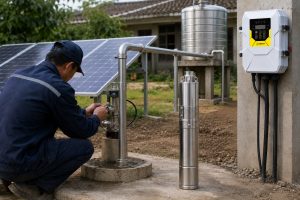
A high-quality solar pump system can effectively work in wells with up to 1,000 feet of total pumping head. This is different from the pump's physical submersion depth, which is typically limited to around 400 feet due to water pressure on the unit's seals.
Understanding the capabilities of solar pumps is the first step toward water independence.
These systems are not just for shallow applications; modern technology has pushed their limits to serve even the deepest wells.
However, selecting the right pump involves more than just looking at the maximum depth rating.
You need to understand your specific well's characteristics and your daily water needs.
Let's explore the factors that determine how deep a solar pump can work for you and which type of pump is best suited for your unique situation.
What is a solar water pump and how does it work?
Tired of hauling water or paying for fuel to run a generator pump?
The constant labor and expense are draining your resources and your time.
Solar pumps harness the sun's free energy to deliver water wherever you need it.
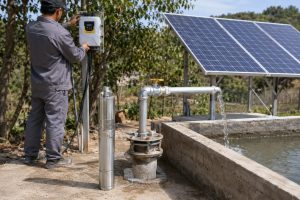
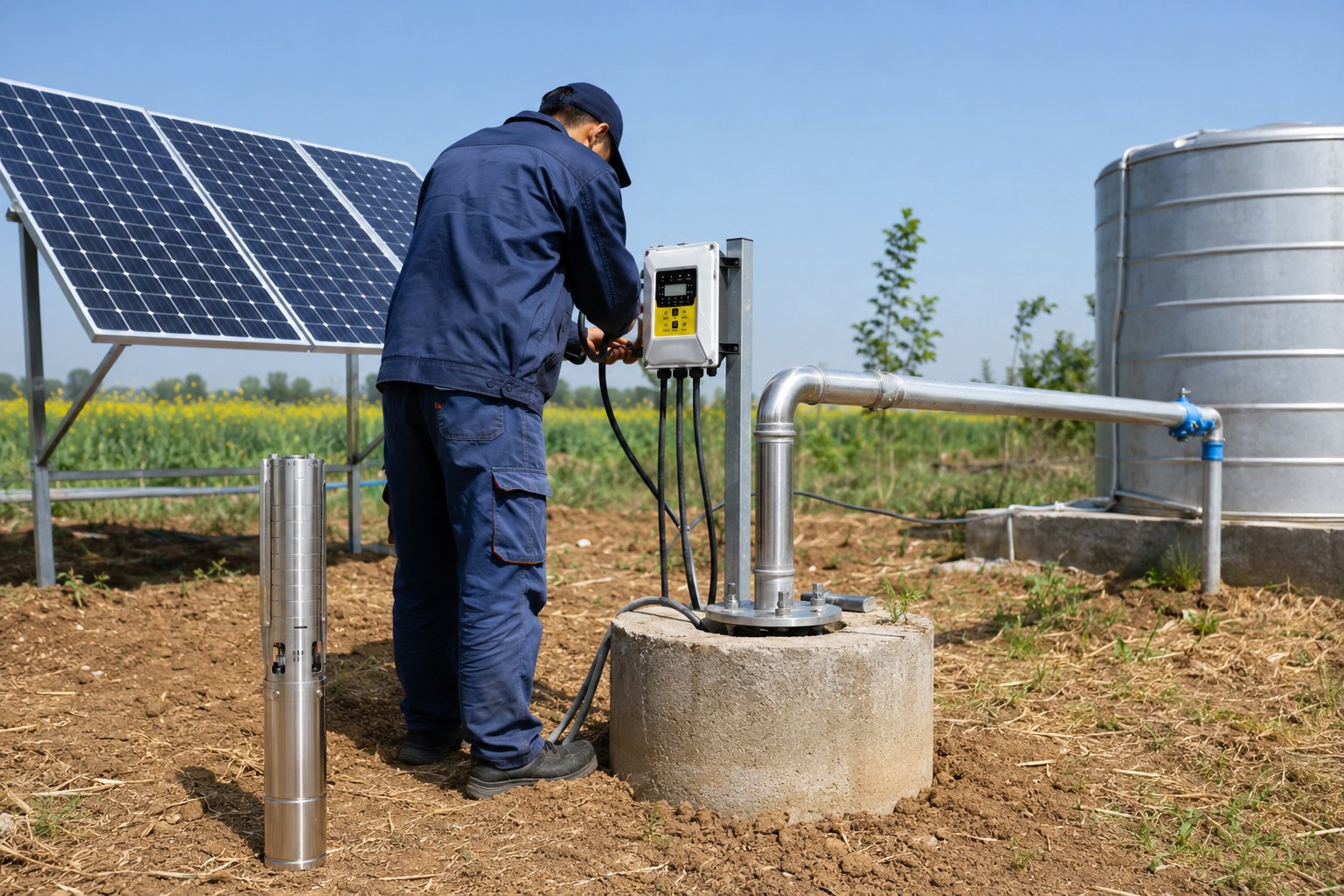
A solar water pump system uses photovoltaic (PV) panels to capture sunlight, converting it into electricity. This electricity powers a motor connected to a pump, which then moves water from a source like a well, river, or pond to your desired location, such as a tank or irrigation system.
A solar water pump operates on a simple yet brilliant principle: converting light into life-sustaining water flow.
It’s an elegant solution for remote locations where grid power is unavailable, unreliable, or simply too expensive to install.
The entire system is a synergistic collection of components designed for maximum efficiency and durability.
Understanding these parts helps demystify the technology and empowers you to appreciate its value.
Core Components of a Solar Pumping System
The system is more than just a pump; it's a complete ecosystem.
Each part plays a critical role in its overall performance.
A failure or inefficiency in one component can compromise the entire system's output.
| Component | Function | Key Insight |
|---|---|---|
| Solar PV Panels | Capture photons from sunlight and convert them into DC electricity. | The size of the array (number and wattage of panels) directly determines the maximum power available to the pump. |
| Pump Controller | Manages the power from the panels to the motor, often including MPPT. | An MPPT (Maximum Power Point Tracking) controller can boost water output by up to 30% by optimizing the power harvest. |
| Motor | Converts electrical energy from the controller into mechanical energy to drive the pump. | High-efficiency BLDC (Brushless DC) motors are the gold standard, with efficiencies exceeding 90%. |
| Pump Unit | The mechanical assembly (e.g., screw or impeller) that physically moves the water. | The type of pump unit determines the system's flow rate and pressure (head) characteristics. |
The Journey from Sunlight to Water Flow
The process begins the moment sunlight strikes the solar panels.
The PV panels are made of semiconductor materials, usually silicon.
When photons hit these cells, they excite electrons, creating a direct current (DC) electrical flow.
This raw DC power is then fed into the pump controller.
The controller is the brain of the operation.
It refines the power, protects the motor from voltage spikes or drops, and crucially, it optimizes the energy transfer.
Using MPPT technology, the controller constantly scans the output of the panels and adjusts the electrical load to ensure it's harvesting the absolute maximum amount of power available at any given moment of sunlight intensity.
This optimized DC power then energizes the motor.
Modern systems overwhelmingly use BLDC permanent magnet motors.
These motors are up to 30% more efficient than older brushed DC or standard AC motors, meaning you get more water for every watt of solar power generated.
Finally, the motor's rotation drives the pump unit, which draws water from the source and pushes it through your pipes.
Understanding Pumping Depth: Total Head vs. Submersion Depth
Confused by pump specifications listing "total head," "lift," and "submersion depth"?
Choosing the wrong pump based on a misunderstanding can lead to poor performance or system failure.
These terms define different, but equally important, aspects of a pump's capability.
Total head is the maximum vertical equivalent distance a pump can move water, including lift from the well, elevation changes, and pressure. Submersion depth is simply how far below the water's surface the pump itself can be safely placed without being damaged by external pressure.
Getting these two concepts right is the most critical part of sizing a solar pump for a deep well.
Many people mistakenly believe a pump with a 1,000-foot head rating can be placed 1,000 feet deep in water.
This is incorrect and could lead to a costly mistake.
The head rating is about the pump's power to push a column of water upward, while the submersion rating is about the pump's structural integrity to withstand external pressure.
Let's break down how to calculate your actual needs.
Calculating Your Total Dynamic Head (TDH)
Total Dynamic Head, or TDH, is the real-world workload your pump will face.
It's the sum of all the vertical and pressure-equivalent forces the pump must overcome.
You can calculate it with a simple formula:
TDH = Static Water Level + Elevation Gain + Friction Loss + Pressure Head
- Static Water Level: This is the distance from the ground down to the surface of the water in your well when the pump is off.
- Elevation Gain: This is the vertical height difference between the top of the well and the inlet of your storage tank.
- Friction Loss: As water moves through pipes, it loses energy due to friction. This is influenced by pipe diameter, length, and flow rate. For most DIY calculations, adding 10% to the total head is a conservative estimate.
- Pressure Head: If you are pumping into a pressure tank, you must add the pressure equivalent in feet. The conversion is 2.31 feet of head for every 1 PSI of pressure. For a standard 40/60 PSI tank, you would use the cut-off pressure (60 PSI) for your calculation: 60 PSI * 2.31 = 138.6 feet.
Why Submersion Depth Matters
While TDH tells you how powerful your pump needs to be, the submersion depth tells you where you can place it.
The deeper a pump goes, the greater the external water pressure on its seals and housing.
Most solar submersible pumps are engineered to withstand the pressure at depths of up to about 400 feet.
Exceeding this can force water past the seals and into the motor, causing catastrophic failure.
If you have a very deep well (e.g., 800 feet deep) but the static water level is at 300 feet, you can safely place the pump at 350 feet below the surface.
The pump will be well within its submersion limit while still having plenty of power to push the water up the remaining 450 feet to the surface (assuming its TDH rating is high enough).
Which Type of Solar Pump is Right for Your Depth?
Facing a deep well and need water, but unsure which pump technology is best?
Choosing between high flow for irrigation or high head for a deep well can be confusing.
The right pump type perfectly balances your well's depth with your required water volume.
For extremely deep wells (over 500 feet), a solar screw pump is ideal due to its high-head, low-flow nature. For moderate depths with higher volume needs, like farm irrigation, a centrifugal pump with either a plastic or stainless steel impeller is the better choice.
The heart of your solar water system isn't just the motor; it's the pump end itself.
The mechanical design of the pump dictates its performance curve—how much water it can move at a given pressure or head.
The two dominant designs in the solar deep well market are screw (or progressive cavity) pumps and centrifugal pumps.
They work very differently and are engineered for completely different applications.
Choosing the right one is the key to an efficient and long-lasting system.
The Specialist: Solar Screw Pumps for High Head
A screw pump works like an Archimedes' screw.
It uses a single helical rotor spinning inside a rubber stator.
This creates sealed cavities of water that are pushed progressively up the pump, generating very high pressure.
This design is perfect for low-flow, high-head applications.
They are the go-to solution for deep domestic wells where you need to lift water from great depths but don't require massive volumes.
Their ability to handle some sand and sediment is another significant advantage in many well conditions.
- Best For: Extreme depth and pressure.
- Typical Head: 500 ft to 1,000 ft.
- Typical Flow Rate: Low (1-10 Gallons Per Minute).
- Key Advantage: Unmatched ability to lift water from deep boreholes.
The Workhorse: Solar Centrifugal Pumps for High Flow
A centrifugal pump uses a spinning impeller (or a stack of them in a multi-stage pump) to move water.
Water is drawn into the center of the spinning impeller and thrown outward by centrifugal force, creating pressure and flow.
These pumps are masters of moving large volumes of water at low to medium heads.
They are the standard for farm irrigation, livestock watering, and filling ponds.
Within this category, the impeller material creates another level of choice.
- Plastic Impeller Pumps: These use durable, engineered plastic impellers. They offer a fantastic balance of performance and cost. They are lightweight, have excellent resistance to fine sand (which can be abrasive), and can produce very high flow rates. This makes them a top choice for agricultural applications in regions like Africa and the Americas.
- Stainless Steel Impeller Pumps: These are the premium option. Using SS304 or SS316 stainless steel for the impellers and pump body provides superior durability and resistance to corrosion. They are essential for wells with acidic or alkaline water, common in parts of Australia or industrial areas. While they come at a higher cost, their longevity in harsh water conditions is unmatched.
Comparison Table: Choose Your Champion
| Feature | Solar Screw Pump | Solar Centrifugal (Plastic) | Solar Centrifugal (Stainless Steel) |
|---|---|---|---|
| Primary Goal | High Head | High Flow | High Flow & Durability |
| Ideal Depth | > 500 ft | < 500 ft | < 600 ft |
| Flow Rate | Low | High | High |
| Sand Handling | Excellent | Very Good (fine sand) | Good |
| Cost | Moderate | Economical | Premium |
| Common Use | Deep Home Well | Farm Irrigation | Corrosive Water, Ranches |
The Unseen Hero: Why the Motor Matters More Than You Think
Think the pump's performance is all about the part that touches the water?
Focusing only on the pump end can lead to an inefficient system that needs more solar panels and costs more to run.
The motor is the true heart of the system, and its efficiency dictates everything.
A high-efficiency Brushless DC (BLDC) motor is the most critical component for performance. Its efficiency, often exceeding 90%, directly reduces the number of solar panels needed, lowers overall system cost, and ensures a longer, maintenance-free service life compared to older motor types.
While the pump end (screw vs. centrifugal) gets a lot of attention, the motor that drives it is arguably more important for the system's overall efficiency and long-term value.
Two pumps might look similar on the outside, but a 20% difference in motor efficiency can mean the difference between needing four solar panels or six to get the same amount of water.
This has a massive impact on the initial purchase price and installation complexity.
This is why the industry has rapidly standardized around one particular motor technology.
What is a BLDC Motor?
BLDC stands for Brushless Direct Current.
As the name implies, these motors have no brushes.
Traditional motors use carbon brushes to transfer power to the spinning rotor, but these brushes create friction, generate heat, waste energy, and eventually wear out, requiring maintenance.
BLDC motors use an electronic controller and powerful permanent magnets (like Neodymium) to create rotation.
This design eliminates physical contact and friction, resulting in significant gains.
The Efficiency Advantage in Numbers
The impact of motor efficiency is not small; it's transformative.
- Energy Savings: A typical BLDC motor operates at over 90% efficiency, while an older brushed DC motor might be 70-75% efficient. This 15-20% difference means that for every 1000 watts of solar power generated, the BLDC motor delivers 150-200 more watts of useful mechanical power to the pump.
- Reduced Panel Cost: Because the motor uses power so effectively, you can achieve your target water flow with a smaller, less expensive solar array. A system that might have required 1200W of panels with a standard motor could perform just as well with only 900W of panels using a high-efficiency BLDC motor, representing a 25% savings on panels alone.
- Compact Design: Advanced BLDC motors are often significantly smaller and lighter than their less efficient counterparts—sometimes up to 47% smaller and 39% lighter. This makes installation easier, especially in deep wells, and reduces shipping costs.
- Longevity and Reliability: With no brushes to wear out, BLDC motors have a much longer operational lifespan and are virtually maintenance-free, a critical feature for a pump installed hundreds of feet underground.
The combination of the BLDC motor and an intelligent MPPT controller creates a powerful duo that squeezes every possible drop of water out of every ray of sunshine.
What If the Sun Isn't Shining?
Worried that choosing a solar pump means you'll be without water on cloudy days or at night?
This dependence on perfect weather is a major concern for many potential users.
Hybrid controllers solve this problem by automatically blending or switching to an alternate power source.
Hybrid AC/DC solar pump systems provide a 24/7 water guarantee. An intelligent controller prioritizes free solar energy but will automatically draw power from the AC grid or a generator when sunlight is insufficient, ensuring you have uninterrupted water flow whenever you need it.
The biggest mental hurdle for many when considering solar power is its intermittency.
What happens when a series of cloudy days roll in, or you need to irrigate a field after sunset?
Historically, the answer was to build a massive water storage system (tanks) or simply go without water.
Modern technology offers a much more elegant and convenient solution: the hybrid AC/DC controller.
This innovation bridges the gap between off-grid savings and on-grid reliability.
The Smarts of a Hybrid Controller
The hybrid controller is designed with two power inputs: one for the DC power from your solar panels and one for AC power from the grid or a generator.
The internal logic is programmed to be "solar first."
It works in a clear priority sequence:
- Full Solar: If the solar panels are producing enough power to run the pump at the desired speed, the controller uses 100% free solar energy. The AC input is dormant.
- Blended Power (Hybrid Function): If clouds reduce the solar output, the controller doesn't just shut down. It intelligently calculates the shortfall and draws only the necessary amount of AC power to supplement the solar input, keeping the pump running smoothly. This maximizes the use of every available watt of solar energy.
- Full AC: At night, or during extremely heavy overcast, when there is zero solar input, the controller automatically switches over to run the pump entirely from the AC source.
The transition between these modes is seamless and fully automatic.
There are no switches to flip or settings to change.
You get the water you need, and the controller ensures it's done in the most cost-effective way possible.
Benefits of a Hybrid Water System
This approach offers the best of both worlds.
It provides the peace of mind of a traditional grid-powered pump with the significant cost savings of a solar pump.
- Total Reliability: Your water supply is no longer dependent on the weather. This is critical for livestock, sensitive crops, and domestic water use.
- Maximum Savings: You are always using the maximum amount of free solar energy available, only paying for grid power when absolutely necessary. This keeps electricity bills to a minimum.
- System Simplicity: It can potentially reduce the need for oversized water tanks or battery banks, simplifying the system and reducing initial costs and long-term maintenance.
A hybrid system is the ultimate solution for anyone who has access to an AC source but wants to leverage solar power to drastically reduce their operational costs without sacrificing reliability.
Conclusion
Choosing the right solar pump depends on your well's depth, water quality, and volume needs.
Matching the pump type and motor efficiency is key to a reliable, cost-effective water solution.
FAQs
How long do solar water pumps last?
A quality system has a long lifespan. Solar panels can last over 25 years, BLDC motors often run for 10+ years, and the pump unit itself may need service every 3-5 years depending on water conditions.
Can a solar pump work on cloudy days?
Yes, but at a reduced flow rate. The pump's output is directly proportional to the amount of sunlight. Hybrid systems can supplement with AC power on cloudy days.
Do solar pumps need batteries?
Most systems do not. It's more efficient and cost-effective to pump water into a storage tank during the day and use gravity for distribution, effectively making the tank a "water battery."
How much does a solar water pump system cost?
Costs vary widely from a few hundred to many thousands of dollars. Price depends on the required depth (head), flow rate, and component quality.
How do you size a solar water pump?
Sizing requires two key figures: your Total Dynamic Head (TDH) to determine the required pressure, and your daily water volume requirement (gallons per day) to determine the flow rate.
Are solar pumps difficult to maintain?
They are very low-maintenance. The primary tasks are keeping solar panels clean and occasionally checking electrical connections. Brushless motors require no internal maintenance.
What is the difference between a surface and a submersible solar pump?
A surface pump sits on the ground and is best for sources like ponds or shallow wells (less than 22ft). A submersible pump is placed down inside the water source, ideal for deep wells.
Can I run a solar pump directly from panels without a controller?
It is not recommended. A controller protects the motor from irregular voltage, prevents damage, and uses MPPT technology to increase water output by up to 30%.