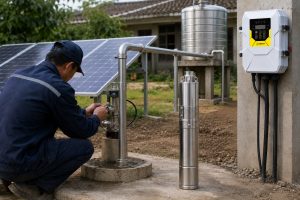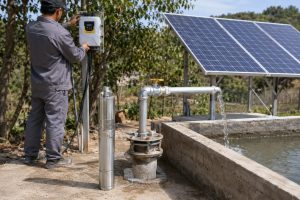
Struggling with unreliable water access and high energy bills in remote locations?
A complete solar-powered water pump system can cost between $500 and $5,000.
The final price depends heavily on the pump type, motor efficiency, the depth of your well, and the amount of water you need.
This range typically covers systems from basic residential use to small-scale agricultural irrigation.
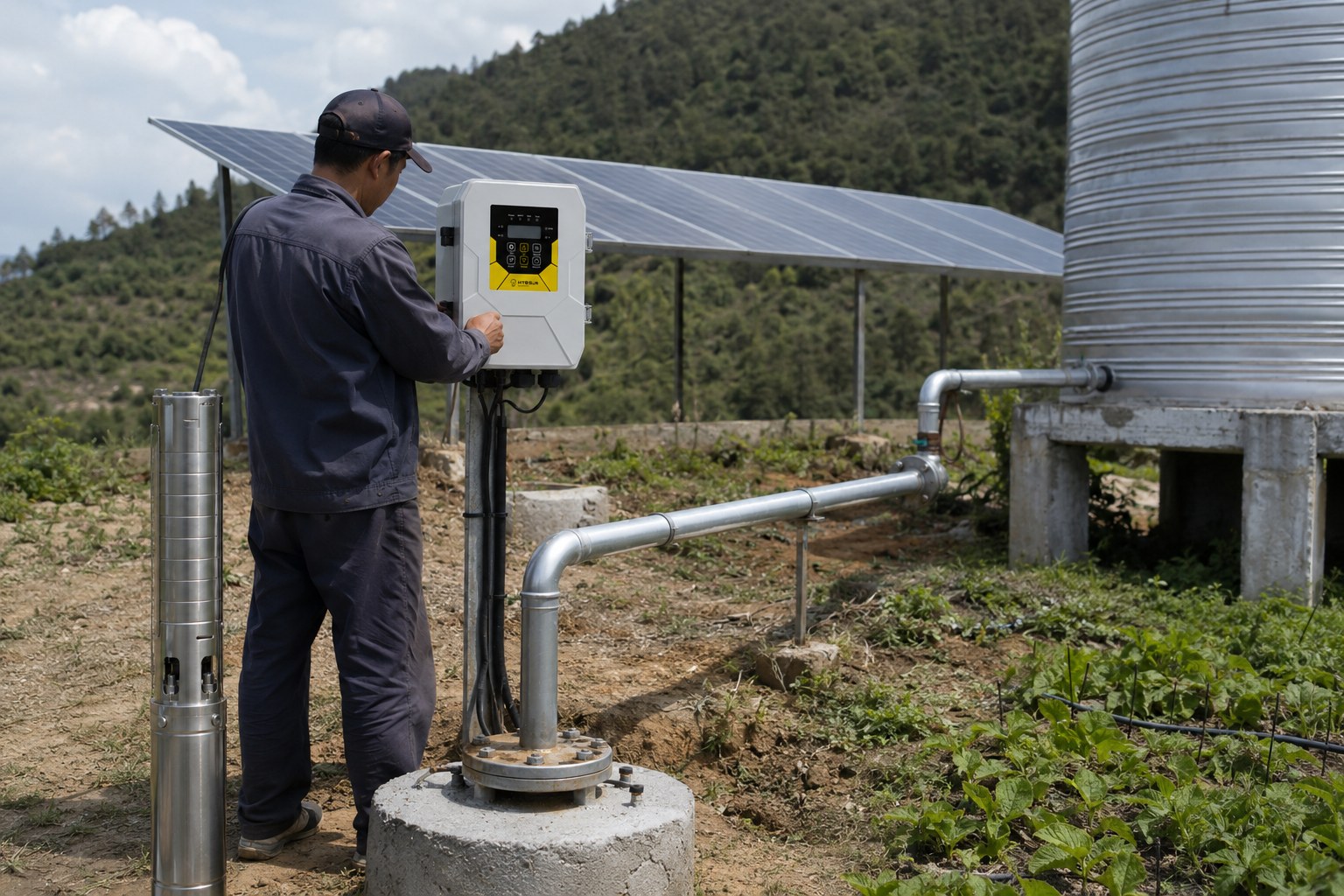
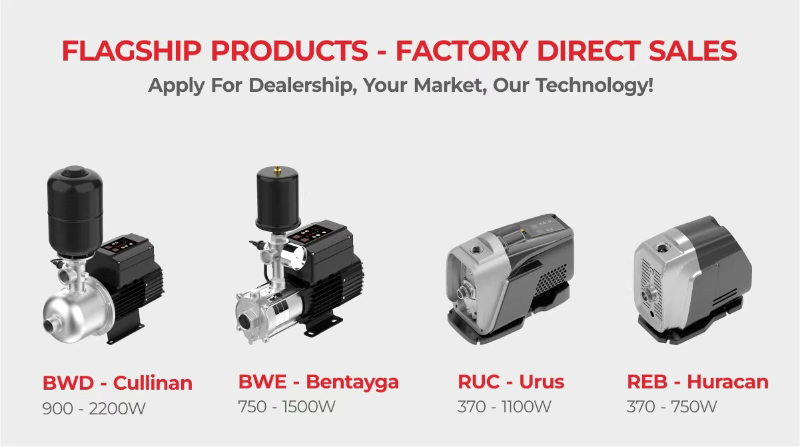
To find the right pump at the right price, you must understand the key components that drive both cost and performance.
These systems are more than just a pump; they are a combination of parts working together.
Understanding these parts helps you avoid overpaying or buying a system that fails to meet your needs.
Let's break down the different pump types, the motors that power them, and the controllers that make them smart, so you can make an informed investment.
Why a Solar Screw Pump Might Be Your High-Head Solution
Do you need to lift water from an exceptionally deep well?
A standard pump might not have the power to do the job.
This is where specialized designs become necessary.
A solar screw pump is the perfect tool for deep wells, offering very high head (pressure) with a lower flow rate. It excels at pushing water from depths over 100 meters, making it ideal for domestic and livestock water supply in remote, off-grid areas.
How a Screw Pump Achieves High Head
The solar screw pump, also known as a progressing cavity pump, operates on a simple yet powerful principle.
It uses a single helix-shaped stainless steel rotor that turns inside a double helix rubber stator.
As the rotor turns, it creates sealed cavities of water that "progress" from the pump's intake to the outlet.
This positive displacement action pushes the water upward with immense force.
This design is fundamentally different from centrifugal pumps, which use velocity to move water.
The screw mechanism generates pressure directly, allowing it to overcome the massive weight of a water column in a very deep well.
This makes it a reliable choice where other pumps would fail.
Key Performance Metrics and Applications
The main trade-off with a screw pump is flow rate versus head.
It is designed for low flow and high head applications.
| Feature | Performance Characteristic | Best Use Case |
|---|---|---|
| Head (Pressure) | 70m - 200m+ | Very deep wells, lifting water to high elevations. |
| Flow Rate | Low (e.g., 0.5 - 2 m³/hour) | Domestic water supply, livestock troughs, drip irrigation. |
| Sand Resistance | Excellent | Can handle water with up to 3% sand content without damage. |
| Cost | Mid-Range | More expensive than a basic pump but valued for its specific capability. |
Its incredible resistance to sand is a major advantage in regions with challenging water quality, like parts of Africa and Latin America.
The rubber stator can handle abrasive particles that would quickly wear down the tight tolerances of other pump types.
Limitations to Consider
The primary limitation is its low flow rate.
This pump is not suitable for applications requiring large volumes of water quickly, such as flood irrigation for large farms.
Its design is specialized for depth, not volume.
For distributors, it represents a crucial part of a product portfolio, serving a specific but vital market segment of customers with deep wells.
When to Choose a High-Flow Solar Plastic Impeller Pump
Do you need to move a large volume of water for a farm or pasture?
A low-flow pump simply won't be able to keep up with demand.
You need a solution designed for high output.
For high-volume needs like farm irrigation, a solar plastic impeller pump is a highly cost-effective choice. It delivers high flow rates at a medium head, is lightweight, and offers good resistance to fine sand, making it a popular workhorse for agriculture.
The Power of a Multi-Stage Centrifugal Design
This pump works by using a series of impellers stacked on top of each other.
Each impeller is a spinning disk with vanes that hurls water outward at high speed.
The water is then collected in a diffuser, which converts the velocity into pressure.
This pressurized water is fed into the next impeller stage, which adds even more velocity and pressure.
By stacking multiple stages, the pump can achieve a useful combination of both high flow and medium head.
The use of durable, engineered plastic for the impellers makes the pump lightweight and more affordable to manufacture.
This makes it an excellent choice for a wide range of applications, especially in the agricultural sectors of Africa and the Americas.
Performance and Cost-Effectiveness
The plastic impeller pump strikes a balance between performance, durability, and cost.
It provides the high water output that farms and ranches need without the premium price tag of all-metal pumps.
| Feature | Plastic Impeller | Stainless Steel Impeller |
|---|---|---|
| Cost | $ | $$$ |
| Flow Rate | High | High |
| Wear Resistance | Good (for fine sand) | Excellent (for abrasives) |
| Corrosion Resistance | Moderate | Excellent |
| Weight | Lightweight | Heavy |
While not as tough as stainless steel, modern engineering plastics are highly resistant to the fine sand often found in agricultural wells.
This makes the pump a reliable and economical solution for its intended purpose.
Where It Shines and Where It Falls Short
This pump is the go-to option for many general-purpose water needs.
Ideal Applications:
- Farm irrigation for crops.
- Water supply for large herds of livestock.
- Filling ponds or reservoirs.
- Large residential gardens.
However, it has its limitations.
In highly corrosive water (acidic or alkaline), the plastic and other components may degrade over time.
Furthermore, its durability is less suited for the extreme pressures found in very deep wells, where a screw pump or a stainless steel model would be a better long-term choice.
For distributors, this pump is a high-volume seller, meeting the needs of the broad agricultural market.
Is a Stainless Steel Impeller Pump Worth the Premium Cost?
Is your local water quality poor, causing pumps to fail prematurely?
Corrosion can quickly destroy your investment and leave you without water.
This is where material selection becomes critical.
A solar stainless steel impeller pump is the premium solution for maximum durability and corrosion resistance. It is specifically engineered for harsh water environments, such as acidic or alkaline sources, ensuring a long and reliable service life where other pumps would quickly fail.
Built for the Toughest Conditions: The SS304 Advantage
The core of this pump's resilience lies in its materials.
The impellers, diffusers, and pump body are typically constructed from SS304 stainless steel.
This grade of steel contains high levels of chromium and nickel, which form a passive, non-reactive layer on the surface.
This layer protects the underlying metal from rust and chemical attack.
This makes the pump exceptionally well-suited for:
- Acidic Water: Prevents the metal from being eaten away.
- Alkaline Water: Resists mineral buildup and scaling.
- Salty or Brackish Water: Greatly reduces the risk of corrosion compared to cast iron or plastic.
This robust construction ensures the pump maintains its performance and structural integrity for many years, even in the most challenging water.
High-End Performance and Long-Term Value
While the upfront cost is higher, a stainless steel pump often provides a lower total cost of ownership in the right application.
Its long service life means fewer replacements and less downtime.
| Feature | Description | Value Proposition |
|---|---|---|
| Material | SS304 Stainless Steel | Superior resistance to corrosion and abrasion. |
| Performance | High Flow & Medium-to-High Head | Versatile for both irrigation and deep well applications. |
| Lifespan | 10+ years | A long-term investment that outlasts cheaper alternatives. |
| Reliability | Very High | Reduces the risk of unexpected pump failure. |
| Cost | High | The initial investment is offset by durability and longevity. |
This pump is for users who cannot afford to take risks with their water supply.
It is popular in regions with known water quality issues, such as the alkaline soil areas of Australia or certain coastal regions in the Americas.
A Niche Product for a Demanding Market
The stainless steel impeller pump targets a high-end, niche market.
It is the ideal choice for high-value homes, critical agricultural operations, and any application where water reliability is non-negotiable.
The added weight and cost are justified by its "set it and forget it" durability.
For a distributor, offering this premium option establishes a reputation for quality and demonstrates the ability to solve even the most difficult water challenges for discerning customers.
The Unseen Hero: Why the Motor Determines Your Real Cost
Are you worried about the high cost and large space required for solar panels?
The efficiency of the pump's motor is the secret to major savings on your total system.
An efficient motor does more work with less power.
The heart of any modern solar pump is its motor. A high-efficiency Brushless DC (BLDC) permanent magnet motor can reduce your required solar panel array by up to 25%, significantly lowering the total system cost while boosting overall water output.
What Makes a BLDC Motor So Efficient?
A Brushless DC (BLDC) motor represents a major leap in technology compared to older brushed DC or AC motors.
Its high efficiency comes from several key design features:
- No Brushes: Traditional motors use carbon brushes to transfer power to the rotor. These create friction, heat, and wear, wasting up to 20-30% of the energy. BLDC motors use an electronic controller, eliminating this waste.
- Permanent Magnets: The rotor is made with powerful rare-earth magnets, such as 40SH neodymium iron boron. This creates a strong magnetic field without consuming any electricity, unlike induction motors.
- Intelligent Control: The electronic controller precisely manages the power sent to the motor's windings, ensuring it operates at peak efficiency across a wide range of speeds.
As a result, a good BLDC motor can achieve an electrical-to-mechanical conversion efficiency of over 90%.
Standard motors often struggle to reach 60-70%.
The Financial Impact of High Efficiency
This efficiency gap has a direct and significant impact on the total cost of your solar water pump system.
Fewer solar panels are needed to produce the same amount of water.
Let's look at an example for a 750-watt pump:
| Motor Efficiency | Required Solar Input | Typical Solar Array |
|---|---|---|
| 70% (Standard Motor) | 750W / 0.70 = 1071 Watts | 4 x 300W Panels (1200W) |
| 90% (BLDC Motor) | 750W / 0.90 = 833 Watts | 3 x 300W Panels (900W) |
Choosing a pump with a high-efficiency BLDC motor can save you the cost of one or more solar panels, along with the associated mounting hardware and wiring.
This can reduce the total system cost by 15-25%.
Technical Advantages Beyond Cost Savings
The benefits of a BLDC motor go far beyond just efficiency.
They are also:
- More Compact and Lighter: Often 40-50% smaller and lighter than traditional motors of the same power output. This makes installation easier and cheaper.
- Higher Torque: They produce high torque even at low speeds, which is excellent for starting the pump under load, especially on cloudy mornings.
- Maintenance-Free: With no brushes to wear out, the motor is sealed for life and requires no maintenance.
- Longer Lifespan: The cooler, frictionless operation results in a significantly longer service life.
The motor is the core driver of the entire system's performance and long-term value.
Insisting on a high-efficiency BLDC motor is one of the smartest decisions you can make when purchasing a solar pump.
Maximizing Your Investment with Intelligent Controllers
What if you could get more water from your pump, even on cloudy days?
An intelligent controller acts as the brain of your system, ensuring you get the most out of every drop of sunlight.
It protects your investment and maximizes performance.
An MPPT (Maximum Power Point Tracking) controller is an essential component that can boost your pump's daily water output by 25-30%. It works by constantly optimizing the power drawn from the solar panels, ensuring the motor runs efficiently from sunrise to sunset.
How MPPT Unlocks More Power
A solar panel's power output (a combination of voltage and current) changes constantly with the intensity of sunlight.
An MPPT controller's job is to find the "Maximum Power Point"—the ideal voltage and current combination that extracts the most possible watts from the panels at any given moment.
Without MPPT, a pump connected directly to the panels would operate at a non-optimal voltage, wasting a significant amount of potential power.
- In the morning and evening: When sunlight is weak, MPPT finds the best power point to allow the pump to start earlier and run later.
- On cloudy days: As clouds pass, the controller instantly adjusts to the changing light conditions, keeping the pump running smoothly instead of stalling.
This intelligent management can be the difference between having water all day and having it for only a few hours around noon.
The AC/DC Hybrid Advantage for 24/7 Water
For critical applications, relying solely on the sun is not always enough.
Advanced systems offer AC/DC hybrid controllers, providing ultimate flexibility and reliability.
These controllers are designed with two separate power inputs: one for solar (DC) and one for an AC source like the grid or a generator.
The controller's logic prioritizes solar power automatically.
- Full Sun: The system runs 100% on solar power.
- Low Sun/Cloudy: The hybrid function can blend AC power with the available solar power to maintain pump operation, maximizing the use of free energy.
- Night/No Sun: The controller automatically switches over to the AC power source to ensure you have water 24 hours a day.
This feature is invaluable for households and farms that need a constant, worry-free water supply without having to manually switch power sources.
Essential Protection Features
A good controller does more than just optimize power.
It also serves as a critical protection device for your pump and motor, safeguarding your investment.
Look for controllers with these built-in safety features:
- Dry Run Protection: Senses when the well has no water and shuts off the pump to prevent it from burning out.
- Over-Voltage/Under-Voltage Protection: Protects the motor from damaging power fluctuations.
- Over-Current/Over-Load Protection: Prevents the motor from drawing too much power and overheating.
- Reverse Polarity Protection: Prevents damage if the solar panels are accidentally wired backward during installation.
These features drastically extend the lifespan of the pump, reducing long-term maintenance costs and providing peace of mind.
Conclusion
The true cost of a solar pump is not its purchase price.
It is the long-term value derived from its efficiency, durability, and intelligence, ensuring reliable water for years to come.
FAQs
How long do solar water pumps last?
A quality solar water pump system can last 15-20 years.
The solar panels have a lifespan of 25+ years, while the pump and motor may require servicing after 10-15 years depending on usage and water quality.
Can a solar pump work without a battery?
Yes, most solar water pumps are designed to work directly from solar panels without batteries.
They pump water when the sun is shining and stop when it's dark, storing water in a tank instead of energy in a battery.
How deep can a solar water pump go?
This depends on the pump type.
Solar screw pumps are designed for very deep wells, capable of lifting water from over 200 meters.
Centrifugal pumps are better for shallower wells, typically up to 80-100 meters.
How many solar panels do I need for a water pump?
The number of panels depends on the pump's power rating and motor efficiency.
A small 250W pump might only need one 300W panel, while a larger 1500W pump could require five or six panels.
Can solar pumps run at night?
A standard solar pump cannot run at night without sunlight.
However, systems with an AC/DC hybrid controller can automatically switch to grid or generator power to pump water 24/7.
What is the main disadvantage of a solar water pump?
The main disadvantage is the high initial investment cost compared to a conventional pump.
Additionally, their performance is dependent on weather and sunlight availability unless paired with a backup power source.
Are solar water pumps worth the money?
For off-grid locations, absolutely.
They eliminate ongoing fuel costs and reliance on an unstable power grid.
The initial investment is typically recovered in 2-4 years through energy savings, making them very cost-effective long-term.