Struggling with unreliable water access in off-grid areas?
Solar pumps are a great solution, but they aren't without potential downsides that you must consider before investing.
The primary weakness of a solar water pump is its dependence on sunlight.
Its performance can be significantly reduced by cloudy weather, shorter winter days, or nighttime, leading to inconsistent water supply if the system is not designed correctly.
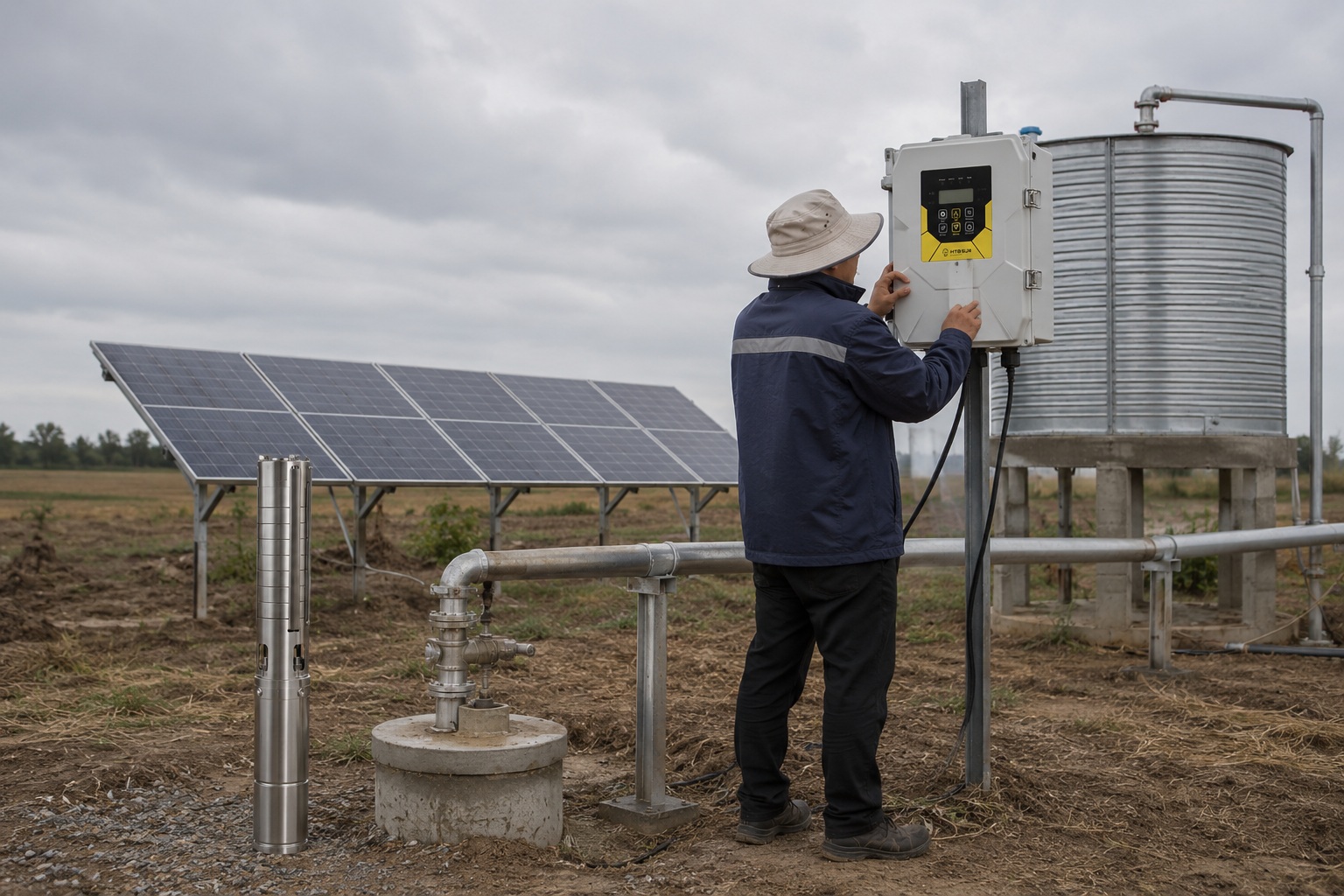
This dependency on the sun is a real concern.
But what if the biggest "weakness" isn't the sun, but choosing the wrong tool for the job?
The truth is, many perceived failures of solar pumps come from a simple mismatch between the pump's design and the user's needs.
Let's explore how selecting the right pump type turns a potential weakness into a powerful strength, ensuring you get the water you need, when you need it.
Understanding these differences is the first step to building a reliable and efficient water system.
The "Wrong" Pump for the Job: A Closer Look at Application Mismatches
You've picked a solar pump, but it's not delivering.
The problem might not be the sun, but a simple mismatch between the pump type and your specific water requirements.
A common weakness arises from application mismatch.
For instance, using a low-flow screw pump for large-scale irrigation will fail, just as a plastic impeller pump will struggle in highly corrosive water.
Matching the pump to the water source is critical.
A solar water pump system is only as strong as its most unsuitable component.
Choosing the wrong pump type for your specific conditions is the most common point of failure, creating a weakness that has nothing to do with solar power itself.
An incorrectly specified pump will underperform, wear out prematurely, and ultimately fail to meet your water demands, leading to frustration and wasted investment.
This is why a flexible product portfolio is essential for distributors and why end-users must understand the distinct advantages and limitations of each pump model.
The three most popular types of solar deep well pumps each serve a unique purpose.
Let's break down how their specific designs can become a weakness if misapplied.
Solar Screw Pumps: High Head, but at What Flow?
Solar screw pumps, also known as progressing cavity pumps, are engineering marvels for deep well applications.
They use a stainless steel screw-shaped rotor rotating inside a rubber stator.
This action creates sealed cavities that move water upwards with tremendous force, allowing them to achieve a very high head, often exceeding 150-200 meters.
Their design also makes them highly resistant to sand and sediment, a common issue in boreholes.
However, their inherent weakness is a low flow rate.
These pumps are designed to push, not to flood.
Using a screw pump for large-scale farm irrigation, where you might need over 10,000 liters per hour, would be a critical misapplication.
The pump would run constantly yet fail to deliver the necessary volume, creating a water deficit.
They are ideal for domestic water supply, livestock troughs, or small-scale drip irrigation, but they are the "wrong" choice for high-volume needs.
Solar Plastic Impeller Pumps: The High-Flow Workhorse with a Caveat
On the opposite end of the spectrum is the multi-stage centrifugal pump with plastic impellers.
These pumps are the go-to solution for high-flow applications like flood irrigation for farms or rapidly filling large pasture tanks.
They can deliver significantly more water per hour than a screw pump at a medium head.
The use of engineered plastic for the impellers makes them lightweight, economical, and surprisingly resistant to abrasion from fine sand.
This makes them a popular, cost-effective choice in many regions.
The weakness, however, lies in their durability under specific stresses.
In very deep wells, the immense pressure and load can cause premature wear on plastic components compared to their stainless steel counterparts.
Furthermore, they are not suited for highly corrosive water with abnormal pH levels, as certain chemicals can degrade the plastic over time.
Placing a plastic impeller pump in a deep, alkaline borewell is setting it up for a shortened service life.
Solar Stainless Steel Impeller Pumps: Built to Last, Priced for Value
For the most demanding environments, the solar stainless steel impeller pump is the premium choice.
Constructed with SS304 stainless steel impellers, diffusers, and pump bodies, this model is built for maximum durability.
Its primary strength is exceptional corrosion resistance, making it the only viable option for water sources with high acidity or alkalinity, such as those found in the alkaline soil regions of Australia or certain industrial runoff areas.
It combines high flow rates with high-pressure capabilities, offering a robust, long-term solution.
The perceived "weakness" here is its upfront cost and weight.
Stainless steel is significantly more expensive and heavier than engineered plastic.
For a customer with neutral pH water and a shallow well, investing in a stainless steel pump would be an unnecessary expense.
The added cost wouldn't provide any functional benefit, making it a poor financial choice.
This pump's strength is unlocked only in the harsh conditions it was designed for, making it a niche, high-value product rather than a universal solution.
| Pump Type | Best For | Key Weakness (When Misapplied) | Flow Rate | Head | Sand Resistance |
|---|---|---|---|---|---|
| Solar Screw Pump | Deep wells, domestic use, livestock | Very low flow rate for large-scale irrigation | Low | Very High | Excellent |
| Plastic Impeller Pump | Farm irrigation, high-volume needs | Poor durability in corrosive water or very deep wells | High | Medium | Good (Fine Sand) |
| Stainless Steel Impeller Pump | Corrosive/alkaline water, high-end applications | Higher initial cost and weight in normal conditions | High | Medium-High | Excellent |
The Core Weakness: Intermittent Power from the Sun
Worried about your water supply on cloudy days or at night?
The sun's intermittent nature is the most cited weakness of any solar-powered system, creating potential gaps in access.
The most significant weakness is inconsistent power due to weather and time of day.
Without sufficient sunlight, a standard solar pump stops working, making it unreliable for critical applications that require a 24/7 water supply.
This is the challenge that defines solar technology.
A solar water pump is fundamentally a reactive system; it can only convert the energy it receives in real-time.
A string of cloudy days, the shorter daylight hours of winter, or the simple fact that the sun sets every evening means that a purely solar-powered pump will have significant downtime.
For a homeowner who needs water for a shower at night or a farmer protecting crops during a multi-day overcast spell, this isn't just an inconvenience—it's a critical system failure.
However, modern solar pump systems have evolved with powerful technologies designed specifically to mitigate or even completely eliminate this core weakness.
The solution lies not in changing the weather, but in maximizing the energy that is available and having a reliable backup plan.
The Efficiency Equation: How Motors Amplify Weakness
The heart of any solar pump is its motor.
An inefficient motor is a massive hidden weakness because it wastes the precious solar energy it receives.
Consider a standard DC motor with an efficiency of 70%.
This means 30% of the power generated by your solar panels is lost as heat before it ever does any work.
In low-light conditions, this inefficiency is amplified.
The motor may fail to start or will operate at a very low speed, providing a mere trickle of water.
This is where the high-efficiency Brushless DC (BLDC) permanent magnet motor changes the game.
With efficiencies exceeding 90%, these advanced motors convert nearly all available solar energy into pumping power.
A BLDC motor can start earlier in the morning, run later in the evening, and perform better on overcast days than a less efficient counterpart.
This high efficiency has a direct financial benefit: a system with a 92% efficient motor might require 25% fewer solar panels to achieve the same water output as a system with a 70% efficient motor.
This significantly reduces the initial investment in panels, wiring, and mounting structures.
Furthermore, these motors are often 40-50% smaller and lighter, simplifying installation and reducing shipping costs.
A weak motor cripples the entire system; a high-efficiency BLDC motor makes it resilient.
Eliminating Downtime: The Power of AC/DC Hybrid Technology
While an efficient motor makes the most of sunny days, it doesn't solve the problem of nighttime or extended periods of no sun.
This is where the ultimate solution comes into play: the AC/DC hybrid controller.
This technology directly confronts the primary weakness of solar pumps and eliminates it.
An AC/DC hybrid system is designed with two power inputs: one for the DC power from your solar panels and another for an AC power source, such as the utility grid or a backup generator.
The intelligent controller constantly monitors the solar input.
When the sun is shining, the pump runs exclusively on free solar energy.
If clouds roll in and solar power drops, the controller automatically supplements the DC power with just enough AC power to maintain performance, maximizing the use of solar energy before drawing from the grid.
When the sun sets or if the photovoltaic input is zero, the controller seamlessly and automatically switches over to the AC power source.
This guarantees you have water 24 hours a day, 7 days a week, regardless of the weather.
It provides the environmental and cost-saving benefits of solar without sacrificing the reliability of a conventional electric pump.
For any application where a consistent water supply is non-negotiable, an AC/DC hybrid system transforms the solar pump's biggest weakness into a worry-free, best-of-both-worlds solution.
Beyond the Pump: Are System Complexity and Maintenance Hidden Weaknesses?
Is a solar water pump system too complex to install and maintain?
This fear often stops potential users, who imagine constant technical problems and costly upkeep for their off-grid water solution.
Perceived weaknesses like complex installation and high maintenance are often myths.
Modern systems are designed for simplicity.
The true weakness lies in systems lacking intelligent controllers or using outdated motors that require frequent service, unlike their brushless counterparts.
Any new technology can seem intimidating.
The idea of combining solar panels, controllers, and pumps can suggest a high degree of complexity and a future filled with maintenance headaches.
However, the reality of modern solar pump systems is quite the opposite.
These systems are engineered for reliability and ease of use in remote, off-grid environments where technical support is scarce.
The real weaknesses emerge not from the technology itself, but from cutting corners on critical system components or misunderstanding the minimal maintenance that is required.
Let's debunk some of these common fears and highlight where the true vulnerabilities lie.
The Unsung Hero: Why an MPPT Controller is Non-Negotiable
A solar pump system without an advanced controller is inherently weak.
The most crucial component here is the Maximum Power Point Tracking (MPPT) controller.
Solar panels have a complex relationship with voltage and current that changes constantly with sunlight intensity and temperature.
An MPPT controller acts as a smart DC-to-DC converter, constantly analyzing the output of the panels and adjusting the electrical load to pinpoint the "maximum power point."
This ensures the pump's motor receives the optimal voltage and current at all times.
A system with an MPPT controller can harvest up to 30% more power from the same solar array compared to a system with a basic or non-existent controller.
On a cloudy day, that 30% boost is the difference between getting a steady flow of water and getting nothing at all.
Choosing a pump system that lacks an integrated, intelligent MPPT controller is like buying a car with a leaky fuel line; you're guaranteed to waste energy and suffer from poor performance, creating a self-inflicted weakness.
Debunking the Maintenance Myth: Brushless vs. Traditional
The fear of constant maintenance often comes from experience with other types of machinery, like diesel generators.
Diesel pumps require regular refueling, oil changes, filter replacements, and engine servicing.
This is a significant, ongoing operational cost and logistical burden.
In contrast, a solar water pump system has very few moving parts.
The key here is the use of a Brushless DC (BLDC) motor.
As the name implies, these motors have no carbon brushes that wear out and need replacement.
This design makes the motor virtually maintenance-free over its entire lifespan, which can exceed 10 years.
The primary maintenance task for the entire system is simply cleaning the solar panels a few times a year to remove dust, pollen, or bird droppings that can block sunlight.
This is a simple task that takes minutes.
The perceived weakness of high maintenance is not only false but is actually one of the system's greatest strengths: near-zero ongoing maintenance costs, which provides a massive advantage over fossil-fuel-powered alternatives.
Installation: A One-Time Hurdle or a Lasting Advantage?
While the initial installation does require careful planning—such as orienting panels to face the sun and ensuring secure wiring—modern systems are designed for straightforward assembly.
The use of lightweight components, driven by the compact nature of BLDC motors, makes handling and installation far easier.
A complete solar pump system can often be installed by two people in a single day without the need for heavy lifting equipment.
Furthermore, it is a low-voltage DC system, which is inherently safer to work with than high-voltage AC grid power.
Once installed correctly, the system is set for over a decade of operation.
This one-time installation effort provides a lasting advantage: complete water independence without reliance on fuel deliveries or a stable electrical grid.
The "complexity" is a short-term process that unlocks long-term simplicity and reliability.
Conclusion
The true weakness of a solar water pump isn't the sun, but poor system design.
With the right pump, an efficient motor, and smart controls, it becomes an unbeatable solution.
FAQs
What is the main disadvantage of a solar pump?
The main disadvantage is its dependence on sunlight. Performance drops on cloudy days and ceases at night, which can be mitigated with AC/DC hybrid systems or battery storage.
How long do solar water pumps last?
A quality solar water pump system can last for over 10-15 years. The solar panels often have a 25-year warranty, and the maintenance-free brushless motor is built for longevity.
Can solar water pumps work at night?
Standard solar pumps cannot work at night. However, systems with an AC/DC hybrid controller can automatically switch to grid or generator power to ensure 24/7 operation.
Do solar pumps work on cloudy days?
Yes, but at a reduced capacity. High-efficiency motors and MPPT controllers maximize performance in low light, but output will be lower than on a bright, sunny day.
Are solar water pumps worth the money?
Yes, for off-grid or high electricity cost areas. The initial investment is offset by zero fuel costs, very low maintenance, and decades of reliable, independent water supply.
How do you increase solar water pump pressure?
Pressure (head) is determined by the pump's design. To increase pressure, you must choose a pump model specifically designed for higher head, such as a solar screw pump.
What size solar pump do I need?
The required size depends on your daily water needs, the vertical height you need to lift the water (head), and your geographic location's average sun hours.
Can a solar pump fill a tank?
Absolutely. A common and efficient setup is to have the solar pump fill a large storage tank during the day, providing a water reserve for use at any time.