Struggling to get water from a deep well?
A 2 hp pump seems powerful, but its actual depth capability is often confusing, leading to costly mistakes.
A 2 hp submersible pump can typically pump water from depths between 200 to 400 feet (60 to 120 meters).
However, the exact depth depends heavily on the pump’s design—whether it’s built for high head (depth) or high flow (volume)—and the required water output.
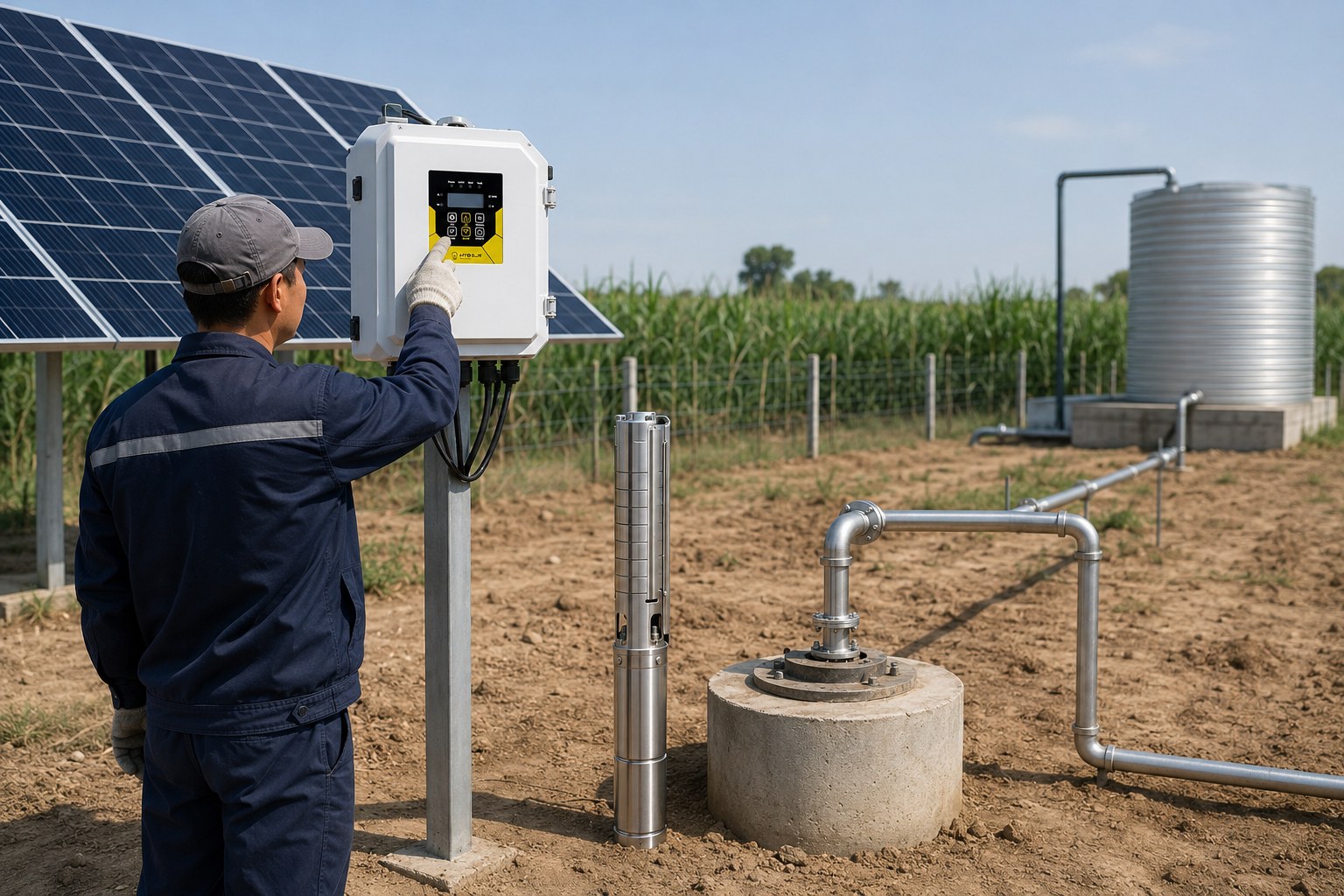
The horsepower rating on a pump is only part of the story.
To truly understand its capabilities, you need to look closer at its internal design, the motor that drives it, and the intelligence that controls it.
Let's explore the different types of 2 hp pumps to see how deep they can really go.
Solar Screw Pumps: The High-Head Specialists
Do you need to lift water from extreme depths?
Traditional pumps often fail, but a specialized design offers a powerful solution for the deepest wells.
Solar screw pumps are the champions of depth.
A 2 hp model can impressively push water from over 500 feet (150+ meters), making it ideal for arid regions where the water table is extremely low.
This focus on depth comes with a trade-off in flow rate.
Screw pumps, also known as progressive cavity pumps, are engineered for high-head, low-flow applications.
Their unique design allows them to generate immense pressure, making them the go-to solution for lifting water from wells that other pumps simply cannot reach.
A 2 hp solar screw pump stands as a testament to this specialized engineering, prioritizing depth over volume.
How Screw Pumps Generate Extreme Pressure
The magic behind a screw pump lies in its simple yet effective mechanism.
It consists of a single helical rotor, typically made of stainless steel, that rotates inside a double-helical rubber stator.
As the rotor turns, it forms a series of sealed cavities that progress from the pump's inlet to its outlet.
Water is trapped in these cavities and pushed upward with consistent pressure.
This compression-based method is fundamentally different from centrifugal pumps, which use velocity to move water.
The result is a consistent flow rate that is largely independent of the pumping depth (head), allowing it to perform reliably even in wells over 500 feet deep.
Performance in Deep Well Scenarios
The key advantage of a 2 hp screw pump is its ability to maintain pressure at great depths.
While a centrifugal pump's flow rate drops dramatically as depth increases, a screw pump's output remains relatively stable.
This makes it exceptionally reliable for domestic water supply, small-scale drip irrigation, and providing drinking water for livestock where the source is a deep borehole.
Its design also grants it superior resistance to sand and silt, as the rubber stator can flex to pass small abrasive particles without significant damage, a common failure point for impeller pumps.
| Pump Type (2 hp) | Max Recommended Head | Flow Rate at 400 ft (122 m) | Sand Resistance |
|---|---|---|---|
| Solar Screw Pump | 500+ ft (152+ m) | ~8 GPM (30 LPM) | Excellent |
| Centrifugal Impeller Pump | ~300 ft (91 m) | ~2 GPM (7.5 LPM) or less | Fair to Poor |
Limitations to Consider
The primary limitation of a screw pump is its inherently low flow rate.
A 2 hp model might only produce 5-10 gallons per minute (GPM).
This is more than enough for a household or a small herd of cattle but is insufficient for flood irrigation or applications requiring large volumes of water quickly.
The rubber stator is also a wear part that will eventually need replacement, though high-quality models offer a service life of several years.
Solar Plastic Impeller Pumps: The High-Flow Workhorses
Need to move a lot of water for your farm or garden?
High flow is essential, but finding an affordable and efficient pump can be challenging.
For high-volume applications, a 2 hp solar pump with plastic impellers is a great choice.
It excels at delivering large quantities of water from moderate depths, typically up to 250 feet (76 meters), making it perfect for irrigation and pasture water supply.
When the goal is to maximize water volume rather than depth, multi-stage centrifugal pumps with plastic impellers are the industry standard.
These pumps are designed to be efficient, lightweight, and cost-effective, offering an excellent balance of performance for a wide range of agricultural and residential uses.
A 2 hp model in this category is a true workhorse, capable of irrigating fields, filling large tanks, and supporting extensive gardens.
The Multi-Stage Centrifugal Design
Unlike a screw pump, a centrifugal pump uses a series of spinning impellers to move water.
Each impeller and diffuser combination forms a "stage."
Water enters the center of the first spinning impeller and is thrown outward by centrifugal force, gaining velocity.
The diffuser then converts this velocity into pressure.
The water is then guided into the next stage, where the process repeats, with each stage adding more pressure.
This multi-stage design allows the pump to achieve a respectable head, while the impeller's shape is optimized for moving a high volume of water.
The Flow vs. Head Trade-off
Every centrifugal pump operates on a performance curve that illustrates the inverse relationship between flow and head (depth).
A 2 hp plastic impeller pump will deliver its maximum flow rate at a very low head.
As the pumping depth increases, the flow rate decreases significantly.
For example, the pump might deliver 40 GPM at 50 feet but only 15 GPM at 200 feet.
This makes it crucial for users to match the pump's performance curve to their specific well depth and water requirements to ensure efficient operation.
Key Advantages of Plastic Impellers
The use of engineered plastic (like Noryl) for impellers offers several benefits.
- Cost-Effective: Plastic impellers are significantly cheaper to manufacture than stainless steel ones, making the overall pump more affordable.
- Lightweight: The reduced weight makes installation and maintenance easier, as the pump can be handled with less effort.
- Wear Resistance: High-quality plastic impellers offer good resistance to abrasion from fine sand, often outperforming metal in these specific conditions as the material has some flexibility.
These advantages make plastic impeller pumps a popular choice in markets across the Americas and Africa for general farming and residential applications where water isn't excessively deep or corrosive.
However, they are not suitable for very deep wells or environments with highly corrosive water, where the plastic can become brittle and fail over time.
Solar Stainless Steel Impeller Pumps: The Durability Meets Performance
Worried about your water's quality damaging your pump?
Corrosive water can destroy standard pumps quickly, leading to frequent and expensive replacements.
When longevity is paramount, a 2 hp pump with stainless steel impellers is the answer.
It combines good flow with robust corrosion resistance, reliably operating at depths up to 300 feet (91 meters) even in harsh, acidic, or alkaline water conditions.
For applications where water quality is a concern or where maximum reliability is non-negotiable, the solar stainless steel impeller pump is the premium choice.
This pump combines the high-flow characteristics of a multi-stage centrifugal design with the superior durability of stainless steel components.
A 2 hp model offers a robust and long-lasting solution, providing peace of mind in challenging environments and justifying its higher initial investment through a lower total cost of ownership.
The Unmatched Durability of Stainless Steel
The primary advantage of this pump type is its construction.
Using SS304 or even higher-grade SS316 stainless steel for the impellers, diffusers, and pump housing provides exceptional resistance to corrosion, rust, and abrasion.
This is critical in regions with acidic water (low pH) or alkaline water (high pH), such as the alkaline soil regions of Australia or parts of the Americas.
Unlike plastic, stainless steel will not become brittle or degrade when exposed to harsh chemicals or high temperatures.
This robust construction ensures a much longer service life and higher operational reliability.
Performance and Applications
In terms of performance, a 2 hp stainless steel impeller pump offers a similar flow-to-head curve as its plastic counterpart, delivering high flow rates at moderate depths up to around 300 feet.
The key difference is its ability to maintain this performance for many years without degradation.
This makes it the ideal choice for high-end residential water systems, commercial operations, ranches, and any off-grid application where maintenance is difficult and reliability is critical.
The slightly higher weight and cost are easily offset by the reduced risk of premature failure and replacement costs.
Durability Comparison: Plastic vs. Stainless Steel
| Feature | Plastic Impeller | Stainless Steel Impeller |
|---|---|---|
| Corrosion Resistance | Fair to Poor | Excellent |
| Abrasion Resistance | Good (fine sand) | Good (mixed particles) |
| Lifespan in Ideal Water | 5-7 years | 10-15+ years |
| Lifespan in Corrosive Water | 1-3 years | 10+ years |
| Initial Cost | Lower | Higher (~20-40% more) |
| Target Market | General, budget-conscious | Premium, reliability-focused |
Choosing a stainless steel model is an investment in durability.
It ensures your water system remains operational for years to come, protecting against the unforeseen costs and hassles associated with pump failure in challenging water conditions.
The Heart of the System: The Brushless DC Motor
Is your solar pump system underperforming?
The problem might not be the pump itself but the inefficient motor driving it, wasting precious solar energy.
The motor is the core of any solar pump.
A 2 hp pump equipped with a high-efficiency Brushless DC (BLDC) motor can achieve over 90% efficiency.
This boosts overall performance, allowing it to pump from greater depths or deliver more water using the same amount of solar power.
The horsepower rating of a pump is useless if the motor converting electrical energy into mechanical force is inefficient.
The single most important component determining a solar pump's overall efficiency and performance is its motor.
Modern solar pumps have moved away from older, inefficient motor designs in favor of high-efficiency Brushless DC (BLDC) permanent magnet motors.
This technology is the driving force that makes today's solar pumping solutions so powerful and cost-effective.
Why BLDC Motors Dominate
A BLDC motor offers several technical advantages over traditional brushed DC or AC motors.
- Exceptional Efficiency: BLDC motors regularly achieve efficiencies of over 90%, compared to 70-80% for older motor types. This means more of the sun's energy is converted into useful work.
- High Torque: They produce high torque across a wide range of speeds, which is crucial for starting the pump under load and maintaining performance in varying sunlight conditions.
- No Brushes: The "brushless" design means there are no brushes to wear out, making the motor virtually maintenance-free and significantly increasing its lifespan.
- Compact and Lightweight: Advanced designs using powerful permanent magnets (like Neodymium iron boron) allow BLDC motors to be up to 47% smaller and 39% lighter than conventional motors of the same power rating.
The Real-World Impact on Performance and Cost
A highly efficient motor directly translates to better performance and lower system costs.
An efficiency gain of just 10-15% means the pump can lift water from a greater depth or produce a higher flow rate using the exact same solar panel array.
Alternatively, it means you can achieve your target water output with fewer solar panels.
Reducing the number of panels can lower the total initial system cost by 20-30%, making the entire project more affordable.
The lighter weight also simplifies installation, further reducing labor costs.
| Motor Efficiency | Solar Power Needed for 2 hp | Relative System Cost | Performance Boost |
|---|---|---|---|
| Standard Motor (75%) | ~2000 Watts | 100% | Baseline |
| BLDC Motor (92%) | ~1630 Watts | ~80% | +22% more efficient |
The strategic role of the BLDC motor cannot be overstated.
It is the core technology that elevates the entire pump system, ensuring that every watt of solar energy is put to its best possible use.
Beyond the Pump: The Role of Intelligent Controllers
Does your solar pump stop working on cloudy days?
Relying solely on direct sunlight creates an unreliable water supply, leaving you without water when you need it most.
An intelligent controller is the brain of the system.
An MPPT controller can increase a 2 hp pump's daily water output by 30%.
Advanced hybrid controllers also allow automatic switching to AC power, guaranteeing a 24/7 water supply regardless of the weather.
A solar pump and motor are only as good as the controller that manages them.
The controller acts as the brain of the operation, optimizing power from the solar panels and protecting the equipment from damage.
Modern controllers have evolved from simple on/off switches to sophisticated devices that dramatically enhance the system's performance, reliability, and versatility.
Maximizing Every Ray of Sunshine with MPPT
The most critical feature of a modern solar pump controller is Maximum Power Point Tracking (MPPT).
Solar panel output varies constantly with sunlight intensity and temperature.
An MPPT algorithm continuously analyzes the panel's output and adjusts the electrical load to extract the absolute maximum amount of power available at any given moment.
This technology can boost the pump's daily water output by up to 30% compared to a system without MPPT, as it allows the pump to start earlier in the day, run faster in full sun, and continue operating longer into the evening.
The Hybrid Advantage: Uninterrupted Water Supply
The latest innovation in controller technology is the AC/DC hybrid capability.
This design provides a revolutionary solution to the intermittency of solar power.
The controller has inputs for both solar panels (DC) and a grid or generator connection (AC).
- Solar Priority: The controller will always prioritize using free solar energy when it is available.
- Hybrid Blending: On partly cloudy days, it can blend AC power with the available DC power to maintain consistent pump operation, maximizing the use of solar energy.
- Automatic Switchover: When the sun goes down or during extended cloudy periods, the controller seamlessly and automatically switches to the AC power source.
This hybrid functionality ensures you have a reliable, 24/7 water supply without any manual intervention, providing true water security for critical applications.
Essential System Protection
Beyond power optimization, the controller serves as a vital safeguard for your investment.
It includes a suite of protective features, such as:
- Dry Run Protection: Senses when the well is out of water and shuts the pump off to prevent burnout.
- Over-Voltage and Over-Current Protection: Protects the motor from damaging power surges.
- Stall Protection: Prevents motor damage if the pump becomes jammed.
An intelligent controller transforms a collection of parts into a smart, resilient, and fully automated water pumping system.
Conclusion
A 2 hp pump's depth is not just about horsepower.
It's a combination of pump type, motor efficiency, and intelligent controls that delivers a reliable, cost-effective water solution for any need.
FAQs
Q. How much water can a 2HP submersible pump move?
A 2 hp pump's flow rate varies widely, from 5 GPM for a deep-well screw pump to over 40 GPM for a shallow-well centrifugal pump.
Q. What is the maximum head of a 2HP pump?
The maximum head can range from 250 feet for a high-flow model to over 500 feet for a high-head screw pump designed specifically for deep wells.
Q. How do I choose a submersible pump for a deep well?
For deep wells, consider the well's depth, required flow rate, and water quality. A screw pump is best for extreme depths, while a stainless steel impeller pump is great for durability.
Q. How many solar panels does it take to run a 2HP water pump?
A 2 hp (approx. 1500W) pump typically requires 1800-2000 watts of solar panels to ensure reliable performance, accounting for system inefficiencies and varying sunlight conditions.
Q. Can a solar pump work without a battery?
Yes, most modern solar pumps are designed to run directly from solar panels during the day. Batteries are optional for storing energy for nighttime or cloudy day use.
Q. How long does a solar water pump last?
A quality solar water pump system can last for 10-15 years or more. The brushless motor is very durable, while solar panels often have a 25-year performance warranty.