Struggling with high electricity bills from your pool pump?
This constant drain on your wallet feels unavoidable.
But what if you could run your pool for free, using only the sun?
A typical residential pool pump requires between 4 and 8 solar panels, around 1,600 to 3,200 watts. The exact number depends on your pump's horsepower, your location's sunlight hours, and the type of system you choose.
Choosing the right solar setup for your pool pump can seem complicated.
There are many factors to consider.
These include the type of pump you have, the size of your solar system, and your budget.
Getting this right means you can enjoy a crystal-clear pool without worrying about high energy costs.
This guide will break down everything you need to know.
We will help you determine the perfect number of solar panels for your specific needs.
Take your pool pump off grid: The Dedicated DC Pump Option
Are you tired of your pool pump adding hundreds of dollars to your yearly electricity bill?
A dedicated off-grid DC solar pump offers a direct solution, completely removing this cost.
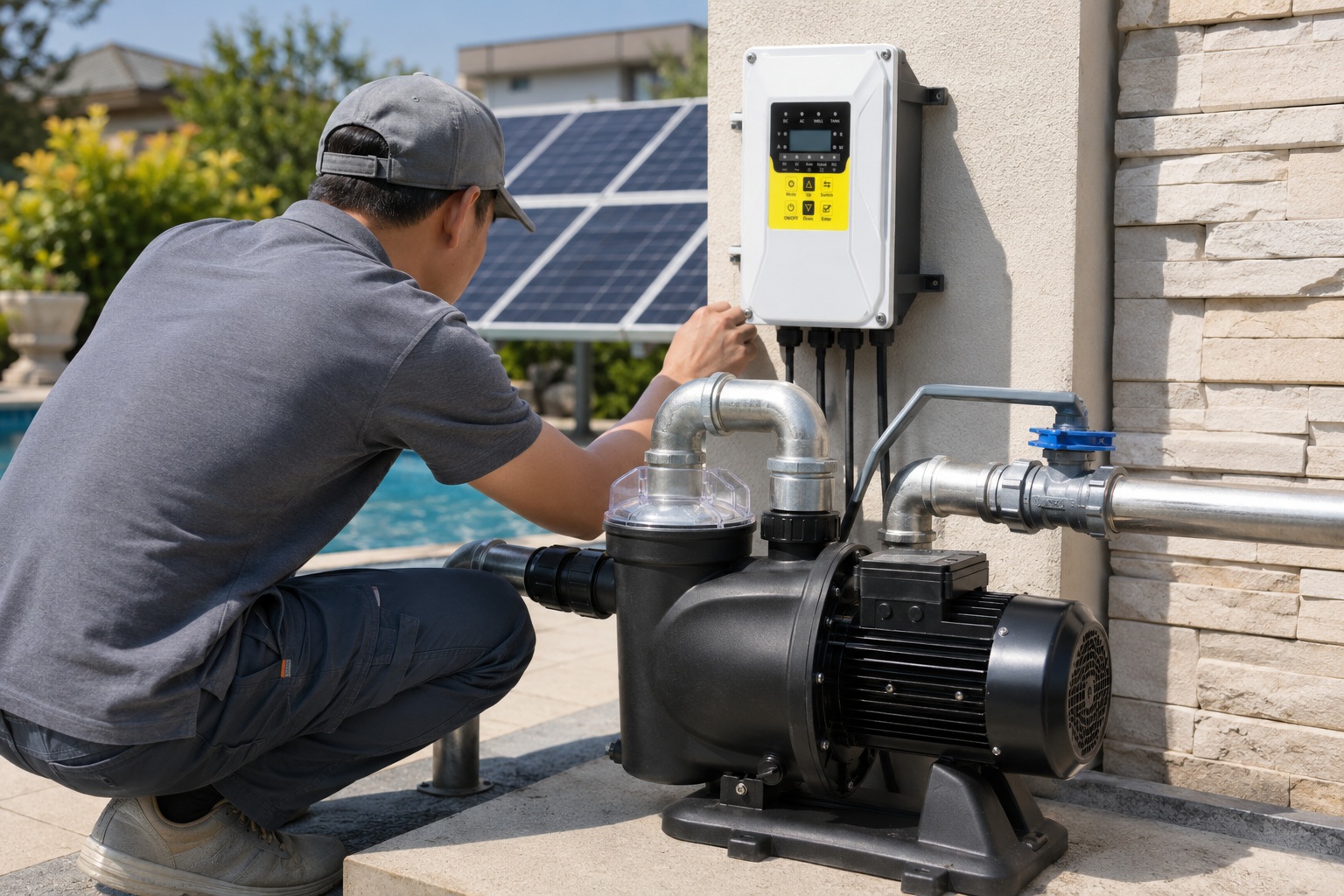
For a dedicated DC solar pool pump, you typically need 4 to 6 solar panels. This setup runs independently from the grid, using a DC pump designed specifically for solar power, making it a highly efficient and self-contained system.
A dedicated DC pump system is a targeted and powerful way to handle your pool's energy needs.
This approach isolates your pool pump from your home's main electricity supply.
It creates a self-sufficient ecosystem powered entirely by the sun.
Let's explore the details of this increasingly popular solution.
The Power of Brushless DC (BLDC) Motors
The heart of a modern DC solar pump is its Brushless DC (BLDC) motor.
These motors are a game-changer for efficiency and longevity.
A standard brushed motor might last for 2,000 to 5,000 hours.
In contrast, a BLDC motor can operate for an impressive 20,000 to 30,000 hours.
That's a lifespan up to 10 times longer.
This durability drastically improves the long-term value of your investment.
BLDC motors are also more efficient, often exceeding 90% efficiency.
This means more of the sun's energy is converted directly into pumping power.
You get the job done with fewer solar panels and lower overall system costs.
Calculating Your Return on Investment (ROI)
The financial benefit is a key reason to switch to a solar pool pump.
Let's analyze a real-world cost breakdown.
Consider replacing a standard 1 hp AC pump that runs 7 hours a day.
This pump consumes about 5.2 kWh daily.
At an average electricity rate of $0.13 per kWh, that's an annual cost of nearly $250.
Now, let's look at the investment for a dedicated DC system.
| Item | Unit Cost | Quantity | Total Cost |
|---|---|---|---|
| 400W Solar Panels | $220.00 | 2 | $440.00 |
| DC Pool Pump (0.67 HP) | $341.00 | 1 | $341.00 |
| PV Cabling | $25.00 | 1 | $25.00 |
| Circuit Timer/Controller | $75.00 | 1 | $75.00 |
| Total Initial Investment | $881.00 |
With annual savings of $247.84, you would break even on this investment in about 3.5 years.
If the BLDC pump lasts for its expected 8-year operational life before needing replacement, you enjoy over 4 years of pure profit.
When it's time to replace the pump, your only cost is the pump itself.
The solar panels will still have over 15 years of productive life.
This makes the payback for the second pump just 1.3 years.
System Sizing and Considerations
Sizing your dedicated system correctly is crucial.
Pumps designed specifically for solar are the most efficient.
They can run on as little as 200 watts (two 100-watt panels) for smaller applications.
A typical 0.5 to 1.0 horsepower pool pump will require between 800 and 1,200 watts.
This usually translates to four or five 300-watt panels.
One major advantage is that these panels don't need grid connection approval.
They also don't take up valuable space on your roof that could be used for a larger home solar array.
You can mount them on a simple ground structure near the pool equipment.
This simplifies installation and wiring significantly.
The system also naturally aligns with your needs.
It runs more in the summer when the sun is strong and you use the pool most.
It runs less in the winter, conserving energy when filtration needs are lower.
Power your pool pump with your grid connected solar system
Already have a home solar system, or planning to get one?
You can easily power your existing AC pump with it.
This avoids the cost of buying a new specialized pump.
If you have a large enough grid-tied solar system (6kW or more), you won't need extra panels for your pump. Simply run your existing AC pump during peak sunlight hours, typically from 10 a.m. to 3 p.m., to use your free solar energy.
Using a grid-connected system is the most common approach for homeowners who already have solar.
It leverages an existing investment to cover one of the home's biggest energy loads.
This strategy is about maximizing the value you get from every kilowatt-hour your panels produce.
Let's examine how to make this option work best for you.
The Efficiency of a Unified System
The biggest advantage here is total energy utilization.
With a dedicated DC pump system, any excess power generated by its panels is wasted if the pump isn't running.
In a grid-tied system, there is no waste.
If your pool pump isn't running, that solar energy is used by other appliances in your home.
This can power your air conditioner, refrigerator, or television.
If your home's needs are met and the pump is off, the excess power is exported to the grid.
You then earn a feed-in tariff (FiT) credit on your electricity bill.
This makes your entire solar investment more efficient and financially productive.
It turns your solar array into a dynamic resource that serves all your energy needs, not just one appliance.
Sizing Your Home System to Include the Pool Pump
A pool pump is a significant energy consumer.
A typical 1 hp pump uses about 750 watts.
Running it for 5-8 hours a day adds 3.75 to 6 kWh to your daily consumption.
To cover this and your home's other daytime loads, a robust solar system is necessary.
A 5kW system is often the minimum recommended size in this scenario.
However, a 6.6kW system or larger provides a much better buffer.
This ensures you can run the pump and other appliances on sunny days without drawing from the grid.
A larger system also helps on partly cloudy days.
It will still produce enough power to offset a significant portion of the pump's consumption.
Here is a look at daily production versus consumption.
| System Size | Average Daily Production | 1 HP Pump (7hr) | Home Base Load | Surplus/Deficit |
|---|---|---|---|---|
| 5.0 kW | 20 kWh | 5.2 kWh | 10 kWh | +4.8 kWh |
| 6.6 kW | 26.4 kWh | 5.2 kWh | 10 kWh | +11.2 kWh |
| 10 kW | 40 kWh | 5.2 kWh | 10 kWh | +24.8 kWh |
As you can see, a larger system provides a much greater surplus.
This surplus can be used for evening energy needs via battery storage or exported for credits.
Smart Timers and Controllers
To make this strategy work, you must run your pump when the sun is shining.
This seems obvious, but many people leave their pumps on legacy nighttime schedules.
Using a simple mechanical or digital timer is essential.
Set the pump to run during peak solar production hours.
This is generally between 10 a.m. and 3 p.m.
More advanced "solar-aware" diverters can automate this process.
These devices monitor your solar production and your home's energy consumption.
They will automatically turn on the pool pump only when there is enough surplus solar power available.
This guarantees you are not accidentally paying for grid electricity to run your pump during the day.
This level of control maximizes your self-consumption of solar energy and delivers the best financial outcome.
Specialized Solar Pumps for Every Need
Not all water sources are the same.
The technology behind solar pumps has evolved to handle diverse conditions.
This ensures there is an efficient solution for almost any application.
Different solar pumps are designed for specific tasks. High-head screw pumps are for deep wells. High-flow plastic impeller pumps are for irrigation. Corrosion-resistant stainless steel pumps are for harsh water, all powered by efficient BLDC motors.
While this article focuses on pool pumps, understanding the broader solar pump landscape is valuable.
The same core motor technology powers pumps designed for vastly different jobs.
Distributors and installers who understand this portfolio can meet a wider range of customer needs.
From deep well domestic water to large-scale agricultural irrigation, there is a solar pump solution.
Let's explore some of these specialized pump types.
Solar Screw Pumps: Low Flow, High Head
Solar screw pumps, also known as progressive cavity pumps, are designed for one thing.
They excel at lifting water from very deep sources.
They use a helical stainless steel screw (rotor) that turns inside a rubber stator.
This action creates sealed cavities that move water upward with each rotation.
This mechanism is not designed for high volumes.
However, it generates immense pressure, or "head."
This makes it perfect for deep wells common in arid regions of Africa and Latin America.
They are the go-to solution for domestic water supply and livestock watering from wells over 100 meters deep.
Their key advantage is sand resistance.
The gentle pushing action is less susceptible to damage from sand and sediment than a centrifugal pump.
This durability is critical in areas with challenging water quality.
Solar Plastic Impeller Pumps: High Flow, High Value
For applications requiring high water volume, multi-stage centrifugal pumps are the answer.
Models using wear-resistant plastic impellers offer a fantastic balance of performance and cost.
These pumps use a series of impellers and diffusers to build pressure and flow.
They are ideal for farm irrigation, pasture water management, and large home gardens.
Their ability to move large volumes of water makes them highly productive for agriculture.
The primary benefit is their high flow rate combined with an economical price point.
The engineered plastic is lightweight and highly resistant to abrasion from fine sand.
This makes them a workhorse pump in agricultural settings across Africa and the Americas.
Their main limitation is in highly corrosive water or extreme deep-well applications, where more robust materials are needed.
Solar Stainless Steel Impeller Pumps: Premium Durability
When water quality is aggressive, you need a pump built to withstand it.
Solar pumps with SS304 stainless steel impellers and housings are the premium choice.
This material provides superior resistance to corrosion from acidic or alkaline water.
They are essential in coastal regions, areas with alkaline soil, or industrial applications.
These pumps are found in high-end homes and ranches in parts of Australia and the Americas where water quality is a known issue.
While they have a higher initial cost, their longevity in harsh conditions provides a better long-term value.
They offer peace of mind and reliable operation where a standard pump would fail quickly.
Their reliability makes them a crucial part of any distributor's high-end product portfolio.
The AC/DC Hybrid: The Best of Both Worlds
What happens when you need water on cloudy days or at night?
Relying solely on solar power has its limitations.
This is where innovative hybrid technology provides a seamless solution.
An AC/DC hybrid solar pump controller automatically switches between solar and grid power. It prioritizes solar energy when available and supplements with AC power from the grid or a generator as needed, ensuring a reliable 24/7 water supply.
The development of hybrid controllers represents a major leap forward in solar pumping technology.
It removes the biggest drawback of off-grid systems: their dependence on sunshine.
For critical applications like household water or livestock, you cannot afford to have your pump shut down.
A hybrid system offers the cost savings of solar with the reliability of the grid.
Let's break down how this technology works and why it's a superior choice.
Intelligent Power Blending
A key feature of advanced hybrid controllers is their ability to blend power sources.
It's not just a simple on/off switch between DC and AC.
These systems use Maximum Power Point Tracking (MPPT) to get every last watt from your solar panels.
On a partly cloudy day, the controller will draw as much power as it can from the solar array.
It will then supplement only the shortfall with AC power from the grid.
For example, if the pump needs 800 watts to run, and the panels are only producing 500 watts due to clouds, the controller will automatically draw the remaining 300 watts from the grid.
This maximizes your use of free solar energy and minimizes your reliance on paid electricity.
This is much more efficient than a system that switches entirely to AC power the moment solar production dips.
Seamless, Uninterrupted Operation
The main benefit of a hybrid system is worry-free water access.
The controller's logic is designed for complete automation.
- Full Sun: The system runs 100% on solar DC power. You pay nothing for electricity.
- Partial Sun/Clouds: The system blends DC solar power with AC grid power to maintain pump operation.
- No Sun (Night/Heavy Overcast): The system switches automatically and fully to AC grid or generator power.
This ensures your pool stays filtered, your water tanks stay full, and your livestock stay watered, regardless of the weather or time of day.
The transition between power sources is instant and seamless.
There is no interruption to the pump's operation.
Is a Hybrid System Right for You?
A hybrid system is the ideal choice for anyone who values both cost savings and reliability.
While a purely off-grid DC system offers the lowest possible running cost, it comes with the risk of downtime.
For a residential pool, this might be an acceptable trade-off.
You can simply wait for the sun to come out.
But for many other applications, it's not.
Consider these scenarios where a hybrid system is superior:
- Households relying on well water: Consistent water pressure for showers, laundry, and drinking is non-negotiable.
- Commercial pools: Health codes require consistent filtration, which cannot be left to the whims of the weather.
- Livestock operations: Animals need constant access to drinking water.
- Critical irrigation: High-value crops may need watering on a strict schedule, rain or shine.
For distributors, offering a reliable AC/DC hybrid option is a significant competitive advantage.
It addresses a key customer concern and positions you as a provider of robust, practical solutions.
Conclusion
Sizing your solar pool pump system involves choosing between a dedicated DC setup or a larger grid-tied array.
Both offer huge savings.
The best choice depends on your specific needs and budget.
FAQs
Is a solar pool pump worth the investment?
Yes, with a payback period often between 3 to 5 years, solar pool pumps offer significant long-term savings on electricity costs and reduce your carbon footprint.
How long do solar pool pumps last?
A quality solar pump with a brushless DC motor can last 20,000 to 30,000 hours, equivalent to 8-10 years of typical use, which is much longer than standard pumps.
Can a solar pool pump run at night?
A standard DC solar pump cannot run at night without a battery bank. However, an AC/DC hybrid system can automatically switch to grid power to operate anytime.
Do you need batteries for a solar pool pump?
Batteries are not required for a standard daytime-only solar pump system, which significantly lowers the initial cost. They are an option for off-grid 24/7 operation.
How many watts does a 1 HP pool pump use?
A 1 horsepower (HP) pool pump uses approximately 746 watts. To run it effectively on solar, you would want a solar array capable of producing at least 800-1000 watts.
Can I use my existing AC pool pump with solar panels?
Yes, you can power your existing AC pump using a large enough grid-tied home solar system. Alternatively, a specialized solar VFD inverter can run an AC pump directly from solar panels.
What size solar panel do I need for a 1.5 HP pool pump?
For a 1.5 HP pump (approx. 1120 watts), you would need a solar array of about 1,500 to 1,800 watts, which is typically four or five 375-watt panels.