Your pool pump is likely your home's second-biggest energy user, driving up your electric bill.
With utility rates constantly climbing, this cost is only getting worse.
A solar pool pump eliminates this expense by running for free on sunlight.
Yes, a solar pool pump is often worth it. It can pay for itself in 3-4 years through significant electricity savings. By running on free solar energy, it reduces your carbon footprint and operates even during grid power outages, though performance depends on sunlight.
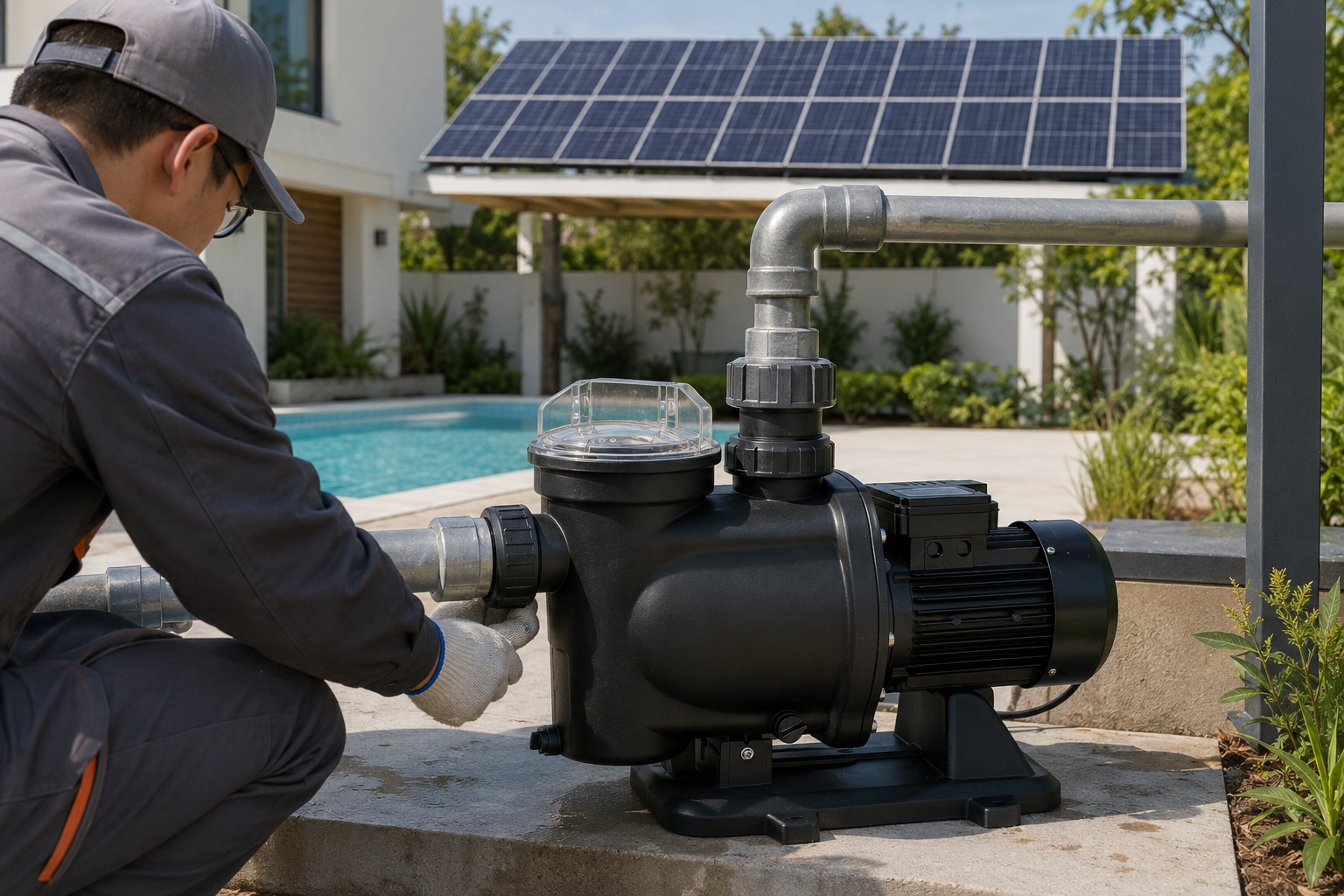
Investing in solar technology for your pool seems like a straightforward way to save money and help the environment.
But the decision involves more than just buying a pump and some panels.
To see if it's the right choice for you, we need to look closely at the initial costs, the long-term savings, the pump's performance limitations, and the technology that makes it all work.
Let's dive into the numbers and details to uncover the real value of a solar pool pump.
What is the real cost and payback period of a solar pool pump?
You see the high monthly cost of running your pool and want to reduce it.
This energy hog continuously adds to your utility bill, especially in sunny climates where you use it most.
A one-time investment in a solar pump system can cut this recurring cost to zero.
The typical payback period for a solar pool pump system is about 3.5 years. With an initial investment of around $900 for a DIY setup, you could save over $250 annually, making it a financially sound and eco-friendly upgrade for your pool.
Calculating Your Return on Investment (ROI)
To understand if a solar pool pump makes financial sense, we need to compare the upfront cost with the long-term savings.
It's a simple calculation, but the results can be very compelling.
Let's break down the investment versus the running cost of a traditional pump.
Initial Investment Breakdown
The total cost includes the pump itself, the solar panels to power it, and necessary components like wiring and timers.
While prices vary, a standard DIY system provides a good baseline.
Here is a typical cost breakdown for a system designed for an average residential pool:
| Component | Estimated Cost |
|---|---|
| Two 400-Watt PV Panels | $440 |
| 500-Watt DC Pool Pump | $341 |
| Circuit Shut-Off / Timer | $75 |
| Cabling and Connectors | $25 |
| Total Initial Investment | $881 |
This total does not include minor hardware like fasteners or plumbing pipes, but it covers the core components needed to get started.
Calculating Annual Energy Savings
The savings come directly from no longer using grid electricity to run your pool.
To quantify this, we calculate the energy consumption of a standard AC pump.
A typical 1 horsepower (hp) AC pump uses about 746 watts (0.746 kW).
If you run this pump for 7 hours a day, the daily energy use is 5.22 kWh.
At an average electricity cost of $0.13 per kWh, the daily cost is about $0.68.
This adds up to an annual running cost of $247.84.
By switching to a solar pump that runs only on sunlight, your direct electricity cost for pumping becomes $0.
Your annual savings are therefore the full $247.84 you would have spent.
Payback Period
With a total initial investment of $881 and annual savings of $247.84, the payback period is calculated by dividing the cost by the savings.
$881 / $247.84 = 3.55 years.
After just three and a half years, the system has paid for itself.
Given that a quality DC brushless motor is rated for 20,000 to 30,000 hours of operation, it could last over 8 years.
This means you get roughly 5 years of completely free pool circulation after breaking even.
When it's time to replace the pump, you already own the solar panels, dramatically reducing the cost of the next pump and shortening its payback period to just over a year.
What are the technical pros and cons to consider?
You're excited by the financial savings of a solar pool pump.
But you worry that the technology might not be reliable or powerful enough for your pool's needs.
Understanding the technical advantages and disadvantages is crucial to avoid disappointment and ensure your pool stays clean.
The primary benefits are zero energy costs, silent operation, and a long motor lifespan of over 20,000 hours. The main drawbacks are inconsistent performance on cloudy days, an inability to run at night without batteries, and potential issues powering extra features like heaters or waterfalls.
Diving Into the Technology
The performance and reliability of a solar pool pump are determined by its core components and how they interact with environmental conditions.
The motor is the heart of the system, but the controller and dependency on sunlight are equally important factors that define its real-world usability.
The Powerhouse: Understanding the DC Brushless Motor
Modern solar pumps are not just an old pump with solar panels attached.
They are powered by advanced Brushless DC (BLDC) permanent magnet motors.
This technology is the key to their efficiency and durability.
- Superior Efficiency: A BLDC motor can achieve an efficiency rating of over 90%. This is a huge leap compared to traditional AC motors, which often operate at 60-70% efficiency. This means more of the sun's energy is converted directly into water-pumping power.
- Exceptional Lifespan: A brushed AC motor typically lasts between 2,000 and 5,000 hours. In contrast, a BLDC motor has a lifespan of 20,000 to 30,000 hours. That's 6 to 10 times longer, meaning fewer replacements and long-term reliability.
- Quiet Operation: The absence of brushes makes these motors incredibly quiet. You will barely hear it running, creating a more peaceful poolside environment.
The core of this motor, the rotor, is often made from high-grade materials like 40SH neodymium iron boron, providing strong torque and power in a compact design.
This advanced engineering reduces the number of solar panels needed, lowering the overall system cost.
The "Cycling Glitch": A Major Drawback of Cheaper Models
One of the most common complaints about entry-level solar pool pumps is premature failure.
This is often caused by a design flaw in the pump's controller.
On partly cloudy days, as the sunlight fluctuates, the voltage from the panels drops.
Instead of smoothly slowing down, the controller on cheaper units will shut the motor off completely.
When the sun returns seconds later, it abruptly starts again.
This constant on-off cycling—sometimes happening every few seconds—puts immense stress on the motor and electronics.
This rapid cycling can burn out the motor in a matter of months, completely negating the pump's long-rated lifespan.
A simple workaround is using an external digital timer to shut off the system in the late afternoon when sunlight becomes inconsistent.
However, premium models solve this with a smarter controller that creates smoother power transitions, protecting the motor from this damaging effect.
What are the better alternatives to a solar pool pump?
A solar pool pump seems great, but its reliance on perfect weather is a big concern.
You need guaranteed circulation to keep your pool clean, especially during extended cloudy periods.
Fortunately, there are alternative solutions that offer a balance of energy savings and reliable, all-weather performance.
The best alternative for most pool owners is a variable-speed pump (VSP) paired with a traditional grid-tied solar panel system. This setup provides massive energy savings by running the pump at low speeds while ensuring you can always run it at full power when needed.
Finding the Right Balance of Savings and Performance
For many pool owners in places like Florida or Arizona, consistent filtration is non-negotiable.
A pool can turn green quickly without adequate water turnover.
While a dedicated solar pump is a step in the right direction, blending technologies can provide a more robust and practical solution that fits all your needs.
The Variable-Speed Pump (VSP) Advantage
Variable-speed pumps have become the industry standard for a reason.
Instead of running at a single, high-energy speed, a VSP can be programmed to run at very low speeds for most of the day.
The key principle is that reducing pump speed by half reduces energy consumption by nearly 88%.
- Massive Energy Savings: By running at a low speed for longer periods, a VSP can cut pumping-related energy costs by up to 90% compared to a single-speed pump. This often results in savings of $300 to $500 per year.
- Full Power on Demand: Unlike a solar-direct pump, a VSP is connected to the grid. If you need to run your spa jets, a waterfall, or a pool cleaner, you can ramp it up to full power at the touch of a button. It can also run at night or on cloudy days without issue.
- Lower Initial Cost: A high-quality VSP costs significantly less than a full solar pump kit, with an initial investment typically a third of a comparable solar system.
The payback period for a VSP is often just 1-2 years, making it one of the most effective energy-saving upgrades a pool owner can make.
The Ultimate Solution: Combining a VSP with a Home Solar System
For those truly committed to eliminating their pool's energy costs without sacrificing performance, the best approach is to combine technologies.
By installing a variable-speed pump and a grid-tied solar PV system on your roof, you get the best of both worlds.
The solar panels generate electricity for your entire home, not just the pump.
During the day, the solar energy produced will offset the energy used by the VSP running at its efficient low speed.
The excess power your panels generate goes back to the grid, earning you credits through net metering.
This integrated system offers several key benefits:
- Eliminates Pumping Costs: Your pump's energy use is covered by your solar production.
- Powers Your Whole Home: The solar panels reduce your entire electricity bill, not just the pool portion.
- Maintains Full Functionality: Your VSP can run at any time, day or night, ensuring your pool features and sanitation are never compromised.
- Excellent ROI: While the initial cost is higher, the ROI of a full home solar system is excellent, and it adds value to your property.
This approach transforms your pool from an energy drain into a sustainable feature powered by clean, reliable energy.
Can one solar water pump system fit all water needs?
Realizing the power of solar for your pool makes you wonder about other applications.
What if you need to pump water from a deep well for your home or for irrigating a farm?
A pool pump is designed for high volume at low pressure, which is entirely different from the demands of a deep well.
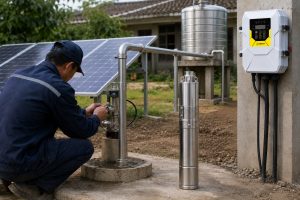
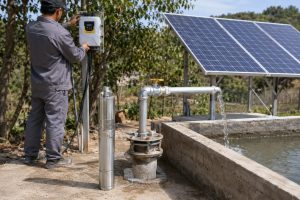
No, one pump cannot fit all needs. Solar water pumps are highly specialized. A solar system requires a screw pump for high head, a plastic impeller pump for high flow in sandy water, or a stainless steel impeller pump for corrosive conditions, all powered by an efficient BLDC motor.
Choosing the Right Pump for the Job
The world of solar water pumping is diverse, with specialized designs engineered to meet specific challenges.
Whether you're supplying water for livestock, irrigating crops, or providing drinking water to a home, the pump's design must match the depth of the well, the required flow rate, and the water quality.
This is where a portfolio of specialized pumps becomes essential.
Deep Wells: The Solar Screw Pump
When you need to lift water from very deep wells, a solar screw pump is the ideal solution.
- Function: It uses a stainless steel screw rotating inside a rubber stator. This action creates sealed cavities that move water upward with each turn, generating immense pressure.
- Best For: Low flow, high head applications. It's perfect for domestic water supply and livestock watering in areas with deep water tables, like parts of Africa and Latin America.
- Key Advantage: Excellent sand resistance. The screw design can handle gritty, sandy water that would quickly destroy other pump types.
High-Volume Irrigation: The Solar Plastic Impeller Pump
For applications requiring a large volume of water, like farm irrigation or large gardens, a multi-stage centrifugal pump is the answer.
- Function: This pump uses a series of stacked plastic impellers. Each stage adds pressure, pushing a high volume of water to the surface.
- Best For: High flow, medium head applications. It's widely used for agriculture and pasture water supply across the Americas and Africa.
- Key Advantage: High efficiency and wear resistance. The durable plastic impellers are lightweight and can handle fine sand effectively, offering a great balance of performance and cost.
Corrosive Water: The Solar Stainless Steel Impeller Pump
In some regions, groundwater can be acidic, alkaline, or saline, which can rapidly corrode standard pumps.
- Function: This pump operates like the plastic impeller model but is constructed with SS304 stainless steel impellers, diffusers, and pump body.
- Best For: Corrosive water conditions. It is the premium choice for alkaline soils in Australia, coastal regions, and high-end properties where water quality is a concern.
- Key Advantage: Unmatched durability and corrosion resistance. It offers a very long service life and high reliability, even in the harshest water environments.
Hybrid Systems: AC/DC Power for 24/7 Operation
What happens when you need water on cloudy days or at night?
Some advanced systems offer a hybrid solution.
These pumps come with an intelligent controller that can accept both DC power from solar panels and AC power from the grid or a generator.
The controller automatically prioritizes solar power.
When sunlight is insufficient, it can blend AC and DC power to maximize the use of solar energy.
When there's no sunlight, it seamlessly switches to AC power, ensuring you have a reliable water supply 24/7 without any manual intervention.
Conclusion
A solar pool pump is a fantastic investment with a quick payback period for the right user.
However, a variable-speed pump often provides superior flexibility and energy savings for most homeowners.
FAQs
Can a solar pump run a pool cleaner?
Yes, but it must be a strong sunny day. Most solar pumps lack the consistent high pressure needed for suction or pressure-side cleaners, making robotic cleaners a better match.
How many solar panels are needed for a pool pump?
Typically, two to four panels are needed. An average system might use two 400-watt panels to power a 500-watt DC pump effectively, but this depends on pump size and location.
Do solar pool pumps work on cloudy days?
They work at a reduced speed. On heavily overcast days, the pump may cycle on and off or stop completely unless you have a battery backup or a hybrid AC/DC controller.
Can solar pool pumps run at night?
No, not without a battery storage system. Standard direct-drive solar pumps only operate when the solar panels receive direct sunlight, so they shut down after sunset.
How long does a solar pool pump last?
A quality solar pump with a brushless DC motor can last 8-10 years. The motor itself is rated for 20,000-30,000 hours, much longer than a traditional AC pump motor.
Are there tax credits for solar pool pumps?
Yes, in the United States, you may be eligible for the Federal Solar Tax Credit. This credit can cover 30% of the total cost of the pump, panels, and installation.
Do I need a professional to install a solar pool pump?
While many solar pool pump kits are designed for DIY installation, professional installation is recommended. This ensures proper wiring, plumbing, and panel mounting for safety and optimal performance.
Can a solar pool pump also heat the pool?
No, a solar pool pump only circulates water. A separate solar pool heating system is required to warm the pool, though the solar pump can circulate water through the heater.