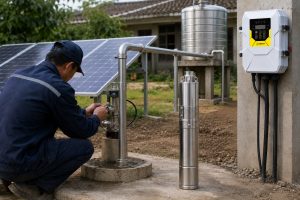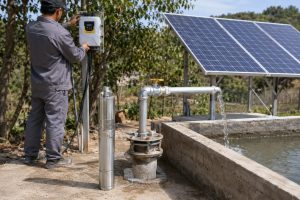
Struggling to get reliable water in an off-grid location?
Connecting solar panels directly to a pump often leads to burnout and failure, wasting your investment.
There is a smarter way to create a durable, efficient solar water system.
To connect two solar panels to a water pump, you first wire the panels together, either in series or parallel.
This connection then runs to a solar charge controller.
Finally, you connect the controller to your battery and the pump, which protects the motor and optimizes power use.
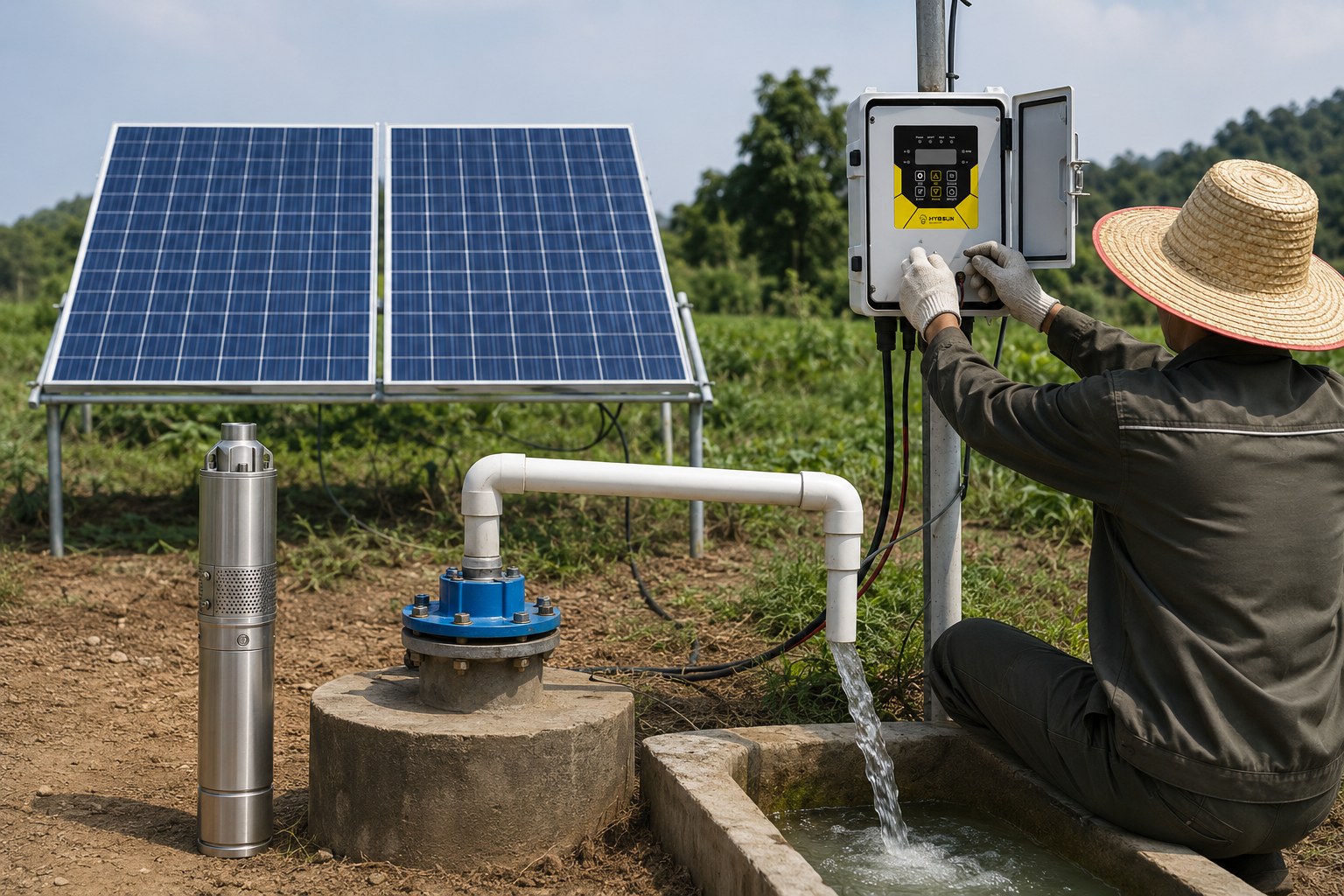
Connecting solar panels to a pump seems straightforward, but a single wrong step can damage your entire system.
The secret isn't just in the connection; it's in understanding how each component works together to deliver pressurized water efficiently and reliably, day after day.
This guide breaks down the process, from selecting the right components to wiring them for maximum performance and longevity.
We will walk you through each step, ensuring you build a system that meets your water needs without the frustration of constant troubleshooting.
Why You Can't Just Connect Panels Directly to a Pump
You have a pump and solar panels, so why not wire them together and call it a day?
This common mistake leads to pump failure.
Direct connections provide unstable power, which burns out the pump motor quickly.
Connecting a solar panel directly to a pump is a bad idea because pumps require a specific, stable current to start and run.
Solar panel output fluctuates with sunlight, causing the pump to start and stop erratically.
This repeated stress rapidly burns out the motor.
A proper solar pump system is more than just a panel and a pump; it's a balanced ecosystem of components designed to manage energy.
The most critical part of this system is the controller.
It acts as the brain, regulating the power from the panels to protect the pump motor from the harsh realities of fluctuating solar energy.
Without it, the pump is vulnerable to under-voltage and current spikes, especially during startup in low-light conditions like early morning or on cloudy days.
This is why many low-cost, direct-connect pumps sold on marketplaces fail within a year.
A system built with a controller ensures a "slow start" function, gradually ramping up power to the motor.
This eliminates the mechanical stress and electrical surges that cause premature failure, extending the life of your pump from months to years.
The Problem with "Direct Connect" Systems
Many entry-level solar pump kits are advertised as "Direct Connect." This means the wires from the solar panel plug directly into the pump.
While this sounds simple, it's a recipe for disaster.
-
Motor Burnout: The biggest issue is motor stress.
A pump motor needs a significant, stable amount of current (amps) to start up.
In the early morning or on an overcast day, a solar panel doesn't produce enough power.
The pump will try to start, fail, and try again repeatedly.
Each attempt sends a weak surge of power that heats the motor windings, eventually causing them to burn out. -
Inefficient Operation: Even when the sun is shining brightly, a direct connection is inefficient.
The pump only runs at full speed under perfect, midday sun.
Any haze, clouds, or lower sun angle dramatically reduces performance.
You get water intermittently, not consistently.
Relying on this for critical applications like livestock watering or irrigation is risky.
The Solution: A Controller-Based System
A professionally designed solar water pump system always includes a controller.
The two most common types are Pulse Width Modulation (PWM) and Maximum Power Point Tracking (MPPT).
MPPT controllers are the industry standard for pumps due to their superior efficiency, often improving system performance by up to 30%.
Here’s how an MPPT controller solves the direct-connect problems:
-
Soft Start Function: An MPPT controller provides a "soft start" or "slow ramp" for the pump.
It waits until the panels are producing enough stable power, then gradually increases the voltage and frequency to the motor.
This gentle startup prevents the mechanical shock and electrical spikes that damage the pump, dramatically increasing its lifespan. -
Optimized Power Use: The "Maximum Power Point Tracking" feature constantly analyzes the output of the solar panels and adjusts the electrical load to maximize the power harvest.
This means the pump can start earlier in the day, run later in the afternoon, and continue pumping even in low-light or overcast conditions, albeit at a slower speed.
It ensures you get the most water possible out of the available sunlight. -
System Protection: Controllers offer critical protections that direct-connect systems lack.
These include sensors for low-well shutoff (to prevent the pump from running dry) and tank-full shutoff (to prevent overflowing a storage tank).
These automated features protect your well and your pump, allowing for a worry-free, set-and-forget operation.
| Feature | Direct Connect System | MPPT Controller System |
|---|---|---|
| Motor Lifespan | Short (Often < 1 year) | Long (5-10+ years) |
| Efficiency | Low (Only works in perfect sun) | High (Up to 30% more efficient) |
| Low-Light Performance | None; fails to start | Excellent; runs at variable speeds |
| System Protection | None | Low well, full tank, overload protection |
| Startup Method | Hard start (high stress) | Soft start (low stress) |
| Initial Cost | Very Low | Higher |
| Long-Term Cost | Very High (due to replacements) | Lower (due to reliability) |
Investing in a system with an MPPT controller is the single most important decision for ensuring a reliable, long-term solar water solution.
It turns an unreliable gadget into a durable piece of infrastructure.
Wiring Two Panels: Series vs. Parallel Connection
You have two solar panels, but how you connect them significantly impacts your pump's performance.
Connecting them the wrong way can provide the wrong voltage.
This will either prevent your pump from starting or damage the controller.
For most 24V solar pump systems, you should connect two 12V panels in series to double the voltage.
To do this, connect the positive wire of the first panel to the negative wire of the second panel.
The remaining negative and positive wires then go to the controller.
Choosing between a series or parallel connection depends entirely on the voltage requirements of your pump's controller.
Getting this right is crucial for system efficiency and safety.
A series connection increases voltage while keeping the current (amps) the same, which is ideal for overcoming wire resistance over long distances.
A parallel connection increases current while keeping the voltage the same, which might be necessary for certain types of controllers or pumps.
Before you connect anything, check the specifications on your controller's label to determine the required input voltage (Vmp) and connect your panels accordingly to match it.
Understanding Series Connections
A series connection is like stacking batteries on top of each other to increase the total voltage.
You are combining the voltage of each panel.
-
How to Wire: You connect the positive (+) terminal of Panel 1 to the negative (-) terminal of Panel 2.
This leaves you with one open positive terminal (on Panel 2) and one open negative terminal (on Panel 1).
These two remaining wires are what you will run to your solar charge controller. -
The Electrical Result: If you have two 100-watt panels that each produce 18 volts (V) and 5.56 amps (A), connecting them in series results in:
- Voltage: 18V + 18V = 36V
- Amperage: 5.56A (stays the same)
- Total Power: 36V * 5.56A = 200W
-
When to Use It: Series connections are the most common method for solar pump systems.
Higher voltage is more efficient for transmitting power over longer wire runs from the panels to the pump house.
It also helps the MPPT controller work more effectively, especially in lower light conditions.
Most solar pump controllers are designed to operate on higher DC voltages (e.g., 24V, 48V, 72V), so a series connection is necessary to meet that requirement.
Understanding Parallel Connections
A parallel connection is like adding more lanes to a highway; you are increasing the capacity for current to flow.
-
How to Wire: You connect the positive (+) terminal of Panel 1 to the positive (+) terminal of Panel 2.
You then connect the negative (-) terminal of Panel 1 to the negative (-) terminal of Panel 2.
You will typically use branch connectors (also known as Y-connectors) to make this connection clean and waterproof. -
The Electrical Result: Using the same two 100-watt panels (18V, 5.56A), connecting them in parallel results in:
- Voltage: 18V (stays the same)
- Amperage: 5.56A + 5.56A = 11.12A
- Total Power: 18V * 11.12A = 200W
-
When to Use It: A parallel connection is less common for dedicated solar pump systems but is used in situations where you must not exceed the controller's maximum voltage limit.
It's more common in 12V systems, such as those used in RVs or for small, temporary setups.
If you were trying to run a 12V pump with two 12V panels, you would wire them in parallel to keep the voltage at 12V while doubling the available charging current for the battery.
| Connection Type | Voltage | Amperage | Best For | Wiring Method |
|---|---|---|---|---|
| Series | Adds Up | Stays the Same | Most 24V+ pump systems, long wire runs | Positive of Panel 1 to Negative of Panel 2 |
| Parallel | Stays the Same | Adds Up | 12V systems, situations with shading issues | Positive to Positive, Negative to Negative |
For almost any dedicated solar deep well pump, a series connection is the correct choice.
It provides the higher voltage needed for efficient motor operation and allows your MPPT controller to perform at its best.
Always confirm the voltage requirements of your specific pump controller before finalizing your wiring.
Choosing the Right Solar Pump for Your Setup
Your solar array is ready, but it's worthless without the right pump.
Choosing the wrong pump type means you either won't get enough water, or it won't handle your well's conditions.
This leads to poor performance and premature failure.
Select a pump based on your water needs: a solar screw pump for low flow and high head (deep wells), a plastic impeller pump for high flow and sandy conditions, or a stainless steel impeller pump for corrosive water and maximum durability.
All should use a high-efficiency BLDC motor.
The heart of any solar water system isn't the panels; it's the pump and motor combination.
The solar panels only provide the fuel.
The pump does the actual work of lifting water, and its design dictates its suitability for your specific application.
Whether you're supplying water for a small home, irrigating a farm, or watering livestock, there is a specialized solar pump designed for the task.
Understanding the difference between a screw pump's ability to handle deep wells and an impeller pump's high-flow capacity is the key to designing a system that is not only effective but also cost-efficient and long-lasting.
Let's break down the three main types to help you make the right choice.
**1.
Solar Screw Pump: The Deep Well Specialist**
This pump is built for one primary purpose: lifting water from great depths.
It uses a different mechanical principle than most pumps.
-
How It Works: A solar screw pump (also known as a progressive cavity pump) uses a single helical screw-shaped rotor that turns inside a rubber stator.
As it rotates, it creates sealed cavities of water that are pushed progressively up the pipe.
This compression-based action generates very high pressure, allowing it to pump water from wells that are hundreds of feet deep. -
Performance:
- Flow: Low.
These pumps are not designed for high-volume applications.
Expect flow rates typically in the range of 1 to 10 Gallons Per Minute (GPM). - Head: Very High.
"Head" refers to the vertical distance a pump can lift water.
Screw pumps excel here, often capable of lifting water over 500 feet.
- Flow: Low.
-
Best Applications:
- Domestic water supply for off-grid homes with very deep wells.
- Livestock drinking water troughs where consistent, low-volume supply is sufficient.
- Small-scale, low-flow irrigation like drip systems.
- Ideal for regions in Africa and Latin America where water tables are deep and power grids are unreliable.
-
Key Advantage: Its design is highly resistant to sand and sediment.
The rubber stator can handle abrasive particles that would quickly destroy the tight tolerances of an impeller pump.
**2.
Solar Plastic Impeller Pump: The High-Flow Workhorse**
When you need to move a lot of water for irrigation or filling large tanks, this is the go-to option.
-
How It Works: This is a multi-stage centrifugal pump.
Water enters the pump and is accelerated by a series of rotating plastic impellers.
Each impeller (or "stage") adds pressure to the water, pushing it higher.
More stages mean more pressure and a higher head capability. -
Performance:
- Flow: High.
These pumps are designed for volume, with models easily delivering 20, 50, or even 100+ GPM. - Head: Medium.
They can handle moderately deep wells, typically up to 300 feet, but they are most efficient at shallower depths.
- Flow: High.
-
Best Applications:
- Farm and ranch irrigation for fields and crops.
- Pasture water supply and large livestock operations.
- Filling large storage tanks (cisterns) quickly.
- Widely used in agricultural regions across the Americas and Africa.
-
Key Advantage: The materials used for the impellers are a durable, wear-resistant polymer.
This makes the pump lightweight, economical, and highly effective at resisting abrasion from fine sand.
**3.
Solar Stainless Steel Impeller Pump: The Premium Durability Option**
This pump is designed for the harshest water conditions and for users who demand the longest possible service life.
-
How It Works: Functionally, it is identical to the plastic impeller pump—a multi-stage centrifugal design.
However, the critical components, including the impellers, diffuser, and pump body, are constructed from SS304 or SS316 stainless steel. -
Performance:
- Flow: High.
Similar high-flow capabilities as the plastic impeller models. - Head: Medium-to-High.
The robust construction often allows for slightly higher head ratings compared to their plastic counterparts.
- Flow: High.
-
Best Applications:
- Water sources with corrosive properties, such as acidic or alkaline water (low or high pH).
- Regions with alkaline soil, like parts of Australia, which can affect water chemistry.
- High-end residential or commercial applications where reliability and longevity are the top priorities.
-
Key Advantage: Extreme corrosion resistance.
Stainless steel will not degrade or become brittle in chemically aggressive water, ensuring a very long and reliable service life.
It is a higher initial investment for a system built to last decades.
| Pump Type | Primary Application | Flow Rate | Head (Lift) | Sand Resistance | Key Benefit |
|---|---|---|---|---|---|
| Solar Screw Pump | Deep Wells, Homes | Low (1-10 GPM) | Very High (500+ ft) | Excellent | High Head & Sand Tolerant |
| Plastic Impeller | Farm Irrigation | High (20-100+ GPM) | Medium (up to 300 ft) | Good (Fine Sand) | High Flow at Low Cost |
| Stainless Steel Impeller | Corrosive Water | High (20-100+ GPM) | Med-High (up to 400 ft) | Fair | Maximum Durability & Lifespan |
The Unseen Hero: The BLDC Motor
You've chosen the perfect pump, but the motor that drives it is just as important.
A cheap, inefficient motor will waste your solar power.
This forces you to buy more panels, increasing the system cost significantly.
High-quality solar pumps use a Brushless DC (BLDC) permanent magnet motor.
With an efficiency of over 90%, these motors convert more solar energy into water pumping power.
This reduces the number of solar panels needed, lowering overall system cost and simplifying installation.
The motor is the engine of your water pump system.
Older pump designs often used brushed DC motors or standard AC motors paired with an inverter.
Brushed motors are inefficient and wear out quickly because the internal brushes physically rub and degrade over time, requiring replacement.
AC motor systems lose a significant amount of energy (often 15-25%) in the conversion process from DC (solar) to AC (motor).
The modern standard for solar pumps is the BLDC motor.
It is the core technology that makes today's solar pumping solutions so powerful and reliable, representing a massive leap in efficiency that directly translates into more water for less money.
What Makes BLDC Motors Superior?
The technical advantages of a BLDC permanent magnet motor are transformative for off-grid water pumping.
The design eliminates the parts that cause failure and inefficiency in older motors.
-
Extreme Efficiency: The biggest advantage is efficiency.
A modern BLDC motor can achieve an electrical-to-mechanical conversion efficiency exceeding 90%.
A typical brushed DC motor might be 60-75% efficient, and an AC motor with an inverter might have a combined efficiency of 70-80%.
This 10-30% efficiency gain is enormous.
It means that for every 1000 watts of solar power you generate, a BLDC motor delivers over 900 watts of pumping power, while a lesser motor might only deliver 700 watts. -
How It Translates to Savings: This efficiency difference directly impacts your wallet.
A system that requires 800 watts with an inefficient motor might only need 600 watts with a BLDC motor.
That could be the difference between needing four solar panels versus three.
This reduces the cost of panels, mounting hardware, and wiring. -
Permanent Magnet Power: The rotor, the part that spins, is constructed with powerful permanent magnets—typically high-grade Neodymium Iron Boron (like 40SH grade).
This creates a powerful magnetic field without consuming any electricity, unlike AC induction motors.
This design results in higher torque, meaning the motor has more "muscle" to start the pump and keep it running under heavy load. -
Long, Maintenance-Free Life: The "brushless" design means there are no internal components physically wearing against each other.
There are no brushes to inspect or replace.
The motor is electronically commutated, and the bearings are typically sealed and lubricated for life.
A well-built BLDC motor can operate for over 20,000 hours with zero maintenance.
Compact Design and its Practical Benefits
The advanced technology inside these motors allows for a much more compact and lightweight design.
Compared to an old AC motor of equivalent power output, a BLDC motor can be up to 47% smaller and 39% lighter.
This isn't just a technical specification; it has real-world benefits:
- Easier Installation: A lighter pump is significantly easier and safer to handle and install, especially when lowering it hundreds of feet down a well.
It often means one person can do the job instead of two. - Lower Shipping Costs: For distributors and importers, the reduced weight and volume translate directly to lower shipping and logistics costs, improving profit margins.
| Motor Feature | BLDC Permanent Magnet Motor | Traditional Brushed DC Motor |
|---|---|---|
| Efficiency | > 90% | 60% - 75% |
| Lifespan | Very Long (20,000+ hours) | Short (3,000-5,000 hours) |
| Maintenance | None (maintenance-free) | Requires brush replacement |
| Torque | High | Moderate |
| Size & Weight | Compact & Lightweight | Bulky & Heavy |
| Initial Cost | Higher | Lower |
| Overall Cost | Lower (less panels, no maintenance) | Higher (panel & maintenance costs) |
The BLDC motor is the key enabling technology for the entire solar pumping industry.
It's the reason why a compact, two-panel system can now outperform the bulky, multi-panel systems of the past.
When you invest in a solar pump, you are really investing in the quality and efficiency of its motor.
Need Water 24/7? The AC/DC Hybrid Solution
Solar power is fantastic, but what happens on cloudy days or at night?
For many critical applications, you can't afford to have your water supply stop.
A standard DC-only system is entirely dependent on the sun.
For 24/7 water access, a hybrid AC/DC solar pump system is the answer.
It uses a specialized controller that automatically switches between solar power and a backup AC source, like the grid or a generator.
This ensures you have pressurized water whenever you need it, day or night.
The ultimate goal for any water system is reliability.
While a DC-only solar pump is perfect for many applications like filling a large storage tank during the day, it has limitations.
If you need on-demand water for a home or a business that operates around the clock, you need a backup power source.
The modern solution is not to have two separate pumps, but one intelligent pump system that can seamlessly utilize whatever power is available.
This hybrid technology provides the best of both worlds: the free, clean energy of solar combined with the unwavering reliability of an AC power source.
How the Hybrid Controller Works
An AC/DC hybrid controller is designed with two separate power inputs: one for the DC power from your solar panels and one for AC power (typically 110V or 220V) from the electrical grid or a generator.
The controller's internal logic is programmed to prioritize solar energy.
-
Priority 1: Solar Power: As long as the solar panels are producing enough power to run the pump, the controller will use 100% solar energy.
The AC input remains dormant.
This maximizes your savings by using free solar energy whenever possible. -
Priority 2: Blended Power (Advanced Controllers): Some of the most advanced hybrid controllers can blend power sources.
If the sun is weak and the panels are only producing 70% of the power the pump needs, the controller can draw the remaining 30% from the AC source.
This feature is excellent for maximizing the use of every bit of available solar energy throughout the day. -
Priority 3: AC Power: When the sun goes down or during extended periods of heavy cloud cover, the solar panel voltage will drop below a usable threshold.
The controller automatically detects this and instantly switches over to the AC input, powering the pump at full capacity.
When the sun returns the next morning, it will automatically switch back to solar power.
The entire process is seamless, requiring no manual intervention.
The Benefits of a Hybrid System
-
Uninterrupted Water Supply: This is the most significant advantage.
You get the confidence of a traditional, grid-powered well pump with the cost-saving benefits of solar.
It's ideal for primary residences, dairy farms, or any application where a lack of water is not an option. -
Reduced Grid Dependency and Costs: Even when connected to the grid, the system will use solar power for the majority of its operation.
This will significantly reduce the electricity bill associated with your well pump, which can be one of the largest energy consumers in a rural home or farm. -
Generator Compatibility: For truly remote locations with no grid access, the hybrid controller can be connected to a generator.
Instead of running a generator for 8 hours a day to fill a tank, you can let the solar panels do the work and only run the generator for short periods when absolutely necessary (e.g., during a week of storms).
This saves thousands of dollars in fuel and reduces generator maintenance. -
System Simplicity: A hybrid system uses a single pump and a single controller.
It is a much cleaner and more reliable solution than trying to rig up complex manual switchover boxes or having two separate pumps in one well.
A hybrid AC/DC system represents the pinnacle of modern solar pumping technology.
It offers a practical, elegant solution to the inherent problem of solar intermittency, providing energy independence without sacrificing reliability.
Conclusion
A successful solar pump connection relies on a controller, proper wiring, and choosing a pump with a high-efficiency BLDC motor.
This synergy ensures a reliable and cost-effective off-grid water solution.
FAQs
Can I connect a solar panel directly to a 12v pump?
No, it is not recommended.
Directly connecting a panel provides unstable power, which can damage the 12v pump's motor over time due to repeated, stressful startup attempts in low light.
How many solar panels do I need for a 1hp pump?
A typical 1 HP DC solar pump requires around 1,000 to 1,200 watts of solar panels.
For an AC pump of the same size, you may need 1,500 watts or more due to inverter inefficiency.
Can you run a well pump on 2 solar panels?
Yes, absolutely.
Two modern, high-wattage panels (e.g., 300-400 watts each) can easily power most residential deep well pumps up to 1 HP when paired with an efficient BLDC motor and MPPT controller.
What size solar controller for well pump?
The controller size depends on the pump's voltage and amperage.
Always choose a controller with a voltage and current rating at least 25% higher than your solar array's maximum output to ensure safety and longevity.
Do I need a battery for my solar water pump?
For most applications, no.
A solar pump system is designed to pump water into a storage tank when the sun is shining.
The tank acts as your "battery" by storing water instead of electricity.
How deep can a solar pump work?
The depth depends on the pump type.
Solar screw pumps are designed for very deep wells, capable of lifting water from over 500 feet.
Impeller pumps are better for shallower wells, typically up to 300-400 feet.