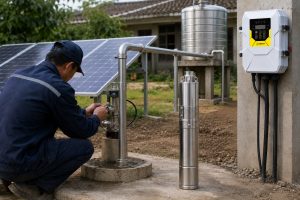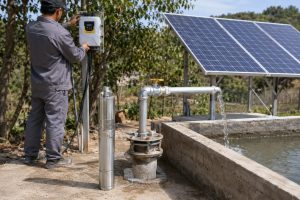
Struggling with unreliable water access in off-grid areas? This uncertainty hinders agricultural growth and daily life, creating a constant challenge for consistent water supply.
A solar water pump doesn't need a specific amount of sun, but rather a minimum solar irradiance, typically around 4-6 peak sun hours per day. The number of solar panels required depends on the pump's horsepower (HP), the well's depth (head), and the desired water volume (flow rate).
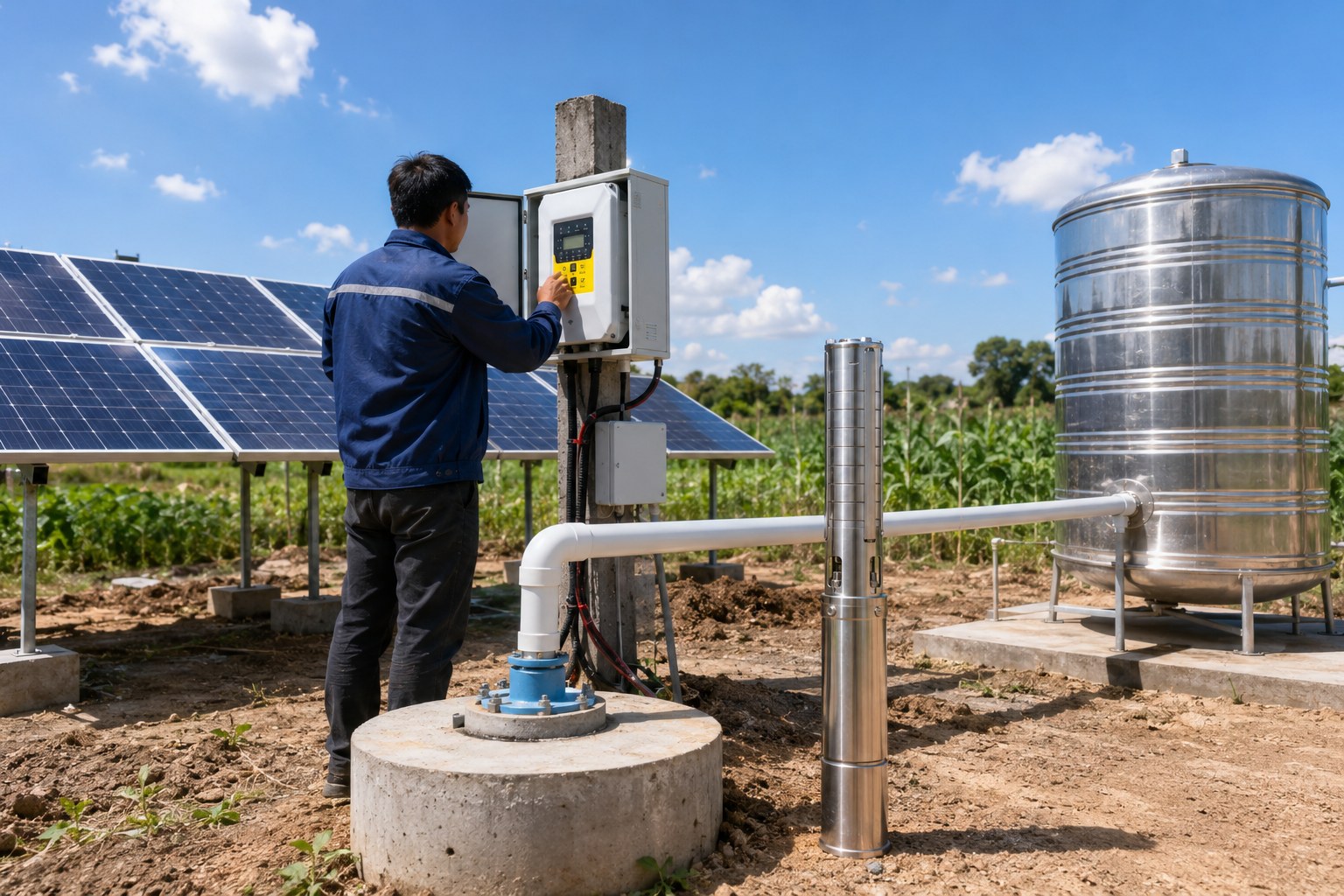
Understanding solar irradiance is just the first step. The true efficiency of a solar water pumping system lies in a well-matched combination of the pump type, motor efficiency, and intelligent controls. This synergy determines not only if the pump runs, but how effectively it delivers water, impacting everything from crop yields to livestock health. Let's delve into the specific components that answer how much sun your system truly needs by examining the technology that makes it all work.
Two Classes of Pumps: Solar-Native vs. AC-Adapted
Choosing the right pump feels overwhelming. Do you go with a system built for solar, or adapt a traditional AC pump? The wrong choice can lead to inefficiency and higher costs.
Pumps designed specifically for solar are highly efficient, often running on DC power directly from 200W to 1,200W of panels. Classic AC pumps adapted for solar require more power, with a 1/2 HP pump needing roughly 800W, demanding more panels and complex inverters.
The distinction between these two pump classes is critical for designing a system that is both effective and economical. Solar-native pumps are engineered from the ground up to maximize the variable power output from solar panels, while AC-adapted systems offer a different kind of flexibility, often at the cost of higher initial power requirements. Understanding the core technology of each will help you select the optimal solution for any application.
Pumps Designed for Solar (DC)
Direct Current (DC) solar pumps are the workhorses of the off-grid water world.
Their design philosophy centers on maximum efficiency.
By running directly on the DC power generated by solar panels, they eliminate the energy loss—often 10-15%—that occurs when converting DC to AC power.
This inherent efficiency means they can start pumping earlier in the day and continue later into the evening, making the most of available sunlight.
These pumps often integrate seamlessly with Brushless DC (BLDC) permanent magnet motors, which boast efficiencies exceeding 90%.
This combination is a game-changer for remote applications.
| Feature | DC Solar-Native Pump | AC-Adapted Pump |
|---|---|---|
| Power Source | Direct Current (DC) | Alternating Current (AC) |
| Typical Panel Wattage | 200W - 1,200W | 800W - 120,000W+ |
| System Efficiency | High (minimal power conversion loss) | Lower (inversion loss of 10-15%) |
| Motor Type | Often integrated BLDC motor (>90% eff.) | Standard AC motor |
| Complexity | Simpler (fewer components) | More complex (requires inverter/VFD) |
| Best Use Case | Off-grid, remote water supply | Hybrid systems, retrofitting existing pumps |
Classic AC Pumps Adapted for Solar
Adapting a traditional AC pump for solar power is a viable, and sometimes necessary, solution.
This approach is common when a property already has a high-quality AC submersible pump installed, or when the required horsepower exceeds what is typically available in DC models (e.g., above 3-5 HP).
The key component in this setup is a specialized solar controller or inverter.
This device takes the raw DC power from the solar array and converts it into the stable AC power the pump needs.
Modern systems use Variable Frequency Drives (VFDs) to manage this process intelligently.
A VFD can adjust the frequency of the AC power supplied to the pump motor, allowing it to run at variable speeds depending on the intensity of the sunlight.
This "soft start" capability reduces mechanical stress on the pump and electrical strain on the system, significantly extending the pump's lifespan.
While this setup requires a larger solar array to compensate for conversion losses and the higher power draw of AC motors, it provides the flexibility to run massive pumps up to 100 HP or more entirely on solar energy.
This makes it a powerful option for large-scale agricultural irrigation and industrial applications.
Choosing the Right Solar Pump: A Portfolio Approach
You need a water pump, but one size doesn't fit all. A pump perfect for a deep well may fail in a sandy one, leaving your project dry and over budget.
The key is a portfolio approach. Solar screw pumps for deep wells (high head, low flow), plastic impeller pumps for high volume (high flow, wear-resistant), and stainless steel impeller pumps for harsh water (corrosion-resistant), all powered by an efficient BLDC motor.
This isn't about finding a single "best" pump; it's about building a versatile product offering that can solve diverse water challenges. By understanding the specific strengths of each pump type and the core motor technology that drives them, you can confidently meet the unique demands of any customer, from a small homestead to a large commercial farm. Let's break down the ideal applications for each.
1. The Deep Well Specialist: Solar Screw Pump
For deep boreholes where water levels are far below the surface, you need a pump that can generate immense pressure.
This is where the solar screw pump excels.
It operates on the principle of a progressing cavity, using a single stainless steel helical rotor that turns within a rubber stator.
As the rotor turns, it creates sealed cavities of water that are progressively "squeezed" upwards.
This mechanism produces very high lifting pressure (head), making it possible to pump water from depths exceeding 150-200 meters with a relatively small solar array.
Another significant advantage is its exceptional sand resistance.
The rubber stator can flex to allow small abrasive particles to pass through without causing significant damage, a feature that centrifugal pumps lack.
This makes it the go-to choice in regions with sandy or silty water conditions, common in parts of Africa and Latin America.
| Attribute | Solar Screw Pump |
|---|---|
| Mechanism | Progressing Cavity |
| Performance | Low Flow, High Head |
| Ideal Well Depth | > 80 meters |
| Sand Resistance | Excellent |
| Primary Application | Deep well domestic supply, livestock water |
| Limitation | Not suitable for high-volume irrigation |
2. The High-Volume Workhorse: Solar Plastic Impeller Pump
When the goal is to move a lot of water for applications like farm irrigation or filling large reservoirs, you need high flow.
The solar plastic impeller pump is a multi-stage centrifugal pump designed for this exact purpose.
It uses a series of stacked impellers, each one adding pressure to the water, to achieve medium head while delivering a high volume of water.
The key innovation here is the use of durable, engineered plastic for the impellers.
This material offers excellent wear resistance against fine sand and sediment, which can quickly erode softer materials.
Furthermore, plastic impellers make the pump significantly lighter and more economical than its stainless steel counterparts, reducing both shipping costs and the initial purchase price.
These advantages make it an extremely popular choice for agricultural and pastoral applications across Africa and the Americas, where maximizing water output in a cost-effective manner is a top priority.
3. The Premium Durability Option: Solar Stainless Steel Impeller Pump
In environments with corrosive water—either acidic or alkaline—pump longevity is a major concern.
Standard pumps can degrade quickly, leading to costly replacements and system downtime.
The solar stainless steel impeller pump is the premium solution for these challenging conditions.
Constructed with SS304 stainless steel impellers, diffusers, and pump body, this model is engineered for maximum corrosion resistance and durability.
It offers high flow rates and medium-to-high head capabilities, similar to the plastic impeller version, but with a vastly extended service life in aggressive water.
This makes it the optimal choice for regions with alkaline soils, such as parts of Australia and the Americas, as well as for high-end residential and commercial properties where reliability is paramount.
While the initial investment is higher due to material costs and weight, the long-term reliability and reduced maintenance make it a sound financial decision for specialized, high-value applications.
The Heart of the System: The BLDC Motor
Your pump choice is critical, but it's nothing without an efficient motor. A power-hungry motor wastes precious solar energy, requiring more panels and increasing system costs significantly.
The core of modern solar pumps is the high-efficiency Brushless DC (BLDC) permanent magnet motor. With efficiencies over 90%, it uses less power, reducing the number of solar panels needed by up to 25% and lowering the total system cost.
The motor's efficiency is a direct multiplier for the entire system's performance. A more efficient motor translates directly into more water pumped per watt of solar power. This technological advantage is not just an incremental improvement; it is the foundational element that makes solar pumping both economically viable and highly reliable.
Unlocking Peak Performance
The technical superiority of a BLDC motor over traditional brushed or AC motors is substantial.
The rotor is constructed from high-grade neodymium iron boron (like 40SH), a powerful permanent magnet.
Since there are no brushes to wear out, the motor is virtually maintenance-free and has a much longer operational lifespan.
The magic lies in its electronic commutation, managed by an intelligent controller.
This allows for precise speed control and high torque across a wide range of RPMs.
This high torque is crucial for starting the pump under load, especially in deep wells.
From a design perspective, BLDC motors are also more compact and lightweight.
They can be up to 47% smaller and 39% lighter than an equivalent AC motor, which simplifies installation—a critical factor when installing a pump hundreds of feet down a borehole.
The Market Value of Efficiency
For a distributor or importer, the motor's efficiency is a powerful selling point.
It directly addresses the end-user's primary concern: cost.
By reducing the required size of the solar array, you lower the single largest expense in the system.
A system that might have required four 300W panels with a less efficient motor might now run perfectly on just three.
This cost saving, which can be over 25% on the solar panel component, makes the entire package more competitive.
Furthermore, the motor's reliability, backed by a maintenance-free design, translates into a lower total cost of ownership and greater customer satisfaction.
The system is paired with an intelligent Maximum Power Point Tracking (MPPT) controller.
This controller constantly analyzes the output from the solar panels and adjusts the electrical load to extract the maximum possible power, regardless of changing light conditions.
An MPPT controller can boost system output by another 20-30% compared to simpler controllers, ensuring that every available ray of sunlight is converted into pumped water.
Do Solar Water Pumps Work at Night?
A common question is whether a solar-powered system can provide water when the sun goes down. Reliance on daylight seems like a major limitation for round-the-clock water needs.
Typically, solar pumps do not work at night as they rely on direct sunlight. However, continuous water access is achieved by either storing energy in batteries or, more commonly, by storing water pumped during the day in an elevated tank for gravity-fed use at night.
The strategy you choose—storing energy or storing water—has significant implications for system cost, complexity, and maintenance. While battery backup offers on-demand pumping, water storage is often a more practical and cost-effective solution for ensuring a reliable 24/7 water supply in most agricultural and domestic settings.
Solution 1: Battery Storage for On-Demand Pumping
Integrating a battery bank into a solar pump system allows you to store the excess energy generated during peak sunlight hours.
This stored energy can then power the pump at night or during overcast days.
This setup provides true on-demand water, functioning just like a grid-powered system.
However, this convenience comes at a cost.
deep-cycle batteries add significant expense and complexity to the initial installation.
They also have a finite lifespan, typically 3-7 years, and require periodic maintenance and replacement.
Furthermore, lead-acid batteries, a common choice, can be sensitive to extreme temperatures.
This approach is best suited for critical applications where on-demand pumping is non-negotiable and the budget allows for the higher initial and long-term costs.
Solution 2: Water Storage for Gravity-Fed Supply
The most common and cost-effective method for nighttime water access is daytime water storage.
The system is designed to pump more water than is needed during the day, with the surplus directed into a large storage tank, often placed on a tower or high ground.
At night, water is supplied via gravity from the tank, eliminating the need for the pump to operate at all.
This approach has several key advantages:
- Cost-Effectiveness: A water tank is a one-time purchase with a lifespan of 20+ years, far outlasting any battery bank.
- Simplicity: The system remains simple, with no complex battery management systems, charge controllers, or additional wiring.
- Reliability: It is a mechanically simple solution with very few points of failure. The only requirement is that the tank is large enough to hold at least 1-2 days of water reserves to cover cloudy periods.
This method transforms the intermittent power of the sun into a constant, reliable water supply.
Solution 3: Hybrid AC/DC Systems
A third, more advanced solution is the hybrid AC/DC water pump system.
This technology offers the best of both worlds, ensuring a completely uninterrupted water supply.
The pump's controller is designed with dual power inputs, allowing it to be connected to both a solar panel array (DC) and a grid or generator power source (AC) simultaneously.
The intelligent controller prioritizes solar power whenever it's available.
If sunlight is insufficient, it automatically supplements with or switches entirely to the AC source.
This ensures the pump can run 24/7, regardless of weather conditions, without the need for batteries.
This setup is ideal for critical applications like commercial farms or community water supplies where consistent water pressure is essential and a backup power source is readily available.
Conclusion
The power of solar pumps lies in matching efficient motors with the right pump type and intelligent controls, ensuring reliable water access regardless of the grid.
Frequently Asked Questions
1. How many solar panels are needed for a 1 HP pump?
A 1 HP DC solar pump typically requires between 800 to 1,200 watts of solar panels, depending on the pump's efficiency and the well's depth.
2. Can a solar pump run directly from panels without a battery?
Yes, most solar water pumping systems are designed to run directly from solar panels during the day without any batteries, storing water in a tank for later use.
3. What is an MPPT controller in a solar pump system?
An MPPT (Maximum Power Point Tracking) controller is an electronic device that optimizes the power output from the solar panels, increasing water flow by up to 30%.
4. How deep can a solar water pump work?
Solar pumps can be configured for various depths. Solar screw pumps are specialists for very deep wells, capable of lifting water from over 200 meters (650 feet).
5. Do solar pumps work on cloudy days?
Yes, solar pumps can operate on cloudy days but at a reduced flow rate. They work as long as there is some daylight, though output is directly proportional to sunlight intensity.
6. What maintenance do solar water pumps require?
Solar pump systems are very low maintenance. The primary tasks are to periodically wipe the solar panels clean and check plumbing connections for any leaks.
7. How long do solar water pump systems last?
A well-designed system is very durable. Solar panels have a lifespan of 25+ years, while a high-quality brushless DC pump motor can run for over 10 years before requiring service.
8. Can I use a solar pump for my house?
Absolutely. A solar pump can supply a whole house with pressurized water by pumping into a pressure tank, providing a reliable off-grid water solution.