Struggling to find a reliable water source for your remote property?
The costs and limitations of grid power or wells can be overwhelming.
A solar water pump offers a sustainable, cost-effective solution.
To choose the right size solar water pump, you must first determine your Total Dynamic Head (TDH) and required daily water volume (Flow Rate).
Next, select a pump type (screw, centrifugal) and motor that meets these needs, then match it with the correct number of solar panels.
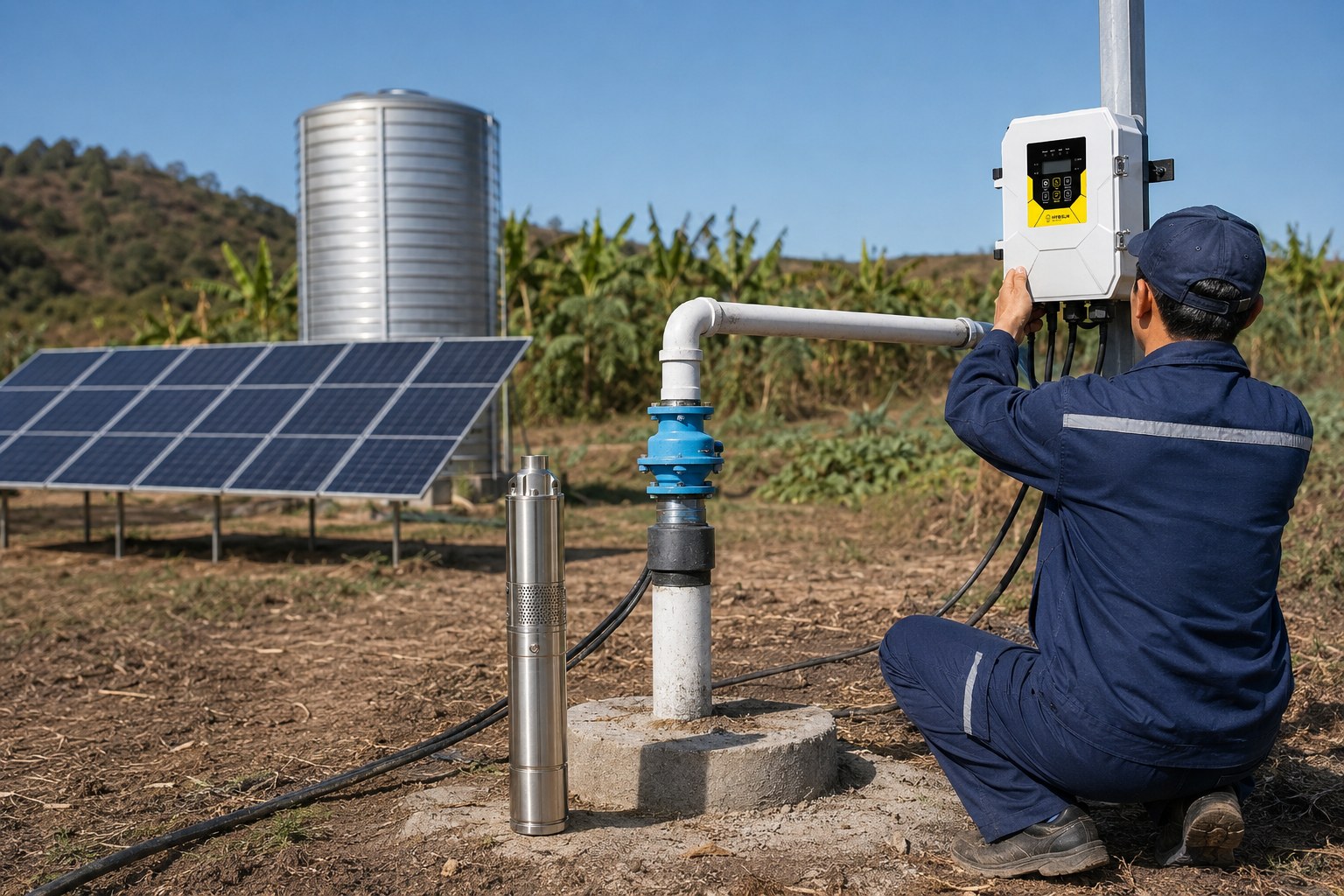
Choosing the right solar pump feels complicated.
There are so many variables to consider, from well depth to sunlight hours.
This guide simplifies the process.
We will break down every component, from the pump itself to the motor and power system.
You will learn about different pump types and how to calculate your exact needs.
This ensures you build a reliable water system that works for you.
Let’s walk through how to design the perfect solar water system for your unique situation.
Understanding Your Core Water Needs: Flow Rate and Head
Unsure how to calculate your water needs for a new pump?
Without the right data, you might buy a pump that is too weak or wastefully powerful.
This leads to inefficiency and extra cost.
First, calculate your total daily water requirement (flow rate).
Then, determine the Total Dynamic Head (TDH), which is the total vertical distance and friction loss the pump must overcome.
These two metrics are the foundation for sizing your entire system.
Calculating Your Water Needs
Choosing a pump begins with understanding your water demand.
This is not just about how much water you need, but also how high you need to lift it.
Step 1: Determine Required Flow Rate
Your required "flow rate" is the total volume of water you need per day.
This is often measured in cubic meters per hour (m³/h) or gallons per minute (GPM).
Start by listing all your water uses.
This includes domestic use, livestock watering, and irrigation.
A typical household might use 100-150 gallons per person per day.
Livestock needs vary significantly. For example, a single dairy cow can drink up to 40 gallons daily.
For irrigation, the calculation depends on the crop type, climate, and irrigation method.
Drip irrigation is about 30% more efficient than sprinkler systems.
Here is a table to help estimate your daily needs:
| Water Use | Gallons per Day (Average) | Notes |
|---|---|---|
| Domestic Use (per person) | 100-150 Gallons | Includes drinking, cooking, sanitation. |
| Beef Cattle (per head) | 15 Gallons | Varies with temperature and feed type. |
| Dairy Cattle (per head) | 40 Gallons | Higher requirement due to milk production. |
| Garden Drip Irrigation (100 sq ft) | 60 Gallons | Based on 1 inch of water, highly efficient. |
| Lawn Sprinkler (100 sq ft) | 90 Gallons | Less efficient, more water lost to evaporation. |
Once you have a total daily volume, divide it by the number of peak sun hours in your location.
This gives you a target hourly flow rate for your pump.
For example, if you need 2,400 gallons per day and have 6 peak sun hours, you need a pump that can deliver 400 gallons per hour (GPH).
This is roughly 6.7 gallons per minute (GPM).
Step 2: Determine Total Dynamic Head (TDH)
"Head" refers to the vertical height the water must be lifted.
However, "Total Dynamic Head" (TDH) is more comprehensive.
It includes both the vertical lift and the friction losses in the piping system.
TDH is the true measure of workload on the pump.
TDH = Static Head + Friction Head
- Static Head: This is the simple vertical distance from the water level in your well (or tank) to the highest point of delivery (your faucet or tank inlet). If you are pumping from a 200-foot deep well to a tank 20 feet high on a hill, your static head is 220 feet.
- Friction Head: As water moves through pipes, fittings, and valves, it encounters resistance, or friction. This friction adds to the workload of the pump. It depends on the pipe diameter, length of the pipe run, flow rate, and the number of bends or elbows. A 100-foot run of 1-inch pipe carrying 10 GPM might add about 4 feet to the TDH. Using a larger diameter pipe, like 1.25 inches, can reduce this friction head by over 50%.
Failing to account for friction head is a common mistake.
It can lead to a pump that underperforms, failing to deliver the expected pressure or flow at the destination.
Always use an online friction loss calculator or consult your pump supplier with your pipe layout details.
A correctly calculated TDH ensures your pump is powerful enough for the job.
Choosing the Right Pump Type for Your Application
Picking the wrong pump type can lead to poor performance and early failure.
A pump designed for clear water may clog with sand, while a low-flow pump cannot irrigate a field.
Matching the pump to the job is critical.
For deep wells with low water needs, choose a solar screw pump.
For high-volume irrigation on farms, a solar plastic impeller pump is best.
For corrosive water or premium applications, use a solar stainless steel impeller pump.
Once you know your required flow and head, you can select a pump type.
Different applications call for different pump designs.
Let’s explore the three most common solar deep well pumps.
Each is designed for a specific set of conditions.
1. Solar Screw Pumps: For Deep Wells and High Head
Solar screw pumps, also known as progressive cavity pumps, excel in high-head, low-flow situations.
They operate by trapping pockets of water between a rotating stainless steel screw and a rubber stator.
The water is then pushed upwards as the screw turns.
This mechanism is highly effective at moving water from extreme depths.
A key advantage is their resilience to sand and sediment.
The gentle pushing action is less susceptible to abrasion than the high-speed spinning of centrifugal impellers.
This makes screw pumps ideal for newly drilled wells or areas with sandy water, where they can last up to 40% longer than impeller-based pumps.
Performance Characteristics:
- Best For: Deep domestic wells, livestock watering in arid regions.
- Flow Rate: Typically low, from 1 to 10 GPM.
- Head: Very high, capable of lifting water from depths exceeding 500 feet (150 meters).
| Feature | Solar Screw Pump |
|---|---|
| Mechanism | Positive Displacement (Screw & Stator) |
| Ideal Head | > 300 feet (90m) |
| Ideal Flow | Low (< 10 GPM) |
| Sand Tolerance | Excellent (Can handle up to 1.5% sand content) |
| Applications | Deep well domestic supply, remote livestock water |
| Limitation | Not suitable for high-volume irrigation. |
If you have a very deep well and modest daily water needs, a solar screw pump provides a reliable and durable solution.
It is a workhorse for challenging water conditions.
2. Solar Plastic Impeller Pumps: For High Flow and General Use
Solar plastic impeller pumps are a type of multi-stage centrifugal pump.
They use a series of stacked impellers made from durable, engineered plastics.
Each impeller stage adds pressure, pushing the water higher.
This design is perfect for achieving high flow rates at medium head levels.
These pumps are the go-to choice for most agricultural and residential applications.
They efficiently move large volumes of water for farm irrigation, pasture management, and large home water systems.
The plastic impellers offer good resistance to wear from fine sand.
They are also lightweight and more economical than their stainless steel counterparts, reducing the initial investment by up to 25%.
Performance Characteristics:
- Best For: Farm irrigation, filling large storage tanks, community water supply.
- Flow Rate: High, often ranging from 10 to 50 GPM or more.
- Head: Medium, typically effective up to 300 feet (90 meters).
| Feature | Solar Plastic Impeller Pump |
|---|---|
| Mechanism | Multi-stage Centrifugal |
| Ideal Head | 50 - 300 feet (15 - 90m) |
| Ideal Flow | High (> 10 GPM) |
| Sand Tolerance | Good (Handles fine sand, but not coarse grit) |
| Applications | Irrigation, residential water, tank filling |
| Limitation | Less durable in highly corrosive water. |
For anyone needing to move a lot of water efficiently without breaking the bank, the plastic impeller pump is a fantastic choice.
Its balance of performance, wear resistance, and cost makes it a versatile solution.
3. Solar Stainless Steel Impeller Pumps: For Durability and Harsh Water
When water quality is a concern, the solar stainless steel impeller pump is the premium solution.
This pump uses impellers and a pump body constructed from SS304 or higher-grade stainless steel.
This provides superior resistance to corrosion, abrasion, and harsh chemical environments.
It is built for longevity in the toughest conditions.
These pumps are ideal for areas with acidic or alkaline water.
This includes coastal regions with saltwater intrusion risks or agricultural areas with high mineral content.
While the initial cost is higher—sometimes up to 40% more than a plastic model—the extended service life can make it more cost-effective in the long run.
They offer exceptional reliability for high-end homes, critical livestock operations, and specialized industrial uses.
Performance Characteristics:
- Best For: Corrosive water environments, high-end residential systems, critical infrastructure.
- Flow Rate: High, similar to plastic impeller models.
- Head: Medium to High, with some models extending beyond 300 feet.
| Feature | Solar Stainless Steel Impeller Pump |
|---|---|
| Mechanism | Multi-stage Centrifugal |
| Ideal Head | 50 - 350+ feet (15 - 107m) |
| Ideal Flow | High (> 10 GPM) |
| Sand Tolerance | Very Good (More abrasion resistant than plastic) |
| Applications | Corrosive water, high-end homes, food-grade use |
| Limitation | Higher initial cost and weight. |
If you prioritize long-term reliability and your water source is challenging, investing in a stainless steel impeller pump is a wise decision.
It ensures clean, consistent water flow for decades.
The Engine of the System: The BLDC Motor
The pump itself is only half the story.
A weak, inefficient motor will bottleneck your entire system, no matter how good the pump is.
This forces you to buy more solar panels, increasing costs.
All modern, high-quality solar pumps should use a Brushless DC (BLDC) permanent magnet motor.
These motors offer over 90% efficiency, reducing solar panel requirements and maximizing water output, especially on cloudy days.
The motor is the heart of your solar water pump system.
It converts electrical energy from the solar panels into the mechanical force that drives the pump.
The efficiency of this conversion is one of the most critical factors in the overall performance of your system.
This is where BLDC permanent magnet motors have revolutionized the industry.
Why BLDC Motors are Superior
Traditional DC motors used brushes to transfer power.
These brushes would wear out, create sparks, and generate significant energy loss as heat.
BLDC motors eliminate these brushes entirely.
They use powerful permanent magnets (often neodymium iron boron) and an intelligent electronic controller to spin the rotor.
The benefits are dramatic:
- High Efficiency: BLDC motors consistently achieve efficiencies above 90%. In comparison, standard brushed DC motors are around 75-80% efficient, and AC motors used in conventional well pumps are often below 70% efficient. This 15-20% gain means more of the sun's energy is converted into pumped water.
- Longer Lifespan: With no brushes to wear out, BLDC motors are virtually maintenance-free. Their operational lifespan can easily exceed 10 years, which is 2-3 times longer than a typical brushed motor.
- Compact and Lightweight: The high power density of a BLDC motor means it can be much smaller and lighter than an AC or brushed DC motor of equivalent power. A BLDC motor can be up to 47% smaller and 39% lighter, which simplifies installation, especially in deep wells.
- High Torque at All Speeds: BLDC motors provide consistent torque from startup to full speed. This is crucial for overcoming the initial inertia of starting a pump, especially in deep wells with a tall column of water to lift.
The Financial Impact of Motor Efficiency
The high efficiency of a BLDC motor translates directly into cost savings.
A more efficient motor requires less power to do the same amount of work.
This means you can power your pump with fewer solar panels.
Consider a 1 HP (750W) pump system.
| Motor Type | Efficiency | Power Needed from Panels | Estimated Panel Wattage (w/ 25% system loss) |
|---|---|---|---|
| BLDC Motor | 92% | 815 Watts | ~1020 Watts |
| Standard AC Motor | 70% | 1071 Watts | ~1340 Watts |
As the table shows, the inefficient AC motor requires over 300 additional watts of solar panels.
At today's prices, this could add $150-$300 to the initial system cost.
Over the lifetime of the pump, an efficient motor ensures you get the most water for your investment, especially during periods of low sunlight.
Always verify that the solar pump you are considering is powered by a high-efficiency BLDC motor.
Powering Your Pump: Solar Panels and Controllers
Your system is incomplete without a power source.
Simply connecting a pump to a panel won't work well.
You need a smart system to manage the variable power from the sun and protect your equipment.
To power your pump, you need a solar panel array sized to meet the motor's power demand and an MPPT controller.
The controller maximizes energy harvest from the panels and ensures the pump runs efficiently and safely under all conditions.
The final pieces of the puzzle are the solar panels that generate the electricity and the controller that manages it.
Sizing these components correctly is essential for a reliable and efficient system.
Sizing Your Solar Panel Array
The number of solar panels you need depends directly on the power requirements of your pump's motor.
Manufacturers specify a pump's power draw in watts (W) or horsepower (HP), where 1 HP is approximately 746W.
As a rule of thumb, you should oversize your solar array by about 25-30% of the motor's rated power.
This accounts for real-world factors like cloudy weather, panel soiling, high temperatures, and wiring losses.
If your pump motor is rated at 1000W, you should aim for a solar array of at least 1250W.
This gives you a buffer to ensure the pump performs well even on less-than-perfect days.
The number of panels is then just the total required wattage divided by the wattage of the individual panels you choose.
For a 1250W array, you could use five 250W panels or four 320W panels.
The Role of the MPPT Controller
A solar pump controller is the brain of the system.
The most important feature to look for is Maximum Power Point Tracking (MPPT).
Solar panels have a specific voltage and current at which they produce the most power—their "maximum power point."
This point changes constantly with sunlight intensity and temperature.
An MPPT controller continuously tracks this sweet spot and adjusts the electrical load to extract the maximum possible energy from the panels.
An MPPT controller can boost your system's output by up to 30% compared to a simpler PWM controller, especially on cloudy days or during early morning and late afternoon.
Beyond MPPT, a good controller provides critical protection features:
- Dry-Run Protection: It uses sensors in the well or monitors the motor's power draw to detect when the water level drops too low. It then shuts off the pump to prevent damage.
- Over-voltage/Under-voltage Protection: Shields the motor from voltage spikes or dips from the solar array.
- Soft Start: Gradually ramps up the motor's speed, reducing mechanical stress on the pump and electrical strain on the system during startup.
AC/DC Hybrid Options for 24/7 Water
For critical applications, relying solely on the sun may not be enough.
What if you need water at night or during extended cloudy periods?
This is where an AC/DC hybrid controller becomes invaluable.
These advanced controllers are designed with inputs for both DC power from solar panels and AC power from the grid or a generator.
The controller intelligently prioritizes solar power.
When the sun is shining, it runs the pump entirely on free solar energy.
If solar output drops due to clouds, it will seamlessly blend in AC power to maintain pump performance.
When there is no sunlight, it will automatically switch over to the AC source.
This ensures you have a reliable, worry-free water supply 24 hours a day while still maximizing your use of renewable energy.
This feature provides the ultimate in water security and flexibility.
Conclusion
Sizing a solar pump involves matching your water needs with the right pump, an efficient motor, and a smart power system.
This ensures a reliable, cost-effective water solution for years.
FAQs
What size solar panel do I need to run a water pump?
Oversize your solar array by 25-30% of the pump motor's wattage rating. A 1000-watt pump motor needs at least 1250 watts of solar panels to perform well in real-world conditions.
Can a solar pump run without a battery?
Yes, most solar deep well pump systems are designed to run directly from solar panels during the day without batteries. They pump water into a storage tank, which acts as a "water battery."
How long do solar water pumps last?
A quality solar pump system can last for 20+ years. The solar panels are rated for 25 years, a BLDC motor can last over 10 years, and the pump end may need servicing every 5-10 years depending on water quality.
Do solar pumps work on cloudy days?
Yes, but at a reduced flow rate. An MPPT controller and an efficient BLDC motor are crucial for maximizing performance in low-light conditions, often allowing the pump to run effectively even on overcast days.
How deep can a solar pump pull water?
It depends on the pump type. Solar screw pumps are designed for extreme depths and can lift water from over 500 feet (150 meters), while centrifugal pumps are typically used for depths up to 300 feet.
Can I run my existing AC pump on solar?
Yes, using a specialized solar inverter or VFD (Variable Frequency Drive). However, it is often less efficient than using a purpose-built DC solar pump system with a high-efficiency BLDC motor.
What is Total Dynamic Head (TDH)?
TDH is the total workload on the pump. It is the sum of the vertical distance you are lifting the water (static head) and the pressure lost due to friction in your pipes (friction head).