Struggling to choose the right water pump for your home or business?
A wrong choice can lead to poor performance, high energy bills, and costly replacements.
The "best" water pump is the one that perfectly matches your specific needs.
This depends on your water source, required flow rate (GPM), pressure (PSI), and application.
Whether for residential boosting, well water extraction, or off-grid solar irrigation, selecting the right type and size is crucial for efficiency and longevity.
Choosing a pump can feel overwhelming with so many types and specifications available.
This guide will simplify the process.
We will break down the top pump categories, key technologies, and sizing factors.
This will help you make an informed decision and invest in a solution built for reliability and efficiency.
Let's dive in.
Understanding Your Core Needs: Pump Types and Applications
Are you confused by terms like centrifugal, submersible, and booster?
Choosing the wrong pump type is a common mistake that wastes both energy and money every single day.
First, you must identify your primary application.
Are you boosting low city water pressure, drawing water from a deep well, circulating hot water for an HVAC system, or managing wastewater?
Each task requires a specifically designed pump to ensure optimal performance and long-term durability.
Selecting the correct pump type is the foundational step.
Different designs are engineered to handle specific conditions, from pressure levels to water purity.
Matching the pump to the job prevents premature wear by up to 70% and ensures you get the water you need, when you need it.
A pump that is correctly matched to its task will operate at its Best Efficiency Point (BEP), minimizing energy use and mechanical stress.
Residential Water Pressure and Supply
For homes and small commercial buildings, maintaining consistent water pressure is a common challenge.
Three types of pumps excel in this area.
-
VFD Smart Variable Frequency Pumps: These pumps are the pinnacle of modern pressure boosting.
They use a variable frequency drive (VFD) to adjust the motor's speed in real-time based on water demand.
When you open a single faucet, the pump runs slowly.
When multiple fixtures are used, it speeds up.
This results in perfectly consistent pressure, eliminates damaging water hammer, and can reduce energy consumption by 30-60% compared to fixed-speed pumps. -
Automatic Booster Pumps with Pressure Tank: This is a traditional and reliable solution.
The pump fills a pressure tank with water, and the compressed air in the tank pushes water to your fixtures.
The pump only turns on when the tank's pressure drops to a preset minimum.
This reduces the number of start/stop cycles by up to 50%, a major cause of motor wear.
This simple mechanism extends the motor's life and provides a buffer against pressure fluctuations. -
Self-Priming Jet Pumps: These are surface pumps often used with water storage tanks or shallow wells (less than 25 feet or 8 meters).
Their key advantage is the "self-priming" capability.
This allows them to re-establish a prime and lift water even if air enters the suction line.
They are a robust and cost-effective choice for boosting supply from a tank.
| Pump Type | Best For | Energy Efficiency | Key Benefit |
|---|---|---|---|
| VFD Smart Pump | Consistent pressure in multi-story homes | Highest (saves 30-60%) | Eliminates pressure fluctuations |
| Automatic Booster Pump | Homes with inconsistent supply | Good | Reduces pump cycling by 50%, improves durability |
| Self-Priming Jet Pump | Boosting from tanks/shallow wells | Standard | Reliable and easy to re-prime |
Well Water Systems
Drawing water from an underground source requires a different approach.
The depth of your well is the single most important factor.
-
Deep Well Submersible Pumps: For wells deeper than 25 feet (8 meters), a submersible pump is the industry standard.
The entire unit, including the motor, is lowered into the well and submerged in the water.
This design is highly efficient because it pushes water to the surface rather than pulling it.
This method overcomes the physical limitations of atmospheric pressure.
They can operate in wells hundreds of feet deep, providing a reliable water supply for rural homes and farms. -
Convertible Jet Pumps: These versatile pumps can be configured for both shallow wells (0-25 feet) and deep wells (25-90 feet or up to 27 meters).
For deep well applications, a two-pipe system with an ejector is installed in the well.
The pump pushes water down one pipe to the ejector, which creates a vacuum to help lift water up the second pipe.
This makes them a flexible option for areas with fluctuating water tables.
Specialized Applications
Beyond general supply, specialized pumps handle specific tasks.
Circulating Pumps are essential for hot water recirculation and HVAC systems.
They can reduce the wait time for hot water by over 90%, saving thousands of gallons of water per year.
Sewage Lifting Systems use powerful grinder pumps to break down solid waste and move it to the main sewer line.
They are crucial for basements or properties situated below the sewer grade.
Swimming Pool Pumps are designed for continuous circulation and filtration.
Modern variable-speed models can cut energy costs by up to 90% compared to older single-speed pumps.
The Rise of Solar Pumps: A Sustainable and Cost-Effective Solution
Facing unreliable grids and soaring energy bills?
Traditional pumps can be a constant drain on your resources and budget.
Solar water pumps offer complete grid-independence, zero operational energy costs, and a low carbon footprint.
They are the ideal solution for agriculture, livestock, and homes in sunny or remote regions, providing a reliable water supply powered by clean, free energy.
The global demand for clean energy is driving innovation in water solutions.
In off-grid regions across Africa, the Americas, Australia, and Asia, solar pumps are not just a convenience—they are a necessity.
They provide life-sustaining water for drinking, sanitation, and food production where electricity is scarce or non-existent.
The true power of these systems lies in their core components and versatile designs.
The Power Behind the Pump: The BLDC Motor
The heart of every modern, high-performance solar pump is the motor.
A Brushless DC (BLDC) permanent magnet motor is the key to unlocking maximum efficiency.
These motors are engineered for one purpose: to convert as much solar energy as possible into water flow.
-
Unmatched Efficiency: BLDC motors achieve efficiencies exceeding 90%.
This is a significant leap from traditional AC or brushed DC motors, which often operate at 60-75% efficiency.
This means more water is pumped using the same amount of sunlight. -
Powerful and Compact Design: The rotor is constructed from high-strength neodymium iron boron (40SH) permanent magnets.
This high-torque design allows the motor to be incredibly powerful yet compact.
A modern BLDC motor can be up to 47% smaller and 39% lighter than a conventional motor of the same power rating. -
Market Value: The high efficiency directly translates to cost savings.
A system with a 90% efficient motor requires 15-25% fewer solar panels to achieve the same water output as a less efficient system.
This lowers the initial investment, simplifies installation, and reduces the physical footprint.
The brushless design also eliminates the need for maintenance and provides a service life of over 10 years.
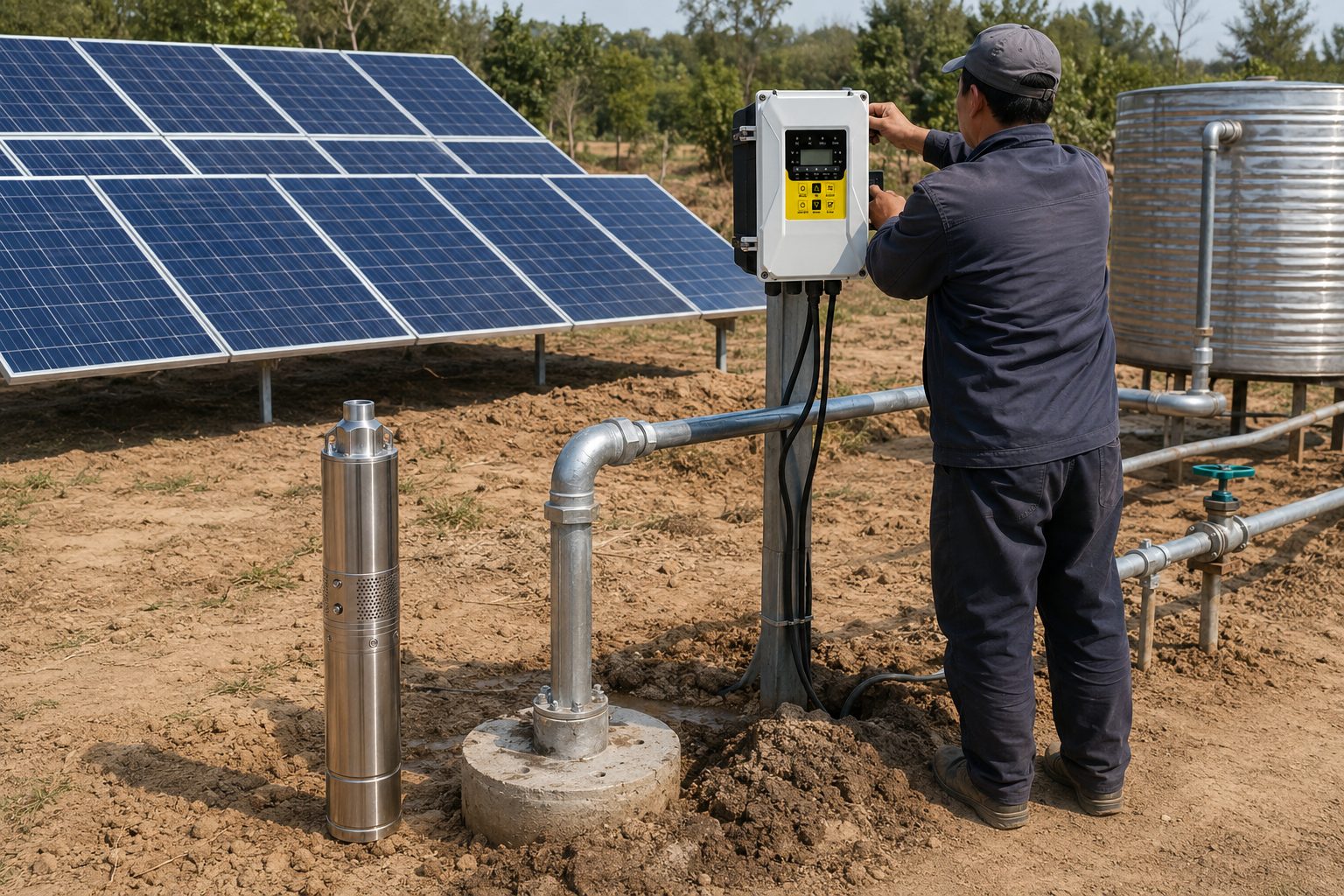
Choosing the Right Solar Deep Well Pump
Not all solar pumps are created equal.
The pump end must be matched to the well's depth and the required flow rate.
Three main designs form a competitive portfolio to meet any need.
-
Solar Screw Pump: This pump uses a stainless steel screw rotating inside a rubber stator.
It functions like an Archimedes' screw, pushing water upward through compression.
It is a low-flow, high-head design, perfect for deep wells where high pressure is needed to lift water to the surface.
Its ability to handle water with high sand content makes it exceptionally durable in harsh water conditions found in parts of Africa and Latin America. -
Solar Plastic Impeller Pump: This is a multi-stage centrifugal pump equipped with durable, wear-resistant plastic impellers.
It is designed for high-flow, medium-head applications like farm irrigation and pasture water supply.
The high-quality plastic is engineered to resist abrasion from fine sand, outperforming metal impellers in certain conditions.
Its lightweight and economical construction makes it a popular choice for large-scale agricultural projects. -
Solar Stainless Steel Impeller Pump: This is the premium option for durability and corrosion resistance.
The entire pump end, including the impellers and housing, is made from SS304 or SS316 stainless steel.
This design is essential for pumping water in acidic or alkaline conditions, such as in the alkaline soil regions of Australia or coastal areas.
It offers high flow rates and a long service life, making it ideal for high-end homes, ranches, and applications where water quality is a concern.
| Pump Type | Flow Rate | Head (Lift) | Key Advantage | Best Application |
|---|---|---|---|---|
| Solar Screw Pump | Low | Very High (up to 200m+) | High sand resistance | Deep domestic wells, livestock watering |
| Solar Plastic Impeller Pump | High | Medium | Wear-resistant, lightweight, economical | Farm irrigation, pasture water supply |
| Solar Stainless Steel Pump | High | Medium-High | Superior corrosion resistance, long life | Corrosive water, high-end homes, ranches |
Advanced Pump Technologies: Smart Control and Hybrid Systems
Worried about pump performance on cloudy days or at night?
A simple solar-direct setup can have frustrating limitations, leaving you without water when you need it most.
Modern pumps feature intelligent controllers that optimize performance 24/7.
Technologies like Variable Frequency Drives (VFD) and AC/DC hybrid systems ensure consistent pressure and uninterrupted operation, maximizing both solar energy use and user convenience.
The true competitive advantage of a modern water pump lies not just in its mechanical design, but in its electronic brain.
An intelligent control system transforms a good pump into a great one.
It ensures the pump operates at peak efficiency, protects it from damage, and provides the flexibility needed for real-world conditions.
This is where leading manufacturers focus their R&D, developing patented technologies that set them apart.
The Brains of the Operation: MPPT Controllers
A solar pump system is only as good as its controller.
A Maximum Power Point Tracking (MPPT) controller is the standard for high-performance systems.
It constantly analyzes the voltage and current from the solar panels and adjusts the electrical load to extract the maximum amount of power available at any given moment.
-
Boosted Efficiency: An MPPT controller can increase the energy harvested from your solar array by up to 30% compared to a basic PWM or non-MPPT controller.
This means the pump can start earlier in the morning, run later in the evening, and perform better on overcast days. -
System Protection: The controller also serves as a comprehensive protection unit.
It monitors for conditions like dry-running, over-voltage, over-current, and overheating, automatically shutting down the pump to prevent catastrophic failure.
This built-in intelligence dramatically increases the system's lifespan.
Uninterrupted Water Supply: AC/DC Hybrid Technology
For applications requiring water 24 hours a day, a hybrid system is the ultimate solution.
Advanced AC/DC controllers are designed with two power inputs, allowing you to connect both solar panels (DC) and a grid or generator source (AC) simultaneously.
The controller's logic prioritizes solar power.
When sunlight is abundant, the pump runs entirely on free solar energy.
If clouds reduce the solar input, the hybrid function can blend AC power with the available DC power to maintain pump speed and water flow, maximizing the use of every available watt of solar.
When there is no solar input at all, such as at night, the controller automatically switches over to the AC source.
This ensures a completely reliable, worry-free water supply around the clock.
The Benefits of Variable Frequency Drive (VFD)
Whether powered by solar or the grid, VFD technology is a game-changer for any pump with variable demand.
Instead of running at a fixed, full speed, a VFD adjusts the motor's speed to precisely match the water demand.
This "soft start" capability ramps up the motor slowly, reducing the initial current surge by up to 75% and eliminating the mechanical shock that damages pipes and connections.
By running the motor at the slowest speed necessary, VFDs can slash energy consumption by 30-60%.
This reduction in mechanical and electrical stress can extend the pump's operational lifespan by 20-30% or more.
Key Metrics for Pump Selection: How to Size Your Pump Correctly
Buying a pump without proper sizing?
This is the most common mistake in the industry, leading to poor performance, high energy costs, and premature failure.
Sizing your pump correctly is non-negotiable.
You must accurately calculate your required flow rate (GPM), total dynamic head (vertical lift + friction loss), and desired pressure (PSI) to ensure your pump operates efficiently and meets your demand.
An undersized pump will fail to deliver adequate water pressure and flow.
An oversized pump will waste a tremendous amount of energy, cycle on and off excessively, and burn out its motor.
Proper sizing ensures the pump operates near its Best Efficiency Point (BEP), where it delivers the most water for the least amount of energy.
Follow these steps to get it right.
Calculating Flow Rate (GPM/GPH)
Flow rate, measured in Gallons Per Minute (GPM) or Gallons Per Hour (GPH), is the volume of water you need.
For residential use, a common rule of thumb is to count the number of water-using fixtures (faucets, showers, toilets, washing machines) and estimate how many could be used simultaneously.
-
Residential Estimation: A typical home with 2-3 bathrooms, a kitchen, and a laundry might require a peak flow rate of 10-15 GPM to maintain pressure when multiple fixtures are in use.
-
Agricultural Estimation: For irrigation, the calculation is based on the area to be watered and the type of irrigation system.
For example, drip irrigation might require 0.5 GPM per 100 feet of tubing, while sprinklers may need 2-5 GPM each.
Understanding Total Dynamic Head (TDH)
Total Dynamic Head (TDH) is the total equivalent height that the pump must move water against.
It is the most critical factor in pump selection and is calculated by adding three components:
-
Vertical Lift (Static Head): This is the vertical distance from the surface of the water source (e.g., the water level in your well) to the highest point where the water will be discharged.
-
Friction Loss: As water moves through pipes, elbows, and valves, it encounters friction, which is equivalent to adding more vertical lift.
Friction loss depends on the pipe diameter, length, and flow rate.
Longer, narrower pipes create significantly more friction.
Using a pipe one size larger than the minimum required can reduce friction loss by over 50%. -
Operating Pressure: This is the pressure you need at the final outlet.
It must also be converted to feet of head.
The conversion is: 1 PSI = 2.31 feet of head.
So, a desired pressure of 50 PSI is equivalent to 115.5 feet of additional head (50 x 2.31).
The formula is: TDH = Vertical Lift + Friction Loss + Pressure Head.
A Sizing Example
Let's imagine you need to pump water from a deep well to a storage tank for a small farm.
- Water level in the well: 150 feet below ground.
- Vertical distance from ground to tank inlet: 20 feet.
- Total Vertical Lift: 150 ft + 20 ft = 170 feet.
- Pipe run: 300 feet of 1.25-inch pipe.
- Required flow rate: 10 GPM.
- Friction Loss: Based on standard charts, 10 GPM through 300 feet of 1.25" pipe results in approximately 10 feet of friction loss.
- Pressure Head: The tank is open to the atmosphere, so no outlet pressure is needed (0 PSI = 0 feet of head).
- Total Dynamic Head (TDH): 170 ft (Lift) + 10 ft (Friction) + 0 ft (Pressure) = 180 feet.
You would then look at a pump's performance curve to find a model that can deliver 10 GPM at a TDH of 180 feet.
Conclusion
The best pump is a system.
It combines a correctly sized pump end with a high-efficiency motor and an intelligent controller, perfectly matched to your unique application for long-term value and reliability.
FAQs
What is the most reliable type of water pump?
Submersible well pumps are often considered the most reliable for deep sources, as they are sealed and protected.
For surface applications, pumps with cast-iron bodies and copper-wound motors offer superior durability.
How many years does a water pump last?
A quality, properly sized water pump can last 8 to 15 years or more.
Factors like water quality, duty cycle, and regular maintenance significantly impact its lifespan.
Which pump is best for low water pressure?
A booster pump, especially a Variable Frequency Drive (VFD) model, is the best solution.
It automatically adjusts to maintain consistent, strong pressure throughout your home or facility.
Is a higher HP water pump better?
Not necessarily.
A higher horsepower (HP) pump that is oversized for your needs will waste energy and fail prematurely.
It's crucial to match the pump's performance to your calculated requirements.
What is the difference between a jet pump and a submersible pump?
A jet pump is a surface pump that pulls water from a source, typically limited to depths of 90 feet.
A submersible pump is placed inside the water source and pushes water up, making it suitable for much deeper wells.
Are smart water pumps worth it?
Yes.
Smart pumps with VFDs and IoT connectivity provide consistent pressure, save 30-60% on energy, and offer remote monitoring and protective features that extend the pump's life, making them a worthwhile investment.
How do solar water pumps work on cloudy days?
Solar pumps can still operate on cloudy days, but at a reduced flow rate.
Systems with MPPT controllers are more effective in low light.
AC/DC hybrid systems can supplement with grid power to ensure full performance.
What size solar pump do I need for a well?
This depends on your well's depth (head) and your daily water needs (flow rate).
A professional can help you calculate your Total Dynamic Head (TDH) and select a pump and solar array to match.