Lifting water from a deep well feels complex.
Choosing the wrong pump leads to weak pressure or costly, premature failure.
This guide simplifies the process to ensure a reliable water supply.
For a 500-foot lift, you typically need a 1.5 HP to 2 HP submersible pump. The final choice depends on your required flow rate (GPM) and Total Dynamic Head (TDH), which includes pressure needs and friction loss. Matching these factors to a pump's performance curve is essential.
Choosing the right pump is about more than just depth.
It's a precise balance of power, flow, and efficiency.
To select the perfect pump, you must first understand the specific demands of your system.
Let's break down the calculation process step-by-step.
This ensures your water system is both reliable and cost-effective for years to come.
Calculating Your Total System Requirements
Sizing a pump without knowing your GPM and TDH is just a guess.
This guesswork often leads to poor performance and wasted money.
Let’s calculate your exact needs first to get it right from the start.
First, determine your peak water demand in gallons per minute (GPM) by adding up your fixtures. Then, calculate the Total Dynamic Head (TDH) by combining the vertical lift, pressure requirements (in feet), and pipe friction loss. This gives you the total work the pump must do.
Step 1: Determine Your Required Flow Rate (GPM)
Your pump's primary job is to meet your household's or farm's water demand.
This is measured in gallons per minute (GPM).
You can estimate this by counting all the water fixtures you might use at the same time.
Each fixture requires a certain flow rate to operate correctly.
Here is a quick reference table:
| Fixture Type | Average GPM |
|---|---|
| Bathroom Faucet | 1-2 GPM |
| Kitchen Faucet | 2-3 GPM |
| Shower | 2-3 GPM |
| Toilet (during fill) | 3 GPM |
| Washing Machine | 3-5 GPM |
| Dishwasher | 2-3 GPM |
| Garden Hose | 3-5 GPM |
To find your peak demand, add up the GPM for all fixtures that could run simultaneously.
For example, a home might have a shower (3 GPM), a toilet filling (3 GPM), and a dishwasher running (2 GPM) at the same time.
Your peak demand would be 3 + 3 + 2 = 8 GPM.
A larger home or small farm might need 10-15 GPM.
Important Note: Your pump’s flow rate should never exceed your well's sustainable yield.
If your well only produces 5 GPM, installing a 10 GPM pump will run the well dry and damage the pump.
Always have a well yield test performed by a professional.
Step 2: Calculate the Total Dynamic Head (TDH)
Total Dynamic Head (TDH) is the total equivalent height that a fluid is to be pumped, taking into account friction losses in the pipe.
It's the most critical calculation for sizing your pump.
The formula is straightforward:
TDH = Vertical Lift + Pressure Head + Friction Loss
Let's break down each component for our 500-foot well scenario.
-
Vertical Lift: This is the vertical distance from the pumping water level in the well to the highest point of use. For this question, our vertical lift is 500 feet. It's important to use the pumping water level (drawdown level), not the static water level.
-
Pressure Head: This is your desired water pressure at the tap, converted into feet of lift. To convert PSI to feet, use the formula:
PSI × 2.31 = Feet of Head. If you want 50 PSI at the house, your pressure head is 50 × 2.31 = 115.5 feet. -
Friction Loss: Water loses energy (pressure) as it travels through pipes and fittings. This loss depends on the pipe's size, length, and the flow rate (GPM). Longer, narrower pipes create more friction.
Here is a table showing the dramatic effect of pipe size on friction loss for a 10 GPM flow rate over 100 feet of pipe.
| Pipe Diameter | Friction Loss (Feet of Head) per 100 ft |
|---|---|
| 1" | ~5.5 ft |
| 1.25" | ~2.0 ft |
| 1.5" | ~1.0 ft |
| 2" | ~0.3 ft |
As you can see, upgrading from a 1" to a 1.25" pipe reduces friction loss by over 60%.
Putting It All Together: A 500-Foot Well Example
Let's calculate the TDH for a typical setup.
- Vertical Lift: 500 feet
- Desired Pressure: 50 PSI (which equals 115.5 feet of head)
- Flow Rate: 10 GPM
- Pipe: 1.25" pipe, with a 200-foot horizontal run to the house. Friction loss would be roughly 2.0 feet per 100 feet, so 200 feet of pipe creates 4 feet of friction loss.
Total TDH = 500 ft (Lift) + 115.5 ft (Pressure) + 4 ft (Friction) = 619.5 feet.
Your target is a pump that can deliver 10 GPM at a TDH of approximately 620 feet.
Choosing the Right Pump Type and Horsepower
You have your GPM and TDH numbers.
Now you face a wall of pump options.
Which type is best for a 500-foot well?
Let's simplify your choice to find the most efficient and durable solution.
For a 500-foot well, a submersible pump is the only practical option, with a 1.5 HP to 2 HP motor being typical. The final selection requires matching your calculated GPM and TDH to the pump's specific performance curve to ensure optimal efficiency and longevity.
Why Submersible Pumps Dominate Deep Wells
There are two main types of well pumps: jet pumps and submersible pumps.
For a 500-foot lift, the choice is simple.
Jet pumps are installed above ground and use suction to pull water up.
Their practical suction lift is limited by physics to about 25 feet.
They are completely unsuitable for deep wells.
Submersible pumps, on the other hand, are placed deep inside the well casing, fully submerged in water.
Instead of pulling water, they efficiently push it to the surface.
This design gives them several key advantages for deep well applications:
- Greater Efficiency: Pushing water is far more energy-efficient than pulling it over long distances.
- No Priming Required: Since the pump is submerged, it is always primed and ready to go.
- Longer Lifespan: The surrounding water constantly cools the motor, preventing overheating and extending its operational life by 30% or more compared to an equivalent surface pump.
- Quiet Operation: Being deep underground makes them virtually silent at the surface.
Matching Horsepower (HP) to Your Needs
Horsepower (HP) is a measure of the motor's power.
While important, it's not the only factor.
Here's a general guide for submersible pumps based on well depth:
| Well Depth | Typical Horsepower |
|---|---|
| Under 100 ft | 1/2 - 3/4 HP |
| 100-200 ft | 3/4 - 1 HP |
| 200-400 ft | 1 - 1.5 HP |
| 400-600 ft | 1.5 - 2 HP |
| 600-800 ft | 2 - 3 HP |
For our 500-foot lift, a 1.5 HP or 2 HP pump is the correct range.
However, simply buying a higher HP pump will not automatically increase water pressure.
Pressure is created by the design of the pump's impellers (stages), not just the motor's power.
Oversizing the motor only increases energy consumption and causes mechanical stress, leading to a shorter lifespan.
The Secret to Perfect Sizing: Reading a Pump Curve
Every pump has a performance curve chart provided by the manufacturer.
This chart is the key to matching a pump to your specific needs.
- The vertical axis (Y-axis) shows the Total Head in feet.
- The horizontal axis (X-axis) shows the Flow Rate in GPM.
To use the chart, you find your calculated TDH on the vertical axis and your required GPM on the horizontal axis.
You then plot where these two points intersect.
The goal is to have this operating point fall on or very close to the pump's main performance curve.
Ideally, you want to operate in the pump's Best Efficiency Point (BEP) range, which is usually in the middle of the curve.
Operating in this "sweet spot" ensures the lowest energy cost per gallon and the longest possible pump life.
Running a pump at the extreme ends of its curve can cause damage and reduce its lifespan by up to 50%.
The Core Technology: High-Efficiency Motors
The true engine of any modern solar pump is its motor.
Advanced solar pump systems utilize a Brushless DC (BLDC) permanent magnet motor.
These motors achieve efficiencies exceeding 90%, a significant leap from traditional AC motors, which often operate at 75-85% efficiency.
This 10-15% efficiency gain has massive implications.
It means the pump can deliver the same amount of water with less power.
This directly reduces the number of solar panels needed by up to 20%, lowering the initial system cost.
These BLDC motors also offer higher torque in a more compact design—often 47% smaller and 39% lighter than their AC counterparts.
This makes installation easier and reduces shipping costs, a key benefit for international distributors.
Their brushless design means no parts to wear out, offering a maintenance-free, long-service life.
Specialized Pumps for Different Water Conditions
Not all well water is the same.
Sand, minerals, or corrosive elements can rapidly destroy a standard pump.
Choosing a specialized pump for your specific water conditions can save you thousands of dollars in premature replacements and downtime.
For sandy water, a screw pump offers superior durability. For general use requiring high flow, a plastic impeller pump is economical. For corrosive or acidic water, a stainless steel impeller pump provides the longest lifespan and greatest reliability.
For Sandy or Silty Wells: The Solar Screw Pump
Wells in certain regions often contain high levels of sand or silt.
This abrasive material can grind down the impellers of a standard centrifugal pump in months.
The solution is a solar screw pump.
This pump uses a progressing cavity design, which consists of a single helical stainless steel rotor turning inside a rubber stator.
This mechanism "squeezes" water upward, making it highly resistant to abrasion.
Performance Profile:
- Low Flow, High Head: These pumps are designed to produce very high pressure, making them perfect for deep wells like our 500-foot example. Flow rates are typically lower, ideal for domestic water supply and livestock watering.
Key Advantage:
- Exceptional Sand Resistance: A screw pump can handle water with significant sand content without damage, whereas a standard pump would quickly fail. This makes it the go-to choice in arid regions of Africa, Australia, and Latin America.
| Feature | Solar Screw Pump | Standard Centrifugal Pump |
|---|---|---|
| Sand Handling Ability | High (can handle solids) | Low (damaged by abrasives) |
| Typical Lifespan (Sandy Well) | 5-8 years | 1-2 years |
| Best Application | Deep wells, low flow, dirty water | Shallow/medium wells, high flow, clean water |
For High Volume Needs: The Plastic Impeller Pump
When the goal is to move a lot of water for applications like farm irrigation or filling large storage tanks, a multi-stage centrifugal pump with plastic impellers is a great choice.
These pumps use impellers made from durable, engineered polymers (like Noryl).
This material is both wear-resistant and highly economical.
Performance Profile:
- High Flow, Medium Head: They are designed to deliver a large volume of water efficiently, making them a workhorse for agriculture.
Key Advantage:
- Cost-Effectiveness and High Output: These pumps provide the most "gallons per dollar," making them a popular choice for budget-conscious applications worldwide. They are lightweight and offer excellent resistance to fine sand particles.
Their main limitation is in very deep wells where high pressure can stress the components, or in highly corrosive water.
For Corrosive Environments: The Stainless Steel Impeller Pump
In areas with acidic or alkaline water (low or high pH), standard pumps can corrode and fail quickly.
This is common in regions with specific geological formations or in areas with alkaline soils, such as parts of Australia and the Americas.
For these harsh environments, a pump with SS304 or SS316 stainless steel impellers, diffusers, and pump body is essential.
Performance Profile:
- High Flow, Medium-to-High Head: These are premium pumps that combine high performance with maximum durability.
Key Advantage:
- Superior Corrosion Resistance: Stainless steel is inert to most chemical corrosion and is also highly resistant to abrasion. A stainless steel pump can last 2-3 times longer than a standard pump in corrosive water.
While the initial cost is higher, the extended lifespan and reliability result in a lower total cost of ownership, making it a wise investment for high-end residential systems, ranches, and critical water supply applications.
Avoiding Common and Costly Sizing Mistakes
A small miscalculation in pump sizing can lead to big problems.
Frequent cycling, low pressure, and premature failure are common symptoms of an improperly sized pump.
Let's learn how to avoid these expensive mistakes.
The biggest mistakes are oversizing the pump, which causes rapid on-off cycling; undersizing it, which results in poor pressure; and ignoring the well's natural yield, which can run the pump dry. Always match the pump to the well, not just your water demand.
The "Bigger is Better" Myth (Oversizing)
Choosing a pump that is too powerful for your system is a very common and costly error.
An oversized pump fills the pressure tank extremely quickly, causing it to hit the cut-off pressure and shut down.
Because the tank is small relative to the pump's power, the pressure drops again in seconds, and the pump turns back on.
This is called short cycling.
This constant starting and stopping generates excessive heat in the motor windings and places extreme mechanical stress on the entire system.
The result is a pump that can fail in 2-3 years instead of lasting 10-15 years, a reduction in lifespan of over 70%.
It also wastes a significant amount of electricity, increasing operating costs by 15-25%.
The Frustration of an Undersized Pump
An undersized pump is unable to produce enough pressure or flow to meet your system's demands.
When you open multiple taps, the water pressure will drop significantly.
In some cases, the pump may run continuously without ever reaching the pressure switch's cut-off setting.
This constant operation puts immense strain on the motor, leading to overheating and eventual burnout.
It's crucial that the pump's performance curve shows it can comfortably exceed your required pressure at your desired flow rate.
Ignoring Your Well's Sustainable Yield
This is arguably the most critical mistake you can make.
Every well has a sustainable yield—the maximum rate (in GPM) at which it can be pumped continuously without the water level dropping indefinitely.
The Golden Rule: The pump's flow rate must be less than or equal to the well's sustainable yield.
If you install a 15 GPM pump in a well that only yields 7 GPM, the pump will draw water out faster than the well can replenish it.
The water level will drop below the pump's intake, causing the pump to run dry.
Submersible pumps rely on the surrounding water for cooling.
Running dry for even a few minutes can cause the motor to overheat and suffer catastrophic failure.
For low-yield wells, the correct solution is to install a smaller pump matched to the well's yield and use it to fill a large atmospheric storage tank.
A separate booster pump then delivers high-pressure water from the tank to the house.
Forgetting the Electrical System
A pump is only as good as the power supplied to it.
For a deep well pump at 500 feet, the length of the electrical wire is significant.
Undersized wire causes voltage drop, which means the motor at the bottom of the well receives less voltage than it needs to run properly.
This forces the motor to draw more amperage, causing it to run hot, operate inefficiently, and fail prematurely.
For a 1.5 HP, 230V pump at a total distance of 500 feet, you should use a minimum of 8 AWG wire, not the standard 10 or 12 AWG.
Always consult the pump manufacturer's wire sizing chart.
Skimping on wire can shorten a motor's life by years and increase electricity costs by 5-10%.
Conclusion
Sizing a pump for a 500-foot well requires balancing TDH, GPM, and well yield.
The right choice ensures efficiency, reliability, and long-term savings for your entire water system.
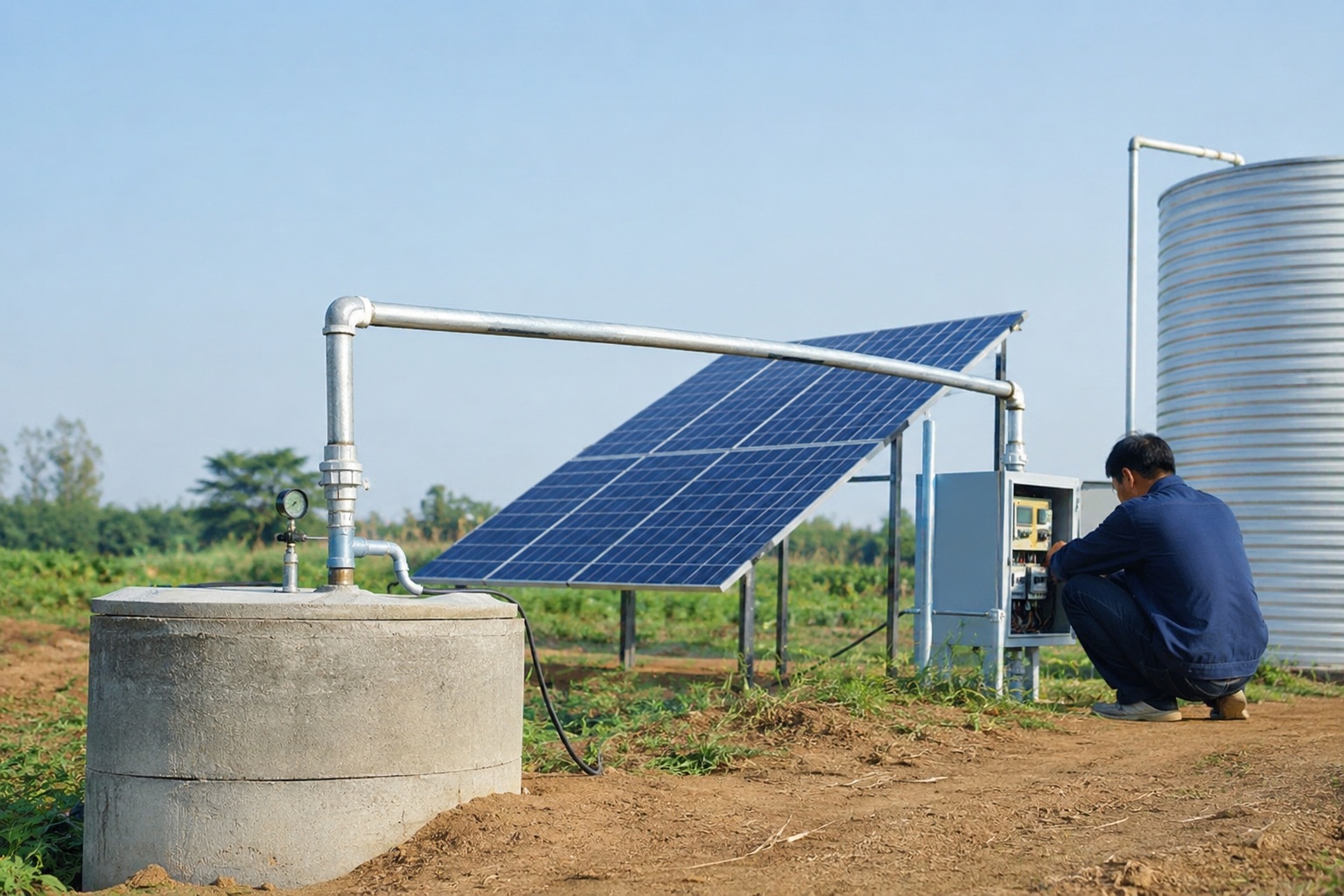
When there is enough sunlight, the system is powered by solar panels.
When there is no solar input, it can be powered by the grid or a generator.
The AC/DC hybrid controller can be connected to both solar and AC power simultaneously.
The controller automatically prioritizes solar energy.
When solar power is insufficient, it intelligently blends in AC power to meet demand.
When there is no solar input at all, it seamlessly switches to full AC power.
This ensures a worry-free water supply 24 hours a day.
FAQs
Will a higher HP pump give me more water pressure?
Not always. Pressure is determined by the pump's impeller design (stages), not just horsepower. A properly staged pump is more effective for increasing pressure than simply a larger motor.
How do you calculate TDH for a well pump?
TDH is calculated by adding the vertical lift from the water level, the desired pressure at the destination (in feet), and all friction losses from pipes and fittings.
What happens if my well pump is too big?
An oversized pump will short cycle (turn on and off frequently), causing the motor to overheat, wasting energy, and drastically reducing the pump's lifespan.
How many solar panels do I need for a 1.5 HP well pump?
A 1.5 HP (1100W) pump typically requires about 1500-1800 watts of solar panels. This ensures sufficient power even in less-than-ideal sunlight conditions.
Can a 1 HP pump lift water 500 feet?
It's unlikely. While a 1 HP pump might be able to lift water 500 feet with very low flow, a 1.5 HP or 2 HP pump is needed for adequate flow and pressure.
What is the difference between a 2-wire and 3-wire submersible pump?
A 2-wire pump has its starting components inside the motor. A 3-wire pump has its starting components in a control box at the surface, which makes them easier to service.
How long should a submersible well pump last?
A properly sized and installed submersible pump should last between 10 to 15 years. Factors like water quality and usage patterns can affect its lifespan.
What is a VFD or constant pressure system?
A Variable Frequency Drive (VFD) adjusts the pump's motor speed in real-time to maintain a consistent water pressure, regardless of how many taps are open, improving comfort and efficiency.