Struggling with high electricity bills or the sheer manual labor of pumping water in remote areas?
You need a reliable water source, but grid power is expensive or unavailable.
Solar water pumps provide a cost-effective, automated, and environmentally friendly solution.
The cost of a solar water pump system varies widely based on its components and capabilities.
A basic kit can start around $1,950, while high-performance agricultural systems often range from $4,800 to over $5,200.
This price depends on the pump type, lift height, and required flow rate.
Understanding the cost of a solar water pump isn't just about a single price tag.
It's about knowing what you're paying for.
The total investment is a combination of the pump itself, the power system, the controller, and the specific technology designed for your unique water needs.
Whether you're providing water for livestock, irrigating crops, or supplying an off-grid home, the right system offers a return on investment through decades of free energy.
Let's break down the factors that determine the final cost, so you can make an informed decision and secure a reliable water supply for years to come.
Solar Pump Kits vs. Individual Components: What’s Included in the Price?
Buying parts for a solar water system separately can be a confusing puzzle.
Mismatched components can lead to a system that underperforms by up to 40%, wasting both time and money.
A complete kit offers an optimized solution, while individual components provide flexibility for custom jobs.
A complete solar pump kit typically starts from $1,950 and includes the pump, controller, solar panels, sensors, and wiring.
Buying a pump alone may cost $1,350 or more, but requires you to source and verify the compatibility of all other components separately.
What's in a Typical Solar Well Pump Kit?
A pre-designed kit is engineered to work seamlessly, removing the guesswork from installation.
This is especially valuable for distributors whose customers value reliability and straightforward setup.
Most quality kits are built around a core set of matched components:
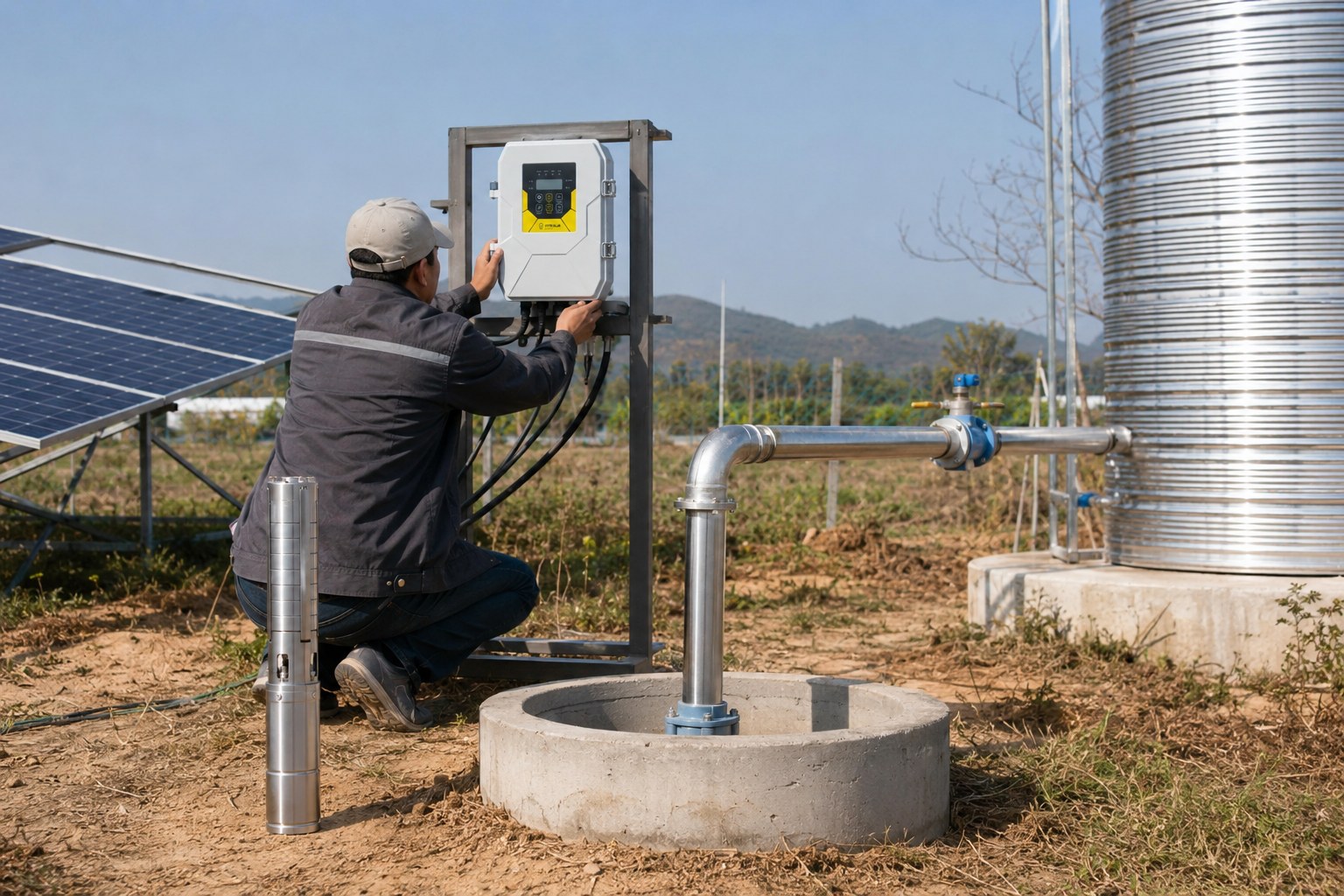
- The Solar Pump: The heart of the system, chosen for a specific depth and flow rate.
- The MPPT Controller: The brain, which optimizes power from the panels to the pump, increasing water output by up to 30%.
- Solar Panels: The power source, with the wattage and number of panels matched to the pump's requirements.
- Submersible Wire: A specialized, waterproof cable to connect the pump in the well to the controller on the surface.
- Sensors: Often includes well water level sensors to prevent the pump from running dry and tank level sensors to stop pumping when the tank is full.
- Step-by-Step Manual: Detailed instructions to ensure correct installation and operation.
Cost Breakdown: Kit vs. DIY Assembly
While buying components individually might seem cheaper at first glance, the total cost can quickly add up.
More importantly, you risk creating an inefficient system.
A kit guarantees that every part is designed to work together for maximum performance.
Consider this comparison for a small-scale livestock watering system.
| Item | All-in-One Kit | DIY Component Sourcing | Notes |
|---|---|---|---|
| Pump & Controller | Included | $1,350+ | A high-quality pump and controller are the biggest expense. |
| Solar Panels | Included | $400 - $800 | Price depends on wattage and quality. Mismatching can reduce efficiency. |
| Wiring & Sensors | Included | $150 - $300 | Costs for specialized submersible cable and sensors can be surprising. |
| Mounting Hardware | Included | $100 - $250 | Often overlooked, but essential for securing panels. |
| Total Estimated Cost | $1,950+ | $2,000 - $2,700+ | The kit offers better value and guaranteed compatibility. |
The Hidden Value of a Kit
The benefits of a kit extend beyond the initial price.
For a business owner like a distributor, offering a reliable, warrantied package is a major selling point.
Customers gain peace of mind knowing the system is backed by a single supplier.
This eliminates the headache of trying to determine which component failed if an issue arises.
Furthermore, the included technical support and comprehensive warranty from a kit provider are invaluable, saving countless hours and potential costs associated with troubleshooting an assembly of mismatched parts.
This turnkey approach ensures the end-user achieves the advertised performance and long-term reliability.
Pump Type and Performance: How Do Flow and Head Impact Cost?
Choosing the wrong pump is a costly mistake.
A pump that's too weak won't deliver enough water, while an oversized pump wastes money on power you don't need.
The key is to match the pump's performance directly to your application's requirements.
The pump's ability to handle high "head" (lift) or deliver high "flow" (GPM) is a primary driver of its cost.
Pumps designed for very deep wells or large-volume irrigation use different technologies and materials, with prices for specialized models ranging from $4,800 to over $5,200.
Understanding GPM and Head
To select the right pump, you must understand two key metrics.
Flow Rate, measured in Gallons Per Minute (GPM) or Liters Per Minute (LPM), tells you how much water the pump can move.
Head, or lift, measured in feet or meters, tells you how high the pump can push that water vertically from the source.
Total Dynamic Head (TDH) is an even more critical calculation.
It includes not only the vertical lift but also the friction loss from water moving through pipes over a distance.
A pump for a 200-foot-deep well that needs to push water 1,000 feet horizontally to a tank will require a much higher head capacity than one pumping straight up into a tank at the wellhead.
Comparing Pump Models by Performance and Price
The market offers a wide range of pumps where price directly correlates with performance capabilities.
As you can see from the data on popular models, a higher price doesn't always mean "better"; it means "specialized."
A pump that excels at high-volume delivery in a shallow well may be useless in a deep well, and vice-versa, even if they have similar price points.
| Sample Pump Model Type | Max Flow Rate (GPM) | Max Lift (Feet) | Starting Price (Approx.) | Best For |
|---|---|---|---|---|
| High-Head Helical Rotor | ~3 GPM | ~655 ft | From $4,849 | Deep domestic wells, low volume needs |
| Medium-Flow Centrifugal | ~6 GPM | ~395 ft | From $4,949 | General purpose, farms, medium-depth wells |
| High-Flow Centrifugal | ~13 GPM | ~395 ft | From $4,849 | Higher volume needs, moderate depth |
| Very High-Flow Centrifugal | ~40 GPM | ~185 ft | From $5,199 | Large-scale irrigation, shallow water sources |
The Trade-off Between Flow Rate and Lift
There is almost always a trade-off between flow rate and head.
A pump designed to generate the immense pressure needed to lift water 500 feet will typically have a lower flow rate than a pump designed to move a large volume of water from a 50-foot-deep well.
This is due to the pump's internal design, specifically the shape and number of its impellers or the design of its helical rotor.
For distributors and importers, it is crucial to stock a portfolio of pumps that covers these different applications.
A customer needing to water 100 head of cattle from a 400-foot well has vastly different needs than a farmer irrigating two acres from a shallow pond.
Understanding this trade-off allows you to guide your customers to the most cost-effective solution, rather than just the most expensive one.
Material Matters: How Do Impeller Types Affect Durability and Cost?
The water in your well can silently destroy the wrong pump.
Corrosion from acidic water or abrasion from sand can cause a cheap pump to fail in months, leading to costly replacements and downtime.
Choosing a pump with an impeller material specifically suited to your water conditions is essential for long-term reliability.
Economical plastic impellers are excellent for handling sand, while robust stainless steel impellers offer maximum durability in corrosive environments.
The material choice directly impacts the pump's longevity and its upfront cost, forming a critical part of the overall value equation.
The Solar Screw Pump: Deep Wells and Sandy Conditions
The solar screw pump, also known as a helical rotor or progressive cavity pump, is a specialist for deep wells.
Instead of spinning impellers, it uses a corkscrew-shaped stainless steel rotor that turns inside a rubber stator.
This action creates sealed cavities of water that are pushed progressively up the pump.
This design generates incredible pressure, allowing it to achieve very high head (over 800 feet in some models) with low energy consumption.
Its key advantage is its high resistance to sand and grit, as the rubber stator can flex to pass small particles without damage.
The main limitation is a lower flow rate compared to centrifugal pumps.
This makes it ideal for domestic water supply and livestock watering in regions with deep water tables, such as parts of Africa and Latin America.
The Solar Plastic Impeller Pump: The Economical Workhorse
For many agricultural and residential applications, the multi-stage centrifugal pump with plastic impellers offers the best balance of performance and cost.
These pumps use a series of stacked impellers that spin at high speed to move water.
Modern, high-quality plastic (like POM, or polyoxymethylene) is engineered to be highly resistant to abrasion from fine sand, often outperforming stainless steel in these specific conditions.
They are lightweight, which reduces shipping costs and simplifies installation.
Their ability to deliver high flow rates makes them perfect for farm irrigation, pasture water supply, and filling residential tanks.
However, they are less suited for highly corrosive water or the extreme pressures of very deep wells, where more robust materials are necessary.
The Solar Stainless Steel Impeller Pump: The Premium Choice
When durability and corrosion resistance are paramount, the stainless steel impeller pump is the top-tier solution.
Constructed with SS304 or even higher-grade stainless steel for both the impellers and pump housing, this model is built to last in harsh water environments.
It is the ideal choice for regions with acidic or alkaline water, such as the alkaline soil areas of Australia or coastal regions with saltwater intrusion risk.
These pumps offer high flow rates and excellent reliability for high-end homes, large ranches, and critical commercial applications.
While the upfront cost and weight are higher, the investment pays off with a significantly longer service life and reduced maintenance, representing the lowest total cost of ownership in challenging conditions.
| Impeller/Pump Type | Best Application | Key Advantage | Relative Upfront Cost |
|---|---|---|---|
| Helical Screw Rotor | Very deep wells, sandy water | Extreme head, sand resistance | Medium-High |
| Plastic Impeller | Farm irrigation, fine sand | High flow, cost-effective | Low-Medium |
| Stainless Steel Impeller | Corrosive or alkaline water | Maximum durability, long life | High |
The Engine of the System: Why the Motor is a Critical Cost Factor?
Choosing a pump with a cheap, inefficient motor is a classic false economy.
An inefficient motor requires more solar panels to do the same amount of work, inflates the total system cost, and is prone to early failure.
Investing in a high-efficiency motor is the single most important factor for long-term savings.
Modern solar pumps are powered by high-efficiency (often over 90%) Brushless DC (BLDC) permanent magnet motors.
While this advanced technology contributes to the pump's initial price, its efficiency can reduce the required solar panel array by up to 47%, dramatically lowering the total system cost.
What is a BLDC Permanent Magnet Motor?
At the core of every top-tier solar water pump is a Brushless DC (BLDC) motor.
Unlike older DC motors that use carbon brushes that wear out, BLDC motors are electronically commutated, making them virtually maintenance-free.
They utilize powerful permanent magnets, often made from rare-earth materials like neodymium iron boron, on the rotor.
This design creates higher torque and greater efficiency compared to traditional induction motors.
The result is a motor that is significantly more powerful for its size.
Remarkably, a modern BLDC motor can be up to 47% smaller and 39% lighter than an older motor with the same power output, simplifying installation and reducing shipping costs.
The Efficiency Advantage: Doing More with Less
Motor efficiency is a measurement of how well the motor converts electrical energy into mechanical work.
A motor with 92% efficiency converts 92% of the incoming electricity into pumping power, losing only 8% as heat.
An older, less efficient motor might only be 65% efficient, wasting 35% of the precious solar energy.
This difference is massive.
For example, a pump requiring 750 watts of power with a 92% efficient motor might only need about 815 watts of solar input.
The same pump with a 65% efficient motor would need over 1150 watts of solar input.
This means you would need to purchase at least one extra high-wattage solar panel, costing hundreds of dollars, just to compensate for the motor's inefficiency.
A high-efficiency motor pays for itself by reducing the cost of the solar array.
Long-Term Value vs. Upfront Cost
The value of a BLDC motor extends far beyond initial system cost.
Their brushless design means there are no parts to wear out and replace, leading to a service life that can exceed 30,000 hours of operation.
This translates to over a decade of reliable service even if run for 8 hours every single day.
Furthermore, many are equipped with a "soft start" feature.
This reduces the high in-rush current upon startup, minimizing stress on the motor and allowing it to start reliably even in low-light conditions with minimal power (often less than two watts).
This intelligent operation, combined with their durability, makes the BLDC motor the most cost-effective choice over the life of the system.
Beyond the Pump: Controllers, Panels, and Hybrid Options
Unfortunately, the sun doesn't always shine brightly from 9 to 5.
Relying on direct sunlight alone means no water on cloudy days or at night, a risk most farmers and homeowners cannot take.
Smart controllers and hybrid power systems are the solution to ensure a reliable 24/7 water supply.
While a standard system runs on solar power only, investing in an AC/DC hybrid controller adds immense value.
This feature allows the system to automatically use grid power or a generator as a backup, guaranteeing you have water whenever you need it, day or night.
The Role of the MPPT Controller
The MPPT (Maximum Power Point Tracking) controller is the unsung hero of a solar pumping system.
It's an intelligent electronic device that sits between the solar panels and the pump motor.
Its job is to constantly monitor the voltage and current from the solar panels and adjust the electrical load to extract the maximum possible power at any given moment.
This is critical because the optimal power output of a solar panel changes continuously with sunlight intensity and temperature.
Without an MPPT controller, a system could lose 20-30% of its potential power.
By ensuring the pump always receives the optimal voltage and current, an MPPT controller can increase the total volume of water pumped per day by as much as 30%, maximizing the return on your solar panel investment.
Calculating Your Solar Panel Needs
The cost of solar panels is a significant part of the total system price, so sizing the array correctly is crucial.
The primary factor determining your panel needs is the pump motor's power rating in watts.
This is another area where a high-efficiency BLDC motor provides huge cost savings.
A 1 HP (750W) pump with a highly efficient motor might be paired with just 1000 watts of solar panels.
A less efficient pump of the same horsepower might require 1300 watts or more to perform the same work.
This difference can easily mean purchasing one or two fewer panels.
As a general rule, the solar panel array wattage should be at least 1.3 to 1.5 times the motor's wattage to ensure good performance even in less-than-ideal sun conditions.
AC/DC Hybrid Systems: The Ultimate in Reliability
For critical applications, a solar-only system may not be enough.
This is where AC/DC hybrid controllers provide the ultimate solution.
These advanced controllers are designed with two power inputs: one for the DC power from solar panels and one for AC power from the electrical grid or a generator.
The controller's internal logic is programmed to prioritize solar power.
It will run the pump entirely on free solar energy whenever it's available.
If cloud cover reduces solar input, the hybrid function can blend AC power with the available solar power to maintain pump speed.
When there is no solar input at all, like at night, it will automatically switch over to the AC source.
This ensures a completely uninterrupted water supply, giving you the cost savings of solar with the 24/7 reliability of the grid.
Conclusion
The true cost of a solar water pump is not found on the price tag alone.
It is a strategic investment balanced between pump type, motor efficiency, and intelligent controls.
A well-designed system will deliver reliable water for decades, with the sun paying back your initial cost many times over.
Frequently Asked Questions
How long do solar water pumps last?
A quality solar pump system is a long-term investment.
The solar panels are typically warrantied for 20-25 years, while a well-maintained BLDC motor and pump can last for over 10 years.
Can a solar pump fill a large tank?
Absolutely.
Systems are sized based on your total daily water needs, not instantaneous flow.
The pump will run throughout the day to fill a large storage tank for use 24/7.
Do solar pumps work on cloudy days?
Yes, but at a reduced flow rate.
MPPT controllers help maximize output in low light, and hybrid AC/DC systems or battery backups can ensure consistent performance on overcast days.
Is a solar well pump worth it?
For off-grid properties, it is almost always worth it.
The return on investment comes from eliminating fuel or electricity bills, with many systems paying for themselves within 3-5 years.
How deep can a solar pump go?
This varies by pump type.
Specialized helical rotor (screw) pumps are designed for deep wells and can lift water from over 800 feet, while centrifugal pumps are for shallower applications.
What does it cost to run a solar water pump?
After the initial installation cost, the running cost is virtually zero.
The energy from the sun is free, and modern brushless pumps are designed to be almost entirely maintenance-free.
Do I need batteries for my solar pump?
Not usually.
It is far more cost-effective to use a water storage tank as a "battery."
The pump fills the tank during the day, and you draw water from the tank as needed.
What size solar pump do I need?
Sizing depends on your daily water volume requirement (Gallons Per Day) and the Total Dynamic Head (vertical lift plus friction loss).
Using an online sizing calculator is highly recommended.