Your water system has failed, and operations are at a standstill.
Every minute of downtime costs you money, highlighting the urgent need for a pump that can run non-stop without failure.
A pump rated for "continuous duty" can run 24/7, provided it is properly selected, installed, and maintained.
Factors like pump type, motor efficiency, cooling mechanisms, and power source reliability are what truly determine its non-stop operational capability.
The ability of a pump to run without stopping is not a simple yes or no answer.
It is a complex balance of engineering, material science, and system design.
A cheap, intermittent-duty pump might last only minutes under constant load, while a purpose-built industrial pump can operate for years with only scheduled maintenance.
Understanding the difference is key to ensuring reliability and avoiding costly failures.
Let's explore the specific factors that allow a water pump to achieve true continuous operation, from its mechanical design to the intelligence of its power system.
What Determines a Pump's Continuous Runtime?
You believe any pump should handle constant use, but it keeps overheating and failing.
This leads to frustrating downtime and repeated replacement costs, making you question if a truly reliable pump exists.
A pump's continuous runtime is dictated by its duty rating, drive system, and thermal management.
Pumps with indirect drives (belt or gear) and effective cooling systems run cooler and longer, making them ideal for commercial continuous use.
The specification sheet for a pump might promise certain performance metrics, but its real-world endurance comes down to fundamental design choices.
A pump is more than just its flow rate and pressure; it's a dynamic system where heat, friction, and vibration are constant enemies of longevity.
Running a pump continuously generates significant heat in the motor and the pump head.
How the pump manages this heat, combined with the mechanical stress from its drive system, will ultimately decide whether it can run for hours, days, or years without a break.
For commercial and industrial users, where uptime is directly linked to revenue, these design details are not just technicalities—they are critical factors for success.
Let’s break down the core components that separate a short-lived pump from a continuous-duty workhorse.
Drive System: Direct vs.
Indirect Drive
The method used to transfer power from the motor to the pump mechanism is a primary factor in its lifespan.
Direct drive pumps connect the motor's driveshaft directly to the pump's crankshaft.
This design is compact and typically less expensive.
However, it forces the pump to operate at the same speed as the motor, which is often a high RPM (e.g., 3450 RPM).
This high speed generates more heat and vibration, leading to faster wear on seals, bearings, and plungers.
Consequently, direct drive pumps are generally suited for intermittent, residential use, not for all-day commercial operations.
In contrast, belt-drive or gear-drive pumps use pulleys or a gearbox to reduce the pump's operational speed.
This allows the pump to run at a much lower RPM (typically 900-1750 RPM) while the motor still runs at its optimal speed.
The lower RPM reduces heat, vibration, and wear, significantly extending the pump's service life.
This design is the standard for commercial and industrial applications where pumps are expected to run for many hours a day.
| Feature | Direct Drive | Belt/Gear Drive |
|---|---|---|
| Pump RPM | High (e.g., 3450 RPM) | Low (e.g., 900-1750 RPM) |
| Heat Generation | High | Low |
| Vibration | High | Low |
| Service Life | Shorter | Longer |
| Typical Use | Residential, Intermittent | Commercial, Continuous |
| Cost | Lower | Higher |
| Maintenance | More Frequent | Less Frequent |
The Role of Unloaders and Bypass Systems
In applications like pressure washing, the pump often runs even when water is not being sprayed.
An unloader valve is a critical component that manages this situation.
When the trigger gun is released, the unloader diverts the flow of water in a loop, either back to the pump inlet or to a separate buffer tank.
This action prevents a dangerous and damaging buildup of pressure and heat.
Pumps with integrated, built-in unloaders are common in consumer-grade equipment.
However, these are often less durable and harder to service.
For serious commercial use, a system with a separate, externally plumbed unloader is far superior.
This setup allows the bypass water to be routed to a buffer tank, where it can cool before re-entering the pump.
This "fully plumbed" configuration allows the machine to run indefinitely "off the trigger" without the risk of the pump overheating, a common failure point in simpler systems.
High-Pressure Pumps: Designed for Demanding Duty
Your standard pump can't generate the force needed for tough jobs like cutting or cleaning.
You're stuck with inefficient processes, wasting time and energy because your equipment lacks the necessary power to perform effectively.
Industrial high-pressure pumps are specifically engineered for continuous, high-stress work.
Constructed from high-strength stainless steel or specialized alloys, they are built to withstand pressures often exceeding 1,000 PSI without failure or leakage.
When an application requires moving fluid under extreme force, a standard pump is not an option.
High-pressure pumps are a different class of machinery, designed from the ground up to handle intense mechanical loads and punishing operational cycles.
The challenges in a high-pressure system go beyond just containing the force.
Internal tolerances must be incredibly tight, sealing systems must adapt to pressure and temperature swings, and the entire pump casing must resist distortion that could lead to catastrophic failure.
Most problems with these pumps arise when the design on paper doesn't match the reality of manufacturing and installation.
Let’s examine the engineering principles that enable these pumps to run continuously under conditions that would destroy lesser equipment.
Why Materials Matter
The ability of a pump to handle high pressures continuously starts with its materials.
Standard cast iron or aluminum may be sufficient for low-pressure applications, but they are not suitable for pressures ranging from 1,000 to over 10,000 PSI.
At these levels, materials must resist extreme stress and prevent leakage.
High-strength stainless steel is a common choice due to its durability and corrosion resistance.
For even more demanding environments, specialized alloys or coatings are used.
These materials ensure the pump's casing can contain immense pressure without warping or fracturing.
The internal components, such as impellers, plungers, and valves, must also be made from hardened, high-grade materials to withstand the constant forces and abrasive wear associated with high-pressure fluid delivery.
A pump built with inferior materials will quickly fail under continuous high-pressure use.
Understanding Vane Pass Vibration
Every centrifugal pump generates pulsations as its impeller vanes pass stationary components inside the pump casing.
This phenomenon is known as vane pass interaction.
In low-pressure pumps, these pulsations are usually negligible.
However, in high-pressure, multistage pumps, these vibrations can be amplified significantly.
If the frequency of these pulsations aligns with the natural resonant frequency of the system's piping or the structure itself, the vibration can increase dramatically.
This resonance can lead to premature wear on bearings and seals, structural fatigue, and ultimately, a shortened equipment life.
Pump designers carefully select the number of impeller vanes and engineer internal geometries to shift these pulsation frequencies away from any potential system resonance.
Advanced analysis, like Computational Fluid Dynamics (CFD), is used to model and predict these interactions before the pump is even built, ensuring a smooth and stable operation.
The Critical Importance of Proper Installation
A perfectly designed and manufactured pump can still fail quickly if it is installed incorrectly.
Installation is one of a leading sources of pump failure.
Pipe strain is a major culprit.
If the system's piping does not align perfectly with the pump's nozzles, forcing them into place introduces significant stress on the pump casing.
This external stress can distort the casing, disrupting the tight internal clearances required for high-pressure operation.
Even a minor deviation can lead to internal rubbing, excessive vibration, and rapid component failure.
Proper installation requires a level and securely grouted baseplate, meticulous alignment of piping to avoid strain, and precise alignment of the coupling between the motor and the pump.
Adhering to strict alignment tolerances is not optional; it is essential for achieving the long, continuous service life the pump was designed for.
Solar Pumps: A New Era of Continuous Operation
You need water in a remote location, but running power lines is too expensive or impossible.
Without a reliable power source, you cannot support agriculture, livestock, or daily living, leaving you dependent on costly and unreliable fuel-powered generators.
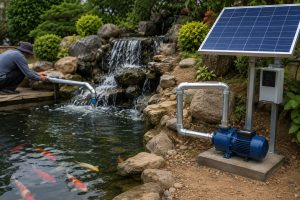
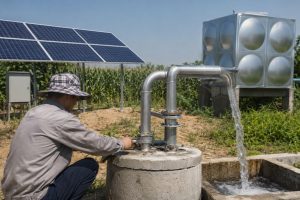
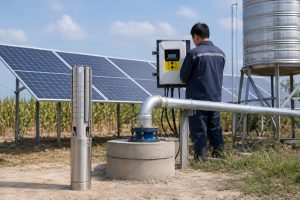
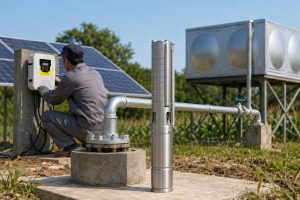
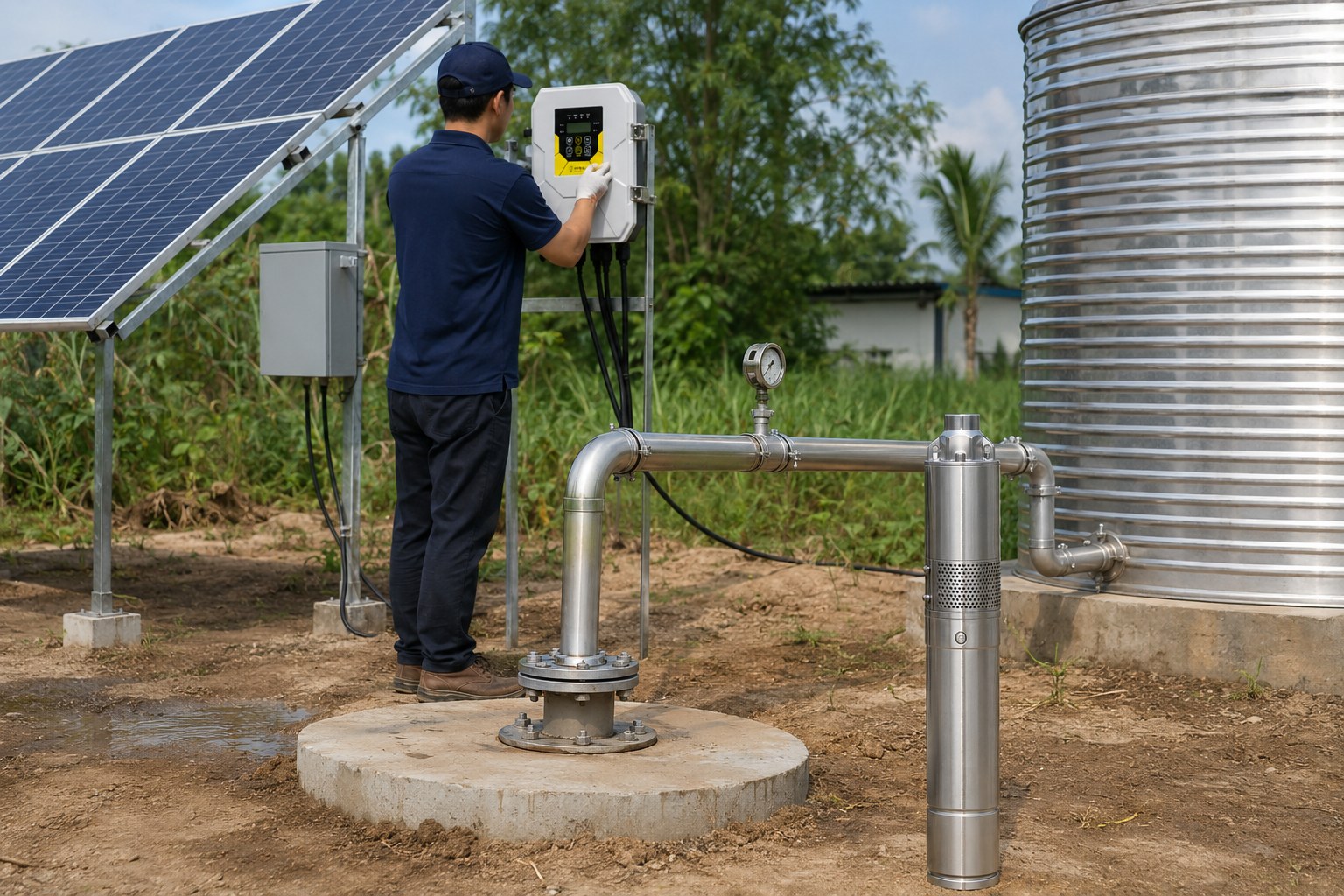
Modern solar water pumps provide grid-independent, continuous water supply.
Powered by efficient motors, they come in specialized types—screw, plastic impeller, and stainless steel impeller—to match any water condition and depth for truly autonomous operation.
As the world seeks sustainable solutions, solar water pumps have emerged as a game-changing technology, particularly in off-grid regions across Africa, Asia, and the Americas.
These systems operate with remarkable autonomy, harnessing sunlight to provide a consistent and cost-effective water supply.
Their ability to run "continuously" is tied to the availability of sunlight, but their design is optimized to maximize every hour of it.
The key to their success lies in a portfolio of pump types, each tailored for a specific job, and a highly efficient motor that powers them all.
This combination allows for a flexible and resilient approach to water management, whether for a single home or a large farm.
The Solar Screw Pump: High Head for Deep Wells
The solar screw pump is a type of positive displacement pump.
It uses a rotating stainless steel screw within a rubber stator.
As the screw turns, it forms sealed cavities that move water upward.
This mechanism is highly effective at creating high pressure, allowing it to pump water from very deep wells.
This design delivers a lower flow rate but achieves a very high head (lifting height).
It is an ideal solution for domestic water supply, livestock watering troughs, and small-scale drip irrigation where well depths are significant.
One of its major advantages is its exceptional resistance to sand and silt, as the rubber stator can tolerate abrasive particles that would quickly destroy other pump types.
This makes it perfect for the harsh water conditions often found in electricity-scarce regions.
The Solar Plastic Impeller Pump: High Flow for Agriculture
This pump is a multi-stage centrifugal pump.
It uses a series of impellers to build pressure and move a large volume of water.
The impellers in this model are made from a durable, wear-resistant engineering plastic.
This design provides a high flow rate at a medium head, making it perfect for applications like farm irrigation, pasture water supply, and filling large tanks quickly.
Its ability to handle fine sand is excellent, and its lightweight construction makes it more economical and easier to install.
This combination of high output and value has made it extremely popular for agricultural use in Africa and the Americas.
However, it may not be the best choice for highly corrosive water or extremely deep wells, where more robust materials are required.
The Solar Stainless Steel Impeller Pump: Durability for Harsh Water
For the most demanding environments, the stainless steel impeller pump is the premium choice.
This model features impellers and a pump body constructed from SS304 stainless steel.
This material provides superior resistance to corrosion from acidic or alkaline water.
It is designed for high flow rates and can achieve medium-to-high head, making it a versatile and highly reliable option.
Typical applications include providing water in regions with alkaline soil, such as parts of Australia, or for high-end homes and ranches where water quality is poor and long-term durability is paramount.
While it comes at a higher cost and weight compared to the plastic impeller model, its extended service life and reliability in corrosive conditions offer significant long-term value.
| Pump Type | Best For | Flow Rate | Head | Sand Resistance | Key Advantage |
|---|---|---|---|---|---|
| Solar Screw Pump | Deep wells, Homes | Low | Very High | Excellent | Lifts water from great depths |
| Solar Plastic Impeller | Farms, Irrigation | High | Medium | Good | High volume and cost-effective |
| Solar SS Impeller | Corrosive Water | High | Medium-High | Fair | Maximum durability & corrosion resistance |
The Heart of the System: The Motor Matters Most
You've invested in a solar pump system, but it's inefficient.
You need more solar panels than expected, driving up costs, and the pump's performance is underwhelming, failing to deliver the water you need when the sun isn't perfect.
The motor is the engine of your pump, and a high-efficiency Brushless DC (BLDC) motor is the key to performance.
With over 90% efficiency, it delivers more power with fewer solar panels, reducing costs and ensuring reliable operation.
While the pump end—be it a screw or centrifugal design—determines the application, the motor determines the system's overall efficiency and economic viability.
In a solar-powered system, every watt of energy is precious.
Wasting energy means you either need a larger, more expensive solar array or you get less water.
The choice of motor technology is therefore not a minor detail; it is the central factor that dictates the performance, cost, and long-term value of the entire solar pumping system.
Advanced motor technology is what transforms a good pump into a great one.
What is a BLDC Motor?
A Brushless DC (BLDC) motor is an advanced electric motor that uses permanent magnets on the rotor and electronic commutation instead of the mechanical brushes and commutator found in traditional DC motors.
The absence of brushes eliminates friction, wear, and energy loss associated with them.
This results in significantly higher efficiency, a longer service life, and virtually no maintenance.
These motors are controlled by an intelligent electronic controller that precisely manages the power delivered to the motor, optimizing its performance based on the available solar energy.
The rotors are often made from high-strength neodymium iron boron permanent magnets, which create a powerful magnetic field, enabling high torque in a compact size.
Efficiency by the Numbers: BLDC vs.
Traditional Motors
The most critical advantage of a BLDC motor is its exceptional efficiency.
A typical brushed DC motor or AC motor might operate at 60-75% efficiency.
This means that 25-40% of the electrical energy is lost as heat and friction.
In stark contrast, a BLDC motor in a solar pump system regularly achieves an efficiency of over 90%.
This 15-30% efficiency gain is massive in a solar application.
It means that for the same amount of sunlight, a system with a BLDC motor can pump significantly more water.
Alternatively, it can deliver the same amount of water while requiring a much smaller and less expensive solar panel array, directly reducing the initial investment cost for the end user.
The Market Advantage of High-Efficiency Motors
The use of BLDC motors provides a powerful competitive edge.
These motors are not only more efficient but also more compact and lightweight.
A modern BLDC motor can be up to 47% smaller and 39% lighter than a traditional motor with the same power output.
This reduces material costs, simplifies shipping, and makes installation far easier, especially in remote locations.
For distributors, offering a product portfolio powered by this core technology means providing a solution that is cheaper to install, more reliable, and costs less to operate.
For end users, it translates to direct savings on the initial purchase (fewer panels) and a durable, maintenance-free system that provides water for years.
The BLDC motor is the enabling technology that makes solar pumping a truly viable and competitive solution.
Achieving 24/7 Operation with Hybrid Power
Solar pumps are great, but what happens on cloudy days or at night?
Your water supply becomes unreliable, halting irrigation and critical operations.
This dependency on sunlight makes it impossible to guarantee a 24/hour water supply.
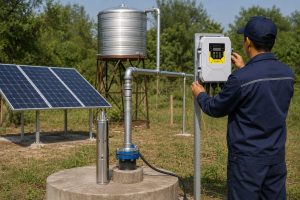
Hybrid AC/DC controllers solve this problem by automatically switching between solar and a secondary power source.
This ensures a continuous, uninterrupted water supply, giving you worry-free operation 24 hours a day, regardless of the weather.给这个文章写一个英文meta描述,不超过120字符,包括关键词How long can a water pump run continuously?
The one limitation of a standard solar pump is its reliance on the sun.
While perfect for many applications, some users require a guaranteed water supply around the clock.
Whether it's for critical irrigation cycles, industrial processes, or ensuring a home never runs dry, a purely solar solution can fall short.
This is where intelligent power management comes into play.
By integrating a secondary power source, a solar pumping system can be transformed from a daytime-only solution into a true 24/7 continuous-duty water utility, offering the best of both worlds: the free energy of the sun and the constant reliability of the grid.
How Hybrid Controllers Work
A hybrid AC/DC controller is the brain of a versatile water pumping system.
It is designed with two separate power inputs: one for DC power from the solar panels and another for AC power from the electrical grid or a generator.
The controller's sophisticated logic constantly monitors the power available from the solar panels.
When there is sufficient sunlight, the system runs exclusively on free solar power.
If solar input drops due to clouds, the controller automatically enters a hybrid mode.
In this mode, it draws the maximum available power from the solar panels and supplements it with just enough AC power to meet the pump's requirements.
When there is no solar input at all, such as at night, it seamlessly switches over to run entirely on the AC power source.
This entire process is automatic, requiring no manual intervention.
The Practical Benefits of Dual Power Input
The primary benefit of a hybrid system is absolute reliability.
You are guaranteed to have water whenever you need it, day or night, rain or shine.
This completely removes the uncertainty of a solar-only system.
Furthermore, it maximizes cost savings.
The system is programmed to prioritize solar energy, so it only draws from the more expensive AC power source when absolutely necessary.
The hybrid function is particularly valuable, as it ensures that even weak sunlight is not wasted.
Instead of shutting down on an overcast day, the pump continues to run by blending solar and AC power, minimizing grid consumption.
This intelligent power management provides peace of mind and ensures that the pump can deliver continuous, uninterrupted service 24/7, making it a viable solution for even the most critical water supply needs.
Conclusion
A pump's ability to run continuously depends on matching its design to the task.
From motor efficiency and drive type to hybrid power options, choosing the right system ensures reliable, non-stop operation.
FAQs
Can a water pump run 24/7?
Yes, a pump specifically rated for "continuous duty" can run 24/7.
This depends on its design, cooling system, and proper installation.
How long should a water pump run at a time?
An intermittent-duty pump may need rest periods, while a continuous-duty pump can run indefinitely.
Always check the manufacturer's specifications for its duty cycle.
What happens if you run a water pump continuously?
Running a pump not designed for continuous use can cause overheating, accelerated wear on seals and bearings, and premature failure of the motor.
How do you keep a water pump from overheating?
Ensure the pump is correctly sized, has adequate ventilation, and that cooling systems (like bypasses to a buffer tank) are functioning correctly.
Can a submersible pump run continuously?
Yes, most submersible well pumps are designed for continuous operation as they are cooled by the water surrounding them.
Always confirm the duty rating.
How many hours a day can a solar water pump run?
A solar pump can typically run for 5-8 hours a day at full power, depending on location and weather.
Hybrid systems can run 24/7.