Struggling to achieve high-pressure fluid transfer without sacrificing flow or efficiency?
Your current system might be underperforming, costing you energy and money.
A three-stage pump is the powerful and efficient solution you need.
A three-stage pump is a type of multi-stage centrifugal pump that uses three impellers in series to progressively increase fluid pressure. It is engineered for high-pressure applications, offering superior performance, energy efficiency, and reliability compared to single-stage pumps, especially for continuous, demanding industrial tasks.
This article will explore the mechanics, components, applications, and core benefits of these essential machines.
We will break down how they deliver unmatched performance in critical industries.
Understanding this technology will help you make a more informed decision for your next project.
Let's dive into the specifics of what makes these pumps a cornerstone of modern fluid dynamics.
The Definition of Three-Stage Pumps
Finding a pump that handles high pressures and abrasive fluids can be a major challenge.
Using the wrong pump leads to frequent failures, costly downtime, and inefficient operations.
Three-stage pumps are specifically built to solve these problems by combining high pressure with robust construction.
A three-stage pump is a multi-stage centrifugal pump using three impellers to boost liquid pressure sequentially. Each stage, comprising an impeller and a diffuser, adds energy, making it ideal for moderate to high-pressure needs with consistent flow rates, particularly with abrasive or corrosive slurries.
Three-stage pumps represent a significant leap in performance over their single-stage counterparts.
The core principle is simple but highly effective: divide the work of pressure generation into three manageable steps.
This staged approach allows for a much higher final pressure without the extreme impeller speeds that would be required in a single-stage design.
Operating at lower speeds per stage reduces wear and tear, increases operational stability, and improves overall efficiency.
This makes them exceptionally well-suited for continuous duty cycles found in industrial and commercial settings.
Multi-Stage vs. Single-Stage
The choice between a single-stage and a multi-stage pump comes down to the application's pressure requirements.
A single-stage pump has one impeller and is perfect for low-pressure, high-flow applications.
A three-stage pump, however, is designed for situations where pressure is paramount.
By distributing the pressure-building task across three impellers, the pump can achieve pressures three times higher, or more, than a comparable single-stage pump, all while maintaining a steady flow.
This incremental pressure boost is far more efficient, consuming up to 20% less energy than using multiple single-stage pumps in series to achieve the same result.
| Feature | Single-Stage Pump | Three-Stage Pump |
|---|---|---|
| Pressure Output | Low to Medium | High to Very High |
| Number of Impellers | 1 | 3 |
| Best Efficiency Point | Narrower Range | Wider Range |
| Initial Cost | Lower | Higher |
| Energy Consumption | Higher for High Pressure | Lower for High Pressure |
| Typical Use Case | Water circulation, drainage | Boiler feed, pipeline transport |
Built for Demanding Environments
Many industrial processes involve fluids that are not just under pressure but are also chemically aggressive or physically abrasive.
Three-stage pumps are often constructed from specialized materials to handle these challenges.
For example, impellers and casings can be made from high-chrome alloys, stainless steel, or even feature rubber linings.
These materials provide exceptional resistance to both corrosion from acidic or alkaline fluids and abrasion from slurries containing sand, grit, or other solids.
This robust construction significantly extends the pump's service life and preserves its performance, ensuring it is ready for any type of slurry or sludge fluid thrown its way.
How Do Three-Stage Pumps Work Exactly?
Need to move fluid over a long distance or to a high elevation without losing pressure?
Standard pumps often fail to maintain the required pressure, causing system inefficiencies and bottlenecks.
Three-stage pumps solve this by adding energy in successive stages, ensuring consistent high pressure at the discharge point.
A three-stage pump works by guiding fluid through three sequential impeller-diffuser pairs. The first impeller spins the liquid, converting motor energy into kinetic energy. The diffuser then converts this velocity into pressure. This process repeats two more times, compounding the pressure before the fluid exits.
The operational principle of a three-stage pump is a masterful application of centrifugal force.
It is not just about a single burst of energy, but a carefully orchestrated, incremental increase in pressure.
This method allows for a smooth and controlled energy transfer to the fluid.
Let's break down the journey of the fluid from the suction port to the discharge port.
The Journey of a Fluid Particle
Imagine a single particle of water entering the pump.
- Entry: The fluid enters through the suction port at a relatively low pressure.
- Stage 1: It is immediately drawn into the eye of the first impeller. The impeller, spinning at high speed, flings the fluid outward, rapidly increasing its velocity (kinetic energy). The fluid then flows into the first diffuser or volute, where the flow area expands. This expansion slows the fluid down, converting its high kinetic energy into higher pressure.
- Stage 2: The now-pressurized fluid is channeled directly to the eye of the second impeller. This stage repeats the process, taking the already increased pressure and boosting it even further. The velocity is increased again by the impeller and converted to more pressure by the second diffuser.
- Stage 3: The fluid enters the final stage for one last pressure boost. The third impeller and diffuser add the final increment of energy, achieving the pump's maximum discharge pressure.
- Exit: The highly pressurized fluid is collected and expelled through the discharge port, ready to travel long distances or overcome significant system resistance.
The Physics of Pressure Increase
The magic of a multi-stage pump lies in its ability to increase pressure without a drastic reduction in flow rate.
In a single-stage pump, attempting to generate very high pressure would require an impractically large impeller diameter or extremely high rotational speeds, which leads to inefficiency and cavitation risk.
By using three stages, the pump can use smaller, more efficient impellers rotating at optimal speeds.
Each stage might contribute a pressure increase of 4-6 bar (approximately 60-90 PSI).
Cumulatively, a three-stage pump can therefore achieve a final discharge pressure of 12-18 bar (180-270 PSI) or more, while a comparable single-stage pump might struggle to exceed 5 bar.
This makes three-stage pumps the ideal choice for applications like feeding high-pressure filter presses or pumping water up mine shafts, where both steady flow and high head are non-negotiable.
What are the Components of a Three-Stage Pump?
A complex machine can seem intimidating, with many parts to track.
Understanding the key components demystifies the pump, making maintenance and troubleshooting much easier and more effective.
Knowing what each part does helps you appreciate the engineering and ensure its long-term reliability.
A three-stage pump's main components include three impellers mounted on a single shaft, a protective outer casing, the shaft itself, suction and discharge ports for fluid flow, and essential seals and bearings that prevent leaks and ensure smooth, low-friction rotation.
Every component in a three-stage pump is engineered to work in harmony to achieve high-pressure performance reliably.
While it appears complex, the design can be broken down into a few core functional groups.
Understanding these groups is key to grasping the pump's operation and maintenance requirements.
Let's examine the primary parts that make up the heart of the machine and the supporting elements that keep it running smoothly.
The Core Trio: Impellers, Casing, and Shaft
These three components form the fundamental structure of the pump.
- Impellers: As the most critical part, the three impellers are responsible for imparting energy to the fluid. They are mounted on the shaft and spin to create centrifugal force. Impeller design (open, semi-open, or closed) is chosen based on the fluid's properties, with closed impellers being most common for clean liquids and open designs for slurries.
- Pump Casing: The casing is the pump's body. It encloses the impellers and diffusers, contains the pressure, and directs the fluid from one stage to the next. Casings are typically split radially or axially to allow for assembly and maintenance.
- Shaft: This is the central rotating element that transmits torque from the motor to the impellers. It must be strong and rigid enough to support the impellers and withstand the high torsional forces without flexing, which could cause contact between rotating and stationary parts.
The Supporting Cast: Seals, Bearings, and Ports
These components ensure the pump operates without leaks and with minimal friction.
Proper function of these parts is essential for efficiency and longevity.
| Component | Material Example | Function | Maintenance Note |
|---|---|---|---|
| Seals | Mechanical Seal, Gland Packing | Prevents fluid from leaking out along the shaft. | Critical wear item. Must be monitored and replaced to prevent failure. |
| Bearings | Deep-Groove Ball Bearings | Support the shaft, reduce friction, and handle radial and axial loads. | Require regular lubrication and monitoring for signs of wear or overheating. |
| Ports | Flanged Cast Iron/Steel | The suction port is the entry point, and the discharge port is the exit. | Their size and design are critical for the pump's hydraulic performance. |
| Diffusers | Cast Iron, Bronze | Stationary vanes that slow the fluid, converting velocity to pressure efficiently. | Located after each impeller. Their condition affects pump efficiency. |
Industrial Applications of Three-Stage Pumps
Many industries require moving liquids under immense pressure, but standard pumps can't handle the job.
This limitation can halt production, from oil extraction to mining dewatering, creating costly operational gaps.
Three-stage pumps are the workhorses designed for these high-pressure tasks across diverse, demanding sectors.
*Three-stage pumps are vital in industries requiring high-pressure fluid movement. Key applications include oil and gas pipeline transport, water injection for enhanced oil recovery, dewatering in mining and construction, and feeding filter press systems for solid-liquid separation in various manufacturing processes.
The versatility of three-stage pumps makes them indispensable in any industry where high pressure is a prerequisite for moving fluids effectively.
Their ability to generate substantial head while maintaining a consistent flow rate is a combination that few other pump types can offer so efficiently.
This unique capability allows them to excel in some of the toughest industrial environments.
Let's explore some of the specific applications where these pumps are not just useful, but absolutely essential.
High-Pressure Pipeline and Injection
In the oil and gas sector, moving crude oil, refined products, and water over vast distances through pipelines requires overcoming significant frictional losses.
Three-stage pumps are ideal for this task, serving as mainline booster pumps to maintain flow and pressure across hundreds of kilometers.
Furthermore, they are crucial for enhanced oil recovery (EOR) operations.
In EOR, high-pressure water is injected into oil wells to displace residual oil and force it toward production wells.
This process can require pressures well over 100 bar, a demand that three-stage pumps are perfectly designed to meet.
Slurry and Water Management in Mining
Mining operations, whether surface or underground, constantly battle with water ingress and the need to transport abrasive slurries.
Three-stage pumps are employed for mine dewatering, lifting water from deep shafts to the surface.
Their high-head capability is essential for overcoming the massive vertical distances involved.
They are also used to transport slurries—mixtures of water and fine rock particles—from a processing plant to a tailings dam.
The robust, abrasion-resistant construction of many three-stage pumps makes them a reliable choice for handling these destructive fluids day in and day out.
Solid-Liquid Separation Systems
Filter press systems are widely used in industries like ceramics, wastewater treatment, and chemical processing to separate solids from liquids.
These systems require a feed pump that can deliver a steady flow while gradually building pressure as the filter cake forms and resistance increases.
A three-stage pump is perfectly suited for this.
It can provide the initial high flow to fill the press quickly and then sustain the high pressure needed to dewater the sludge effectively, resulting in a drier, more compact filter cake and clearer filtrate.
A Look at Modern Solar Pump Solutions
Need to pump water in a remote location with no access to the power grid?
Grid-dependency limits agricultural and domestic water supply in off-grid areas, hindering development and productivity.
Solar-powered pumps offer a sustainable, cost-effective, and reliable solution, operating entirely independently of the grid.
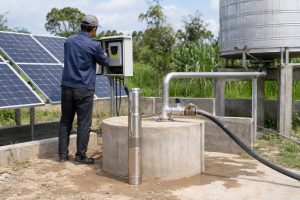
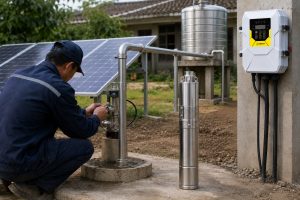
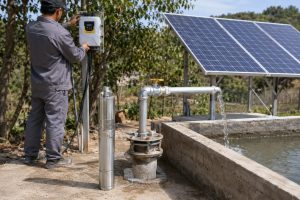
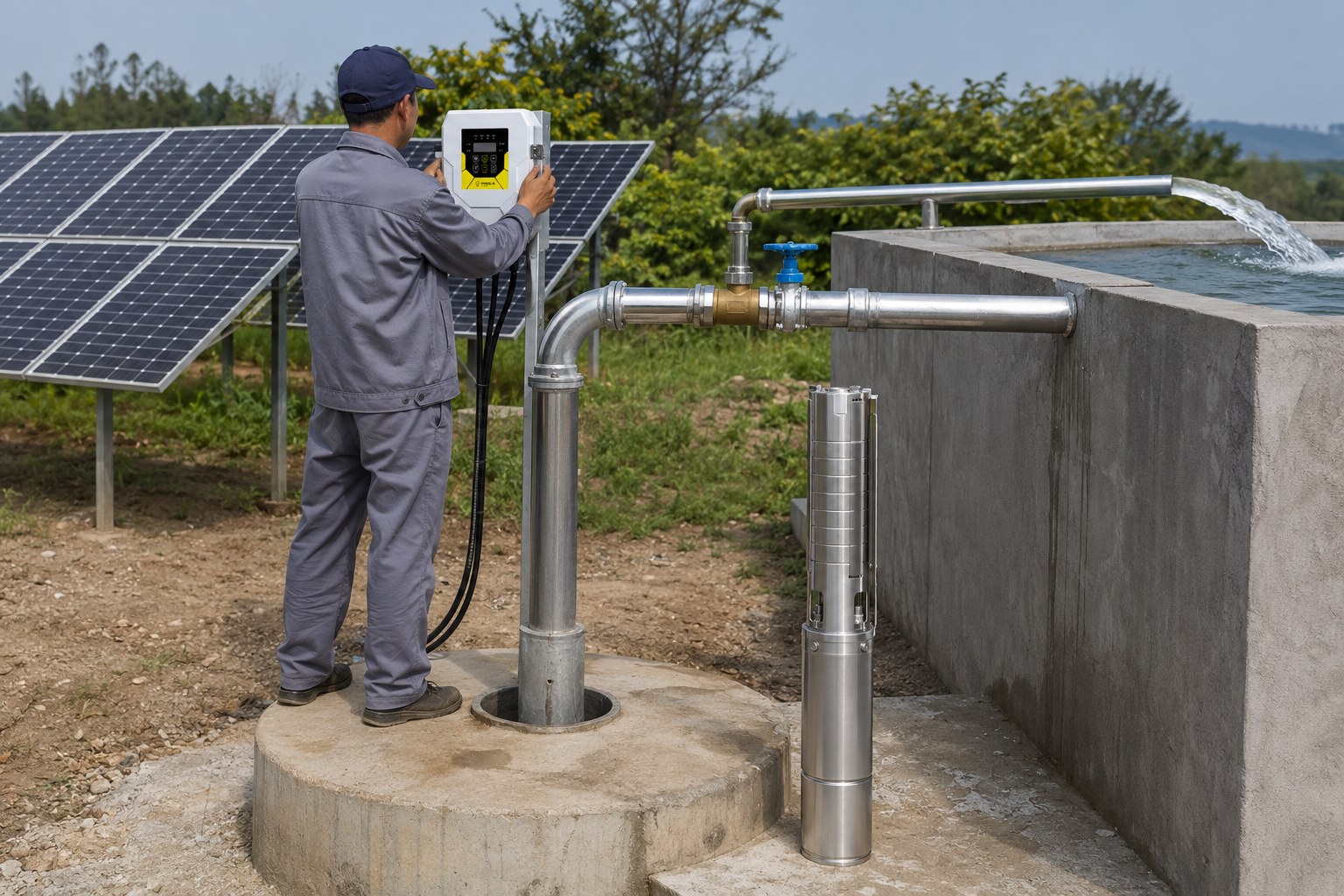
Modern solar pumps, powered by high-efficiency BLDC motors and intelligent controllers, provide reliable water solutions for off-grid areas. Different pump types—screw, plastic impeller, and stainless steel impeller—are available to meet diverse needs, from low-flow, high-head domestic use to high-flow agricultural irrigation.
While three-stage pumps are masters of high pressure in grid-powered industrial settings, a parallel revolution is happening in off-grid water supply: the rise of specialized solar deep-well pumps.
These systems are not always multi-stage in the traditional sense, but they are engineered with a similar goal: to solve specific water-lifting challenges with maximum efficiency.
They have become essential equipment in regions like Africa, Australia, and the Americas for everything from livestock watering to crop irrigation.
Let's examine the core components and pump types that make up this competitive and game-changing technology.
The Power of a BLDC Motor
The heart of every modern solar pump is its motor.
Unlike conventional AC motors, these pumps use a Brushless DC (BLDC) permanent magnet motor.
This technology is a game-changer, with operational efficiencies exceeding 90%.
The rotor, made from high-strength neodymium iron boron magnets, delivers powerful torque in a compact design.
A BLDC motor can be up to 47% smaller and 39% lighter than a traditional motor of equivalent power.
This high efficiency is crucial for solar applications, as it means the pump can do more work with less power.
This directly reduces the number of expensive solar panels needed, lowering the system's overall cost and simplifying installation.
Matching the Pump to the Well
No single pump type fits every need.
The most effective solar pump portfolios offer a range of solutions tailored to different flow and head requirements.
| Pump Type | Best For | Flow Rate | Head | Key Advantage | Limitation |
|---|---|---|---|---|---|
| Solar Screw Pump | Deep wells, domestic use | Low | Very High | Excellent sand resistance, high lift | Limited flow for large-scale use |
| Plastic Impeller Pump | Farm irrigation, high output | High | Medium | Economical, lightweight, wear-resistant | Less durable in corrosive water |
| SS Impeller Pump | Corrosive water, premium use | High | Med-High | Superior corrosion resistance, long life | Higher initial cost and weight |
The Brains of the Operation: Intelligent Control
A solar pump system is more than just a pump and panels.
It includes an intelligent controller, often featuring Maximum Power Point Tracking (MPPT).
MPPT technology constantly adjusts the pump's electrical load to ensure the solar panels operate at their peak efficiency, maximizing water output throughout the day as sunlight conditions change.
Advanced controllers also offer AC/DC hybrid functionality.
These controllers can automatically switch to an AC power source (grid or generator) when sunlight is insufficient, ensuring a worry-free, 24-hour water supply for critical applications.
What are the Main Advantages of Three-Stage Pumps?
Is your current pump setup inefficient, bulky, and struggling to meet pressure demands?
These issues lead to high energy bills, wasted space, and unreliable system performance.
Three-stage pumps directly address these pain points with a superior, integrated design.
Three-stage pumps offer significant advantages, including the ability to generate much higher pressures than single-stage pumps. They are highly energy-efficient, provide a compact, space-saving footprint compared to multiple pumps in series, and are built with enhanced durability for demanding environments.
When evaluating pumping solutions for high-pressure applications, three-stage pumps consistently emerge as a superior choice for several compelling reasons.
Their design philosophy revolves around efficiency, power, and reliability.
These advantages are not just marginal improvements; they translate into significant long-term savings and more dependable operations.
Let's delve deeper into the specific benefits that set these pumps apart from single-stage or even two-stage alternatives.
Superior Pressure Generation
The most obvious advantage is the ability to produce high pressure.
By adding energy in three distinct stages, these pumps can achieve discharge pressures that are simply unattainable for a single-stage pump of similar size.
For instance, where a single-stage pump might max out at 7 bar (~100 PSI), a three-stage pump in the same service class can comfortably deliver over 20 bar (~300 PSI).
This capability is essential for applications such as boiler feed water, reverse osmosis systems, and high-rise building water supply, where overcoming high system resistance is the primary objective.
Optimized Energy Efficiency
Efficiency is a critical factor in the total cost of ownership.
Three-stage pumps are designed to operate at or near their Best Efficiency Point (BEP) across a wider range of conditions.
Because the work is divided among three impellers, each can be designed for optimal hydraulic performance within its specific pressure range.
This results in significantly lower energy consumption.
A single, properly sized three-stage pump can be over 15-25% more energy-efficient than using multiple single-stage pumps piped together in series to achieve the same duty point, leading to substantial savings on electricity costs over the pump's lifetime.
Compact Footprint and Durability
Compared to the alternative of installing two or three separate single-stage pumps in series, a single three-stage pump offers a much more compact and elegant solution.
This saves valuable floor space in mechanical rooms and simplifies piping, installation, and control.
Furthermore, three-stage pumps are inherently more robust.
The casing and internal components are engineered to withstand the high pressures they generate.
This reinforced design, combined with balanced axial and radial forces, results in a more durable and longer-lasting machine compared to a single-stage pump pushed to its operational limits.
Are There Any Challenges in Using Three-Stage Pumps?
While three-stage pumps are powerful, are they a fit-and-forget solution?
Ignoring their specific needs can lead to unexpected failures, reduced efficiency, and costly emergency repairs.
Awareness of their challenges is key to unlocking their full potential and ensuring long-term reliability.
Yes, challenges exist. Three-stage pumps require more diligent, regular maintenance due to their complexity. Their initial purchase price is higher than single-stage pumps, and like all centrifugal pumps, they are susceptible to damage from cavitation if not operated under proper suction conditions.
No technology is without its considerations, and three-stage pumps are no exception.
While their advantages are significant, potential owners and operators must be aware of the challenges associated with their complexity and high-performance nature.
Addressing these challenges proactively is the difference between a reliable, long-lasting asset and a source of operational headaches.
By understanding these factors, you can properly plan for the pump's integration and long-term care.
The Importance of a Maintenance Schedule
Due to their multiple stages and tighter internal tolerances, three-stage pumps demand a more rigorous maintenance regimen than their simpler single-stage cousins.
The increased number of components—three impellers, multiple diffusers, and more complex seals and bearings—means there are more potential points of wear.
- Bearings: Must be lubricated according to a strict schedule to prevent overheating and failure.
- Seals: Mechanical seals are precision components that must be inspected for leaks, as a failure can damage the bearings and motor.
- Impellers: Periodic inspection for wear or damage from cavitation or abrasion is crucial to maintain performance.
A proactive maintenance plan, including vibration analysis and performance monitoring, is essential to catch minor issues before they escalate into catastrophic failures.
Understanding Total Cost of Ownership
The initial investment for a three-stage pump is noticeably higher than for a single-stage pump.
This can be a barrier for buyers focused solely on upfront capital expenditure.
However, a smart evaluation focuses on the Total Cost of Ownership (TCO).
The TCO equation includes:
- Initial Purchase Price (Higher): The cost of the more complex machine.
- Installation Cost (Lower): Often cheaper than installing multiple pumps.
- Energy Cost (Lower): Superior efficiency leads to significant long-term savings.
- Maintenance Cost (Higher): Requires more diligent preventative care.
When calculated over the pump's lifespan (10-15 years), the lower energy costs often more than offset the higher initial price and maintenance needs, making the three-stage pump the more economical choice in the long run.
Preventing and Managing Cavitation
Like all centrifugal pumps, three-stage pumps are vulnerable to cavitation.
Cavitation occurs when the pressure at the suction eye of the first-stage impeller drops below the liquid's vapor pressure.
This causes tiny vapor bubbles to form.
As these bubbles move into the higher-pressure zone of the impeller, they collapse violently.
This collapse creates micro-jets of fluid that can erode the impeller surface, causing noise, vibration, and a sharp drop in performance.
Preventing cavitation requires careful system design, ensuring adequate Net Positive Suction Head Available (NPSHa) is always present.
Regular maintenance to keep impellers clean and free of blockages also helps mitigate this destructive phenomenon.
Conclusion
Three-stage pumps are powerful, efficient, and reliable solutions for high-pressure fluid handling.
Their advanced design makes them indispensable in demanding industrial environments, justifying their investment through superior performance and long-term value.
FAQs
What is the difference between single stage and 3 stage pump?
A single-stage pump has one impeller to generate pressure. A 3-stage pump uses three impellers in series, with each stage adding more pressure, resulting in a much higher final output.
What is a 3 stage pump used for?
They are used for high-pressure applications like boiler feedwater, reverse osmosis, pipeline transport, mine dewatering, and feeding high-pressure systems like filter presses, where high head is critical.
How much pressure can a 3 stage pump produce?
While it varies by design, a typical industrial three-stage pump can produce pressures exceeding 20 bar or 300 PSI, significantly more than a comparable single-stage pump.
What are the disadvantages of a multi-stage pump?
The main disadvantages are a higher initial cost, increased complexity, and the need for more rigorous, regular maintenance on components like seals and bearings compared to simpler single-stage pumps.
Is a 3 stage pump a centrifugal pump?
Yes, a three-stage pump is a type of centrifugal pump. It falls under the category of multi-stage centrifugal pumps because it uses multiple impellers to generate pressure via centrifugal force.
How do you increase the pressure of a centrifugal pump?
You can increase pressure by using a larger diameter impeller, increasing the pump's rotational speed, or by adding more stages (impellers) in series, which is the principle of a multi-stage pump.