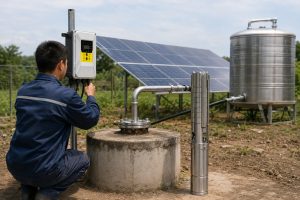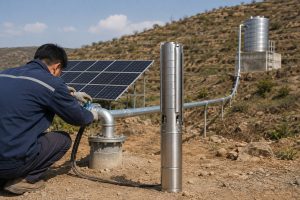
Worried about relying on inconsistent sunlight for your water pump?
An unreliable water supply can jeopardize your crops, livestock, or daily life, causing significant stress and financial loss.
A solar pump doesn't need full sun all day.
It typically requires 4 to 6 "Peak Sun Hours" (PSH) to operate effectively.
This metric, combined with an efficient system design—including the right pump, motor, and controller—ensures you get the water you need, even on cloudy days.
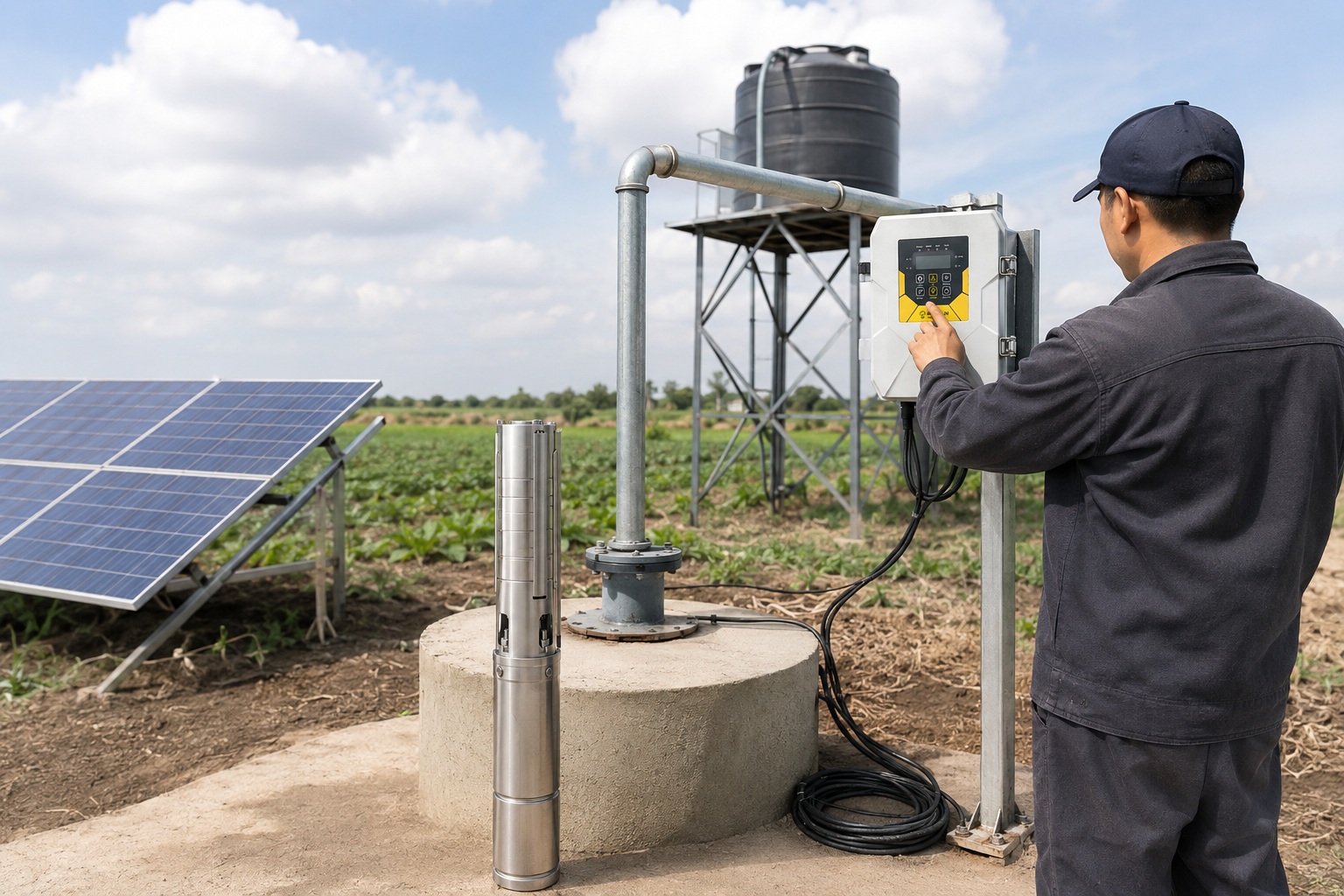
Understanding how solar energy powers a water pump involves more than just counting the hours from sunrise to sunset.
It requires a careful balance of technology, geography, and your specific water demands.
Getting this balance right is the key to creating a dependable, off-grid water solution.
Let's dive into the essential factors that determine your system's solar needs.
This knowledge will empower you, whether you're a user or a distributor, to make smart, cost-effective decisions that guarantee a reliable water supply for years to come.
Understanding Solar Panel Output and Peak Sun Hours
Are you confused by solar panel ratings and how they translate to real-world performance?
Miscalculating your power needs can lead to an underperforming system that fails exactly when you need it most, wasting your investment.
The key is understanding "Peak Sun Hours" (PSH), not just daylight hours.
One PSH equals one hour of sunlight at a peak intensity of 1,000 watts per square meter.
A well-designed solar pump system typically needs 4 to 6 PSH daily to function effectively.
The amount of sun a solar pump needs is the single most important factor in designing a system.
However, the answer isn't as simple as "eight hours a day."
The quality and intensity of that sunlight matter far more than the duration.
This is where the concept of Peak Sun Hours becomes critical for anyone looking to invest in solar pumping technology.
It is the universal standard for measuring the "useful" sunlight available for solar energy production in a specific location.
What is a Peak Sun Hour (PSH)?
Imagine all the sunlight in a day—weak in the morning, strong at noon, and weak again in the evening—being compressed into a period of equivalent, high-intensity sunlight.
That compressed period is your PSH.
For example, a location might receive 10 hours of daylight, but only have 5 PSH.
This means the total solar energy received is equivalent to 5 hours of the sun shining at its absolute peak intensity.
Different parts of the world receive vastly different amounts of PSH, which directly impacts the size of the solar array needed.
- High PSH Regions: Places like Arizona, USA, or most of Australia might get 6-7 PSH per day on average.
- Low PSH Regions: Locations like Germany or the UK might only average 3-4 PSH per day.
Knowing your location's PSH is the first step to accurately sizing your solar panel system.
How to Calculate Your Solar Array Size
Once you know your daily water requirement and your location's PSH, you can estimate the solar panel wattage you'll need.
The calculation involves considering the pump's power consumption, the total dynamic head (the vertical distance the water is lifted), and the pump's overall efficiency.
A simplified formula looks something like this:
Required Panel Wattage = (Daily Water Volume Needed x Total Head) / (Pump System Efficiency x Local PSH)
Let's look at a table to illustrate how PSH affects panel requirements for the same pumping job.
| Daily Water Goal | Total Head | Location PSH | Pump Efficiency | Required Panel Wattage (Approx.) |
|---|---|---|---|---|
| 10,000 Liters | 50 Meters | 6 PSH (e.g., Chile) | 50% | ~2,300 Watts |
| 10,000 Liters | 50 Meters | 4 PSH (e.g., Turkey) | 50% | ~3,450 Watts |
As you can see, a location with 50% more sun requires a solar array that is roughly 33% smaller to do the exact same job, leading to significant cost savings.
The Impact of Panel Technology and Angle
The type of panels you use and how you install them also play a huge role.
Advancements in solar technology are constantly pushing the boundaries of efficiency.
Panel outputs are expected to exceed 700W by 2025, meaning you'll need fewer panels to generate the same amount of power.
Furthermore, the angle and orientation of your panels can dramatically impact their energy capture.
Properly angling your panels towards the equator can increase their annual energy production by 15-25% compared to simply laying them flat.
Why Pump Type Matters for Your Solar Needs
Do you think all solar pumps are the same?
Choosing the wrong pump type can drain your solar power, increase system costs, and lead to premature failure, turning your sustainable solution into a frustrating problem.
The right pump type significantly reduces your solar energy demand.
A solar screw pump is perfect for deep wells (high head, low flow), while a plastic impeller pump suits irrigation (high flow, medium head).
Matching the pump to the application is key to efficiency.
After determining how much sun you have, the next critical step is choosing a pump that uses that sunlight as efficiently as possible.
The pump itself is a major variable in your system's overall energy equation.
Different pump designs are engineered for specific tasks.
Selecting the wrong one is like using a sports car to haul lumber—it might work, but it's incredibly inefficient and will eventually cause problems.
For distributors and importers, offering a diverse portfolio of pumps is crucial to meeting varied market demands and providing true value to end-users.
Solar Screw Pumps: The Deep Well Specialist
The solar screw pump is a type of positive displacement pump.
It uses a single stainless steel helical screw that rotates inside a rubber stator.
This action creates sealed cavities of water that are pushed progressively up towards the outlet.
This design is exceptionally good at creating high pressure, making it ideal for applications with a very high head (lifting water from deep underground) but a relatively low flow rate.
- Applications: Perfect for domestic water supply in rural homes, livestock drinking troughs, and small-scale, high-pressure drip irrigation.
- Advantages: It excels in deep wells, with some models capable of pumping from over 200 meters. It also has excellent resistance to sand and silt, which would quickly destroy other pump types.
- Ideal Markets: Its durability and deep-well capability make it a go-to solution in the electricity-scarce regions of Africa and Latin America.
Solar Impeller Pumps: The High-Volume Workers
Unlike screw pumps, centrifugal impeller pumps use a spinning impeller to throw water outwards at high speed, creating flow.
These are multi-stage pumps, meaning they have several impellers stacked together to achieve the desired head and flow.
They come in two main varieties for solar applications: plastic impeller and stainless steel impeller.
-
Solar Plastic Impeller Pump: This is the workhorse for high-volume applications. The engineered plastic impellers are durable, lightweight, and provide excellent resistance to wear from fine sand. They deliver high flow rates at a medium head, making them perfect for farm irrigation, pasture water supply, and filling large storage tanks. Their economic price point makes them widely popular in Africa and the Americas.
-
Solar Stainless Steel Impeller Pump: This is the premium option. Using SS304 stainless steel for both the impeller and pump body provides superior resistance to corrosion. It is specifically designed for environments with acidic, alkaline, or otherwise aggressive water conditions. This pump is the ideal choice for alkaline soil regions in Australia, certain parts of the Americas, and high-end residential or ranch water systems where water quality is a concern and long-term reliability is paramount.
Matching Pump Type to Application for Maximum Efficiency
Choosing the right pump isn't just about whether it will work; it's about how efficiently it will work.
An efficient pump requires less power, which means a smaller and less expensive solar array.
This table provides a clear comparison to help distributors build a flexible and competitive product portfolio.
| Pump Type | Flow Rate | Head Performance | Sand Resistance | Primary Advantage | Best Application |
|---|---|---|---|---|---|
| Solar Screw Pump | Low | Very High (up to 200m+) | Excellent | Deep well performance | Domestic water, Livestock |
| Solar Plastic Impeller | High | Medium (up to 100m) | Good (fine sand) | High flow, Cost-effective | Farm irrigation, Tank filling |
| Solar SS Impeller | High | Medium-High (up to 150m) | Fair | Superior corrosion resistance | Aggressive water, Ranches |
The Role of the Motor and Controller in Efficiency
Your solar panels are generating power, but is your pump using it wisely?
An inefficient motor or a basic controller can waste up to 40% of your precious solar energy, forcing you to buy more panels.
The motor and controller are the brains and heart of your system.
A high-efficiency Brushless DC (BLDC) motor (>90% efficiency) and an MPPT controller can boost water output by over 30% using the same solar panels, drastically reducing the sun needed.
Even with the perfect pump and plenty of sun, your system's performance hinges on two crucial components: the motor that drives the pump and the controller that manages the power.
These components are where modern technology creates the biggest gains in efficiency.
Investing in a superior motor and controller means you can get significantly more water for every watt of solar power generated.
This reduces the overall system cost and increases its reliability, especially on days with less-than-perfect sun.
The BLDC Motor Advantage
The core driving force of any modern solar pump is its motor.
The most advanced and efficient option is the Brushless DC (BLDC) permanent magnet motor.
- Efficiency: BLDC motors operate at efficiencies exceeding 90%. In contrast, older brushed DC motors or standard AC motors are often only 60-75% efficient. This 15-30% efficiency gain means the pump does more work with less power.
- Durability: With no brushes to wear out, BLDC motors have an operational lifespan of 20,000 to 30,000 hours. Brushed motors typically last only 2,000 to 5,000 hours, meaning a BLDC motor can last up to 10 times longer.
- Power and Size: These motors utilize powerful rare-earth magnets (like 40SH neodymium iron boron). This allows them to be incredibly compact and powerful for their size—often up to 47% smaller and 39% lighter than traditional motors with the same power output.
The strategic value of a high-efficiency BLDC motor cannot be overstated.
It directly reduces the number of solar panels required, lowers operating costs, simplifies installation, and provides a maintenance-free, long-life solution.
Maximizing Power with MPPT Controllers
If the motor is the heart, the controller is the brain.
An intelligent controller with Maximum Power Point Tracking (MPPT) technology is essential for maximizing solar energy utilization.
Solar panels have a specific voltage and current at which they produce the most power—their "maximum power point."
This point changes constantly with temperature and sunlight intensity.
An MPPT controller continuously analyzes the panel's output and adjusts the electrical load to ensure the motor is always receiving the maximum possible power.
This "tracking" can increase the amount of water pumped per day by up to 30% compared to a system with a simple, non-tracking controller.
It's especially effective during periods of low light, such as early morning, late evening, and cloudy days.
The Hybrid Solution: AC/DC Controllers
For applications requiring 24/7 water access regardless of sunshine, the AC/DC hybrid controller is a game-changing innovation.
This controller is designed with two power inputs: one for the DC power from the solar panels and one for an AC power source like the grid or a generator.
- Automatic Switching: The controller's intelligence prioritizes solar power. When the sun is shining, it runs the pump using free DC energy.
- Hybrid Function: When solar power is insufficient (e.g., on a very cloudy day), it can blend AC power with the available DC power to keep the pump running, maximizing the use of solar energy.
- Full Backup: When there is no solar input at all (e.g., at night), it automatically switches to the AC power source.
This ensures a completely worry-free, uninterrupted water supply without the need for a complex and expensive battery bank.
Sizing Your Inverter and Handling Surge Currents
Is your pump struggling to start or constantly tripping your system?
You might be ignoring the hidden power demand of surge currents, a common and costly mistake that can damage your inverter and pump motor.
Pumps need a massive burst of power to start, known as surge current.
Your inverter must have a surge rating that is 3 to 5 times the pump's continuous running wattage.
A properly sized inverter ensures smooth startups and protects your entire system.
While many modern solar pumps run directly on DC power and do not require a separate inverter, systems that use AC pump motors or power other AC loads rely on this critical component.
The inverter's job is to convert the DC electricity from your solar panels (or batteries) into AC electricity that the pump can use.
The most common point of failure in these systems is an undersized inverter that cannot handle the pump's startup demands.
Continuous Power vs. Surge Power
Every AC motor has two power ratings that you must understand:
- Continuous Power (Running Watts): This is the amount of power the pump needs to run steadily after it has started. A 1 HP pump, for example, has a continuous power draw of about 750 watts.
- Surge Power (Starting Watts): This is the initial, momentary burst of power required to overcome inertia and get the motor spinning. This surge can be 3 to 8 times higher than the continuous power. That same 750-watt pump might need 3,000 watts or more for a split second.
If your inverter's surge capacity is lower than the pump's starting requirement, the inverter will either shut down to protect itself or, in worst-case scenarios, suffer permanent damage.
How to Calculate Your Inverter Size
Choosing the right inverter involves looking at both its continuous and surge ratings.
- Continuous Rating: A good rule of thumb is to choose an inverter with a continuous power rating that is at least 25% higher than your pump's running watts. This provides a safety margin and allows the inverter to operate without being constantly maxed out.
- Surge Rating: This is the most critical number. The inverter's surge rating must exceed the pump's starting wattage.
This table provides general guidelines for sizing an inverter for common pump sizes. Always check the pump manufacturer's specific surge requirements.
| Pump Size (HP) | Running Watts (Approx.) | Recommended Continuous Inverter Watts | Minimum Required Surge Inverter Watts |
|---|---|---|---|
| 0.5 HP | 375 W | 500 W+ | 1,500 W+ |
| 1.0 HP | 750 W | 1,000 W+ | 3,000 W+ |
| 2.0 HP | 1,500 W | 2,000 W+ | 6,000 W+ |
| 3.0 HP | 2,200 W | 3,000 W+ | 9,000 W+ |
For a 2 HP pump, you need an inverter capable of providing at least 2000W continuously, but more importantly, a surge capacity of at least 6000W.
Why Inverter Efficiency Matters
Just like motors, inverters are not 100% efficient.
They lose a small amount of energy as heat during the DC-to-AC conversion process.
Modern high-quality inverters have efficiency ratings between 90% and 98%.
While the difference between a 92% and a 97% efficient inverter may seem small, it adds up over time.
A more efficient inverter wastes less of your valuable solar power, meaning more energy is available to run your pump.
This can be the difference between your pump running effectively or struggling on days with lower sunlight.
Do You Need Batteries for Your Solar Pump System?
What happens when the sun goes down or thick clouds roll in?
Without a storage solution, your water supply stops, potentially disrupting critical irrigation cycles or leaving your home without water.
Batteries provide energy independence, allowing your pump to run at night or during low-sun periods.
However, an AC/DC hybrid system can often be a more cost-effective and maintenance-free alternative for ensuring 24/7 operation.
The question of whether to include batteries is a major decision point in designing a solar pump system.
It fundamentally changes the system's cost, complexity, and operational capabilities.
While batteries offer the allure of true 24/7 off-grid operation, they are not always the best or most practical solution.
The Case for Batteries: Energy on Demand
The primary function of a battery bank is to provide operational continuity.
By storing excess energy generated during peak sun hours, batteries allow your system to:
- Run at Night: Pump water for overnight irrigation or household needs.
- Operate During Low Sun: Power through cloudy or rainy days without interruption.
- Handle Higher Surges: Provide the high current needed to start large pumps more reliably than some inverters can alone.
Residential battery capacities typically range from 2.4 kWh to 15 kWh, allowing for a tailored solution.
However, this flexibility comes at a price.
The Case Against Batteries: Cost and Complexity
Adding batteries to a solar pump system introduces several significant drawbacks that often weaken the return on investment.
- High Upfront Cost: Batteries can easily double the initial cost of a solar pump system.
- Limited Lifespan: While panels last 25+ years, most solar batteries need to be replaced every 5 to 15 years, creating a significant long-term expense.
- Maintenance: Batteries require regular monitoring and maintenance to ensure their health and longevity.
- Efficiency Loss: The process of charging and discharging a battery results in energy losses of 10-20%. This means you need a larger solar array to both run the pump and charge the batteries.
A Smarter Alternative? Water Storage and Hybrid Systems
For many applications, there are more efficient and cost-effective ways to achieve 24/7 water access.
-
Water Storage: The simplest and most reliable "battery" is a water tank. The system uses sunlight to pump a full day's worth of water into a large, elevated storage tank. The water is then available 24/7 via gravity feed or a small pressurizing pump. This is far cheaper, longer-lasting, and more efficient than storing energy in chemical batteries.
-
AC/DC Hybrid System: As discussed previously, an AC/DC hybrid controller provides the ultimate reliability without the drawbacks of batteries. It uses free solar power whenever possible and seamlessly switches to a grid or generator backup when needed. This is the ideal solution for critical applications where both 24/7 operation and cost-effectiveness are priorities.
For most agricultural and residential pump users, combining a direct-drive DC solar pump with a water storage tank offers the best balance of performance, cost, and reliability.
Calculating Your System's Payback Period
A solar pump system is a significant investment.
How can you be sure it will actually pay off, and how quickly can you expect a return on that investment?
The payback period for a solar well pump is surprisingly short, often between 3 to 5 years.
By completely eliminating recurring fuel or grid electricity costs, the annual savings quickly cover the initial investment, delivering free water for many years to come.
For any business owner, importer, or large-scale user, the financial viability of a project is paramount.
The beauty of a solar water pump is that its return on investment (ROI) is not a matter of "if," but "when."
Unlike a diesel or grid-powered pump with never-ending fuel and electricity bills, a solar pump has a fixed upfront cost and then provides nearly free energy for decades.
Calculating this payback period is a powerful tool for making an informed investment decision and a key selling point for distributors.
Step-by-Step ROI Calculation
Let's walk through a realistic example of a farmer replacing a 1 HP grid-powered AC pump with a solar-powered system.
1. Calculate Annual Operating Cost of the Old Pump:
- Pump Power: 1 HP ≈ 0.75 kW
- Daily Runtime: 7 hours
- Electricity Cost: $0.15 per kWh (a global average)
- Daily Cost: 0.75 kW 7 hours $0.15/kWh = $0.7875
- Annual Cost: $0.7875 * 365 days = $287.44
This $287 is the annual savings the solar pump will generate.
2. Calculate the Initial Investment of the Solar System:
- 1200W Solar Panel Array: $600
- 1 HP High-Efficiency DC Solar Pump Kit (with BLDC motor and MPPT controller): $700
- Mounting and Cabling: $150
- Total Initial Investment: $1,450
3. Calculate the Payback Period:
- Payback Period = Total Initial Investment / Annual Savings
- Payback Period = $1,450 / $287.44 = 5.04 Years
After just 5 years, the system has paid for itself.
For the next 20+ years of the solar panels' life, the water is virtually free.
Factors That Shorten Your Payback Period
The 5-year payback in our example can be even shorter.
Several factors can accelerate your ROI:
- Higher Energy Costs: If you are replacing an expensive diesel pump or live in an area with high electricity rates (e.g., >$0.25/kWh), your annual savings will be much larger, and your payback period could be as short as 2-3 years.
- Government Incentives: Many countries offer tax credits, rebates, or grants for installing renewable energy systems, which can reduce your initial investment by 30% or more.
- High Solar Irradiance: If you live in a location with more Peak Sun Hours, your pump can do more work each day, increasing its value and shortening the payback period.
- System Efficiency: Choosing a high-efficiency BLDC motor and MPPT controller ensures you get the most out of your investment, maximizing water pumped per dollar spent.
The Long-Term Value Proposition for Distributors
For distributors and importers, understanding and communicating this financial case is critical.
The conversation is not about selling a pump; it's about selling a long-term financial solution.
A payback period of 3-5 years is a powerful argument.
Furthermore, by providing high-quality components—solar panels that last 25+ years and BLDC motors with a 20,000+ hour lifespan—you are ensuring long-term customer satisfaction.
This builds brand loyalty and creates a reputation for providing durable, high-value solutions, which is the foundation of a successful distribution business.
Conclusion
A well-designed solar pump system delivers reliable, cost-effective water.
By matching pump type, motor efficiency, and controller intelligence to your specific needs, you can maximize every ray of sun.
FAQs
Can a solar pump run without a battery?
Yes, most direct-drive systems run only when the sun shines. Batteries or AC/DC hybrid systems are needed for 24/7 operation or cloudy day reliability.
How many solar panels does it take to run a well pump?
It depends on the pump's horsepower and local sun hours, but a 1 HP pump typically needs between 1000 and 1500 watts of solar panels.
How deep can a solar pump go?
Specially designed solar pumps, like screw-type models, are made for deep wells and can effectively pump water from depths exceeding 200 meters or 650 feet.
Do solar pumps work on cloudy days?
Yes, they do, but at a reduced output. High-efficiency panels and MPPT controllers help maximize performance, but water flow will be lower than on a bright, sunny day.
What is the life expectancy of a solar water pump?
The solar panels can last over 25 years. The pump motor, especially a quality brushless DC (BLDC) type, can operate for 10 years or more with proper system design.
How do you size a solar pump system?
Sizing involves calculating your daily water needs, the total vertical lift (head), and your location's Peak Sun Hours to select the right pump and solar array.
Can a solar pump fill a water tank?
Absolutely. This is a very common and efficient strategy, using daytime sun to fill a storage tank, creating a water reserve that is available anytime, day or night.
What is the difference between a solar pool pump and a solar well pump?
Solar pool pumps are designed for high-volume, low-pressure circulation, while solar well pumps are engineered to lift water from deep underground, requiring high-pressure (head) capabilities.