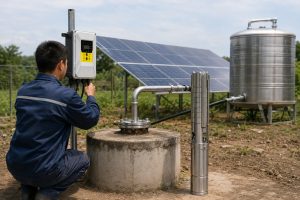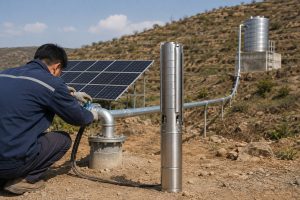
Struggling with unreliable grid power for your water pump?
High electricity bills and frequent outages can disrupt your water supply.
A solar water pump offers a dependable, cost-effective solution.
A 3 HP (horsepower) solar water pump typically requires a 3 kilowatt (kW) solar panel array to operate effectively. This ensures the pump receives sufficient power (3000 watts) to perform optimally, accounting for sunlight variations and delivering a consistent water supply without relying on the grid.
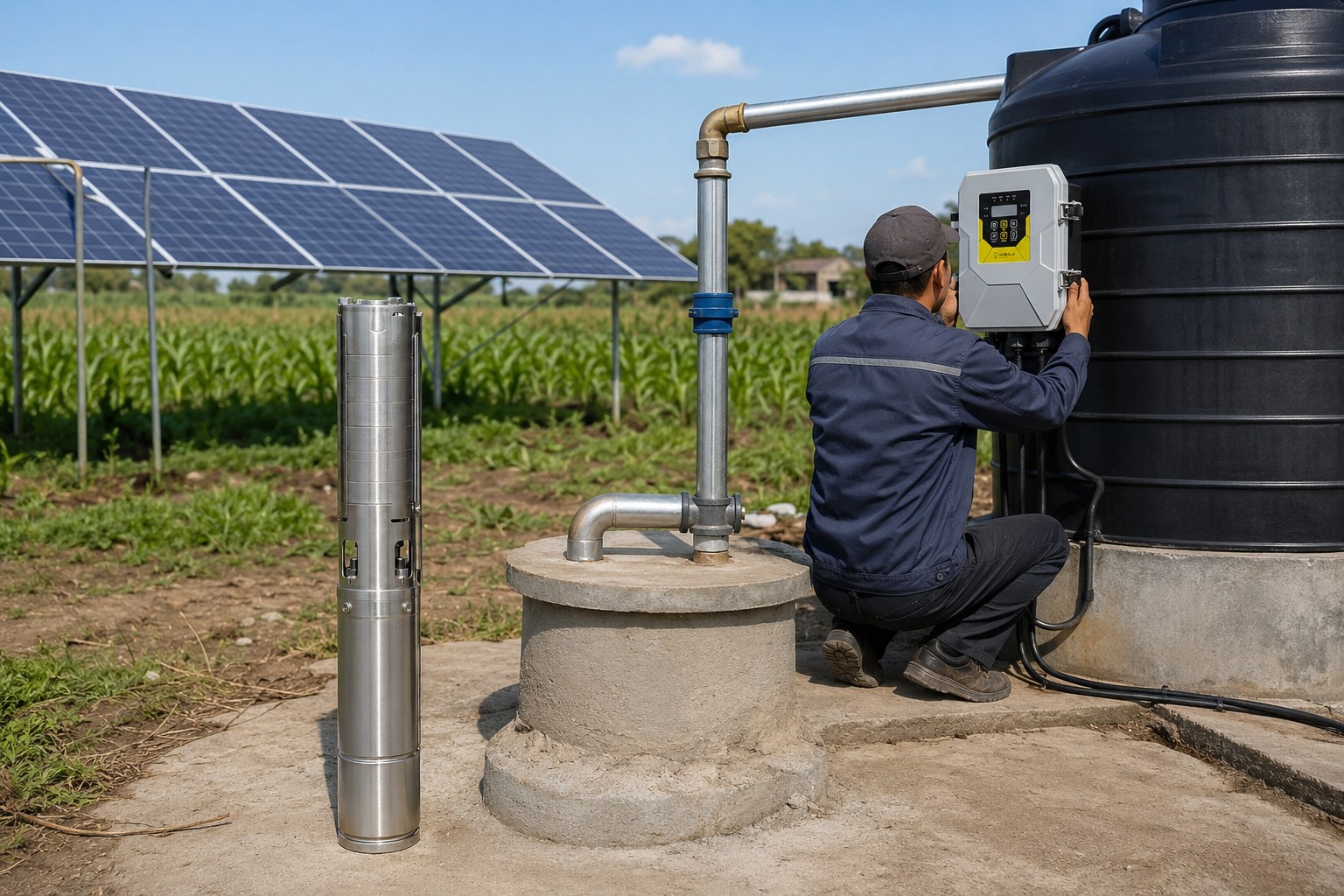
While 3 kW is the straightforward answer, the journey to selecting the perfect solar pump system is more detailed.
The ideal setup depends on the pump's type, the technology you choose, and your specific water needs.
Understanding these factors is crucial for maximizing efficiency and ensuring a reliable water supply for years to come.
This guide will walk you through every component, from price and types to the advanced technologies that power modern solar pumps.
3HP Solar Pump Price
Worried about the initial investment for a solar pump?
The cost can seem high, but understanding the value is key.
Let's break down the price factors to find a solution that fits your budget.
The price of a 3 HP solar water pump system in India ranges from ₹1,30,000 to ₹2,50,000 (approximately $1,550 to $3,000 USD). This variation depends heavily on the pump's type (AC/DC, submersible/surface) and the chosen operational technology like VFD, Hybrid, or On-Grid.
The price isn't just a single number; it's a reflection of the technology, durability, and features included in the system.
A higher initial cost can often lead to greater long-term savings and reliability.
Let's explore what drives these price differences and how to choose the most cost-effective solution for your needs.
Understanding the Price Components
The total cost of a 3 HP solar pump system is influenced by several key components.
The pump itself is just one part of the equation.
The solar panels, controller, and specific technology chosen all contribute to the final price.
For instance, a DC pump system might have a higher upfront cost due to its advanced motor technology, but it saves money by not requiring a separate inverter.
| System Type | Typical Price (INR) | Typical Price (USD) | Key Feature |
|---|---|---|---|
| 3HP VFD Solar Solution | ₹1,30,000 | ~$1,550 | Converts an existing pump to solar. |
| AC Surface Solar Pump | ₹1,80,000 | ~$2,150 | For shallow water sources. |
| DC Submersible Solar Pump | ₹1,95,000 | ~$2,330 | Highly efficient for deep wells. |
| AC Submersible Solar Pump | ₹2,08,000 | ~$2,490 | Uses an inverter for deep wells. |
| On-Grid 3 HP Water Pump | ₹2,40,000 | ~$2,870 | Sells excess power back to the grid. |
| Hybrid 3HP Solar Pump | ₹2,50,000 | ~$3,000 | Runs on solar, grid, or battery. |
Note: Prices can vary by ±10-12% based on location, brand, and promotions. These prices are generally exclusive of government subsidies.
Why VFD Solutions Are So Cost-Effective
A Variable Frequency Drive (VFD) solar solution is the most budget-friendly option for a specific reason.
It allows you to use your existing AC water pump.
This means you don't need to invest in a brand-new pump, only the solar panels and the VFD controller.
The VFD acts as the brain, converting the DC power from the panels into AC power and adjusting the frequency to control the pump's speed.
This technology is a game-changer for farmers and property owners who have already invested heavily in a conventional pump.
It provides a direct path to energy independence without discarding existing equipment, reducing the initial investment by over 40% compared to a full hybrid system.
Types of 3 HP Solar Pump
Choosing the right pump type can feel overwhelming.
You see terms like "submersible," "surface," "AC," and "DC."
Let's simplify this and help you identify the perfect pump for your water source.
The two primary types of solar pumps are Submersible and Surface. Submersible pumps are installed underwater in deep wells (over 20 meters), while Surface pumps are placed above ground for shallow sources like ponds or tanks. Both types are available with AC or DC motors.
The choice between a submersible and a surface pump is the first and most important decision.
It is determined entirely by your water source's depth.
Once you know the type, you can then consider the motor technology and internal components that best suit your water quality and flow requirements.
Submersible Pumps: For Deep Water Applications
Submersible pumps are engineered for one primary purpose: lifting water from deep underground.
If your water source is a borehole or a well deeper than 20 meters (65 feet), a submersible pump is your only option.
These pumps are installed directly inside the water, pushing it upwards to the surface.
Within the submersible category, the pump's internal mechanism is critical for performance and longevity.
Solar Screw Pump: High Head, Low Flow
This pump is ideal for very deep wells where high pressure is needed to lift water.
It uses a stainless steel screw rotating within a rubber stator.
This design is highly resistant to sand and other abrasives, making it perfect for boreholes with challenging water conditions.
It's a popular choice for domestic water supply and livestock watering in regions with deep water tables.
- Best for: Deep wells (>80m), high sand content.
- Limitation: Lower flow rate, not ideal for large-scale irrigation.
Solar Plastic Impeller Pump: High Flow, Wear-Resistant
This is the workhorse for general agricultural use.
It uses multiple stages of durable plastic impellers to move large volumes of water.
It offers an excellent balance of high flow and moderate head.
Its design provides good resistance to fine sand and is lightweight and economical, making it a go-to for farm irrigation and pasture water supply.
- Best for: Farm irrigation, moderate well depths, high water volume needs.
- Limitation: Less durable in highly corrosive water.
Solar Stainless Steel Impeller Pump: Premium and Corrosion-Resistant
When water quality is a concern, this pump is the premium choice.
Both the impellers and pump body are made from SS304 or SS316 stainless steel.
This provides superior resistance to corrosion from acidic or alkaline water.
It is the most reliable option for harsh water environments, ensuring a long service life and consistent performance for high-end homes and critical agricultural operations.
- Best for: Corrosive water, alkaline soils, high-reliability applications.
- Limitation: Higher initial cost and weight.
Surface Pumps: For Shallow Water Sources
Surface pumps are designed for applications where the water source is easily accessible.
They are installed above ground and pull water from sources like ponds, streams, rivers, or storage tanks.
The critical limitation is their suction depth, which is typically a maximum of 20 meters (65 feet).
They are simpler to install and maintain since they are not submerged.
Like submersible pumps, they are available in both AC and DC versions.
An AC surface pump requires an inverter, while a DC surface pump can be powered directly by solar panels, offering higher system efficiency.
3 Technologies to Operate 3 HP Solar Pump
Want your pump to do more than just run on sunshine?
Relying solely on the sun can be limiting.
Modern systems offer advanced technologies for unmatched flexibility and control.
You can operate a 3 HP pump with three main technologies. A VFD Drive solarizes your existing pump. A Hybrid system uses solar, grid, and/or batteries for 24/7 operation. An On-Grid system lets you power your pump and sell surplus energy back to the grid.
Choosing the right technology transforms your solar pump from a simple device into a smart water and energy management system.
Your decision depends on whether you have an existing pump, need water 24/7, or live in an area with high electricity costs.
Let's explore how each technology works to help you make the best choice.
VFD Drive: The Smart Upgrade for Existing Pumps
A Variable Frequency Drive (VFD) is a revolutionary device for anyone who already owns a conventional AC water pump.
Instead of replacing your entire setup, you can install a VFD controller and solar panels to run your existing pump on solar energy.
The VFD is an intelligent controller that takes DC electricity from solar panels and converts it into variable frequency AC power.
This allows it to control the speed of a standard 3-phase AC motor with remarkable precision.
- How it works: It matches the pump’s speed to the available solar energy. More sun means a faster pump speed and more water.
- Key Benefit: It is the most cost-effective path to solar pumping, with potential savings of 40-50% compared to purchasing a completely new system.
- Protections: Advanced VFDs include essential safety features like dry run protection, reverse polarity protection, and over/low voltage cutoffs, protecting your existing pump motor.
Hybrid Pump: Uninterrupted 24/7 Water Supply
A hybrid solar pump system is the ultimate solution for applications where a constant water supply is non-negotiable.
It is designed to draw power from multiple sources, ensuring you have water day or night, rain or shine.
The core of this system is an advanced AC/DC hybrid controller.
This controller intelligently manages power inputs from solar panels and an AC source (grid electricity or a generator).
- Priority 1: Solar Power. When there is sufficient sunlight, the system runs 100% on free solar energy.
- Priority 2: Hybrid Function. On cloudy days or during periods of low light, the controller automatically blends solar power with AC power. It maximizes the use of available solar energy and only draws the supplemental power it needs from the grid. This feature can increase solar energy utilization by up to 30%.
- Priority 3: AC Power. At night or when there is no solar input, the controller seamlessly switches to 100% AC power.
This automatic, worry-free operation makes it perfect for critical domestic water supplies, livestock, and irrigation schedules that cannot be interrupted.
On-Grid Pump: Powering Your Pump and the Grid
An on-grid solar pump system, also known as a grid-tied system, is designed for users who have a stable grid connection but want to eliminate their electricity bills.
This technology not only powers your pump but also turns your system into a mini power plant.
When the solar panels generate more electricity than the pump needs, the excess power is not wasted.
Instead, it is exported to the public utility grid through a process called net metering.
Your electricity meter spins backward, earning you credits that offset the cost of any power you draw from the grid at night or on cloudy days.
In many cases, this can reduce your electricity bill to zero or even generate an income.
This system is best suited for regions with high electricity tariffs and supportive net-metering policies.
It is an excellent investment for achieving long-term energy savings and a faster return on investment.
The Core of Efficiency: The BLDC Motor
What truly makes a modern solar pump so powerful?
It’s not just the solar panels.
The secret lies in the advanced motor technology driving the pump.
High-efficiency Brushless DC (BLDC) permanent magnet motors are the heart of top-tier solar pumps. With an efficiency of over 90%, these motors are up to 47% smaller and 39% lighter than traditional motors, significantly reducing the number of solar panels needed and lowering overall system costs.
The motor is the engine of your water pump.
Its efficiency directly determines how much water you get for every watt of solar power generated.
Investing in a system with a high-quality BLDC motor is the single most important factor for achieving long-term performance, reliability, and cost savings.
Why BLDC Motors Dominate the Market
BLDC motors have become the industry standard for solar pumping for several key reasons.
Their design eliminates the brushes and commutators found in traditional DC motors.
This removes the most common points of wear and failure.
- Unmatched Efficiency: BLDC motors convert over 90% of electrical energy into mechanical power. Traditional AC motors often operate at 60-70% efficiency. This 20-30% efficiency gain is massive.
- High Torque: They produce high torque even at low speeds, allowing the pump to start easily in low-light conditions early in the morning and late in the afternoon, extending the daily pumping time.
- Compact and Lightweight: Using powerful permanent magnets like Neodymium Iron Boron (40SH grade), these motors are significantly smaller and lighter. This simplifies installation, especially for deep well submersible pumps, and reduces shipping costs.
- Maintenance-Free: With no brushes to wear out, BLDC motors offer a true "fit and forget" solution with a much longer operational lifespan.
The Financial Impact of High Motor Efficiency
The efficiency of your pump's motor has a direct and significant impact on your wallet.
A more efficient motor requires less power to do the same amount of work.
In a solar-powered system, this means you can achieve your water pumping goals with fewer solar panels.
Let's compare a system with a high-efficiency BLDC motor to one with a standard motor.
| Feature | High-Efficiency BLDC System | Standard Efficiency System | Financial Impact |
|---|---|---|---|
| Motor Efficiency | >90% | ~70% | |
| Power Needed for 3 HP | 2238 W | 2238 W | |
| System Power Required | ~2.5 kW (2238W / 0.9) | ~3.2 kW (2238W / 0.7) | |
| Solar Panels (335W) | 8 Panels (2.68 kW) | 10 Panels (3.35 kW) | Saves cost of 2 panels |
| Initial System Cost | Lower | Higher | Lower panel and structure cost. |
| Lifetime Maintenance | Negligible | Brush replacements possible. | Lower long-term costs. |
This comparison clearly shows that a 20% increase in motor efficiency can reduce your solar panel requirement by 20%.
For a 3 HP system, this can mean saving the cost of two entire solar panels, along with the mounting structure and wiring.
This makes the higher initial cost of a premium BLDC pump a smart investment that pays for itself quickly.
Conclusion
A 3 HP solar pump needs a 3 kW solar array.
However, true efficiency comes from choosing the right pump type, technology, and a high-performance BLDC motor for your specific needs.
FAQs
How many solar panels do I need for a 3 HP pump?
You typically need a 3 kW array, which consists of about 8 to 9 solar panels rated at 335-340 watts each.
This provides enough power for consistent operation.
Can a 3 HP solar pump run directly from panels?
Yes, a DC solar pump runs directly from solar panels.
It does not require an inverter, which makes the system simpler, more efficient, and more reliable.
How deep can a 3 HP solar pump go?
A 3 HP submersible solar pump can typically lift water from depths ranging from 50 to 90 meters (165 to 295 feet), depending on the specific model's design.
How much water can a 3hp solar pump?
A 3 HP solar pump can typically discharge between 25,000 to 60,000 liters of water per day.
The exact amount depends on the total head and daily sunlight.
Can I run my existing 3 phase pump on solar?
Yes, you can.
By using a Variable Frequency Drive (VFD), you can connect your existing 3-phase AC pump to a solar panel array and run it on solar power.
What is a hybrid solar pump?
A hybrid solar pump is a system that can run on multiple power sources.
It automatically switches between solar panels, grid electricity, or a generator for a 24/7 water supply.
What is the lifespan of a solar water pump?
A complete solar pumping system comes with a 5-year warranty.
The solar panels have a performance warranty of 25 years, ensuring long-term reliability and energy production.