Are you confused about optimal pump runtimes?
Struggling with high energy costs and worries about premature pump failure?
The key is matching the runtime to the pump type and its job.
The ideal run time depends entirely on your pump type and application. For swimming pools, 8-12 hours is a good target. For residential well pumps, the goal is to minimize start-stop cycles, not total hours. For solar pumps, runtimes are maximized during daylight to meet daily water needs.
Determining the perfect runtime for your water pump isn't a one-size-fits-all answer.
It involves a careful balance of achieving the task, conserving energy, and prolonging the life of your equipment.
Whether you're circulating pool water, supplying a home from a well, or irrigating fields with a solar pump, the strategy changes dramatically.
Let's explore the specifics for each scenario to help you find the most efficient and cost-effective operational schedule for your pump.
Understanding Pool Pump Runtimes
Is your pool water looking dull despite the pump running constantly?
High electricity bills from your pool pump can be frustrating.
You can achieve sparkling clean water by simply aligning your pump's schedule with your pool's actual filtration needs.
Generally, a single-speed pump should run one hour for every 10°F (or about 5.5°C) of ambient air temperature. A more efficient variable-speed pump should run for 8 to 12 hours, which is typically enough time to circulate the entire pool volume at a lower, energy-saving speed.
Single-Speed vs. Variable-Speed Pumps
The type of pump you own is the biggest factor in determining its ideal runtime.
Single-speed pumps operate at one fixed, high speed.
This means they use a significant amount of electricity whenever they are on.
The traditional rule of thumb provides a simple starting point.
For example, if the air temperature is 90°F (32°C), your pump should run for a minimum of 9 hours.
Variable-speed pumps (VSPs), however, are a game-changer for energy efficiency.
They can be programmed to run at different speeds throughout the day.
This allows you to run the pump for longer periods at very low, energy-sipping RPMs, accomplishing the necessary filtration and circulation without the high cost.
Running a VSP at a low speed for 12 hours can use up to 75% less energy than running a single-speed pump for 8 hours.
| Pump Type | Typical Runtime | Energy Consumption (Example) | Key Feature |
|---|---|---|---|
| Single-Speed | 8-10 hours | 1,500 - 2,500 Watts | Runs at one high speed |
| Variable-Speed | 10-12 hours (or 24/7) | 100 - 400 Watts (at low speed) | Adjustable speed for efficiency |
The Turnover Myth vs. Practical Needs
For years, the industry standard was to achieve at least one "turnover" per day.
A turnover means passing the entire volume of your pool's water through the filter system.
While this is a useful guideline, it's not a strict rule.
The primary goals of running your pump are skimming, filtering, and distributing chemicals.
Effective skimming removes debris from the surface before it can sink and decay.
Consistent filtering keeps the water clear and free of suspended particles.
Proper circulation ensures chemicals like chlorine are evenly mixed, preventing algae and bacteria growth.
A variable-speed pump running at a low speed for 24 hours can provide constant, gentle skimming and superior chemical distribution, often for less cost than a single-speed pump running for 8 hours.
Tips for Saving Money
You can further reduce energy consumption by being strategic about when you run your pump.
Many utility companies charge higher rates during "peak hours," typically in the morning and early evening when electricity demand is highest.
Running your pump overnight or during mid-day (e.g., 9 am to 5 pm) can result in significant savings.
For a 1.5 HP single-speed pump, shifting an 8-hour cycle from peak to off-peak hours could save you 20-40% on its operating cost, depending on your local electricity rates.
Also, ensure your water level is correct, ideally halfway up the skimmer opening.
A proper water level dramatically improves the skimmer's efficiency, allowing it to capture more debris with less effort from the pump.
Maximizing Well Pump Lifespan
Are you constantly worried that your well pump might fail unexpectedly, leaving you without water?
The thought of an expensive and urgent replacement is a major concern for homeowners.
You can dramatically extend your pump’s life and prevent sudden failures by understanding and reducing its duty cycles.
A quality submersible well pump is designed to last 10 to 20 years, but its lifespan is directly tied to how often it starts and stops. The most effective way to prolong its life is to minimize these "duty cycles" by using a properly sized, or even oversized, pressure tank.
What is a Duty Cycle and Why Does It Matter?
A duty cycle is one complete on-and-off sequence for your pump.
The pump turns on when the pressure in your system drops to a pre-set low point (the "cut-in" pressure).
It turns off when the pressure tank is full and reaches the "cut-out" pressure.
The electric motor and the pump's internal components experience the most wear and tear during startup.
Each startup creates a surge of electrical current and mechanical stress.
Therefore, a pump that cycles 100 times a day will wear out much faster than one that cycles only 20 times a day, even if the total daily runtime is the same.
Frequent cycling is the number one cause of premature well pump failure.
The Role of the Pressure Tank
The pressure tank is a crucial component that acts as a reservoir.
It stores a certain amount of pressurized water, so the pump doesn't have to turn on for every small water demand, like washing your hands.
A larger pressure tank holds more water, creating a larger "drawdown" (the amount of water you can use before the pump kicks on).
This means the pump will run for longer periods but far less frequently.
Upgrading from a small 20-gallon tank to an 80-gallon tank can reduce the number of daily pump cycles by over 75%, adding years to your pump's operational life.
| Pressure Tank Size (Gallons) | Approx. Drawdown (Gallons) | Estimated Cycles (Avg. Family of 4) | Impact on Lifespan |
|---|---|---|---|
| 20 | 5-7 | 70-100 per day | High Wear / Shorter Lifespan |
| 44 | 11-15 | 30-40 per day | Moderate Wear |
| 86 | 20-27 | 15-25 per day | Low Wear / Longer Lifespan |
How Water Quality Affects Pump Longevity
The environment inside your well also plays a significant role.
Water with high mineral content can lead to scale buildup on the pump's impellers and housing.
This buildup forces the motor to work harder and can eventually cause it to overheat and fail.
Water containing sand or grit is even more destructive.
These abrasive particles act like sandpaper on the internal components, wearing down impellers and bearings.
A pump in a well with clear water might last 20+ years, while the same pump in a sandy well may only last 5-7 years without proper protection like a sand separator.
If you know you have poor water quality, factor in more frequent inspections and potentially a shorter replacement timeline.
Optimizing Solar Deep Well Pump Performance
Are you searching for a dependable water source in an area with an unreliable or non-existent power grid?
The cost and logistics of running electricity to a remote well can be prohibitive.
Harnessing the sun's power with the right type of solar pump provides a sustainable, cost-effective, and autonomous water solution.
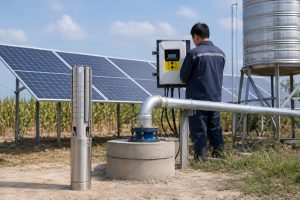
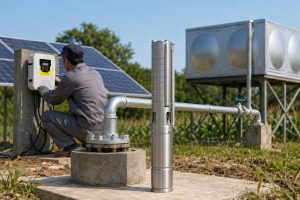
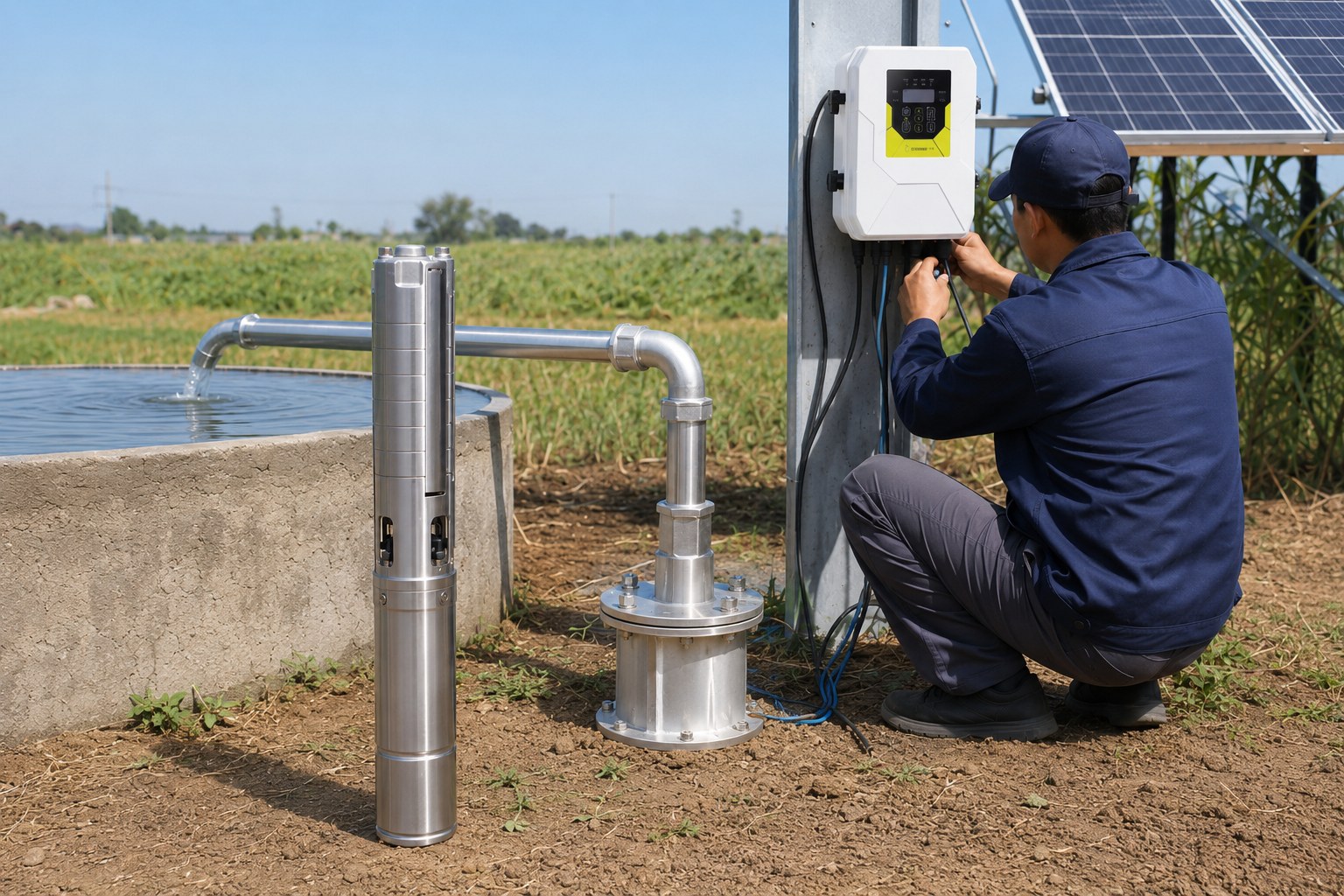
The runtime of a solar pump is governed by the sun's intensity and your daily water requirements. These systems are designed to operate most efficiently during peak daylight hours. The key to success is selecting a pump model—screw, plastic impeller, or stainless steel impeller—that precisely matches your well's depth and required flow rate.
The Power Behind Solar Pumps: BLDC Motors
At the heart of modern solar water pumps is a high-efficiency Brushless DC (BLDC) permanent magnet motor.
These motors are a significant technological leap forward.
They can achieve efficiencies exceeding 90%, compared to 60-70% for standard AC motors.
This high efficiency is crucial because it means more of the sun's energy captured by the panels is converted into water flow.
Technically, these motors use powerful neodymium iron boron magnets and a smart electronic controller instead of traditional carbon brushes.
This design results in a motor that is more powerful, has higher torque, and is significantly more compact—often 45% smaller and 40% lighter than conventional motors.
For an end-user, this means you need fewer solar panels to get the job done, which lowers the initial investment cost and simplifies installation.
Choosing the Right Solar Pump Type
There is no single "best" solar pump; there is only the best pump for your specific application. The choice primarily comes down to your required "head" (the vertical distance the water needs to be lifted) and "flow" (how many gallons or liters per minute you need).
| Pump Type | Best For | Flow Rate | Head (Lift) | Key Advantage |
|---|---|---|---|---|
| Solar Screw Pump | Deep Wells, Homes | Low | Very High | Excellent sand resistance |
| Plastic Impeller Pump | Farms, Irrigation | High | Medium | High flow, cost-effective |
| Stainless Steel Impeller | Corrosive Water | High | Medium-High | Superior durability |
Solar Screw Pumps: For Deep Wells and High Head
A solar screw pump works like an Archimedes' screw.
It uses a helical stainless steel rotor turning inside a rubber stator.
This action creates sealed cavities of water that are pushed progressively up to the surface.
This design is excellent at creating high pressure, making it ideal for very deep wells (up to 500 feet or more) or situations where water needs to be pushed a long distance uphill.
While their flow rate is lower, their ability to handle sandy or silty water without damage is a major advantage in many regions.
They are perfect for domestic water supply, livestock watering troughs, and small-scale drip irrigation.
Solar Plastic Impeller Pumps: For High Flow and General Use
This is a multi-stage centrifugal pump.
It uses a series of impellers made from durable, wear-resistant engineering plastics.
Each impeller stage adds pressure to the water, pushing it higher.
These pumps are designed to deliver a high volume of water at a medium head.
This makes them the go-to choice for farm irrigation, filling large tanks or reservoirs, and general pasture water supply.
They are lightweight and more economical, providing an excellent balance of performance and cost for a wide range of agricultural and residential applications.
Solar Stainless Steel Impeller Pumps: For Corrosive Conditions
This premium option uses impellers and a pump body made from SS304 or even higher-grade SS316 stainless steel.
They are specifically engineered for wells where the water is acidic, alkaline, or has high salinity.
These conditions would quickly corrode or degrade standard pumps.
While they have a higher initial cost, their extreme durability and resistance to corrosion ensure a very long service life and high reliability in harsh water environments.
They are essential for certain coastal regions, areas with alkaline soil, and high-end applications where water quality and system longevity are the top priorities.
The Brains of the Operation: Smart Controllers and Hybrid Systems
What happens to your water supply when clouds roll in or after the sun sets?
Relying solely on sunshine can be a point of anxiety for critical water needs.
Modern smart controllers and hybrid systems eliminate this worry by intelligently managing power sources to guarantee a 24/7 water supply.
An intelligent MPPT controller can boost a solar pump's efficiency by over 30% by constantly optimizing the load on the solar panels. For ultimate reliability, advanced AC/DC hybrid systems automatically switch to grid power or a generator when solar energy is insufficient, ensuring an uninterrupted flow of water.
What is an MPPT Controller?
MPPT stands for Maximum Power Point Tracking.
It is a sophisticated electronic technology integrated into the pump's controller.
A solar panel's power output (voltage and current) changes constantly with the level of sunlight.
An MPPT controller continuously monitors the panel's output and adjusts the electrical load of the pump motor to extract the absolute maximum amount of power available at any given moment.
It allows the pump to start earlier in the day, run more consistently through intermittent clouds, and stop later in the evening.
This technology dramatically increases the total volume of water pumped per day compared to a system without it.
The Advantage of AC/DC Hybrid Technology
For applications where a water supply is non-negotiable, like providing drinking water for a large herd of livestock or for a household, a hybrid system is the solution.
These advanced controllers are designed with two separate power inputs: one for DC power from the solar panels and another for AC power from the utility grid or a backup generator.
This creates a failsafe water system.
The controller's internal logic is programmed to prioritize solar power above all else.
It will use 100% free energy from the sun whenever it's available.
How a Hybrid System Works
The process is fully automatic and seamless.
- Full Sun: The controller directs DC power from the solar panels to the pump. The AC input is on standby.
- Low Sun/Cloudy: If solar power drops but is still present, the controller can enter a "hybrid" mode. It will use all available solar power and supplement it with just enough AC power to keep the pump running at the desired speed. This maximizes the use of free solar energy.
- No Sun/Night: When solar input drops to zero, the controller automatically and instantly switches over to the AC power source to continue running the pump.
This ensures your tanks stay full and your water is always flowing, day or night, rain or shine, without any manual intervention.
| Power Source Priority | Condition | System Response | User Benefit |
|---|---|---|---|
| 1. Solar (DC) | Sufficient Sunlight | Runs 100% on solar power | Maximum cost savings |
| 2. Hybrid (DC+AC) | Insufficient Sunlight | Blends solar and grid power | Maximizes use of free energy |
| 3. Grid/Generator (AC) | No Sunlight (Night) | Switches fully to AC power | Uninterrupted 24/7 water supply |
Applications Where Hybrid Systems are Essential
This technology is invaluable for more than just convenience.
In commercial agriculture and livestock operations, a lack of water for even a single day can have severe financial consequences.
For off-grid homes, it provides the security of a municipal water supply without the associated infrastructure.
It combines the economic and environmental benefits of solar with the ironclad reliability of the grid, offering the best of both worlds.
Conclusion
Optimizing your water pump's runtime is about efficiency, not just hours.
Whether it's for a pool, well, or solar application, matching the pump's operation to its specific task saves money and extends equipment life.
FAQs
How many hours a day should a well pump run?
A well pump's daily runtime isn't fixed. It depends on your water usage. The key is to have a large enough pressure tank to minimize start-stop cycles, which cause the most wear.
Is it OK to run a pool pump 24/7?
Yes, especially with a variable-speed pump. Running it 24/7 at a very low, energy-efficient speed can provide superior filtration and skimming for less cost than a single-speed pump running 8 hours.
Do variable speed pumps really save money?
Absolutely. A variable-speed pump can reduce your pool's electricity consumption by up to 90% compared to a single-speed pump by running longer at much lower, more efficient speeds.
How do I know if my well pump is cycling too much?
Listen to your pump. If you hear it kicking on and off frequently during a single task like a shower or running a sprinkler, your pressure tank is likely undersized, causing excessive cycling.
What is the best time of day to run a pool pump?
To save money, run your pump during off-peak electricity hours. This is typically overnight or during the middle of the day (e.g., 9 am - 5 pm). Check with your local utility for specific rates.
Can a solar pump work at night?
A standard solar pump only works with sunlight. However, an AC/DC hybrid system allows the pump to automatically switch to grid power or a generator at night, ensuring a 24/7 water supply.
How long does a solar water pump last?
A quality solar pump system can last for 15-25 years. The solar panels themselves are often warrantied for 25 years, while the pump may need maintenance or replacement after 10-15 years depending on water quality.