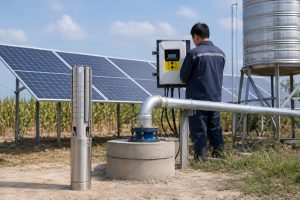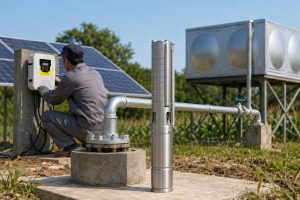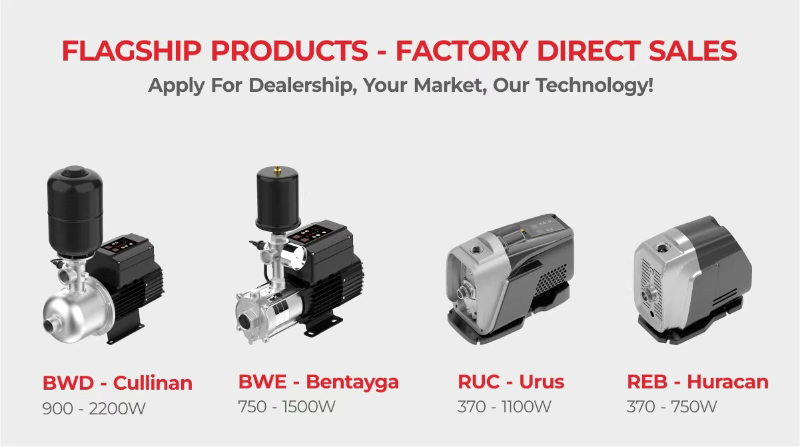
Struggling with high fuel costs or unreliable grid power for your water pump?
These expenses are unpredictable, and maintenance is a constant headache, especially in remote areas.
Solar water pumps offer a reliable, cost-effective, and independent solution.
Yes, solar water pumps are an excellent investment for many applications. Modern systems are highly efficient, providing reliable water access with zero fuel costs and minimal maintenance. They are ideal for agriculture, livestock, and off-grid living, paying for themselves over a few years.
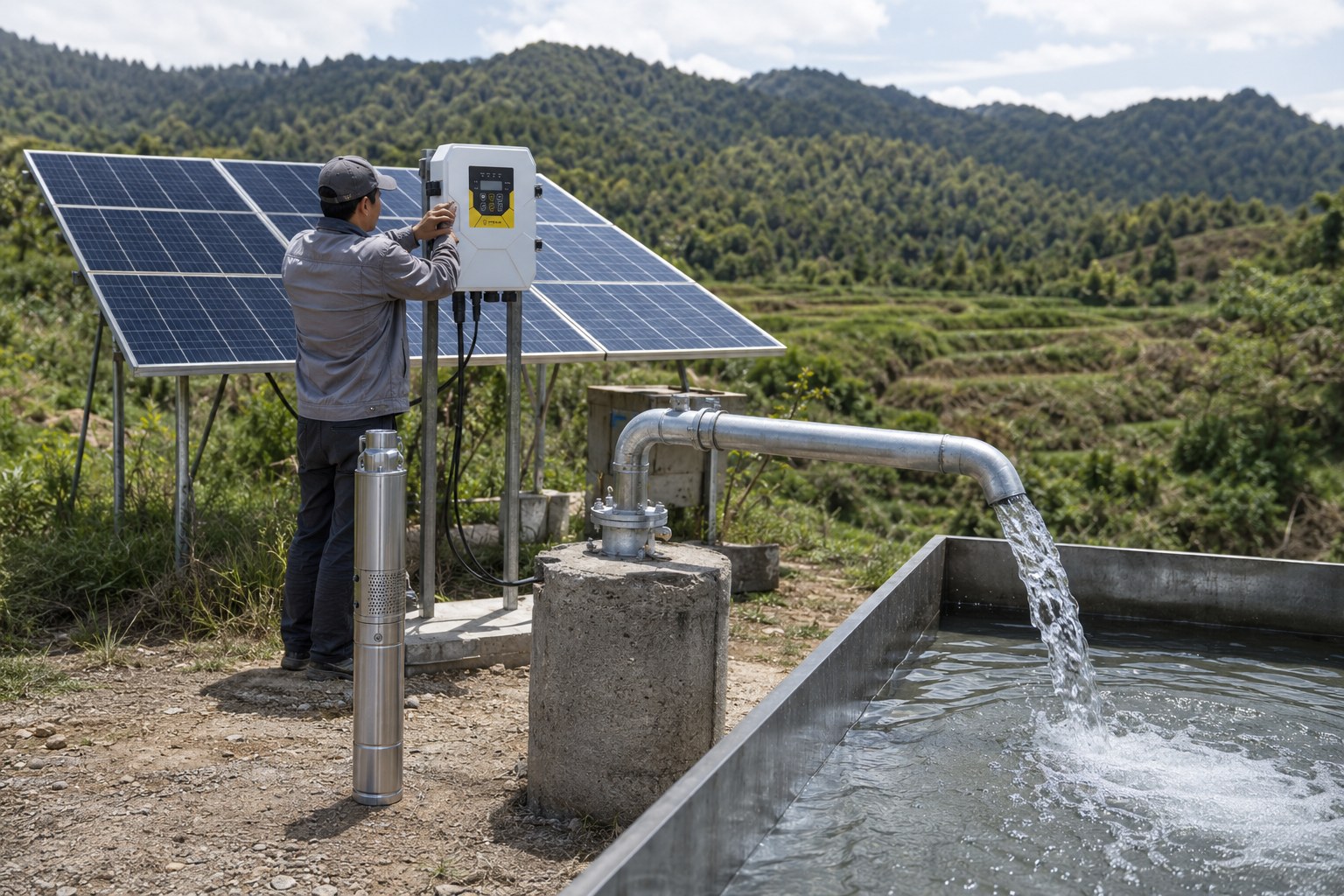
But are they the right choice for every situation, and how do you navigate the different options available?
The upfront cost can seem daunting, and performance on cloudy days is a common concern.
However, understanding the long-term benefits and the technology that powers these systems reveals a compelling case for making the switch.
Let's explore the real-world performance, costs, and types of solar pumps to help you decide if they are the right fit for your water needs.
What are the Pros and Cons of Solar Water Pumps?
Tired of hauling fuel to a remote generator or paying ever-increasing electricity bills just to get water?
This constant drain on your time and money feels like a battle you can't win.
Solar pumps eliminate these recurring costs and labor, offering true water independence powered by the sun.
The primary advantages are zero ongoing energy costs, low maintenance needs, and environmental friendliness. The main disadvantages can include a higher initial purchase price and reduced performance on heavily overcast days, though modern systems have effective solutions for this.
The Financial Case: Upfront Cost vs. Long-Term Savings
The most significant barrier for many is the initial investment.
A complete solar water pump system can indeed have a higher price tag than a conventional AC or diesel-powered pump.
However, this perspective often overlooks the total cost of ownership (TCO).
A traditional pump's sticker price is just the beginning.
You have to factor in the continuous cost of electricity or fuel, which is subject to inflation and market volatility.
For a diesel pump, fuel costs can easily amount to thousands of dollars per year.
Grid-tied pumps add a significant and permanent load to your electricity bill.
In contrast, once a solar pump system is installed, the fuel is free.
Your return on investment begins immediately.
Many users find that their system pays for itself within just 1 to 3 years, depending on usage and local energy costs.
After that payback period, the water you pump is virtually free for the lifespan of the system, which can be over 20 years for the solar panels.
Let's look at a simplified 5-year cost comparison for a pump running 6 hours a day.
| Cost Factor | Solar Pump System | Diesel Generator Pump |
|---|---|---|
| Initial Cost | $3,500 | $1,500 |
| Fuel Cost (Year 1) | $0 | $2,190 (@ $1/L, 1L/hr) |
| Maintenance (Year 1) | $50 (Panel Cleaning) | $300 (Oil, Filters) |
| 5-Year Fuel Cost | $0 | $10,950 |
| 5-Year Maintenance | $250 | $1,500 |
| Total 5-Year Cost | $3,750 | $13,950 |
As the table shows, the solar pump becomes the more economical choice after just the first year.
The savings of over $10,000 in five years are substantial.
The Maintenance Myth: Less Labor, More Reliability
Another powerful advantage is the drastic reduction in labor and maintenance.
Diesel and AC pumps have numerous moving parts, require regular servicing, and are prone to mechanical failure.
Think of the time spent hauling fuel, changing oil, replacing filters, or troubleshooting a complex motor.
Windmills, another traditional off-grid solution, require dangerous climbing and frequent mechanical repairs.
Solar pump systems are remarkably simple by comparison.
The core components—the solar panels and the brushless motor—have no moving parts that wear out.
The primary maintenance task is simply wiping dust and debris off the solar panels a few times a year to ensure they capture maximum sunlight.
This reliability is crucial in remote agricultural or livestock operations where a pump failure can have dire consequences.
With a solar pump, you eliminate the risk of running out of fuel when your livestock are thirsty or your crops are wilting.
Addressing the "No Sun, No Water" Concern
The most common objection is straightforward: what happens on cloudy days or at night?
This is a valid question, but modern solar pump technology has several effective answers.
-
High-Efficiency Performance: Modern systems don't need perfect, bright sunshine to operate. High-efficiency monocrystalline solar panels paired with advanced controllers can continue to pump water, albeit at a reduced flow rate, even on overcast or rainy days. Many systems can produce 40-60% of their peak output under moderate cloud cover.
-
Water Storage: The most common and cost-effective strategy is to pump water into a storage tank during peak sun hours. You can then use gravity or a small, on-demand pressure pump to distribute water whenever it's needed, day or night. This creates a water buffer that makes you independent of daily weather fluctuations.
-
Battery Backup: For applications requiring uninterrupted pumping, systems can be equipped with batteries. The solar panels charge the batteries during the day, and the batteries power the pump at night or during poor weather. While this adds to the initial cost and complexity, it provides true 24/7 operational capability.
-
AC/DC Hybrid Systems: The most flexible solution is a hybrid controller. These systems can be connected to both solar panels and an AC power source (grid or generator) simultaneously. The controller intelligently prioritizes solar power, only drawing from the AC source when solar energy is insufficient. This guarantees a constant water supply while maximizing the use of free solar energy.
How Do Solar Water Pumps Actually Work?
Is the technology behind solar pumps complex and difficult to manage?
Many assume it involves complicated wiring and electronics that are hard to maintain in the field.
In reality, a solar pump system is elegantly simple, consisting of just three core components working in harmony.
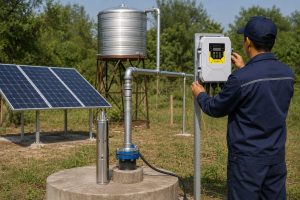
A solar pump system works by using photovoltaic (PV) panels to convert sunlight into DC electricity. An intelligent controller manages this power and feeds it to a specialized, highly efficient DC motor, which drives the pump to move water. The system is designed for maximum efficiency and durability.
A solar water pumping system is more than just a pump; it's an integrated ecosystem designed for a single purpose: moving water efficiently using only the sun.
Understanding each part reveals why these systems are so reliable and effective.
The Components of a Solar Pumping System
A standard system is comprised of three main parts.
-
Solar Panels: These are the system's power plant. They are made of photovoltaic (PV) cells that capture photons from sunlight and convert them directly into DC (Direct Current) electricity. The number and wattage of the panels determine the total power available to run the pump.
-
The Controller: This is the brain of the operation. It sits between the solar panels and the pump motor. Its job is to optimize the power from the panels and protect the motor. A key feature is Maximum Power Point Tracking (MPPT), which constantly adjusts the electrical load to ensure the panels are operating at their peak efficiency, squeezing up to 30% more power out of them throughout the day. The controller also provides vital protection against over-voltage, under-voltage, and overheating.
-
The Pump Unit: This is the part that does the physical work. It consists of the pump end (the part that moves water) and the motor. The vast majority of modern solar pumps use a Brushless DC (BLDC) permanent magnet motor, which is the secret to their incredible efficiency.
The Heart of the System: The BLDC Motor
The motor is arguably the most critical component for overall performance.
Traditional AC motors can be inefficient, losing a significant amount of energy as heat.
BLDC motors are a technological leap forward.
They use powerful permanent magnets on the rotor, eliminating the need for energy-wasting brushes and commutators found in older DC motors.
This design offers several game-changing advantages:
-
Extreme Efficiency: BLDC motors can achieve efficiencies of over 90%. This means more of the precious solar energy is converted into water-pumping power, and less is wasted. A higher efficiency motor requires fewer solar panels to do the same amount of work, directly reducing the system's cost and footprint.
-
High Reliability and Long Lifespan: With no brushes to wear out, BLDC motors are virtually maintenance-free and have a much longer operational life than their brushed counterparts.
-
Compact and Lightweight: These motors are significantly smaller and lighter for the same power output. A typical BLDC motor can be up to 47% smaller and 39% lighter than a traditional motor, making installation far easier, especially for deep well pumps.
-
High Torque: They provide excellent torque even at low speeds, allowing the pump to start reliably in the early morning or under cloudy conditions when power is limited.
The use of a high-efficiency BLDC motor is what makes modern solar pumping not just possible, but highly practical and economically superior.
What Are the Different Types of Solar Water Pumps?
You know you need a solar pump, but the variety of options—submersible, surface, screw, impeller—is confusing.
Choosing the wrong type could mean poor performance, premature failure, or spending more than necessary.
Understanding the main categories and their specific applications is key to selecting the perfect pump for your well and water needs.
Solar pumps are mainly categorized as submersible (for deep wells) or surface (for ponds and rivers). Within submersible pumps, common types include screw pumps for high head, plastic impeller pumps for high flow, and stainless steel impeller pumps for corrosive water.
Choosing the right pump is not about finding the "best" one, but about matching the pump's design to your specific water source, depth, and volume requirements.
Let's break down the major types to clarify which is suited for what task.
Surface vs. Submersible Pumps
The first and most basic distinction is where the pump is located.
-
Surface Solar Pumps: These pumps are positioned on land, near the water source. They work by pulling water up from a shallow source like a pond, stream, or cistern. They are generally less expensive and easier to access for maintenance. However, their suction lift is limited, typically to less than 7 meters (about 23 feet), making them unsuitable for deep wells. They are perfect for small-scale irrigation, livestock watering from a dam, or moving water between tanks.
-
Submersible Solar Pumps: As the name implies, these pumps are installed completely underwater in the well or borehole. They work by pushing water up to the surface, which is far more efficient than pulling it. This design allows them to pump water from incredible depths, often hundreds of meters. They are the go-to solution for deep wells, providing water for homes, farms, and entire communities.
Since most off-grid water needs involve wells, we will focus on the different types of submersible pumps.
Deep Dive: Types of Submersible Solar Pumps
Within the submersible category, the design of the pump end determines its performance characteristics.
Here are the three most popular types:
1. Solar Screw Pump (Progressing Cavity)
This pump uses a helical-shaped stainless steel rotor that spins inside a rubber stator.
This action creates sealed cavities that "progress" from the inlet to the outlet, pushing the water ahead of them.
- Performance: Low Flow, High Head. They are designed to push a smaller volume of water to very great heights.
- Best For: Deep wells where high pressure is needed to lift water to the surface. Ideal for domestic water supply, filling livestock troughs, and small-scale, low-volume irrigation.
- Advantages: Excellent sand and silt resistance. The gentle pumping action is also less likely to be damaged by abrasive particles. They are workhorses for challenging well conditions.
- Limitations: The flow rate is limited, making them unsuitable for applications requiring large volumes of water quickly, like flood irrigation.
2. Solar Plastic Impeller Pump (Centrifugal)
This is a multi-stage centrifugal pump.
It uses a series of stacked impellers made from durable, engineered plastics.
As each impeller spins, it flings water outward, and a diffuser channels it up to the next stage, increasing pressure with each step.
- Performance: High Flow, Medium Head. They are designed to move large volumes of water efficiently at moderate depths.
- Best For: Farm irrigation, pasture water supply, and filling large reservoirs or ponds.
- Advantages: Delivers significantly more water than a screw pump at a comparable power level. They are lightweight and generally more economical. Modern plastic composites offer excellent wear resistance against fine sand.
- Limitations: Not ideal for extremely deep wells where very high head is required. May have a shorter lifespan in highly abrasive or corrosive water compared to stainless steel.
3. Solar Stainless Steel Impeller Pump (Centrifugal)
This pump operates on the same centrifugal principle as the plastic impeller model, but its key components—the impellers, diffusers, and pump body—are all constructed from SS304 or SS316 stainless steel.
- Performance: High Flow, Medium-to-High Head. Offers robust performance and durability.
- Best For: Corrosive water environments, such as areas with acidic or alkaline water. Also used in high-end residential or commercial applications where longevity and maximum reliability are paramount.
- Advantages: Superior corrosion and abrasion resistance. Offers the longest service life, especially in harsh water conditions.
- Limitations: Higher upfront cost and greater weight compared to plastic impeller models. This is a premium option for specific and demanding situations.
| Pump Type | Best For | Flow Rate | Head (Lift) | Sand Resistance | Cost |
|---|---|---|---|---|---|
| Screw Pump | Deep Wells, Homes | Low | Very High | Excellent | Medium |
| Plastic Impeller | Irrigation, Farms | High | Medium | Good | Low |
| SS Impeller | Corrosive Water | High | Medium-High | Very Good | High |
How to Choose the Right Solar Water Pump for Your Needs?
Faced with terms like "flow rate," "total dynamic head," and "panel wattage," selecting the right system feels overwhelming.
Making a mistake can lead to a system that underperforms or fails to meet your daily water requirements.
A systematic approach, starting with your water needs, ensures you build a perfectly sized and cost-effective system.
To choose the right solar pump, first determine your daily water volume (flow rate) and the total vertical lift plus friction loss (total dynamic head). Then, select a pump type that matches these needs and pair it with a properly sized solar array and controller.
Sizing a solar water pump system correctly is the most critical step to ensure satisfaction.
It's a process of matching the equipment to the demands of the site.
Rushing this step is the most common cause of a poorly performing system.
Here is a step-by-step guide to making the right choice.
Step 1: Determine Your Water Needs (Flow Rate)
First, calculate how much water you need on a daily basis.
This is typically measured in gallons per day (GPD) or liters per day (LPD).
Be specific and generous in your estimates.
- Household Use: Estimate 75-100 gallons per person per day.
- Livestock: A cow might drink 15 gallons per day, while sheep might only need 2. Multiply by the number of animals.
- Irrigation: This varies widely. Drip irrigation for a garden might need 0.5 gallons per square foot per day, while a larger field will have much higher requirements.
Once you have your total daily volume, you need to determine the required flow rate.
Divide your total daily volume by the number of peak sun hours in your area (typically 4-6 hours).
For example, if you need 1,200 gallons per day and have 5 peak sun hours:
1,200 gallons / 5 hours = 240 gallons per hour (GPH), or 4 gallons per minute (GPM).
You need a pump that can deliver at least 4 GPM.
Step 2: Calculate Your Total Dynamic Head (TDH)
"Head" is the total pressure the pump must overcome to deliver water.
It's the most critical factor in pump selection and is measured in feet or meters.
TDH is calculated by adding two components:
-
Vertical Lift (Static Head): This is the vertical distance from the water level in your well to the highest point where the water will be delivered (e.g., the inlet of your storage tank). If your well water level is 100 feet down and your tank is on a stand 20 feet high, your static head is 120 feet.
-
Friction Loss: As water moves through pipes, it encounters friction, which creates back pressure. This loss depends on the pipe's diameter, length, and the flow rate. A longer, narrower pipe will have much higher friction loss. Online calculators can help you estimate this, but for a 100-foot run of 1.25" pipe at 5 GPM, you might add about 5-10 feet of head for friction.
Total Dynamic Head (TDH) = Vertical Lift + Friction Loss
You must choose a pump that is rated to perform at your calculated TDH.
Step 3: Select the Pump and Power System
With your required flow rate and TDH, you can now consult pump performance charts.
These charts show how much water a specific pump model will deliver at various head levels.
- Find a pump that provides your target flow rate (e.g., 4 GPM) at your calculated TDH (e.g., 125 feet).
- Based on the well conditions and application, decide between a screw pump, plastic impeller, or stainless steel impeller model as discussed in the previous section.
- The pump's specifications will tell you the required power (wattage) and voltage (e.g., 48V).
- Finally, size your solar array to meet or exceed the pump's power requirement. It's wise to oversize the solar array by about 25-30% to ensure good performance even on less-than-perfect days. For a 500W pump, an array of 650-750W would be ideal.
Following these steps ensures you invest in a system that is built for your reality, providing reliable water for years to come.
Conclusion
Solar water pumps are a powerful, reliable, and economically smart solution for modern water needs.
They offer true independence from fossil fuels and the grid, delivering long-term value.
FAQs
How long do solar water pumps last?
A quality solar pump system can last for decades. The solar panels are often warrantied for 20-25 years, while the brushless pump motor typically has a lifespan of 3-5 years or more with minimal maintenance.
Do solar pumps work on cloudy days?
Yes, they do. Modern high-efficiency panels and controllers allow pumps to operate even in overcast conditions, though at a reduced flow rate. Storing water in a tank is the best strategy to ensure a consistent supply.
Can a solar pump run without a battery?
Absolutely. The vast majority of solar water pump systems are direct-drive and do not use batteries. They pump when the sun is shining, and the water is typically stored in a tank for later use.
How many solar panels does it take to run a water pump?
This depends entirely on the pump's power requirement and the well's depth. A small pump for a shallow well might only need two 100-watt panels, while a large irrigation pump for a deep well could require 10 or more 300-watt panels.
Are solar water pumps strong enough for waterfalls or irrigation?
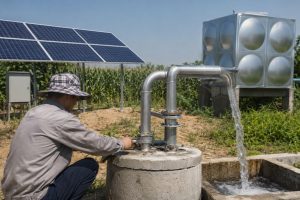
Yes. For small waterfalls or garden features, there are many suitable models. For large-scale farm irrigation, high-flow centrifugal pumps (like plastic or stainless steel impeller types) are specifically designed for the job and can move thousands of gallons per hour.
Is it possible to power a pond pump with solar power?
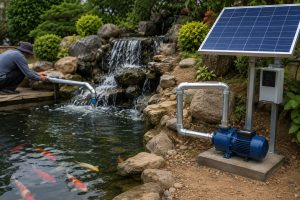
Yes, solar pond pumps are very popular. They provide essential water circulation and aeration to keep a pond healthy, all without the need for dangerous electrical wiring near the water.
What is the maintenance for a solar water pump?
Maintenance is incredibly low. The main task is to periodically clean the solar panels to remove dust or debris. The pump itself, especially with a brushless motor, requires very little attention.
Can I use a solar pump for my house?
Yes, a properly sized submersible solar pump is an excellent way to supply water to an off-grid home. The system pumps water to a large storage tank, and a separate, smaller pressure pump then delivers water to your taps on demand.