Need to drain your pool but your pump is broken or you don't have one?
It seems like a huge task.
Luckily, you can easily drain it using simple physics and household items.
The easiest way to drain a pool without its dedicated pump is by creating a siphon with a garden hose or a wider pool vacuum hose. For pools with a built-in drain outlet, you can simply open it. Manual methods like a wet-dry vac or buckets work for the last few inches.
These pump-free methods are effective for many situations, especially for above-ground pools or for lowering the water level.
However, they come with trade-offs in speed, effort, and efficiency.
For large pools or situations where time is critical, these manual methods might not be enough.
Let's explore the pump-free options in detail first.
Then, we'll cover more powerful and modern solutions for when you need the job done fast and efficiently.
This guide will help you choose the right method for your specific pool and needs.
Use the Garden Hose Siphon Method
Draining a pool seems tough without a pump.
It feels like it will be slow and messy.
A simple garden hose can turn this into an easy, hands-off job using gravity.
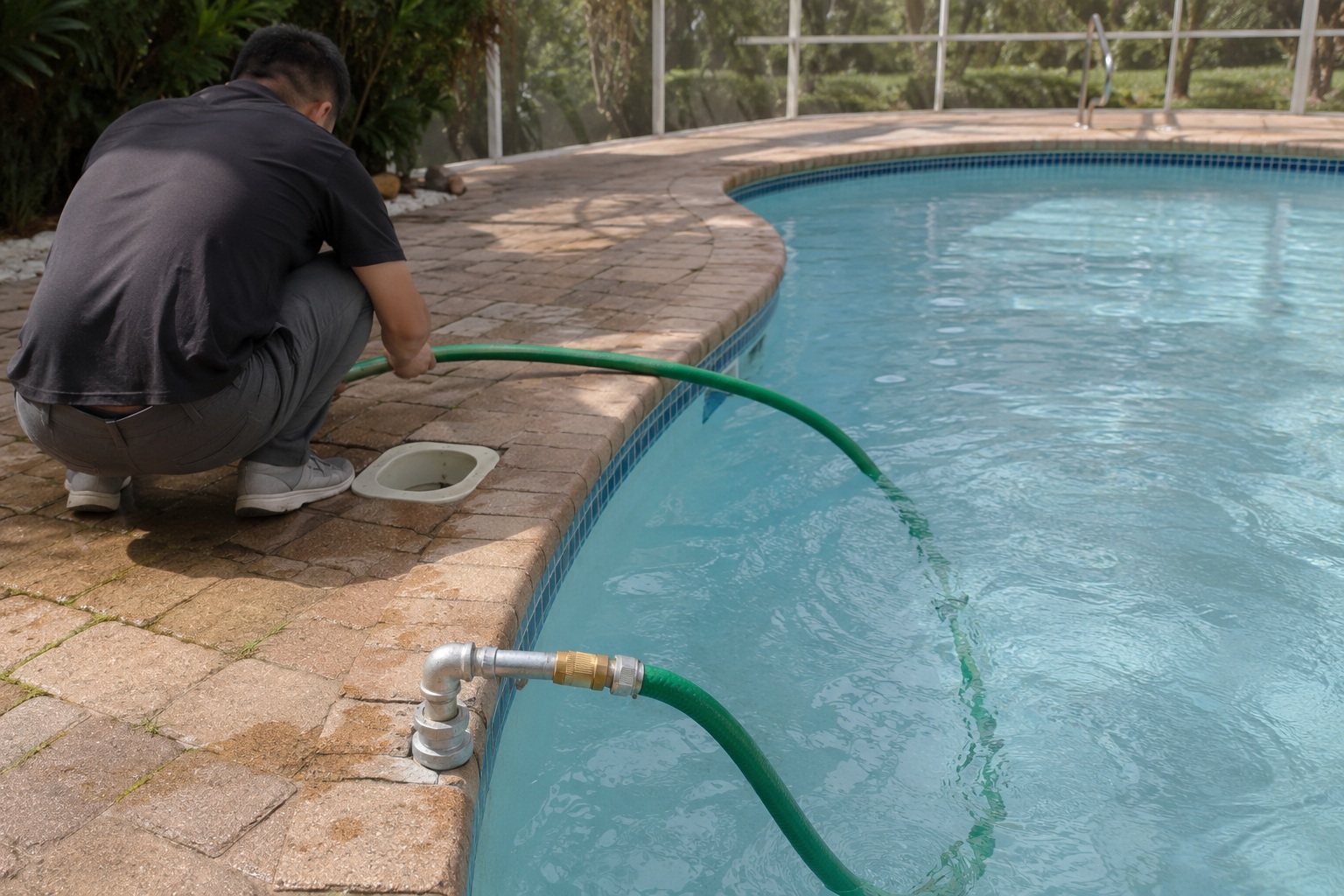
Use gravity to your advantage by creating a siphon. Submerge a garden hose completely in the pool, seal one end with your thumb, and place it at a lower elevation than the pool water. Unseal it to start draining. This method is slow but requires no electricity.
This technique is one of the most popular pump-free methods because of its simplicity.
It relies on a basic principle of physics and requires nothing more than a standard garden hose.
However, the effectiveness of this method depends heavily on a few key factors.
Understanding them will help you drain your pool more efficiently and avoid common frustrations.
How a Siphon Works
A siphon moves liquid from a higher reservoir to a lower one.
Once the hose is filled with water and free of air, the weight of the water in the lower part of the hose pulls the rest of the water over the edge of the pool.
This continuous flow is driven by the difference in pressure created by the height difference between the water level in the pool and the end of the hose.
The greater the vertical drop, the faster the water will flow.
Step-by-Step Siphon Guide
- Submerge the Hose: Place the entire garden hose into the pool. You will see air bubbles escaping from the hose. Wait until the bubbles stop, which indicates the hose is completely full of water.
- Seal the End: Without lifting it out of the water, place your thumb or palm securely over one end of the hose to create a seal. This prevents water from escaping and air from entering.
- Position the Hose: Carefully walk the sealed end of the hose to your desired drainage area. This spot must be at a lower elevation than the bottom of your pool.
- Release and Drain: Uncover the end of the hose. The water should begin to flow immediately.
Optimizing Siphon Flow Rate
The speed of your siphon depends on the hose diameter and the elevation drop (head).
A wider hose or a greater drop will significantly increase the flow rate.
| Hose Diameter | Typical Flow Rate (GPH) | Time to Drain 5,000 Gallons |
|---|---|---|
| 1/2 inch | ~180 GPH | ~28 hours |
| 5/8 inch | ~250 GPH | ~20 hours |
| 3/4 inch | ~360 GPH | ~14 hours |
Note: Flow rates are estimates and vary based on the height difference.
This method's primary limitation is its speed.
While it's a great "set it and forget it" option for small to medium above-ground pools, it can be impractical for draining a large in-ground pool, which could take several days.
Try Draining with a Pool Vacuum Hose Siphon
A garden hose is just too slow for your large pool.
You need it drained faster but still don't have a pump.
Using a wider pool vacuum hose can drastically speed up the draining process.
A pool vacuum hose works on the same siphon principle as a garden hose but drains water much faster due to its larger diameter, which is typically 1.5 inches. This method is ideal for draining large volumes of water more quickly without a powered pump.
If you have a pool, you likely already have a vacuum hose on hand, making this a convenient upgrade from the garden hose method.
The significant increase in diameter has a dramatic effect on the volume of water you can move per hour.
This makes it a far more practical solution for owners of larger above-ground or even in-ground pools who need to lower their water level substantially.
Why Is a Vacuum Hose Siphon Faster?
The flow rate of water through a hose is exponentially related to its diameter.
A standard garden hose might be 5/8 inches wide, but a typical pool vacuum hose is 1.5 inches wide.
This seemingly small difference in size results in a massive increase in cross-sectional area.
As a result, a 1.5-inch vacuum hose can siphon water at a rate of over 1,000 gallons per hour (GPH).
This is more than 300% faster than a standard garden hose under the same conditions.
This increased speed can reduce a multi-day draining job to less than a single day.
Setup and Challenges
The setup process is identical to the garden hose method, but on a larger scale.
- Submerge the Hose: This can be trickier with a long, buoyant vacuum hose. It may help to have another person hold one end down while you feed the rest of the hose into the pool.
- Clear the Air: Ensure all air bubbles have escaped. Due to the corrugated design, you may need to shake or rotate the hose underwater to release trapped air pockets.
- Seal and Move: Sealing the 1.5-inch opening can be more difficult. You may need to use a flat object or a specialized plug if your hand isn't large enough.
- Start the Flow: Position the end at a low point and release it.
A primary challenge is keeping the large, lightweight hose from floating and breaking the siphon.
You may need to place a weight on the end of the hose inside the pool to keep it submerged as the water level drops.
Comparison: Garden Hose vs. Vacuum Hose Siphon
| Feature | Garden Hose Siphon | Pool Vacuum Hose Siphon |
|---|---|---|
| Typical Diameter | 5/8 inch | 1.5 inch |
| Estimated Flow Rate | ~250 GPH | ~1,000+ GPH |
| Best For | Small pools, lowering water levels | Medium to large pools, faster draining |
| Effort | Low | Medium (harder to submerge) |
| Cost | Minimal (if you own a hose) | Minimal (if you own a vacuum) |
Find the Pool Drain Outlet if Available
Siphoning seems complicated and you're worried about getting it right.
You just want a simple plug-and-drain solution.
Many above-ground pools offer this exact feature for hassle-free draining.
Some above-ground and portable pools have a built-in drain outlet or plug near the bottom. You can simply open the plug and, if possible, attach a hose to direct the water away. This is one of the most straightforward methods, though it's not a universal feature.
This is by far the least labor-intensive method if your pool is equipped with it.
It's designed specifically for emptying the pool, eliminating the need to set up siphons or use other equipment.
However, this feature is almost exclusively found on soft-sided or metal-frame above-ground pools.
In-ground pools typically do not have a simple drain plug; their main drains are part of a complex circulation system and are not meant for simple draining.
Identifying and Using Your Drain Outlet
The drain outlet is usually a capped fixture located on the exterior wall of the pool, near the base.
It might have a threaded connection that allows you to attach a standard garden hose.
To use it:
- Locate the Cap: Find the drain cap on the outside of your pool. There may also be an interior plug you need to remove first.
- Attach a Hose: If the outlet is threaded, securely attach a garden hose to guide the water to a safe drainage area. This prevents flooding your yard or property.
- Open the Valve: Carefully unscrew the outer cap to begin the draining process. The water will flow out due to the pressure from the water inside the pool.
Best Practices and Limitations
Before you drain, consider where the water will go.
Pool water contains chemicals like chlorine or salt that can harm lawns, gardens, and local waterways.
Check your local municipal rules about draining pool water.
You may be required to let the chlorine level drop to zero or drain it into your sanitary sewer cleanout, not the storm drain.
The main limitation of a drain outlet is that it will stop working once the water level drops below the opening.
This will always leave a few inches of water at the bottom of the pool, which must be removed by other means.
When Are Manual Methods like Buckets or a Wet-Dry Vac Useful?
The main draining is done, but a few stubborn inches of water remain.
Siphons and drain outlets stop working at this shallow level.
You need a way to get the pool completely dry for cleaning or storage.
For the last few inches of water that siphons can't reach, manual methods are best. Use a wet-dry vacuum to suck up water from corners or a simple bucket for the final cleanup. These are labor-intensive but perfect for finishing the job or for very small kiddie pools.
Once the water level is too low for gravity to do the work, you have to switch to more hands-on techniques.
These methods are not practical for draining an entire pool but are essential for getting it completely empty.
Choosing between a wet-dry vac and a bucket depends on the amount of water left and the tools you have available.
Using a Wet-Dry Vacuum Safely
A wet-dry shop vacuum is an excellent tool for this final stage.
It can suck water out of the lowest points and corners efficiently.
Safety First: Electricity and water are a dangerous combination. Keep the vacuum's motor unit, power cord, and any extension cords far away from the water. Plug into a GFCI-protected outlet.
How to Use It:
- Remove the dry filter from your vacuum to prevent damage.
- Place the hose in the remaining water and turn the vacuum on.
- The tank will fill quickly. A typical 5-gallon wet-dry vac will need to be emptied 20 times just to remove 100 gallons of water.
- Turn off the vacuum when the tank is full, empty it in a safe location, and repeat until the pool is dry.
The Bucket Method and Other Tricks
Using buckets is the simplest, most low-tech option.
It's free but requires the most physical effort.
This method is only practical for very small kiddie pools or for scooping out the last few gallons of water.
To make manual removal easier, use a pool brush or a push broom to guide all the remaining water into one low spot in the pool liner.
Consolidating the water makes it much faster to remove with either a wet-dry vac or buckets.
When Should You Consider an External Pump for Draining?
Pump-free methods are slow, and you need the pool drained now.
Your time is valuable, and manual labor is exhausting.
Renting or buying an external pump offers a powerful, fast solution.
When speed is critical, or you're draining a large in-ground pool, an external pump like a submersible or trash pump is the best option. These pumps can drain thousands of gallons per hour, saving significant time and effort compared to any siphoning method.
While the title of this article is about pump-free methods, it's important to know when those methods are no longer practical.
For a 20,000-gallon in-ground pool, siphoning is simply not a realistic option.
An external pump can turn a week-long ordeal into a matter of hours.
These pumps are widely available for rent from local hardware or tool rental stores.
Submersible Pumps vs. Trash Pumps
- Submersible Pump: This is the most common choice. As the name suggests, you place the entire pump unit at the deepest point of your pool. It pushes water out through a connected discharge hose. They are quiet, efficient, and can drain water down to a very low level. A typical 1/2 HP model can pump over 2,000 GPH.
- Trash Pump: This is a heavy-duty, gas-powered pump that sits outside the pool. It uses a suction hose to pull water in and a discharge hose to expel it. It's much faster and more powerful than a submersible pump and can handle small debris like leaves, which is why it's called a "trash" pump. These are best for large commercial pools or very dirty water.
The Rise of Efficient Pumping Solutions
Renting a pump is a great temporary fix.
But what if you had a permanent, modern, and energy-efficient solution for all your water management needs, including pool maintenance?
The technology behind water pumps has advanced significantly.
Modern pumps are not only more powerful but also far more energy-efficient.
A high-efficiency pump can reduce operational costs by over 50% compared to older, conventional models.
This evolution leads us to the most sustainable solution available today: solar-powered water pumps.
The Modern Solution: Solar Powered Water Pumps for Pools and More
You need a reliable pump but are off-grid or want to slash your energy costs.
Traditional electric pumps are expensive to run.
Solar pumps offer a cost-effective, green alternative that pays for itself over time.
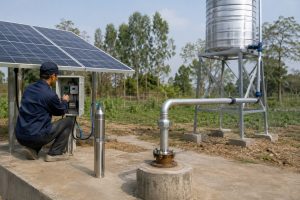
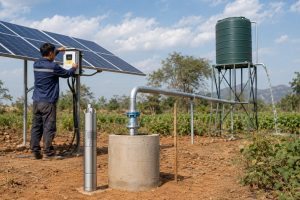
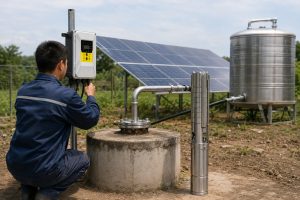
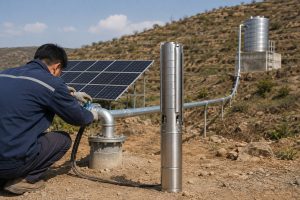
Solar water pumps use energy from the sun to move water, making them perfect for off-grid pool draining, irrigation, and livestock watering. They are environmentally friendly, have virtually zero operating costs, and operate independently of the electrical grid, providing a truly sustainable solution.
With the growing global demand for clean energy, solar water pumps have become essential equipment in regions like Africa, the Americas, and Australia.
They provide water security where the grid is unreliable or nonexistent.
The core of this technology is a highly efficient motor that makes the entire system viable.
The Core Technology: BLDC Permanent Magnet Motors
The engine driving modern solar pumps is the Brushless DC (BLDC) permanent magnet motor.
These motors achieve efficiencies exceeding 90%, compared to 40-50% for traditional AC motors.
This incredible efficiency means they require significantly fewer solar panels to do the same amount of work, which dramatically reduces the initial investment cost for the end-user.
Compared to older designs, these motors are also much more compact and durable, with some models being up to 47% smaller and 39% lighter.
A Portfolio for Diverse Water Needs
The beauty of a modern solar pump system is that it's not a one-size-fits-all solution.
The pump itself can be tailored to the specific job, whether it's draining a pool, irrigating a field, or drawing water from a deep well.
| Solar Pump Type | Best For | Flow / Head Characteristics | Key Advantage for Distributors |
|---|---|---|---|
| Solar Screw Pump | Deep wells, domestic water supply | Low Flow / High Head | Meets high-head, low-volume demand |
| Solar Plastic Impeller | Farm irrigation, high-volume use | High Flow / Medium Head | Cost-effective, high-demand product |
| Solar SS Impeller | Corrosive water, high-end homes | High Flow / Medium-High Head | Premium, durable, niche market solution |
Choosing the Right Solar Pump for Your Market
As a distributor, your customers have vastly different needs.
One pump model simply won't fit all applications.
Offering a diverse yet strategic portfolio is the key to capturing the market.
For distributors, a flexible product portfolio is crucial. Solar screw pumps serve deep well needs in Africa. Plastic impeller pumps are ideal for American farms. Stainless steel models target high-end or corrosive environments in Australia, ensuring you can meet any customer demand.
Understanding the specific strengths of each pump type allows you to guide your clients to the perfect solution, building trust and establishing your business as an expert in the field.
This tailored approach is far more effective than a generic sales pitch.
For Low Flow, High Head Demands: The Solar Screw Pump
In many parts of Africa and Latin America, water must be drawn from very deep wells.
Here, a pump needs to generate immense pressure (high head) to lift water to the surface, even if the volume (flow) is low.
The solar screw pump excels in this environment.
It uses a stainless steel screw rotating inside a rubber stator to push water upwards.
This design is highly resistant to sand and sediment, a common issue in well water, ensuring long-term durability.
It's the ideal solution for domestic water supply and livestock drinking troughs.
For High Flow, General Use: The Solar Plastic Impeller Pump
For applications like farm irrigation or filling large tanks, high flow is more important than high head.
The solar plastic impeller pump is the workhorse for these scenarios.
It uses a multi-stage centrifugal design with durable, wear-resistant plastic impellers to move large volumes of water efficiently.
Its lightweight and economical construction makes it a top seller in agricultural regions across the Americas and Africa.
It offers an excellent balance of performance and cost, making it an attractive option for a wide customer base.
For Premium & Harsh Environments: The Solar Stainless Steel Impeller Pump
Some water sources are corrosive, with high levels of acidity or alkalinity.
This is common in parts of Australia and certain industrial regions.
In these conditions, a standard pump would quickly fail.
The solar stainless steel impeller pump is built for this challenge.
Constructed with SS304 stainless steel impellers and housing, it offers superior corrosion resistance and a much longer service life.
It targets a premium, niche market of high-end homes, ranches, and specific industrial sites where reliability and durability are paramount.
Maximizing Performance with Intelligent Control and Hybrid Power
Your customers worry about cloudy days and nighttime water needs.
A solar-only pump seems limiting and unreliable.
Advanced hybrid systems provide a 24/7 solution, removing all doubt and ensuring constant water access.
Modern solar pumps use smart MPPT controllers that boost solar energy utilization by up to 30%. For continuous operation, AC/DC hybrid controllers automatically switch to grid or generator power when sunlight is insufficient, ensuring a reliable, worry-free water supply around the clock.
The pump and motor are only part of the system.
The "brain" of the operation is the controller.
It's what makes the system not just functional, but intelligent, efficient, and incredibly reliable.
For a distributor, offering advanced controller options is a major competitive advantage.
What is an MPPT Controller?
MPPT stands for Maximum Power Point Tracking.
This technology constantly analyzes the output from the solar panels and adjusts the electrical load of the pump to extract the absolute maximum amount of power available at any given moment.
It allows the pump to start earlier in the day, run later in the evening, and perform better during overcast conditions.
An MPPT controller can increase the total water pumped per day by as much as 30% compared to a basic controller.
The Power of AC/DC Hybrid Systems
The ultimate solution for water security is the AC/DC hybrid controller.
This brilliant piece of engineering solves the primary concern of solar power: what happens when there's no sun?
A hybrid system allows you to connect both solar panels (DC power) and the electrical grid or a generator (AC power) to the controller at the same time.
The controller's logic is programmed to prioritize solar power.
When solar energy is sufficient, it runs the pump entirely off the sun.
If clouds roll in and solar power drops, the controller automatically supplements the remaining solar energy with just enough AC power to keep the pump running at the desired speed.
When the sun goes down, it seamlessly switches over to 100% AC power, guaranteeing 24/hour operation without any manual intervention.
This provides the best of both worlds: the free energy of solar and the unwavering reliability of the grid.
Conclusion
Draining a pool without a pump is possible with siphoning or drain plugs.
However, for superior speed, efficiency, and reliability, modern solar pumps with hybrid controllers offer a complete and sustainable solution.
FAQs
What is the fastest way to drain a pool without a pump?
The fastest non-pump method is siphoning with a wide-diameter pool vacuum hose (1.5 inches). It can move over 1,000 gallons per hour, which is much faster than a garden hose.
How long does it take to drain a pool with a garden hose?
It depends on the pool size and hose diameter. A 5,000-gallon pool can take 14-28 hours to drain with a standard garden hose siphon, as flow rates are only around 200-350 GPH.
Can you drain a pool by siphoning uphill?
No, a siphon cannot move water to a location that is higher than the water's source. The exit point of the hose must always be at a lower elevation than the pool's water level.
Is it bad to completely drain an in-ground pool?
Yes, it can be very risky. An empty in-ground pool can be lifted out of the ground or its walls can collapse due to pressure from groundwater. Always consult a professional first.
How do you get the last bit of water out of a pool?
Use a wet-dry vacuum, buckets, or a small submersible utility pump. You can also use a pool brush to push all the remaining water into one low spot for easier removal.
Do I need to turn off the power before draining a pool?
Yes, absolutely. Before the water level drops below the skimmer, turn off all power to the pool equipment at the circuit breaker to prevent the pump from running dry and burning out.
Where is it safe to drain pool water?
Check local regulations. Many areas require you to drain it into your home's sanitary sewer cleanout, not the storm drain. Avoid draining chlorinated water onto your lawn or into natural waterways.