Are you tired of high electricity bills just to keep your pool clean?
The constant hum of the pump is the sound of money draining from your account.
A solar-powered pool pump can eliminate these costs entirely.
Yes, solar-powered pool pumps are a mature and highly effective technology.
They operate by using photovoltaic (PV) panels to capture sunlight, which is converted into DC electricity.
This power runs a specialized, high-efficiency pump motor, circulating your pool water without relying on the utility grid, saving you money and reducing your carbon footprint.
Switching to a solar pump seems like a simple decision.
But the real question isn't just if they exist, but how to choose a system that performs reliably and delivers a true return on investment.
Many off-the-shelf solutions fail to meet expectations, leaving pool owners with underperforming systems and buyer's remorse.
Understanding the core components—the motor, the controller, and the pump itself—is crucial to navigating the market and finding a solution that offers both efficiency and durability.
This guide will break down how these systems work, how to size one for your needs, and what defines a high-quality solar pump that will serve you well for years to come.
How Does a Solar Pool Pump Work?
Frustrated by pumps that are noisy and inefficient?
Traditional AC pumps consume significant power and have shorter lifespans due to their mechanical design.
A solar pump with a modern motor solves these issues.
A solar pool pump works by converting sunlight into electricity via solar panels to power a DC motor.
This motor drives an impeller or screw mechanism that circulates water through your pool’s filtration system.
An intelligent controller, known as an MPPT (Maximum Power Point Tracking), optimizes the power from the panels to ensure the pump runs efficiently even in changing light conditions.
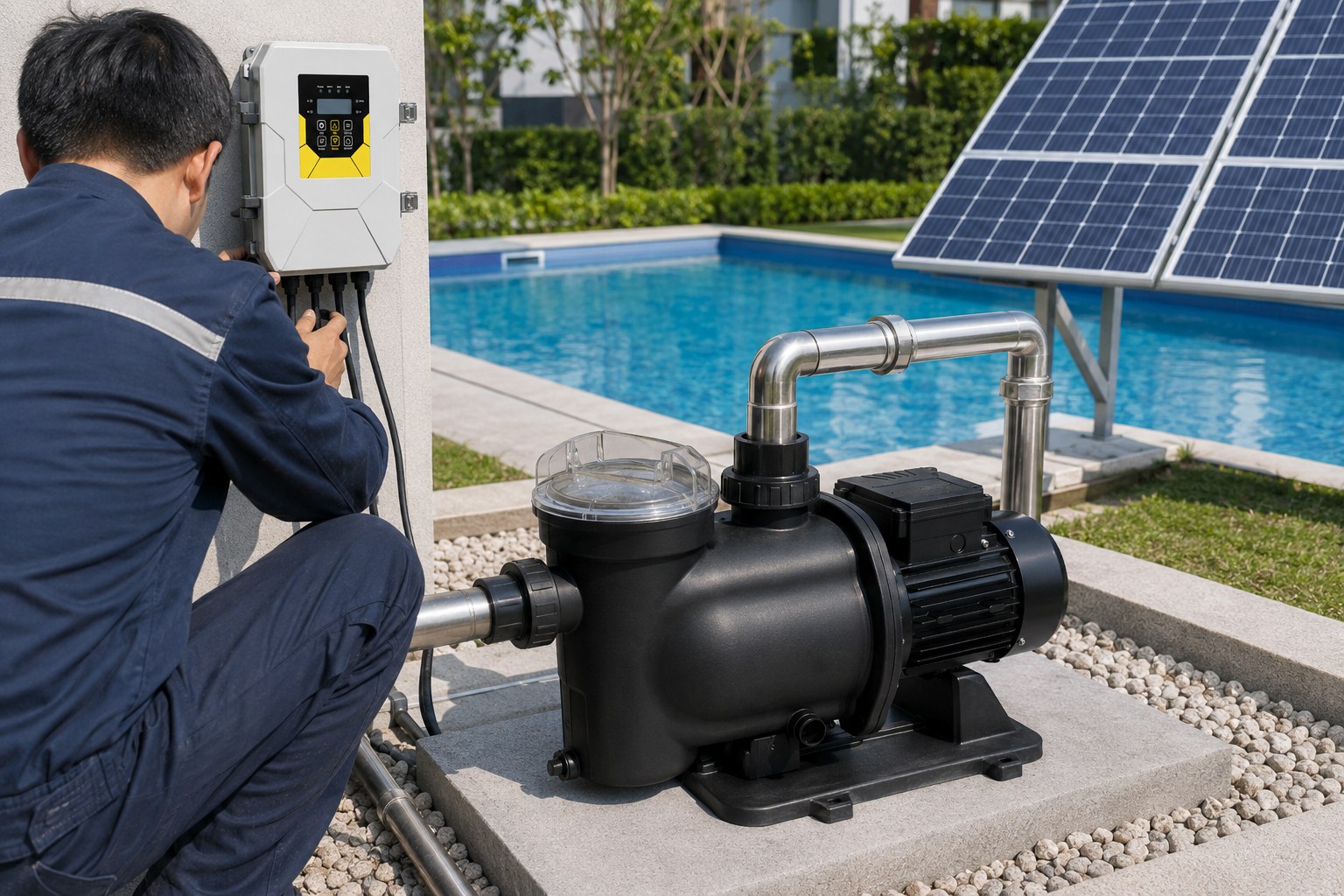
A solar pool pump system consists of three main parts: solar panels, a controller, and the pump unit.
The magic isn't just in using solar power; it's in the efficiency of the components, especially the motor.
The core of a modern, high-performance solar pump is the Brushless DC (BLDC) permanent magnet motor.
The Power of the BLDC Motor
Unlike traditional AC pumps or older DC pumps with brushed motors, a BLDC motor has no brushes to wear out.
This design dramatically increases its lifespan and efficiency.
A typical brushed motor may last only 2,000 to 5,000 hours.
In stark contrast, a BLDC motor is engineered for a lifespan of 20,000 to 30,000 hours, offering 6 to 10 times the operational life.
This leap in durability means fewer replacements and a much more reliable system.
Efficiency is where BLDC motors truly excel.
Many achieve an electrical-to-mechanical conversion efficiency of over 90%.
This is a significant improvement over the 60-75% efficiency of many standard AC motors.
| Feature | Brushed DC Motor | Brushless DC (BLDC) Motor |
|---|---|---|
| Average Lifespan | 2,000 - 5,000 hours | 20,000 - 30,000 hours |
| Typical Efficiency | 75% - 80% | > 90% |
| Maintenance | Requires brush replacement | Virtually maintenance-free |
| Noise Level | Higher due to friction | Lower, quieter operation |
The Role of the MPPT Controller
The MPPT controller is the brain of the system.
Its job is to continuously adjust the electrical load to extract the maximum possible power from the solar panels as sunlight conditions change throughout the day.
A system without an MPPT controller can lose 20-30% of its potential power.
By maximizing the energy harvest, the MPPT controller ensures the pump starts earlier in the day, runs longer, and maintains better performance during intermittent cloud cover.
This intelligent power management reduces the total number of solar panels needed, lowering the initial investment cost.
How Many Solar Panels to Run a Pool Pump?
Worried about the complexity and cost of a solar setup?
Miscalculating the number of panels can lead to an underpowered system or unnecessary expense.
Sizing your system correctly is a straightforward process.
To determine the number of solar panels, you first calculate your pump's daily energy use (wattage × hours of operation).
Then, divide this by your location's "peak sun hours" to find the required solar system size in kilowatts (kW).
Finally, divide the system size by the wattage of a single panel to find how many panels you need.
Let's walk through a detailed, step-by-step calculation to demystify the process.
This example will use a common 2-horsepower (HP) pool pump.
Following these steps ensures you create a system that is both effective and economical.
Step 1: Calculate Your Pool Pump's Energy Consumption
The first step is to figure out how much energy your pump uses daily.
Pump power is often listed in horsepower, which we need to convert to watts.
One horsepower is equal to 745.7 watts.
So, a 2 HP pump uses:
Wattage = 2 HP × 745.7 watts/HP = 1,491.4 watts
Next, determine how many hours you run your pump each day.
A typical run time is 6 to 8 hours.
For this example, we'll use 6.5 hours.
Daily Energy Consumption = 1,491.4 watts × 6.5 hours = 9,694.1 watt-hours (Wh)
This is approximately 9.7 kilowatt-hours (kWh) per day.
Step 2: Determine Your Location's Peak Sun Hours
"Peak sun hours" do not refer to the total hours of daylight.
Instead, it's a standardized value representing the number of hours per day when solar intensity averages 1,000 watts per square meter.
This value varies significantly by location.
Here is a table showing average peak sun hours for various U.S. states.
| State | Peak Sun Hours | State | Peak Sun Hours |
|---|---|---|---|
| Arizona | 5.25 - 5.75+ | Florida | 4.75 - 5.5 |
| California | 4.0 - 5.75+ | Texas | 4.5 - 5.75+ |
| New York | 4.0 - 4.25 | Ohio | < 4.0 - 4.25 |
| Illinois | 4.0 - 4.5 | Washington | < 4.0 - 4.5 |
For our example, let's assume a location like Los Angeles, California, with approximately 6 peak sun hours.
Step 3: Size the Solar System
Now, divide your daily energy consumption by the peak sun hours to determine the necessary size of your solar array in kilowatts (kW).
Size of Solar System = 9.7 kWh / 6 peak sun hours = 1.62 kW
You need a solar system capable of producing 1.62 kW of power.
Step 4: Account for Efficiency Losses
Real-world conditions are not perfect.
Factors like panel temperature, dust, wire resistance, and controller inefficiency reduce a system's output.
It's standard practice to add a buffer of around 14% to compensate for these losses.
Adjusted System Size = 1.62 kW × 1.14 = 1.85 kW
Your system should be sized to at least 1.85 kW, or 1,850 watts.
Step 5: Calculate the Number of Panels
Finally, divide the adjusted system size by the wattage of the individual solar panels you plan to use.
Panels typically range from 250 to 400 watts.
Let's use 300-watt panels for this example.
Number of Panels = 1,850 watts / 300 watts/panel = 6.17 panels
Since you cannot install a fraction of a panel, you must round up.
You would need 7 panels of 300 watts each to reliably power your 2 HP pool pump.
However, a pump with a high-efficiency BLDC motor could reduce this number.
If a BLDC pump performs the same work using 25% less energy (around 7.3 kWh/day), the adjusted system size would be 1.38 kW, requiring only 5 panels.
What’s the Payback?
Is the upfront investment in a solar pump actually worth it?
The initial cost is higher than a conventional pump, causing many to hesitate.
But focusing only on the purchase price ignores long-term savings.
The payback period for a solar pool pump system is surprisingly short, often between 3 to 5 years.
This is calculated by dividing the total initial investment (pump, panels, and installation) by the annual electricity savings.
After the payback period, the system generates free energy, leading to significant long-term financial benefits.
To understand the true financial picture, we need to compare the cost of installing and running a solar system versus continuing to operate a standard AC pump.
The return on investment (ROI) is compelling, especially when considering rising electricity costs.
Let's break down the numbers to see how quickly a solar pump pays for itself.
ROI Calculation: A Real-World Example
We will analyze the payback for replacing a standard 1 HP AC pump with a .67 HP high-efficiency DC solar pump system.
This example is based on a real-world case study, with costs adjusted for a typical scenario.
1. Calculate the Initial Investment:
This includes all the necessary components for a complete, functional system.
- Two 400-watt PV panels: 2 x $220 = $440
- 500-watt DC Pool Pump with controller: $341
- Mounting hardware and cabling: $100
- Total Initial Investment: $881
2. Calculate the Annual Energy Savings:
First, we determine the annual cost of the old AC pump.
A 1 HP pump uses 746 watts (0.746 kW).
Assuming it runs 7 hours a day for a full year:
Daily Energy Consumption = 0.746 kW × 7 hours = 5.222 kWh
The average electricity cost in the U.S. is around $0.17 per kWh, but this varies.
Using a conservative rate of $0.13/kWh:
Daily Cost = 5.222 kWh × $0.13/kWh = $0.679
Annual Cost = $0.679 × 365 days = $247.84
The new DC solar pump runs entirely on solar power, so its direct electricity cost is $0.
Therefore, the annual savings are $247.84.
3. Determine the Payback Period:
Payback Period = Total Initial Investment / Annual Savings
Payback Period = $881 / $247.84 = 3.55 years
In just over three and a half years, the system pays for itself.
Given that the BLDC motor in the pump is rated for over 20,000 hours (over 8 years of operation at 7 hours/day), you would enjoy more than 4 years of pure profit before the pump's expected end of life.
The solar panels themselves have a performance warranty of 25 years, so the savings continue for decades.
| Cost/Saving Component | Value | Notes |
|---|---|---|
| Total System Cost | $881 | Includes pump, panels, and hardware. |
| Annual Electricity Savings | $248 | Based on a 1HP AC pump at $0.13/kWh. |
| Payback Period | 3.55 Years | System becomes profitable after this point. |
| 10-Year Total Savings | ~$1,597 | After subtracting the initial investment. |
This analysis clearly demonstrates that a solar pool pump is not an expense but a high-return investment.
An Opportunity for Solar Pool Pumps to Shine
Have you heard negative reviews about solar pumps failing quickly?
Many imported, low-cost models suffer from technical glitches and lack support.
This creates a risky market for buyers.
The current market is filled with inconsistent products, but this presents an opportunity for high-quality manufacturers to stand out.
By addressing common failures—like motor burnout from frequent on/off cycling—with advanced controllers and durable materials, reliable solar pumps can deliver on their promise of long-term, cost-effective performance.
The widespread adoption of solar pool pumps is being held back by a few key issues that plague the lower end of the market.
Many direct-import pumps fail within months, not because the core technology is flawed, but because of poor design and control logic.
A common failure point is the controller's inability to handle variable sunlight.
On a partly cloudy day, a basic controller might cause the pump to cycle on and off rapidly—running for a few seconds, shutting down, and repeating.
This frequent cycling puts immense stress on the DC motor, leading to premature burnout.
This is where a premium, well-engineered system proves its worth.
The Hallmarks of a Superior Solar Pump System
A professional-grade solar pump system moves beyond the basic, failure-prone designs.
It integrates superior components and intelligent controls to create a reliable and durable solution.
Here's what distinguishes a high-quality system:
1. An Intelligent, Protective Controller:
A sophisticated controller does more than just turn the motor.
It includes software that prevents rapid cycling by creating a buffer, ensuring the pump only runs when there is stable, sufficient power.
Advanced systems also offer hybrid functionality.
An AC/DC hybrid controller can be connected to both solar panels and the grid (or a generator) simultaneously.
It prioritizes solar power, but if sunlight is insufficient—on a cloudy day or at night—it automatically supplements or switches to AC power.
This guarantees 24/7 water circulation without manual intervention.
2. A Portfolio of Purpose-Built Pumps:
A one-size-fits-all approach doesn't work for water pumps.
Water conditions and performance needs vary dramatically.
A top-tier manufacturer will offer a portfolio of pump types tailored to different applications.
| Pump Type | Key Feature | Best Application | Water Conditions |
|---|---|---|---|
| Progressing Cavity (Screw) | High Head, Low Flow | Deep wells, domestic water supply | Handles sandy water well |
| Plastic Impeller Centrifugal | High Flow, Wear-Resistant | Farm irrigation, high-volume needs | Good for fine sand |
| Stainless Steel Impeller Centrifugal | Corrosion-Resistant, Durable | High-end homes, ranches | Ideal for acidic or alkaline water |
This portfolio approach allows distributors and installers to select the perfect pump for a customer's specific needs, whether it's for a deep well in an arid region or a large pool with corrosive water chemistry.
3. Unwavering Focus on Motor Efficiency:
As discussed, the BLDC permanent magnet motor is the heart of the system.
A focus on quality means using rotors made from high-grade materials like neodymium iron boron, achieving efficiencies over 90%.
This isn't just a number—it means the pump requires up to 47% less physical space and 39% less weight than a comparable motor, simplifying installation and reducing the number of solar panels needed, directly saving on upfront costs.
Conclusion
Solar-powered pool pumps are a powerful, existing solution for reducing energy costs and environmental impact.
True value lies in choosing a system with a high-efficiency motor, intelligent controls, and durable construction.
FAQs
Can a solar panel run a pool pump directly?
Yes, a DC solar pump can run directly from panels via an MPPT controller. This device optimizes the variable DC voltage from the panels to run the motor efficiently.
How long do solar pool pumps last?
The lifespan depends on the motor. A high-quality brushless DC (BLDC) motor can last 20,000-30,000 hours, while cheaper brushed motors may only last 2,000-5,000 hours.
Are solar pool pumps worth it?
Absolutely. With a typical payback period of 3-5 years and significant long-term savings on electricity bills, they are a financially sound investment for most pool owners.
What size solar system do I need for a 1.5 HP pool pump?
A 1.5 HP pump (approx. 1119W) running 8 hours needs about 9 kWh. Depending on your location's sun hours, you would likely need 5 to 7 300-watt panels.
Do solar pool pumps work on cloudy days?
They will run at a reduced speed on cloudy days. Advanced systems with hybrid AC/DC controllers can automatically switch to grid power to ensure continuous operation.
Can you add solar panels to an existing pool pump?
Generally, no. Standard AC pool pumps require AC power and cannot be run by DC solar panels directly. You need a dedicated DC solar pump or a special solar inverter.
How much does a solar powered pool pump cost?
A complete system, including the pump and panels, can range from $800 to over $2,000, depending on the pump size, quality, and number of panels required.
Do solar pool pumps increase home value?
Yes, energy-efficient upgrades like solar pool pumps are attractive to potential buyers, as they demonstrate lower operating costs and a commitment to sustainability, potentially increasing home value.