Struggling with unpredictable water pump installation quotes?
The wrong pump choice can inflate labor costs, turning a simple project into a major expense.
Labor to install a water pump costs between $300 and $1,500+, but this depends heavily on the pump type. Choosing a modern solar pump can cut installation time and costs by over 40% due to its lightweight design and simpler setup requirements.
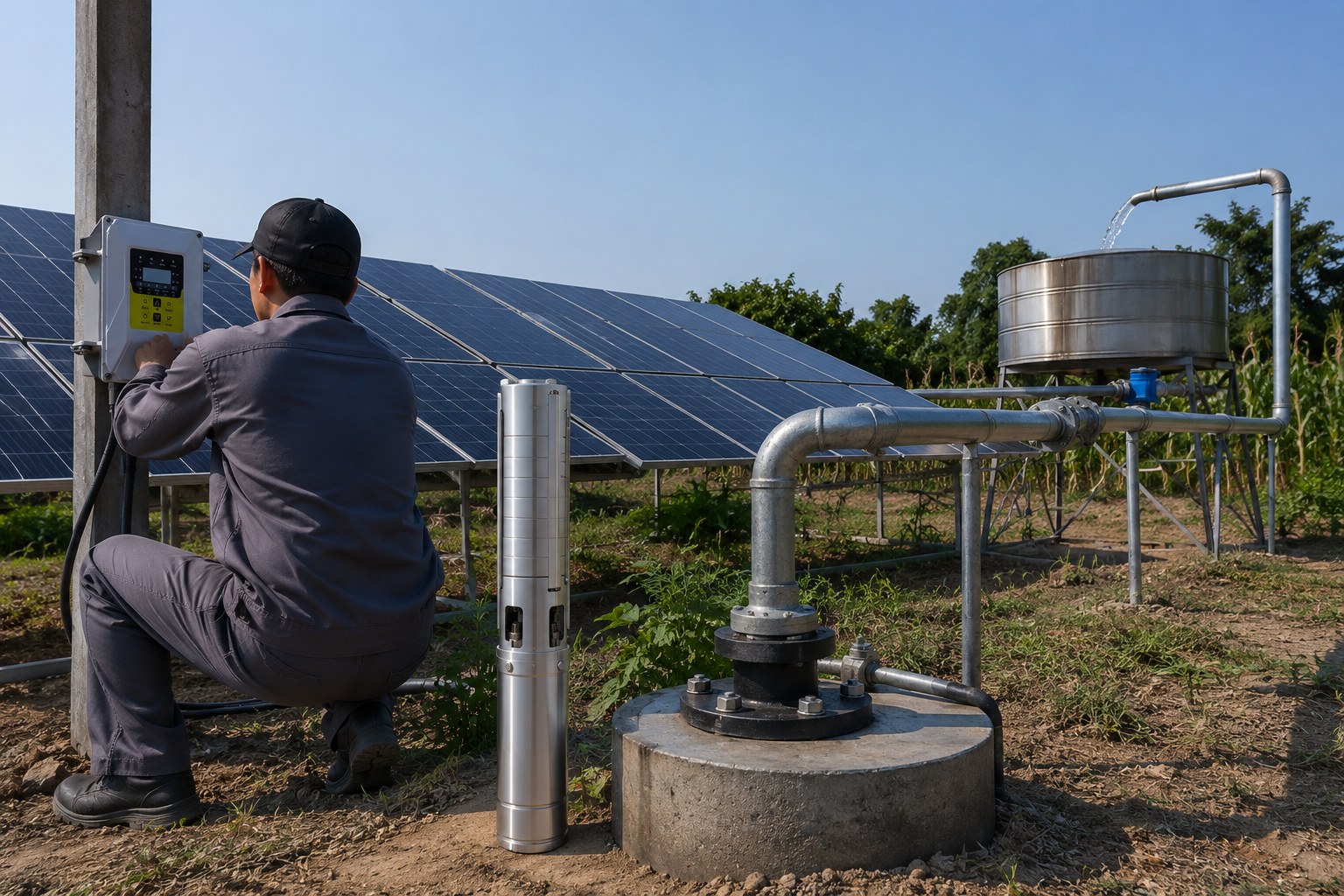
These numbers are just a starting point.
The real driver of your final bill isn't the hourly rate, but the pump itself.
The pump's design, technology, and application dictate the complexity and duration of the job.
Let's explore how specific pump types directly impact your labor expenses.
How Does a Solar Screw Pump Impact Labor Costs?
Need to pump from a very deep well but worried about massive installation costs?
Traditional heavy pumps for deep wells often require specialized equipment and more labor hours.
Solar screw pumps can reduce labor costs for deep well installations. Their design excels at high-head applications without the bulk of older models, simplifying handling and potentially eliminating the need for heavy lifting equipment, saving time and money on-site.
A solar screw pump represents a significant shift in deep-well technology, directly influencing the labor required for installation.
Its unique design, which uses a stainless steel screw rotating within a rubber stator, is inherently efficient at creating high pressure (head) with low flow.
This is critical for deep wells where water must be pushed hundreds of feet to the surface.
Historically, achieving this required large, multi-stage centrifugal pumps that were incredibly heavy and cumbersome.
The installation of such pumps often demanded a multi-person crew and sometimes a tripod or small crane to lower the unit into the well casing, dramatically increasing labor hours and costs.
The modern solar screw pump, by contrast, is comparatively slender and lighter, making it a much more manageable task.
Why a Screw Pump's Design Reduces Labor
The primary labor-saving feature is its power-to-weight ratio.
You get high-head performance in a package that is easier for a single installer to handle.
This reduces the physical strain and the need for a larger crew.
Furthermore, its high resistance to sand is a hidden labor-saver.
In wells with sandy water, installers often have to set up complex pre-filtering systems or select a pump that is oversized to compensate for future wear.
A screw pump's ability to handle abrasive particles means a simpler, faster installation without these extra steps.
Labor Factors for Deep Well Installations
| Labor Factor | Traditional Multi-Stage Pump | Solar Screw Pump | Labor Cost Impact |
|---|---|---|---|
| Average Weight | 50 - 100+ lbs | 25 - 45 lbs | Reduced crew size, no heavy lift gear |
| Crew Size Needed | 2-3 people | 1-2 people | Up to 50% reduction in manpower cost |
| Lifting Equipment | Often required (tripod, hoist) | Rarely required | Eliminates rental and setup time/cost |
| Handling Sand | Requires filters, frequent service | Highly resistant | Fewer components to install, faster setup |
| Est. Install Time | 4-8 hours | 2-4 hours | Direct reduction in billable hours |
Ultimately, choosing a solar screw pump for a deep well or a domestic water supply in an area with poor water quality directly translates to a more efficient installation process.
The installer spends less time wrestling with heavy equipment and more time getting the system operational, which means a lower final bill for you.
Can a Solar Plastic Impeller Pump Reduce Installation Expenses?
Facing high quotes for a farm irrigation system?
Bulky, heavy pumps require more hands and more time, driving up the installation price for high-flow applications.
Absolutely. A solar plastic impeller pump is significantly lighter than metal alternatives, making it a one-person job in many cases. This directly cuts down on labor hours and makes it an economical choice for high-flow needs like farm irrigation.
When the primary goal is moving a large volume of water for applications like farm irrigation or pasture water supply, a multi-stage centrifugal pump is the go-to solution.
Traditionally, these pumps featured impellers made from cast iron or stainless steel.
While durable, these materials make the pump heavy and difficult to manage.
The introduction of solar pumps with durable, wear-resistant plastic impellers has been a game-changer for installation efficiency and cost.
The most immediate impact on labor is the dramatic reduction in weight.
A pump that one person can comfortably carry and lower into a well or cistern is fundamentally cheaper to install than one requiring two people and specialized rigging.
This simple fact can cut the on-site labor cost by 50% or more.
The True Value of a Lightweight Design
Installers bill by the hour.
Every minute spent setting up hoisting equipment, coordinating a two-person lift, or simply struggling with a heavy object is a minute you pay for.
A lightweight plastic impeller pump eliminates much of this "non-productive" time.
The installation becomes a more streamlined process: connect the pipe, attach the wiring, and lower the pump.
This simplicity is especially valuable for large projects like farms or ranches where multiple pumps might be needed across the property.
The cumulative labor savings can become substantial.
Installation Profile: Plastic vs. Metal Impellers
This table clearly illustrates how a material choice in the pump's design directly affects the time and cost of labor.
| Installation Factor | Solar Plastic Impeller Pump | Traditional Metal Impeller Pump | Cost Implication |
|---|---|---|---|
| Average Weight | 15 - 30 lbs | 40 - 80+ lbs | A single installer can easily manage the plastic model. |
| Required Crew Size | 1 person | 2 people | Halves the on-site manpower cost. |
| Average Install Time | 1.5 - 3 hours | 3 - 6 hours | Significantly fewer billable hours. |
| Handling & Positioning | Easy; minimal physical strain | Difficult; requires care and effort | Faster setup, less risk of damage or injury. |
While a plastic impeller pump may not be suitable for extremely deep wells or highly corrosive water, its advantages for standard irrigation and water supply are undeniable.
For a vast number of applications in regions like Africa and the Americas, it offers the perfect balance of high water output and low installation expense, making it an economically intelligent choice.
Is a Stainless Steel Impeller Pump's Premium Price Justified by Labor Savings?
Worried that special water conditions mean a complicated and expensive pump installation?
Corrosive water can destroy a standard pump, leading to frequent, costly replacements and labor.
Yes, in corrosive environments, the higher initial cost is offset by long-term savings. Its durability means fewer replacements, so you pay for installation labor once, not multiple times. The robust design also ensures reliability, preventing costly emergency call-outs.
At first glance, a solar pump with SS304 stainless steel impellers and a stainless steel body seems like a high-cost option.
The materials themselves are more expensive than plastic or cast iron.
However, viewing the installation cost in isolation is a mistake.
The true labor cost associated with a pump is not just the initial setup; it's the total labor cost over the pump's entire service life.
This is where the stainless steel model proves its worth.
In environments with acidic or alkaline water, such as in parts of Australia or areas with specific soil chemistries, a standard pump can fail in as little as 2-3 years.
Each failure requires a complete replacement: pulling the old pump, installing a new one, and paying for that labor all over again.
A stainless steel pump, designed specifically to resist this corrosion, can last 10 years or more in the same conditions.
The "Total Cost of Ownership" Perspective
Think of labor as a recurring expense.
With a cheap, non-resistant pump, you are essentially pre-paying for future labor costs every 2-3 years.
With a stainless steel pump, you pay a higher initial price for the unit, but you are buying a decade or more of service with a single installation fee.
The math is compelling.
If the labor to replace a pump is $500, a standard pump that fails three times in a decade will accrue $1,500 in repeat labor costs, in addition to the cost of three pumps.
The stainless steel pump incurs that $500 labor charge only once.
10-Year Labor Cost Outlook: Stainless Steel vs. Standard
| Cost Factor | Standard Plastic Impeller Pump | Solar Stainless Steel Pump | Financial Outcome |
|---|---|---|---|
| Average Lifespan (Corrosive Water) | 3 Years | 10+ Years | Stainless model lasts 3x+ longer. |
| Initial Labor Cost | ~$500 | ~$500 | Costs are identical for the first installation. |
| Replacements in 10 Years | ~3 times | 0 times | Avoids the entire cycle of repeated work. |
| Total Replacement Labor Cost | ~$1,500 (3 x $500) | $0 | $1,500 in pure labor savings over the decade. |
| Total Labor Cost Over 10 Years | $2,000 | $500 | A 75% reduction in total labor expenditure. |
The decision to use a stainless steel impeller pump is an investment in reliability and a strategic move to minimize future expenses.
For high-end homes, ranches, or any application where water quality is a concern and long-term, hassle-free operation is a priority, the higher initial cost is easily justified by the massive long-term labor savings.
The Core of Cost Savings: Why the BLDC Motor Slashes Labor Time
Think all pump motors are the same?
The motor's size, weight, and power requirements can secretly be the biggest drivers of your installation labor bill.
The BLDC permanent magnet motor is the key to lower labor costs. Being up to 47% smaller and 39% lighter than traditional motors, it makes the entire pump unit easier to handle, position, and install, significantly reducing on-site labor time.
The motor is the heart of any solar water pump, but its impact extends far beyond just driving the impellers or screw.
The choice of motor technology directly affects nearly every aspect of the installation, and this is where the Brushless DC (BLDC) permanent magnet motor creates enormous labor savings.
All three pump types previously discussed—screw, plastic impeller, and stainless steel impeller—achieve their peak performance and installation efficiency when paired with a BLDC motor.
Here’s how this core technology reduces the installer's time on-site and, consequently, your final bill.
A Revolution in Physical Design
The most tangible benefit is the motor's incredible power density.
Using powerful neodymium iron boron magnets, BLDC motors deliver more power in a smaller, lighter package.
- Up to 47% Smaller: A more compact pump is easier to guide down a narrow well casing, reducing the risk of it getting snagged, which is a common and time-consuming installation problem.
- Up to 39% Lighter: As discussed, weight is a primary driver of labor cost. Shaving off nearly 40% of the unit's weight makes the pump a one-person job, drastically cutting manpower requirements.
Reduced Infrastructure, Reduced Labor
The second major labor-saving advantage comes from the motor's efficiency, which often exceeds 90%.
A more efficient motor requires less power to do the same amount of work.
For a solar pump, this means fewer solar panels are needed.
- Fewer Panels to Install: Installing a solar array is a significant part of the job. If a high-efficiency BLDC pump system needs only 4 panels instead of the 6 an older system might require, the installer saves hours. That’s less time spent on the roof or ground mount, less wiring, and fewer connections to make and test. This alone can save hundreds of dollars in labor.
- Maintenance-Free Operation: BLDC motors have no brushes that wear out and need replacement. This eliminates a future maintenance task that would require another service call and more labor costs down the line.
Motor Technology's Direct Impact on Installation Labor
| Installation Factor | Traditional AC/DC Brushed Motor | High-Efficiency BLDC Motor | Labor Cost Reduction |
|---|---|---|---|
| Motor Size & Weight | Larger and heavier | Up to 47% smaller, 39% lighter | Easier handling, faster positioning, smaller crew. |
| Solar Panel Requirement | Higher (due to lower efficiency) | Lower (due to >90% efficiency) | 25-33% less time spent on panel installation. |
| Wiring & Connections | More complex, higher amperage | Simpler, lower amperage | Faster, safer wiring and commissioning. |
| Future Maintenance Labor | Brush replacement required | None required | Eliminates future labor costs for motor service. |
The BLDC motor isn't just a feature; it's an enabling technology that redefines the entire installation process.
It makes the pump lighter, the solar array smaller, and the system simpler, all of which directly contribute to a faster, less expensive installation.
The Complete System: How AC/DC Hybrid Pumps Affect Installation Complexity
Worried that a solar pump means no water on cloudy days?
Adding a backup system often sounds complicated and expensive to install.
AC/DC hybrid systems streamline installation by integrating two power inputs into one smart controller. Instead of wiring two separate systems, the installer works with a single, auto-switching unit, reducing complexity, potential errors, and overall labor time.
The ultimate goal of any water system is 24/7 reliability.
For off-grid or rural properties, the fear of having no water on overcast days or at night is a major concern.
The traditional solution involved installing two separate systems: a primary solar pump and a secondary AC-powered pump for backup, often with a manual transfer switch.
This was an installer's nightmare—double the pumps, double the wiring, complex switching—and double the labor cost.
Modern AC/DC hybrid controllers completely change this dynamic by integrating all the logic into one smart, compact box.
This innovation dramatically simplifies the installation of a truly resilient water system.
Simplified Wiring, Simplified Labor
The core labor-saving feature of a hybrid controller is its unified input design.
The installer connects the solar panels to one set of terminals and the AC grid (or a generator) to another.
The controller handles the rest.
- No Manual Transfer Switch: Installing a separate transfer switch is a time-consuming electrical task that requires careful wiring to prevent back-feeding and ensure safety. A hybrid controller has this functionality built-in, eliminating an entire component from the installation process.
- Automatic Identification: The controller automatically senses when photovoltaic (PV) power is available and prioritizes it. When sunlight fades, it can automatically blend in AC power or switch over completely. The installer doesn't need to program complex logic; they just need to connect the wires. This plug-and-play nature saves significant commissioning time.
One Pump, Two Power Sources
The hybrid approach also eliminates the need to install a second backup pump in the well.
The same high-efficiency pump runs on either DC solar power or AC grid power.
This cuts the physical installation labor in half.
The installer only has to lower one pump, connect one set of pipes, and manage one down-well power cable.
Backup System Installation: Old vs. New Method
| Installation Factor | Old Method (Separate Systems) | New Method (AC/DC Hybrid) | Labor Savings |
|---|---|---|---|
| Pumps to Install | 2 (1 DC, 1 AC) | 1 (The same pump) | 50% reduction in physical pump installation. |
| Switching Method | Manual Transfer Switch | Integrated Automatic Controller | Eliminates an entire component and its wiring time. |
| Wiring Complexity | High (two separate circuits, switch logic) | Low (connect PV and AC to one box) | Reduces risk of errors and cuts electrical labor time. |
| Est. Total Install Time | 6 - 10 hours | 3 - 5 hours | Up to 50% faster installation for a fully redundant system. |
By choosing an AC/DC hybrid system, you are not just getting 24-hour water security; you are choosing a more elegant, integrated, and ultimately less expensive system to install.
The technology simplifies the entire process for the installer, which translates directly into a lower final labor cost for a more capable and reliable water solution.
Conclusion
The final installation bill depends less on the hourly rate and more on the pump you choose.
Efficient, lightweight designs and smart technology are key to reducing labor time and overall project costs.
FAQs
-
How long does it take to replace a well pump?
Replacing a well pump typically takes 2 to 6 hours, depending on the pump's depth, type, and the complexity of the plumbing and electrical system. -
Can I replace a well pump myself?
While possible for shallow wells and simple systems, it's often not recommended. Deep wells require specialized equipment, and improper wiring can be dangerous and damage the pump. -
What is the average life of a well pump?
A quality well pump can last 8 to 15 years. However, this can be much shorter in areas with sandy or corrosive water if the wrong pump type is used. -
Is it expensive to replace a well pump?
The total cost, including the pump and labor, can range from $1,000 to $4,000+. The pump type, well depth, and labor rates are the biggest factors. -
How do you know if your well pump is bad?
Signs of a failing pump include no water, low water pressure, dirty water, or the pump running constantly. High electricity bills can also be a symptom. -
What is the most common reason a well pump fails?
The most common causes are motor failure from wear and tear, running dry, or damage from sediment. Electrical issues like power surges can also cause failure. -
How deep are most well pumps?
Residential well pumps are often set at depths from 100 to 300 feet, but they can be much deeper in arid regions or for agricultural use. -
Does a deeper well mean higher labor cost?
Yes, absolutely. Deeper wells require more pipe, more wire, and more time and effort to pull the old pump and lower the new one, increasing labor costs.