Your customers need reliable water, but pump failures are costly.
Choosing the wrong pump can damage your reputation and profits.
What is the real solution?
The "best" submersible pump isn't about a single brand but matching technology to the application. For distributors, the best choice is a supplier with a diverse portfolio—like screw, plastic impeller, and stainless steel impeller pumps—all powered by high-efficiency BLDC motors for maximum value and reliability.
Choosing wisely means looking beyond the pump's brand name and into the technology that powers it.
It's about understanding the total cost of ownership, the engineering behind the motor, and the specific needs of your market.
Let's break down what truly matters for your business.
How Submersible Well Pumps Work
Your clients see a pump, but do they understand the technology?
Selling on features alone is tough.
What if you could sell based on superior, efficient engineering?
Submersible pumps push water from below the waterline, which is more efficient than pulling it from the surface. The core of modern, high-performance pumps is a Brushless DC (BLDC) permanent magnet motor, which delivers unmatched efficiency and reliability, reducing long-term operating costs for the end-user.
A submersible pump operates fully submerged inside the well casing.
This method of pushing water to the surface is fundamentally more efficient than a surface pump trying to pull water up.
Because the pump is submerged, it is constantly primed and cooled by the surrounding water.
This design significantly reduces the risk of common issues like cavitation, which occurs when air pockets disrupt flow and damage the pump.
The real revolution in modern submersibles, however, is not the placement but the motor technology.
The Power of BLDC Permanent Magnet Motors
The heart of a top-tier solar submersible pump is its Brushless DC (BLDC) permanent magnet motor.
Unlike traditional AC motors, BLDC motors use powerful magnets and sophisticated electronics to achieve incredible efficiency.
The rotor is often constructed from high-grade materials like 40SH neodymium iron boron for maximum magnetic force.
This advanced design translates into motor efficiencies exceeding 90%, a significant leap from the 65-70% efficiency of many conventional motors.
For your customers, this means more water is pumped for every watt of energy used.
This efficiency also results in a more compact and lightweight design, with motors being up to 47% smaller and 39% lighter than their AC counterparts.
This simplifies installation and reduces shipping costs, adding direct value to your distribution chain.
| Feature | Traditional AC Motor | Modern BLDC Motor | Distributor Advantage |
|---|---|---|---|
| Efficiency | 65-70% | >90% | Sells systems requiring fewer solar panels, lowering total cost. |
| Lifespan | 10-15 Years | 15-20+ Years | Higher product reliability, fewer warranty claims. |
| Maintenance | Brushes require replacement | Maintenance-free design | Reduced post-sale service costs and happier customers. |
| Size & Weight | Larger & Heavier | Up to 39% lighter | Lower shipping costs and easier installation. |
For your business, offering pumps with BLDC motors is a clear competitive advantage.
It allows you to sell a technically superior product that provides tangible benefits: lower energy consumption, reduced system costs (fewer solar panels), and a longer, maintenance-free service life.
The Specs That Matter
GPM, TDH, HP... these specs are confusing for end-users.
Focusing only on these can lead to bad choices.
How can you guide customers to what really impacts long-term value?
Beyond basic specs like flow rate (GPM) and total dynamic head (TDH), the most critical factors are motor efficiency and material construction. A pump with a high-efficiency motor (>90%) and application-specific materials (e.g., stainless steel) will deliver lower lifetime costs and greater reliability.
Every pump data sheet is filled with specifications.
While Gallons Per Minute (GPM) and Total Dynamic Head (TDH) are fundamental for sizing a pump, they don't tell the whole story.
Relying on these alone is like judging a car only by its top speed.
The real performance and value are found in the engineering details that are often overlooked.
Distributors who can explain these deeper specs can position themselves as expert consultants, not just product sellers.
Matching Pump Type to Application Needs
The first step beyond basic specs is understanding that different pump constructions are designed for different jobs.
A single pump type cannot be the best solution for every well condition.
A strategic product portfolio includes various pump ends to meet specific market demands, all powered by the same high-efficiency motor technology.
This approach allows you to provide a tailored, high-performance solution for any scenario your customers face.
| Pump Type | Best For | Ideal Application | Key Material Feature |
|---|---|---|---|
| Solar Screw Pump | Low Flow, High Head | Deep wells, domestic use, livestock watering | Stainless steel screw, rubber stator |
| Solar Plastic Impeller Pump | High Flow, Medium Head | Farm irrigation, high-volume needs | Wear-resistant POM plastic impellers |
| Solar Stainless Steel Impeller Pump | High Flow, High Corrosion Resistance | Acidic/alkaline water, coastal regions | Full SS304/SS316 construction |
The Role of Intelligent Control
The most advanced pump system is incomplete without an intelligent controller.
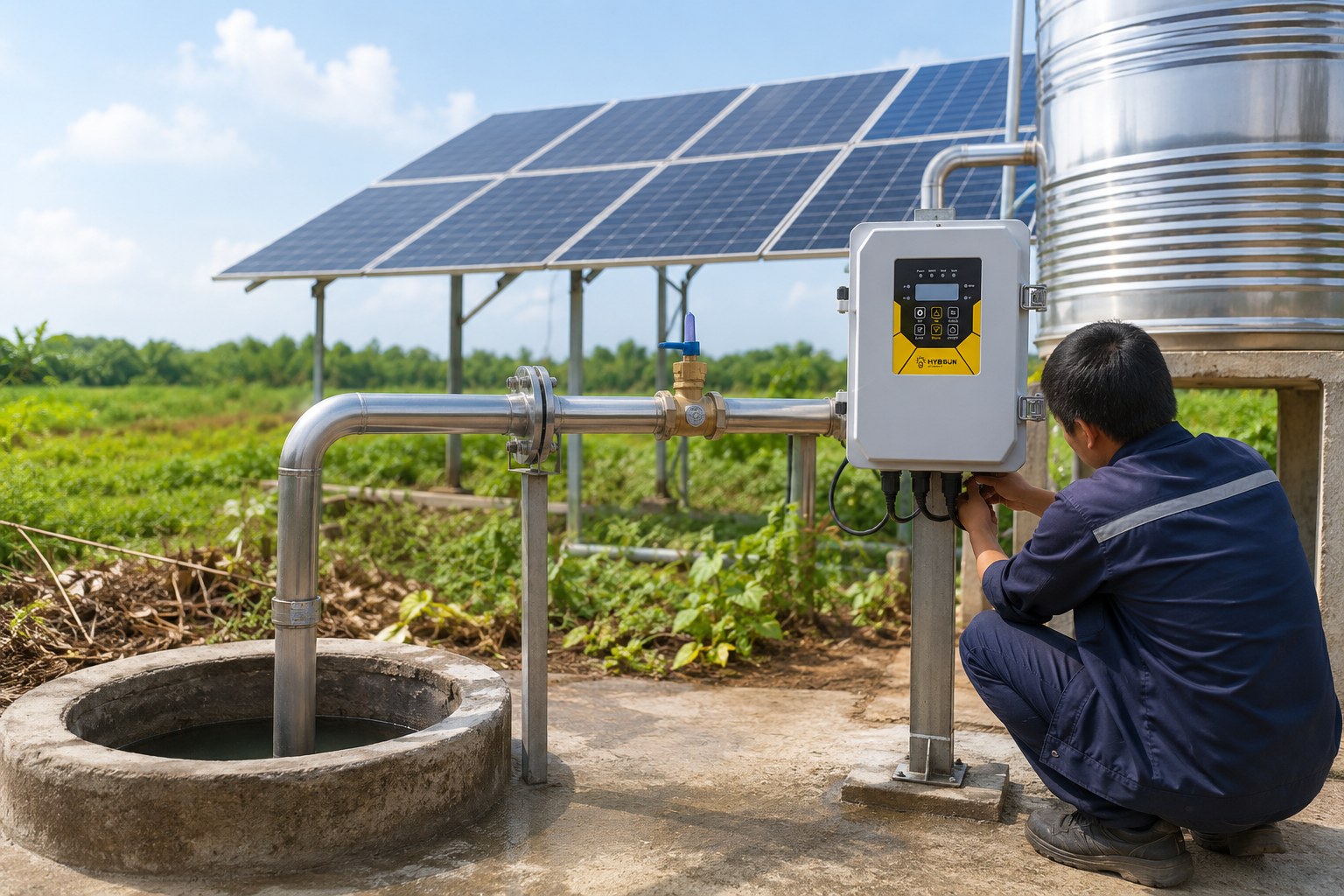
A Maximum Power Point Tracking (MPPT) controller is essential for solar pumps.
It constantly adjusts the pump's electrical load to ensure the solar panels are operating at their peak efficiency point, maximizing water output by up to 30% throughout the day.
For even greater reliability, hybrid AC/DC controllers offer the ultimate solution.
These controllers can be connected to both solar panels and an AC power source (grid or generator) simultaneously.
The system prioritizes free solar energy whenever available.
If sunlight is insufficient, the controller automatically supplements with AC power or switches to it completely.
This guarantees a 24/7 water supply, making it an ideal, worry-free solution for critical applications and a powerful selling point for distributors.
Top Picks for Different Needs
A "one-size-fits-all" pump doesn't exist.
Your inventory is full, but are you meeting every customer's specific needs?
How can you offer a complete, targeted solution?
The best strategy is a portfolio approach. Offer solar screw pumps for deep wells (low flow, high head), plastic impeller pumps for high-volume irrigation (high flow, sand resistance), and stainless steel impeller pumps for corrosive water conditions, ensuring you have the perfect solution for any scenario.
Instead of trying to find a single "best" pump, the most successful distributors build a portfolio that addresses the diverse needs of their market.
This strategy empowers you to be a solutions provider, equipping your customers with the precise tool for their specific environment.
It also protects your business from being overly dependent on a single product category.
Let’s explore the strengths of each specialized pump type.
The Workhorse: Solar Screw Pumps
This pump type is the specialist for high-head, low-flow applications.
It uses a progressing cavity design, where a single helical stainless steel screw rotates within a rubber stator.
This action creates sealed cavities that move water upward with each turn, generating very high pressure.
This makes it perfect for deep wells where water needs to be lifted hundreds of feet.
It's an ideal solution for domestic water supply and livestock watering in the electricity-scarce regions of Africa and Latin America.
A key advantage is its exceptional resistance to sand and abrasives, as the rubber stator can accommodate small particles without significant wear.
The Irrigator: Solar Plastic Impeller Pumps
When high water volume is the priority, the multi-stage centrifugal pump is the answer.
This design uses a series of impellers and diffusers to accelerate water, converting velocity into pressure.
Models with impellers made from high-strength, wear-resistant engineered plastic (like POM) offer a fantastic balance of performance, durability, and cost-effectiveness.
These pumps deliver high flow rates at medium head, making them perfect for agricultural irrigation, pasture water supply, and large gardens.
Their excellent resistance to fine sand and lightweight construction have made them a popular choice across the Americas and Africa for farming applications.
The Specialist: Solar Stainless Steel Impeller Pumps
In environments with aggressive water, material choice is everything.
For acidic, alkaline, or saline water conditions, a pump with a full stainless steel construction is non-negotiable.
These premium models utilize SS304 or SS316 stainless steel for the pump body, impellers, and all wetted parts.
This provides superior corrosion resistance, ensuring a long and reliable service life where other pumps would quickly fail.
These pumps are critical for projects in the alkaline soil regions of Australia, coastal areas, and for high-end residential or commercial properties where water quality and system longevity are paramount.
While the initial cost is higher, the investment pays off through unmatched durability in harsh environments.
| Specification | Solar Screw Pump | Solar Plastic Impeller Pump | Solar Stainless Steel Impeller Pump |
|---|---|---|---|
| Primary Function | High Head Lifting | High Volume Pumping | Pumping in Corrosive Water |
| Flow Rate | Low | High | High |
| Head Capability | Very High (up to 300m+) | Medium (up to 150m) | Medium-High (up to 200m) |
| Sand Resistance | Excellent | Good (for fine sand) | Fair (prefers clean water) |
| Corrosion Resistance | Good | Fair | Excellent (SS304/SS316) |
| Target Market | Deep wells, domestic use | Agriculture, irrigation | Industrial, coastal, high-end homes |
Best Submersible Pump Brands (2026) | Ranked
Your customers ask for famous brands, but are they the best value?
Stocking expensive brands eats into your margins.
How do you offer superior quality without the premium brand price tag?
The best "brand" for a distributor is a manufacturing partner focused on OEM/ODM and quality. Instead of focusing on retail brand names, evaluate the manufacturer's technical patents, quality control systems (IQC, PQC, OQA), and global certifications (CE, IEC, RoHS) to ensure product excellence and market competitiveness.
The conversation about the "best brand" is often dominated by a few well-known names.
However, for a B2B distributor, the goal is not to promote someone else's brand; it is to build your own.
The smartest strategy is to look past the marketing and evaluate the manufacturer behind the product.
A strong manufacturing partner provides the foundation upon which you can build a profitable and reputable brand in your local market.
What to Look for in a Manufacturing Partner
A world-class manufacturing partner distinguishes itself through technical innovation and rigorous quality control.
Look for a company with a deep commitment to research and development.
A robust portfolio of technical patents, such as over 100 patents in intelligent pump technology, is a clear indicator of a market leader.
Equally important is a multi-layered quality control system.
This should include:
- IQC (Incoming Quality Control): Verifying the quality of all raw materials before they enter production.
- PQC (Process Quality Control): Monitoring and inspecting products at every stage of the assembly line.
- OQA (Outgoing Quality Assurance): Conducting final, comprehensive tests on finished products before they ship.
Furthermore, demand proof of durability through stringent testing, such as 144+ hour salt spray tests for corrosion resistance and 1000+ hour UV resistance tests.
Global certifications like CE, IEC, and RoHS are not just formalities; they are proof of compliance with international safety and quality standards.
The Value of OEM/ODM
Partnering with an Original Equipment Manufacturer (OEM) or Original Design Manufacturer (ODM) is the most effective way to build your own brand.
This model allows you to leverage the manufacturer's R&D and production capabilities while selling the product under your own brand name.
It gives you control over your market, your pricing, and your brand's reputation.
This is a stark contrast to simply reselling an established brand, where you are often just another dealer competing on price with limited margins.
| Factor | Reselling Retail Brands | Partnering with an OEM/ODM |
|---|---|---|
| Profit Margin | Low, fixed by brand owner | High, controlled by you |
| Brand Control | None, you build their brand | Full, you build your own brand equity |
| Market Exclusivity | Unlikely, high competition | Possible through negotiation |
| Product Customization | None | High, can tailor to market needs |
| Technical Support | Varies, often indirect | Direct access to manufacturer's engineers |
By choosing a strong OEM/ODM partner, you transform from a simple reseller into a brand owner, a much more powerful and profitable position in the market.
Franklin vs Grundfos: Head-to-Head Comparison
Customers are stuck comparing two big names.
This debate often misses the bigger picture.
How can you shift the conversation from brand-vs-brand to value-vs-value?
Instead of comparing established retail brands, the more profitable comparison for a distributor is evaluating the core technology. A high-efficiency BLDC motor in a cost-effective pump body can outperform a premium-branded pump with older tech, offering your customers better long-term value and you better margins.
The debate between major consumer brands is a distraction from the real conversation about value.
While these brands have built strong reputations, their technology is not always the most advanced or cost-effective.
As a distributor, your opportunity lies in educating the market and shifting the focus to what truly determines performance and long-term cost: the core technology.
By doing this, you can redefine value and position your products as the smarter choice.
The Real Head-to-Head: Energy Efficiency
The most important battle is not between brand names but between motor technologies.
A pump's energy efficiency has the single greatest impact on its lifetime operating cost, especially in solar applications where every watt counts.
A modern BLDC motor offers a decisive advantage over older, less efficient AC motors commonly found in many well-known brands.
| Technology Comparison | Typical Premium Brand Pump | Modern BLDC Solar Pump |
|---|---|---|
| Motor Type | Standard AC Induction | Brushless DC (BLDC) Permanent Magnet |
| Motor Efficiency | ~65-75% | >90% |
| Power Source | Grid-Dependent (AC) | Solar-Native (DC) / Hybrid AC/DC |
| Core Technology | Established, Less Efficient | Modern, High-Efficiency |
| Long-Term Cost | Higher Energy Bills | Significantly Lower Energy Cost |
This efficiency gap of 15-20% is not a minor detail.
It is a game-changer.
Calculating Total Cost of Ownership (TCO)
The true cost of a pump system is not the price on the box.
It is the Total Cost of Ownership (TCO), which includes the initial purchase price, installation costs, and long-term energy costs.
Higher efficiency directly translates to a lower TCO.
In a solar pumping system, a 20% increase in motor efficiency means you can achieve the same water flow with 20% less solar panel wattage.
With solar panels being a major component of the system cost, this provides a massive, immediate saving for the end-user.
Example TCO Calculation:
- A system requiring a 1000W pump with 70% efficiency needs roughly a 1430W solar array.
- A system with an equivalent 1000W pump with 90% efficiency needs only a 1110W solar array.
- This 320W reduction in solar panel requirements can save the customer hundreds of dollars upfront, making the more efficient pump the cheaper option overall, even if its initial price is slightly higher.
By arming your sales team with this TCO calculation, you can effectively demonstrate that your technologically advanced pumps offer a lower total cost and a better return on investment.
Conclusion
The best pump is a complete system.
It combines an efficient motor, the right pump materials, and intelligent controls.
Partnering with a top-tier manufacturer is the key to delivering this value and building your brand.
FAQs
What is the most reliable submersible well pump?
Reliability comes from matching the pump to the well. A stainless steel pump is best for corrosive water, while a screw pump excels in sandy, deep wells. The right application match is more important than a single brand name.
How long should a submersible well pump last?
A quality pump with a high-efficiency BLDC motor can last 15-20 years. Lifespan is directly affected by correct sizing, installation, and water quality.
Is a 2-wire or 3-wire well pump better?
Traditionally, 3-wire pumps were preferred for easier service via an above-ground control box. Modern solar pumps with integrated BLDC motors and controllers simplify this, often making the distinction less critical.
How much does it cost to replace a submersible well pump?
Labor to replace a pump in a deep well can cost $1,500 or more, often exceeding the pump's price. This high service cost makes investing in a durable, long-lasting pump the most economical choice.
Can I use a solar pump with my existing AC power?
Yes. Modern hybrid AC/DC controllers allow a solar pump to run on solar panels during the day and automatically switch to grid or generator power at night or on cloudy days, ensuring a constant water supply.
What size pump do I need for my well?
Pump sizing requires calculating the Total Dynamic Head (TDH), which includes well depth and friction loss, and your required Gallons Per Minute (GPM). A professional should perform this calculation to ensure optimal efficiency.
What are the main types of submersible pumps?
The main types include screw pumps for high head, centrifugal pumps with plastic impellers for high flow, and centrifugal pumps with stainless steel impellers for corrosion resistance. Each serves a different application.
Why is motor efficiency so important in a solar pump?
Higher motor efficiency means more water is pumped per watt of solar power. This reduces the number of solar panels needed for the system, significantly lowering the total upfront cost for the customer.