Choosing the right water pump for your home feels overwhelming with so many technical options.
Making the wrong choice can lead to years of high energy bills, poor water pressure, and costly repairs.
This guide simplifies the process by breaking down exactly what you need to know.
The best water pump for a home depends entirely on your specific needs, primarily well depth and water demand.
For deep wells over 110 feet, high-efficiency submersible pumps are superior.
For shallow wells under 25 feet, centrifugal or jet pumps provide excellent value and performance.
Selecting the perfect pump is a critical decision that impacts your daily life and budget for over a decade.
It's not just about buying a piece of hardware; it's about investing in a reliable, efficient water system tailored to your property.
To make the right choice, you need to look beyond the initial price tag and consider the pump's type, size, power source, and material construction.
This article will walk you through the key factors, compare the latest technologies, and provide the data you need to select a pump that delivers consistent water pressure, saves you money, and stands the test of time.
Understanding Well Pump Types and Their Applications
With three main pump types dominating the market, knowing which one fits your well is the first step.
A mismatch between pump type and well depth leads to inefficiency and premature failure.
Each pump—centrifugal, jet, and submersible—is engineered for a specific range of applications, making the right choice essential for a reliable water supply.
Centrifugal pumps are economical solutions for shallow wells under 25 feet.
Jet pumps offer versatility for depths up to 90 feet.
Submersible pumps are the unmatched choice for deep wells, efficiently pushing water from 110 feet or more.
Understanding the fundamental differences between these pumps is crucial for anyone relying on a private well.
Your decision will directly influence installation complexity, maintenance requirements, energy consumption, and the pump's overall lifespan.
Let's break down the mechanics, ideal applications, and performance expectations for each type to ensure you invest in the right technology for your home.
Centrifugal Pumps: The Shallow Well Solution
Centrifugal pumps are the go-to option for moving water from a shallow source.
They operate above ground, using an impeller to spin and force water out through suction.
This design makes them easy to access for maintenance.
However, their suction-based operation limits them to a maximum vertical lift of about 25 feet.
They are highly effective for applications like boosting pressure from a city water supply, circulating water in a closed loop, or drawing from a shallow well or cistern.
Because they are not submerged, they must be "primed" (filled with water) before the first use to create the necessary suction, which can be a drawback if the system develops an air leak.
Jet Pumps: Bridging the Gap with Versatility
Jet pumps offer a clever solution for wells that are too deep for a centrifugal pump but don't necessarily require a submersible unit.
They also operate above ground but use an "ejector"—a nozzle and venturi—to create a high-velocity jet of water that generates a vacuum, allowing them to pull water from greater depths.
There are two main configurations:
- Shallow Well Jet Pumps: Use a single pipe to draw water from depths up to 25 feet, similar to a centrifugal pump but with more robust pressure performance.
- Convertible Jet Pumps: Employ a two-pipe system, where one pipe sends water down to the ejector located in the well, and the other brings water up.
This design allows them to effectively draw water from depths down to 90 feet, adapting to fluctuating water tables.
Submersible Pumps: The Deep Well Champion
For deep wells (110 feet and deeper), the submersible pump is in a class of its own.
Unlike other pumps that pull water, a submersible pump pushes it upwards from within the well.
This long, cylindrical pump contains a sealed motor and a series of impellers stacked on top of each other.
The entire unit is submerged deep in the well water.
Pushing water is far more energy-efficient than pulling it over long distances, resulting in 10-30% lower energy consumption compared to a jet pump operating at its depth limit.
Because the motor is cooled by the surrounding water and the pump is protected from the elements, submersibles enjoy a long lifespan of 10 to 15 years and require minimal maintenance.
| Pump Type | Ideal Well Depth | Pressure Performance | Key Advantage | Key Limitation |
|---|---|---|---|---|
| Centrifugal | Under 25 feet | Moderate | Economical & easy to access | Can't lift water from deep sources |
| Jet Pump | 25 to 90 feet | Good to High | Versatile for various depths | Less efficient than submersibles |
| Submersible | 110 to 300+ feet | High & Consistent | Highest efficiency & long life | Higher upfront & installation cost |
Sizing Guide: Matching Pump Capacity to Household Water Demands
An improperly sized pump is a recipe for disaster.
A pump that's too small results in weak showers and poor pressure, while an oversized pump short-cycles, wasting energy and burning out the motor.
Getting the size right is the single most important step for long-term satisfaction.
To size a pump correctly, you must calculate your peak water demand in gallons per minute (GPM) and the total dynamic head (TDH).
A typical home needs 8-12 GPM, plus 1 GPM for every major water-using fixture, to meet its needs.
Sizing a pump isn't guesswork; it's a straightforward calculation based on your home's plumbing and your well's characteristics.
By taking the time to measure your requirements accurately, you ensure the pump you buy will operate within its most efficient range.
This not only provides the performance you expect but also extends the life of the pump and pressure tank, saving you significant money over time.
Let's walk through the essential calculations.
How to Calculate Your Peak Demand (GPM)
Peak demand is the maximum amount of water your household would use at one time.
This determines the flow rate, or Gallons Per Minute (GPM), your pump must be able to deliver.
A simple method to estimate this is the fixture count method.
Start with a baseline and add for each fixture that could run simultaneously.
- Baseline for a typical home: 8-12 GPM
- Add 1 GPM for each additional fixture:
- Kitchen Sink
- Dishwasher
- Washing Machine
- Bathroom Sink (each)
- Shower (each)
- Toilet (each)
- Outdoor Hose Bib
For example, a home with 2 bathrooms, a kitchen, and laundry might calculate its peak demand as:
(1 Shower + 1 Toilet + 1 Washing Machine + 1 Kitchen Sink) = 4 fixtures.
If we use a conservative baseline of 10 GPM, the total required GPM would be 10 + 4 = 14 GPM.
Your pump should be able to supply this flow rate without a significant drop in pressure.
Understanding Total Dynamic Head (TDH)
Total Dynamic Head (TDH) is the total resistance the pump must overcome to deliver water.
It's measured in feet and is a critical factor in pump selection.
TDH is composed of three main components:
- Vertical Lift: The total vertical distance in feet from the water level in the well to the highest point of use in your home.
- Friction Loss: As water travels through pipes, it loses pressure due to friction.
Pipe length, diameter, and the number of fittings (elbows, valves) all contribute to this loss.
As a rule of thumb, every 100 feet of horizontal pipe run can add about 5 feet of head. - Operating Pressure: The desired pressure at the fixture, typically 40-60 PSI for a home.
To convert PSI to feet of head, multiply the PSI by 2.31.
(e.g., 50 PSI * 2.31 = 115.5 feet of head).
The formula is: TDH = Vertical Lift + Friction Loss + Operating Pressure (in feet).
A pump's performance curve chart will show you how many GPM it can deliver at a specific TDH.
You must select a pump that can provide your required GPM at your calculated TDH.
Deep Well Submersible Pumps: Efficiency and Durability Compared
When your water source is deep, you need a pump engineered for the challenge.
Pushing water from over 100 feet below ground requires a level of power and efficiency that surface pumps can't match.
This is where deep well submersible pumps have become the undisputed industry standard.
Modern deep well submersible pumps offer unparalleled long-term value, combining 10-15 year lifespans with energy savings of 10-30%.
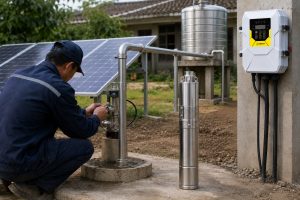
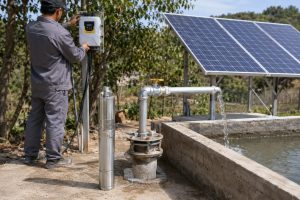
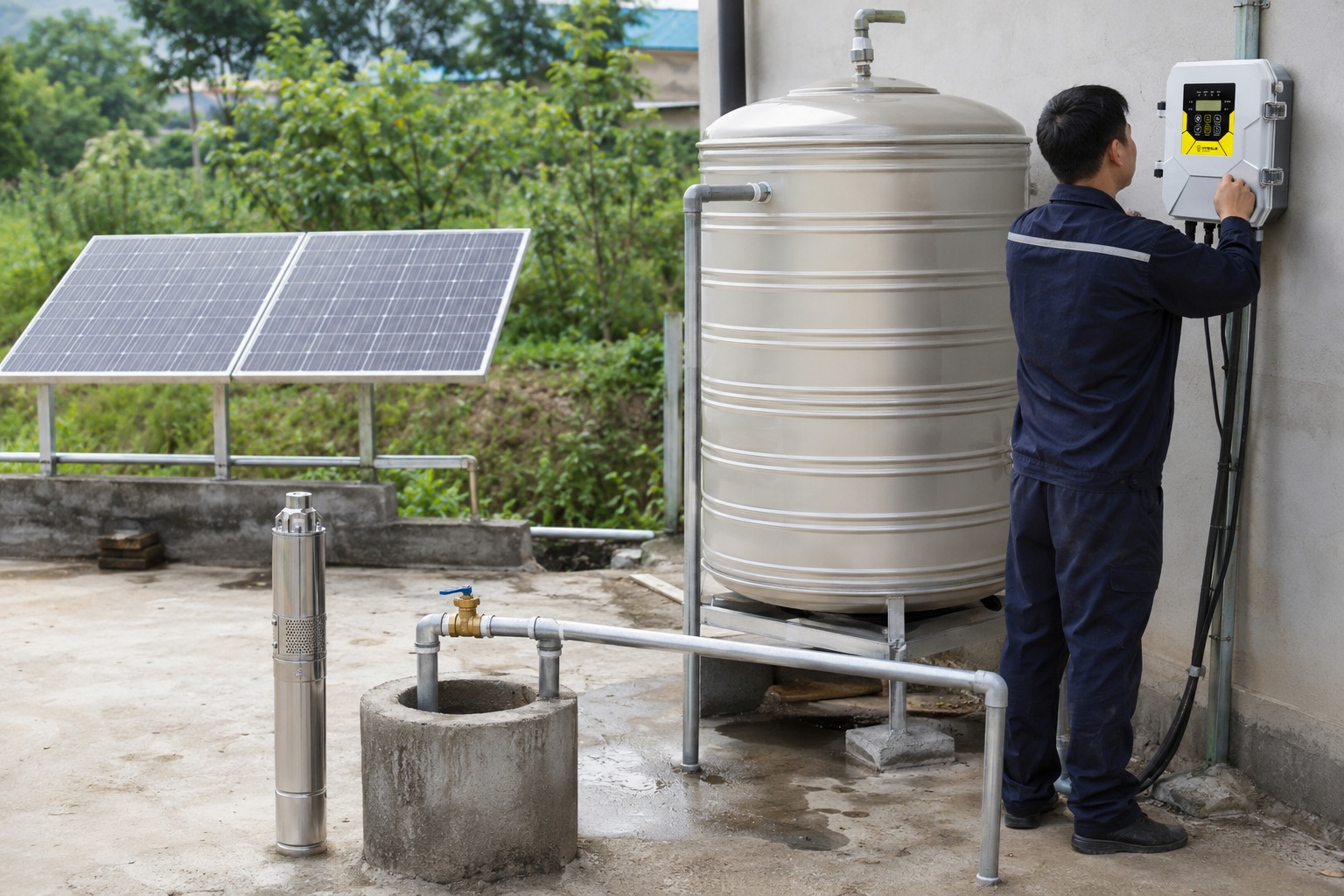
Emerging solar-powered models further reduce operating costs, making them a sustainable choice for off-grid and rural properties.
The true innovation in deep well pumping isn't just about going deeper; it's about doing it more efficiently and sustainably.
The latest advancements have moved beyond simple grid-powered units to highly efficient, solar-driven systems.
These systems are powered by cutting-edge motor technology and can be tailored with different pump ends to meet a wide range of flow and pressure needs, from household use to small-scale agriculture.
Let's examine the components that make these pumps the superior choice for deep well applications.
Core Technology: The BLDC Permanent Magnet Motor
The heart of a modern, high-efficiency solar pump is its motor.
Brushless DC (BLDC) permanent magnet motors represent a massive leap forward in pump technology.
Unlike traditional AC motors, BLDC motors use powerful magnets (often Neodymium Iron Boron) and sophisticated electronics to achieve efficiencies exceeding 90%.
This is a significant improvement over the 60-70% efficiency of many conventional motors.
The practical benefits for a homeowner or distributor are substantial:
- Higher Efficiency: Up to 47% smaller and 39% lighter than a traditional motor of the same power output.
- Lower Energy Demand: The high efficiency means the pump requires fewer solar panels to operate, reducing the system's total upfront cost by 15-25%.
- Long, Maintenance-Free Life: The brushless design eliminates the most common point of failure and wear, leading to a much longer operational lifespan.
Pump End Variations for Every Application
While the motor provides the power, the "pump end" does the work of moving water.
The choice of pump end depends on the well's depth, the required flow rate, and the water quality.
For solar deep well systems, three main types offer a complete and competitive portfolio.
-
Solar Screw Pump (Low Flow, High Head): This pump uses a stainless steel helical rotor (screw) inside a rubber stator.
As the screw turns, it creates sealed cavities that move water upward.
This design generates very high pressure (head) but at a lower flow rate.
It's exceptionally resistant to sand and ideal for deep, narrow wells providing domestic water. -
Solar Plastic Impeller Pump (High Flow, Wear-Resistant): This is a multi-stage centrifugal pump that uses a stack of durable plastic (e.g., Noryl) impellers.
It's designed to deliver high flow rates at medium head.
This makes it perfect for farm irrigation, livestock watering, and applications needing a lot of water.
Its light weight and economic cost are major advantages. -
Solar Stainless Steel Impeller Pump (Premium, Corrosion-Resistant): This pump is functionally similar to the plastic impeller model but uses impellers and a pump body made from SS304 stainless steel.
It is the premium choice for environments with corrosive water (acidic or alkaline) or for users demanding the highest durability and reliability.
| Solar Pump Type | Best For | Flow Rate | Head (Pressure) | Sand Resistance |
|---|---|---|---|---|
| Screw Pump | Deep wells, domestic use | Low (1-10 GPM) | Very High | Excellent |
| Plastic Impeller | Farms, high-volume use | High (10-50 GPM) | Medium | Good |
| Stainless Steel Impeller | Corrosive water, high-end use | High (10-50 GPM) | Medium-High | Good |
Power Consumption Analysis: Beyond the Grid
A pump's purchase price is just the beginning of its total cost.
Energy consumption over a decade can easily exceed the initial investment, making efficiency a critical factor in your decision.
This is especially true in off-grid or energy-conscious applications.
While traditional pumps are tied to utility costs, modern solar pumps offer remarkable energy independence and efficiency.
Paired with intelligent controllers, they can reduce or even eliminate electricity bills for water pumping, offering a rapid return on investment.
The conversation around power consumption has shifted from simply minimizing grid usage to maximizing renewable energy sources.
Intelligent technologies are now available that not only optimize the performance of solar pumps but also bridge the gap between solar and grid power, ensuring you have water 24/7, regardless of the weather.
Understanding these technologies is key for anyone looking for a truly reliable and cost-effective water solution.
Maximizing Solar Energy with MPPT Controllers
A solar pump system is more than just a pump and a solar panel.
The "brain" of the system is the MPPT (Maximum Power Point Tracking) controller.
This intelligent device constantly adjusts the electrical load to ensure the solar panels are operating at their peak efficiency, or maximum power point.
This is crucial because a panel's power output changes continuously with sunlight intensity and temperature.
An MPPT controller can boost the energy harvested from your solar array by up to 30% compared to a system without one.
This means you can get the water you need with a smaller, less expensive solar array, or get more water from your existing one.
It also allows the pump to start earlier in the morning and run later in the evening, extending the daily pumping window.
Hybrid AC/DC Systems for 24/7 Reliability
The most common question about solar pumps is: "What happens on a cloudy day or at night?"
The answer lies in hybrid AC/DC controllers.
These advanced controllers are a game-changer for water supply reliability.
They are designed with inputs for both DC power from solar panels and AC power from the grid or a generator.
The controller's logic is simple but brilliant:
- Priority on Solar: When the sun is shining, the controller powers the pump exclusively with free solar energy.
- Automatic Blending: If clouds roll in and solar power drops, the controller can automatically blend in just enough AC power to maintain pump operation, maximizing the use of every available watt of solar.
- AC Takeover: When there is no solar input (at night or during heavy storms), the controller seamlessly switches to 100% AC power.
This ensures an uninterrupted water supply 24 hours a day, providing the cost savings of solar with the on-demand reliability of the grid.
Reliability Across Brands and Materials
The price on the box rarely tells the whole story of a pump's value.
Long-term reliability is determined by the quality of the materials used in its construction and the engineering behind its design.
A pump that fails prematurely can cause major disruptions and unexpected costs.
True reliability comes from durable, corrosion-resistant materials like stainless steel and robust internal components.
While top brands like Grundfos and Franklin Electric set a high standard, the key is to assess the material quality, not just the brand name on the label.
Investing in a pump made from superior materials is one of the smartest decisions you can make.
A pump is constantly exposed to water, minerals, and potential abrasives like sand.
Over time, these elements will degrade inferior materials, leading to performance loss and eventual failure.
By understanding the differences in construction, you can choose a pump that is built to last in your specific water conditions.
The Great Debate: Cast Iron vs. Stainless Steel
The pump's housing is its first line of defense.
The two most common materials are cast iron and stainless steel.
-
Cast Iron: Known for its durability and excellent noise-dampening qualities, making for quieter operation.
It is very strong and resistant to deformation.
However, it is susceptible to rust and corrosion over time, especially in acidic or highly mineralized water.
This corrosion can weaken the housing and contaminate the water. -
Stainless Steel: The superior choice for longevity and purity.
Stainless steel is highly resistant to corrosion and rust, ensuring the pump's structural integrity and keeping the water clean.
While it typically comes with a higher upfront cost (around 15-20% more), it pays for itself by dramatically reducing the need for premature replacement.
This makes it the best long-term investment, particularly for drinking water systems.
Impeller Materials: Performance Under Pressure
The impellers are the spinning discs that actually move the water.
Their material composition is critical for both efficiency and durability.
-
Plastic/Noryl: High-quality thermoplastic impellers are common in many residential pumps.
They are lightweight, low-cost, and have good resistance to abrasion from fine sand.
They perform very well in neutral water conditions.
However, they can become brittle and crack over time, especially in very deep wells with high pressure or in chemically aggressive water. -
Stainless Steel: Stainless steel impellers offer unmatched durability.
They are impervious to corrosion and can withstand the high pressures found in deep well applications without deforming.
They can handle more aggressive water conditions and are far more resistant to damage from larger particulates.
For the ultimate in reliability and long-term performance, stainless steel impellers are the clear winner.
Choosing a pump with a stainless steel housing and stainless steel impellers provides the best possible defense against corrosion and wear, ensuring the longest possible service life for your water system.
Conclusion
The best water pump is a complete system.
It's a blend of the right pump type, a highly efficient motor, and intelligent controls.
For distributors, offering a flexible portfolio that meets diverse customer needs is the key to market leadership.
FAQs
How many GPM does a house of 4 need?
A house of 4 typically requires 10-15 GPM. This accounts for baseline use and the potential for multiple fixtures like showers and sinks running simultaneously.
What is the best type of pump for a deep well?
A submersible pump is the best and most efficient type for a deep well (over 110 feet). It pushes water up rather than pulling it, saving energy.
How long do residential well pumps last?
A quality submersible pump can last 10-15 years. Jet and centrifugal pumps typically have a shorter lifespan of 8-12 years due to their above-ground placement.
Can a solar water pump work at night?
A standard solar pump only works when the sun shines. However, a hybrid AC/DC system allows the pump to automatically switch to grid or generator power at night.
What's the difference between a 2-wire and 3-wire submersible pump?
A 2-wire pump has simpler wiring but integrated starting components in the motor. A 3-wire pump uses an external control box, making service and diagnosis easier.
Is a more expensive water pump worth it?
Yes, often it is. A higher price usually reflects superior materials like stainless steel and a more efficient motor, leading to lower energy bills and a longer lifespan.
How do I protect my pump from sand?
Choose a pump designed for your conditions. Screw pumps have excellent sand resistance. For other types, ensure the pump intake is raised off the well bottom.
What is an MPPT controller?
An MPPT (Maximum Power Point Tracking) controller is an electronic device that maximizes the power harvested from solar panels, increasing a solar pump system's efficiency by up to 30%.