Struggling to find a clear price for a deep well pump?
The costs seem confusing and can vary wildly.
This guide breaks down every factor for you.
A complete 400-foot borewell pump system typically costs between $2,000 and $5,000.
This price includes the pump, professional installation, and necessary components.
The final cost depends heavily on the pump type, performance requirements, and your specific location.
The price tag on the pump itself is only the beginning of the story.
To accurately budget for a 400-foot well, you must understand that the total expense is a sum of several critical parts.
Many homeowners are surprised when the final invoice is more than double the cost of the pump they saw online.
This is because a deep well installation is a complex project involving specialized labor, extensive materials, and sometimes, additional system upgrades.
Understanding these components is the first step toward making a smart, long-term investment in your water supply and avoiding unexpected costs down the road.
Let's explore what really goes into the total price.
What Factors Determine the Total Cost?
Confused by quotes with wildly different prices?
Many hidden factors can inflate your final bill.
We'll reveal what truly drives the price of a deep well pump installation.
The total cost for a 400-foot well pump isn't just the pump.
It includes the pump itself, labor, piping, wiring, and potentially a new pressure tank.
These elements often make up over 60% of the final price.
The final cost of your well pump project is a puzzle with several pieces.
Simply looking at the pump's price tag gives you an incomplete picture.
For a deep well of 400 feet, each component's cost is magnified compared to a shallow well installation.
Let's break down the primary cost drivers you need to consider.
Labor Costs
Professional installation is not optional for a 400-foot well.
Labor costs typically range from $45 to $150 per hour.
For a deep well, this can total between $500 and $1,500 or more.
This price reflects the complexity, specialized equipment needed to lower the pump, and the expertise required for a safe and correct electrical hookup.
The Pump Itself
The heart of the system, the pump, varies greatly in price.
A standard submersible pump for this depth might cost between $400 and $1,200.
High-efficiency solar pumps or constant-pressure models can range from $1,500 to over $4,000.
The material, such as stainless steel versus thermoplastic, also significantly impacts the price and durability.
Piping and Wiring
Your pump needs a way to get water to the surface and power to operate.
For a 400-foot well, you need at least 400 feet of drop pipe and submersible electrical wire.
The cost of piping and wiring can add $400 to $1,000 or more to the project, depending on the material quality and diameter.
Additional System Components
Often, a pump replacement reveals other aging parts.
A pressure tank, which stores water and protects the pump, may also need replacing.
A new pressure tank installation can cost between $800 and $3,900.
Other potential costs include new pressure switches, check valves, and well caps.
| Cost Component | Typical Price Range (for 400-ft Well) | Percentage of Total Cost (Approx.) |
|---|---|---|
| Well Pump | $400 - $4,000+ | 25% - 50% |
| Labor | $500 - $1,500+ | 20% - 30% |
| Piping & Wiring | $400 - $1,000+ | 15% - 25% |
| Pressure Tank | $800 - $3,900 (if replaced) | 20% - 40% |
| Miscellaneous Parts | $100 - $300 | 5% |
Which Pump Type is Right for a 400-Foot Well?
Choosing the wrong pump for a deep well is a costly mistake.
It can lead to poor performance, high energy bills, and early failure.
Let's find the perfect match for your needs.
For a 400-foot well, a submersible pump is the industry standard.
Your main choices are between traditional AC-powered pumps and modern solar-powered pumps.
Each offers different costs and benefits for deep-well applications, so the right choice depends on your priorities.
At a depth of 400 feet, jet pumps are no longer an option.
The only practical choice is a submersible pump, which is placed deep inside the well and pushes water to the surface.
This design is far more efficient and reliable for deep applications than trying to pull water from the surface.
Within the submersible category, however, you have several important choices to make, each tailored to different needs and environments.
The Deep Well Standard: AC Submersible Pumps
These are the most common pumps for residential wells connected to the grid.
They are reliable and come in a wide range of sizes to meet different flow and pressure needs.
For a 400-foot well, you'll likely need a pump between 1.5 and 3 horsepower.
Their main drawback is their reliance on the electrical grid and the associated monthly utility costs.
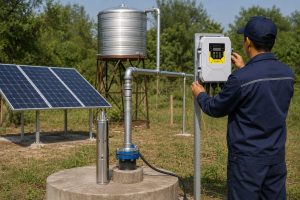
The Off-Grid Solution: Solar Submersible Pumps
Solar pumps are a game-changer for remote properties or anyone seeking energy independence.
They operate using power from solar panels, eliminating electricity bills.
Modern solar pumps use highly efficient motors that can deliver impressive performance even on less sunny days.
While the initial investment is higher, the return on investment from energy savings is significant, often paying for itself within 5-8 years.
There are three main types of solar pumps for deep wells:
- Solar Screw Pumps: These are ideal for very deep wells with lower flow requirements. They excel at creating high pressure (head) and are very resistant to sand.
- Solar Plastic Impeller Pumps: These centrifugal pumps offer a great balance of high flow and affordability. They are lightweight and resistant to wear from fine sand, making them perfect for irrigation and general home use.
- Solar Stainless Steel Impeller Pumps: This is the premium option. Built entirely from corrosion-resistant stainless steel, these pumps are designed for harsh water conditions and offer the longest service life.
The Premium Experience: Constant-Pressure Pumps
A constant-pressure system uses a variable frequency drive (VFD) controller to adjust the pump's speed in real-time.
This ensures you have strong, consistent water pressure throughout your home, even when multiple faucets are running.
It's like having city-like water pressure from a private well.
These systems also reduce wear on the pump by avoiding harsh start/stop cycles.
| Pump Type | Initial Cost (Pump Only) | Best For | Key Advantage |
|---|---|---|---|
| AC Submersible | $400 - $1,200 | Grid-connected homes | Lower upfront cost, widely available |
| Solar Submersible | $1,500 - $4,000 | Off-grid, energy savings | No electricity bills, sustainable |
| Constant-Pressure | $2,000 - $5,000 | Premium home water systems | Superior water pressure, pump protection |
Why is Horsepower Not the Most Important Factor?
Thinking a higher horsepower pump is always better?
This common myth can cost you thousands in energy bills and lead to premature pump failure.
Let's uncover the real metric for performance.
Focus on the "design point," which is the required flow rate (GPM) and pressure (TDH), not just horsepower.
A more efficient, correctly sized pump with lower horsepower can easily outperform a larger, mismatched one, saving you money.
Many people fall into the "bigger is better" trap when buying a pump.
They assume that a 3 HP pump must be better than a 2 HP pump.
This is a fundamental misunderstanding of pump dynamics that can lead to significant problems.
An oversized pump will not only consume far more energy but can also damage itself and even over-pump your well, causing it to run dry.
The key to proper pump selection is matching the pump's performance curve to your system's specific needs.
Understanding Total Dynamic Head (TDH)
TDH is the total pressure the pump must overcome to deliver water.
It's the most critical calculation for sizing a pump.
It is calculated by adding together several factors:
- Pumping Water Level: The depth to the water in the well while the pump is running (not the total well depth).
- Elevation: The vertical height difference between the wellhead and the storage tank or house.
- Pressure Requirement: The desired pressure at the destination (e.g., 50 PSI at the house).
- Friction Loss: The pressure lost due to friction as water moves through pipes.
Calculating Your Design Point for a 400-Foot Well
Let's use a real-world example.
Imagine your well is 400 feet deep, and the water level drops to 300 feet when pumping.
Your house is on a hill 50 feet above the well, and you want 60 PSI of pressure.
- Pumping Water Level: 300 feet
- Elevation: 50 feet
- Pressure Requirement: 60 PSI (which equals 60 x 2.31 = 139 feet of head)
- Friction Loss (estimated): 35 feet
Total Dynamic Head (TDH) = 300 + 50 + 139 + 35 = 524 feet
Your design point is the desired flow rate (e.g., 15 GPM) at 524 feet of TDH.
Reading a Pump Curve
With your design point, you can now look at a manufacturer's pump curve chart.
This chart shows how much flow (GPM) a pump produces at different levels of head (TDH).
You want to find a pump where your design point falls within the "Best Efficiency Point" (BEP) on its curve.
A 2 HP pump operating at its BEP will be more effective and last longer than a 5 HP pump operating far from its ideal range.
How Do Solar Pumps Offer a Competitive Advantage?
Tired of high electricity bills and grid dependency?
There's a sustainable solution that pays for itself over time.
It offers true energy freedom for your water supply.
Solar pumps eliminate electricity costs and work reliably off-grid.
Powered by high-efficiency brushless DC (BLDC) motors, they offer long-term savings and energy independence.
This makes them ideal for remote homes, farms, and ranches worldwide.
The true revolution in well pump technology is happening with solar power.
What was once a niche product is now a mainstream solution due to massive leaps in efficiency and reductions in cost.
For anyone living off-grid, in an area with an unreliable power supply, or simply looking to reduce their carbon footprint and utility bills, a solar water pump is the most logical choice.
The advantage isn't just about the sun; it's about the advanced technology that powers the system.
The Power of BLDC Motors
At the core of every modern solar pump is a Brushless DC (BLDC) permanent magnet motor.
These motors are an engineering marvel.
They achieve efficiencies of over 90%, compared to 60-70% for typical AC motors.
This means they convert more solar energy into water-pumping power.
They are also 40% smaller and lighter, making installation easier.
Because they have no brushes to wear out, they are virtually maintenance-free and have an exceptionally long service life.
Choosing the Right Solar Pump for Your Needs
The beauty of a modern solar pump portfolio is its ability to meet diverse needs.
You can choose the perfect pump based on your well's characteristics and water demands.
| Solar Pump Type | Flow Rate | Head (Pressure) | Best For | Sand Resistance |
|---|---|---|---|---|
| Solar Screw Pump | Low | Very High | Very deep wells, domestic water | Excellent |
| Solar Plastic Impeller | High | Medium | Irrigation, livestock, high output | Good |
| Solar SS Impeller | High | Medium-High | Corrosive water, premium homes | Good |
The Role of the Intelligent Controller
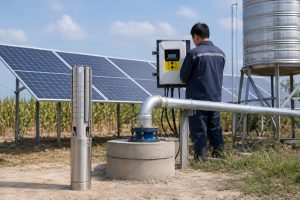
A solar pump system includes a smart controller, often with Maximum Power Point Tracking (MPPT).
This technology constantly adjusts the electrical load to maximize the power drawn from the solar panels, boosting water output by up to 30%.
Advanced controllers also offer hybrid functionality.
They can be connected to both solar panels and an AC power source (grid or generator) simultaneously.
The controller will prioritize solar power and automatically switch to AC power at night or on cloudy days, ensuring you have a reliable water supply 24/7.
Can I Install a 400-Foot Well Pump Myself?
Thinking about a DIY installation to save money?
A mistake at 400 feet deep can be dangerous, costly, and will void your warranty.
This is a job for trained professionals only.
No.
Installing a pump in a 400-foot well is a complex and hazardous job.
It requires specialized lifting equipment and electrical expertise.
Professional installation is essential for safety, proper function, and to maintain your pump's warranty.
While the DIY spirit is admirable for many home projects, well pump installation is not one of them, especially for a deep well.
The risks involved are significant, and a single mistake can have catastrophic and expensive consequences.
Attempting to save a few hundred dollars on labor could end up costing you thousands in damages or, worse, lead to serious injury.
Here’s why you should always hire a professional.
The Risks of DIY Installation
- Dropping the Pump: A 400-foot column of pipe, wire, and a heavy pump is incredibly difficult to handle without a dedicated pump hoist or rig. Dropping the entire assembly down the well can permanently damage the well casing or lodge the pump, requiring a costly well-drilling service to fix.
- Electrical Hazards: Submersible pump wiring involves making a waterproof, high-voltage connection deep underground. An improper splice can fail quickly, shorting out the pump. Incorrect wiring at the control box is a serious fire and electrocution risk.
- Well Contamination: A professional knows how to install the pump without introducing bacteria or other contaminants into your water supply. They will properly sanitize the well after installation.
The Value of a Professional
A licensed well contractor brings much more than just muscle.
They have the experience to correctly size the pump based on your well's production rate and your home's needs.
They ensure all components, from the wire gauge to the pipe diameter, are correct for the application.
Most importantly, they have the right equipment to do the job safely and efficiently, often completing the replacement in just a few hours.
Warranty Considerations
Virtually all pump manufacturers will void the warranty if the pump is not installed by a licensed professional.
If a DIY-installed pump fails prematurely, you will be responsible for the full cost of a new pump and the professional installation you should have paid for in the first place.
Conclusion
The cost of a 400-foot well pump is an investment in your property's most vital resource.
It's about choosing the right, efficient system and ensuring professional installation for long-term reliability.
FAQs
How long does a well pump last?
A well pump typically lasts 8 to 15 years.
Its lifespan depends heavily on the pump's duty cycle and the quality of the water.
What is the best pump for a deep well?
A submersible pump is the only suitable choice for a deep well.
The specific model depends on your required flow rate and pressure needs.
How much horsepower do I need for a 400 ft well?
It depends on your required flow and pressure, not just depth.
Pumps for a 400-foot well commonly range from 1.5 to 3 horsepower.
Is a solar well pump worth it?
Yes, especially for off-grid locations or to reduce energy costs.
The long-term savings on electricity often make it a very wise investment.
Can a well be too deep for a pump?
While most residential pumps have limits, specialized pumps can work in wells over 1,000 feet deep.
A 400-foot depth is common for deep-well pumps.
How much does it cost to pull a well pump?
The labor cost to pull and replace a well pump typically ranges from $500 to $1,500, depending on the well's depth and complexity.
What are the signs of a failing well pump?
Signs include low water pressure, sputtering faucets, dirty water, high electricity bills, or the pump running constantly.
An annual inspection is recommended.
Does homeowners insurance cover well pump replacement?
It depends on the policy.
Insurance usually covers damage from specific events like lightning but not failure from normal wear and tear.