Struggling to get consistent water from your well?
The problem might be that your pump isn't suited for your well's depth, leading to poor pressure and unreliable supply.
A standard shallow well jet pump can pull water from a maximum depth of about 25 feet (7.6 meters). Deep well jet pumps can draw water from depths of up to 100 feet (30 meters), but their efficiency drops significantly as the depth increases.
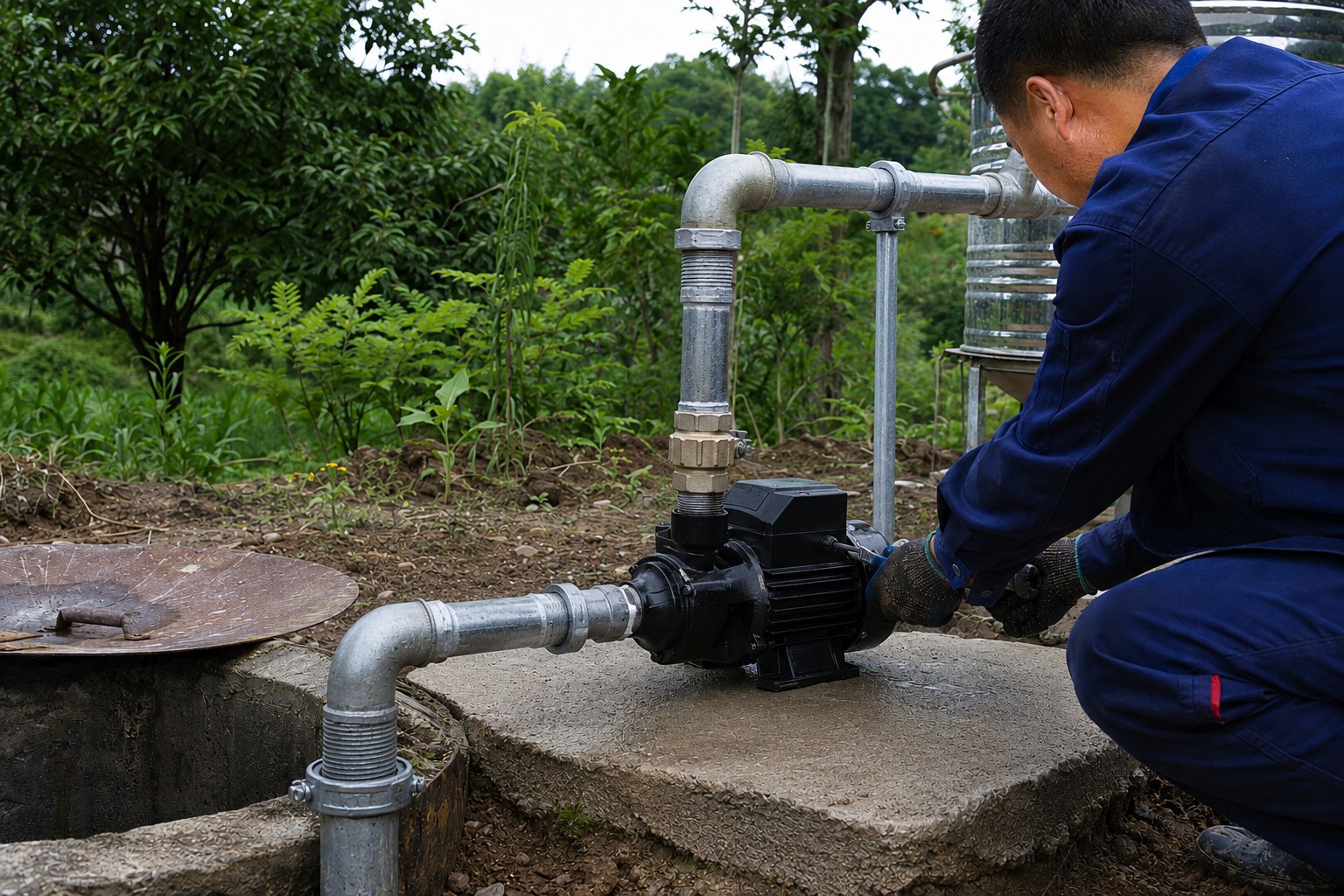
Jet pumps are a common choice for many, but they are just one piece of a much larger puzzle.
Understanding the limitations of a jet pump is the first step.
The next is exploring the full range of modern water pump solutions.
This ensures you select a system that is not only effective for your depth but also efficient and cost-effective for the long term.
Let's dive into the specifics to find the perfect pump for your needs.
Well pump cost by type
Worried about the cost of a new pump?
Different types have vastly different price tags, and choosing the wrong one can be an expensive mistake.
A well pump replacement can cost from $400 to over $20,000. The price depends heavily on the pump type, from a simple hand pump to a complex windmill system, with installation fees adding to the total.
The cost of a well pump is one of the most critical factors for any project.
It's not just about the initial purchase price.
You must also consider installation labor, potential electrical work, and long-term energy consumption.
A cheaper pump might save you money today but could cost you significantly more in electricity and repairs over its lifespan.
Making an informed decision requires a clear understanding of the costs associated with each pump type.
Cost Breakdown by Pump Category
The market offers a wide array of pumps, each with a specific price range.
The most common choices for residential and agricultural use are jet pumps and submersible pumps.
However, specialized options like constant pressure, solar, and windmill pumps are gaining traction due to their unique benefits.
| Pump Type | Average Installed Cost | Best For |
|---|---|---|
| Shallow Well Jet Pump | $400 – $1,000 | Wells up to 25 feet deep |
| Deep Well Jet Pump | $500 – $1,400 | Wells 25 to 100 feet deep |
| Submersible Pump | $1,000 – $2,500 | Deep wells over 100 feet |
| Constant Pressure Pump | $2,000 – $5,000 | Homes needing steady pressure |
| Solar Pump | $1,500 – $6,500 | Off-grid, sunny locations |
| Windmill Pump | $4,000 – $20,000 | Windy, rural areas |
Submersible vs. Jet Pump Costs
Submersible pumps, which cost between $1,000 and $2,500 installed, are the standard for deep wells.
Their higher price reflects their robust design, greater efficiency, and longer lifespan of 10-15 years.
They are placed inside the well, making them silent and protecting them from the elements.
Jet pumps are more budget-friendly, ranging from $400 to $1,400.
They are installed above ground, which makes maintenance easier but also exposes them to weather and makes them noisier.
Their lower efficiency means they consume more energy to lift the same amount of water compared to a submersible pump, especially in deeper wells.
Factoring in Installation and Labor
The pump unit itself is only part of the total cost.
Installation is a significant expense.
- Plumbing Labor: Expect to pay $250 to $800 on average for a standard installation. Complex jobs can exceed $1,000.
- Electrician Labor: If new wiring is needed, an electrician will charge $50 to $130 per hour.
- New vs. Replacement: A new installation is typically more expensive than a replacement because it may involve drilling, trenching, and running new pipes and wires.
For a complete off-grid setup, installing a new well and septic system can cost anywhere from $6,000 to $20,000, highlighting the importance of budgeting for the entire infrastructure, not just the pump.
Understanding Flow and Head – Design Point Basics
Choosing a pump based on horsepower alone is a common and costly mistake.
This approach often leads to an oversized or undersized pump, resulting in inefficiency and premature failure.
The correct way to size a pump is by defining its "design point." This is the specific combination of the required flow rate (Q) and the total pressure, or head (H), needed for your application.
Thinking a higher horsepower pump is always "better" is a trap.
For instance, two pumps with the same 1 HP motor can have vastly different performance.
One might deliver 10 gallons per minute (GPM) at high pressure, while another delivers 20 GPM at lower pressure.
This is because their internal components, the impellers, are designed for different tasks.
Focusing on the required flow and head—the design point—ensures you select a pump that operates at its peak efficiency.
This not only guarantees performance but also saves thousands in energy costs over the pump's 7-10 year lifespan.
Defining Flow and Head
To select the right pump, you must understand these two fundamental concepts.
- Flow Rate (Q): This is the volume of water the pump can move in a given time. It's typically measured in Gallons Per Minute (GPM) or Liters Per Minute (LPM). Your required flow rate depends on the number of fixtures, irrigation needs, and household demand.
- Head (H): This represents the pressure the pump must generate to lift the water and overcome resistance. It's measured in feet (ft) or meters (m) of head. One PSI of pressure is equivalent to lifting water 2.31 feet vertically.
Calculating Your Total Dynamic Head (TDH)
The Total Dynamic Head is the total equivalent height that water must be pumped, considering all factors.
It is the most critical calculation for pump selection.
The formula is:
TDH = Static Head + Friction Loss + Pressure Head
Let's break down each component:
| Component | Description | Example |
|---|---|---|
| Static Head | The total vertical distance the water needs to be lifted, from the pumping water level in the well to the highest point of delivery (e.g., a storage tank). | Pumping water level is 200 ft deep. Tank is 50 ft above ground. Static Head = 250 ft. |
| Friction Loss | The pressure lost due to friction as water moves through pipes, fittings, and valves. Longer pipes and higher flow rates increase friction loss. | For a 15 GPM flow rate through a specific pipe length, the friction loss might be calculated as 35 ft. |
| Pressure Head | The desired water pressure at the point of use, converted into feet of head. | A desired pressure of 50 PSI at the house. 50 PSI * 2.31 ft/PSI = 115.5 ft of head. |
Using the examples above, the TDH would be:
TDH = 250 ft (Static) + 35 ft (Friction) + 115.5 ft (Pressure) = 400.5 ft
With this design point (15 GPM @ 400.5 ft TDH), you can now look at pump performance curves to find the most efficient model for your exact needs.
Choosing the right submersible pump for your water well.
Your well is over 100 feet deep and you need a reliable water supply.
Is a deep well jet pump really the best choice for this demanding task?
For wells deeper than 100 feet, submersible pumps are the superior solution. They are more efficient, quieter, and more durable than deep well jet pumps, making them the modern standard for deep well applications.
While jet pumps have their place, their technology is limited by physics.
They work by creating a vacuum to pull water up, which becomes highly inefficient at greater depths.
Submersible pumps, on the other hand, are designed to push water up from inside the well.
This pushing action is far more energy-efficient and allows them to deliver high volumes of water from hundreds of feet deep without strain.
As global demand for sustainable water solutions grows, the focus has shifted to even more advanced submersible systems, particularly those powered by solar energy.
The Submersible Advantage Over Jet Pumps
For any well deeper than 100 feet, a submersible pump offers clear benefits.
- Efficiency: Submersibles use around 30% less energy to move the same amount of water as a deep well jet pump.
- Durability: Submerged in water, the motor stays cool, leading to a longer lifespan of 10-15 years, compared to 8-10 years for a jet pump.
- Performance: They provide stronger, more consistent water pressure because they are not limited by suction lift.
- Quiet Operation: Since the pump is deep underground, it is virtually silent.
The Power of Solar: A Sustainable Evolution
The next generation of submersible pumps is solar-powered.
These systems are essential in off-grid regions across Africa, the Americas, and Australia.
They operate independently of the grid, have zero emissions, and offer significant long-term cost savings by eliminating electricity bills.
The core of these systems is a high-efficiency motor driving a specialized pump end.
Types of Solar Submersible Pumps
Different applications require different pump designs. The three most competitive solar options form a complete portfolio.
-
Solar Screw Pump (Low Flow, High Head)
This pump uses a stainless steel screw rotor within a rubber stator. It excels at pushing water from extreme depths.- Application: Deep well domestic water supply, livestock watering.
- Advantage: Excellent for very deep wells (over 300 ft) and can handle sandy water.
-
Solar Plastic Impeller Pump (High Flow, Medium Head)
This multi-stage centrifugal pump uses durable, wear-resistant plastic impellers to deliver high volumes of water.- Application: Farm irrigation, pasture water supply, large homes.
- Advantage: High water output and excellent value. Lightweight and economical.
-
Solar Stainless Steel Impeller Pump (High Flow, High Durability)
This premium model uses SS304 stainless steel for the impellers and pump body, designed for harsh water conditions.- Application: Corrosive or acidic water, high-end homes, and critical agricultural operations.
- Advantage: Superior corrosion resistance and maximum reliability.
| Pump Type | Key Feature | Ideal Head | Ideal Flow | Primary Use Case |
|---|---|---|---|---|
| Solar Screw | High Head | >300 ft | Low | Deep domestic wells |
| Solar Plastic Impeller | High Flow | 100-300 ft | High | Farm irrigation |
| Solar SS Impeller | Corrosion Resistance | 100-400 ft | High | Harsh water quality |
What to Check in Motor & Components
The pump itself is only half the story.
The motor and internal components are what truly determine the system's efficiency, reliability, and lifespan.
A high-quality pump system is defined by its core components. Look for a copper-wound motor, stainless steel or noryl impellers, and built-in thermal overload protection to ensure performance and longevity.
The motor is the heart of your water pump.
Its efficiency directly impacts your operating costs.
A low-quality motor might be cheaper initially, but it will consume more power and fail sooner, erasing any upfront savings.
Modern pump systems have moved beyond traditional AC motors to advanced brushless DC (BLDC) permanent magnet motors.
These motors represent a leap forward in technology, offering unparalleled efficiency and control, which is especially critical for solar-powered applications.
Understanding the motor is key to understanding the long-term value of your investment.
The Heart of the Pump: The BLDC Motor
The most advanced solar pumps are driven by Brushless DC (BLDC) permanent magnet motors.
This is not just an incremental improvement; it's a transformative technology.
Technical Advantages of BLDC Motors
- Extreme Efficiency: BLDC motors achieve efficiencies exceeding 90%. Traditional AC motors often operate at 60-75% efficiency. This means more water is pumped using less power.
- Powerful and Compact: They use high-strength neodymium iron boron permanent magnets in the rotor. This design delivers higher torque in a smaller package. A BLDC motor can be up to 47% smaller and 39% lighter than a conventional motor with the same power output.
- Durability and Low Maintenance: With no brushes to wear out, these motors are virtually maintenance-free and have a significantly longer service life.
Market Value and Strategic Impact
The use of a high-efficiency BLDC motor has profound implications for the entire system.
- Reduced System Cost: Because the motor is so efficient, it requires fewer solar panels to achieve the same water output. This can reduce the total initial investment by 15-25%.
- Enhanced Reliability: The simple, robust design with fewer wearing parts means the system is more reliable, a critical factor for remote and off-grid installations.
- Intelligent Control: BLDC motors are perfectly paired with smart controllers.
The Brains of the System: Smart Controllers
A modern water pump system is more than just a pump and motor.
An intelligent controller is essential for maximizing performance.
- MPPT Controller: A Maximum Power Point Tracking (MPPT) controller constantly adjusts the electrical load to ensure the solar panels are operating at their peak efficiency, boosting water output by up to 30% throughout the day.
- AC/DC Hybrid Controller: For applications requiring 24/7 water access, a hybrid controller is the solution. It automatically prioritizes solar power when available. If sunlight is insufficient, it seamlessly blends in or switches to an AC power source (grid or generator), ensuring an uninterrupted water supply. This provides the best of both worlds: the cost savings of solar and the reliability of the grid.
Conclusion
Choosing the right pump means looking beyond simple metrics.
Focus on the design point, motor efficiency, and control systems to ensure a reliable, cost-effective water solution for years to come.
FAQs
What is the maximum depth for a shallow well jet pump?
A shallow well jet pump is limited to a suction lift of about 25 feet (7.6 meters).
Beyond this depth, its ability to create a vacuum and pull water diminishes rapidly.
Can a jet pump pull water 100 feet?
Yes, a deep well jet pump can pull from depths up to 100 feet (30 meters).
However, it becomes very inefficient at this depth compared to a submersible pump.
What's the difference between a jet pump and a submersible pump?
A jet pump sits above ground and pulls water up.
A submersible pump is placed inside the well and pushes water up, making it more efficient for deeper wells.
How do I increase my jet pump pressure?
You can adjust the pressure switch to a higher setting (e.g., 40/60 PSI).
However, ensure the pump is capable of handling the increased pressure without strain.
Why is my jet pump not building pressure?
Common causes include a leak in the suction line, a clogged impeller, a faulty pressure switch, or a low water level in the well.
Always check for air leaks first.
How long does a jet pump last?
With proper maintenance, a jet pump can last 8 to 10 years.
Factors like water quality and run time can affect its lifespan.
Regular inspections are key.
What is better, a jet pump or a submersible pump?
For wells shallower than 25 feet, a jet pump is a cost-effective choice.
For any well deeper than that, a submersible pump is far superior in efficiency and performance.
How much does it cost to replace a well pump?
Replacement costs range from $400 for a simple jet pump to over $2,500 for a deep well submersible pump, including labor.
Costs vary by pump type and job complexity.