Choosing a water pump feels overwhelming.
A wrong decision leads to costly repairs and downtime, wasting thousands.
This guide simplifies your choice, ensuring reliability and performance.
The best water pump brand depends entirely on your application. For general residential and industrial use, brands like Grundfos and Franklin Electric are top contenders for their reliability and efficiency. However, for specialized off-grid solar applications, the "best" brand is defined by its motor technology, pump-end design, and smart controls, not just a name.
Finding the single "best" brand is a common goal for homeowners and industrial managers alike.
But the reality is more complex.
A pump that excels in a residential basement may fail in a deep agricultural well.
The global pump market is dominated by giants who have built their reputations over decades.
They offer proven reliability and extensive service networks.
However, the future of water pumping, especially in developing regions and for sustainable agriculture, is shifting.
It's moving towards specialized, highly efficient systems.
This article will first explore the established leaders who set the industry standard.
Then, we will dive deeper into the specific technologies that define the "best" pump for the modern, energy-conscious world, particularly in the growing solar pump market.
Understanding both will empower you to make the most informed and cost-effective decision for your specific needs.
Top 10 Water Pump Brands in 2026 – A Global Overview
Your project's success hinges on a reliable pump.
But with hundreds of manufacturers, choosing one feels like a gamble.
A poor choice means operational failure and budget overruns.
The world's top pump manufacturers, including Grundfos, Xylem, and Flowserve, are distinguished by their global reach, heavy investment in R&D, and comprehensive product portfolios. They provide industry-specific solutions backed by robust warranties and service networks, ensuring long-term operational efficiency and reliability.
When evaluating a pump manufacturer, it's crucial to look beyond the initial price tag.
The true measure of a top-tier brand lies in its ability to deliver consistent performance over decades, minimize operational costs, and provide support when you need it most.
The leading companies have earned their status by excelling in several key areas.
What Defines a Top-Tier Manufacturer?
Global Market Presence: Top brands operate on a global scale.
This ensures they have localized service centers, faster parts delivery, and a deep understanding of regional challenges, from water quality in Southeast Asia to the deep wells of Australia.
Research & Development (R&D): Companies like Grundfos and Xylem invest hundreds of millions annually into R&D.
This leads to patented technologies like intelligent, self-regulating pumps, predictive maintenance sensors, and advanced materials that can withstand highly corrosive or abrasive fluids.
This innovation translates directly into higher efficiency and longer pump lifespans.
Product Portfolio Breadth: A leading manufacturer doesn't just make one type of pump.
They offer a vast range of solutions, including centrifugal, submersible, positive displacement, and diaphragm models.
This allows them to serve diverse sectors, from municipal wastewater and chemical processing to residential water supply and agricultural irrigation.
Head-to-Head: The Big Players
To make the comparison clearer, let's look at how some of the top global players stack up.
Each has carved out a niche where they excel, making them the "best" for certain applications.
| Manufacturer | Country of Origin | Key Focus Sectors | Core Strength | Estimated Market Share (Global) |
|---|---|---|---|---|
| Grundfos | Denmark | Water, Buildings, Municipal | Sustainability, Smart Controls, High Efficiency | ~10-12% |
| Xylem | USA | Utilities, Industrial, Residential | IoT-Enabled Systems, Water Reuse Tech | ~8-10% |
| Flowserve | USA | Oil & Gas, Chemical, Power | Large-Scale Reliability, Global Service | ~4-5% |
| Sulzer | Switzerland | Refining, Chemicals, Water | Swiss Precision, High-Efficiency Pumps | ~3-4% |
| KSB Group | Germany | Industrial, Infrastructure | Automation-Ready Pumps, Service Reliability | ~3-4% |
| Ebara | Japan | HVAC, Water Treatment | Robust Design, Clean Energy Focus | ~2-3% |
| Wilo SE | Germany | Building Services, Industry | Modular Systems, Smart Interfaces | ~2-3% |
This table shows that while some brands have a larger overall market share, others dominate critical, high-value sectors.
For an importer or distributor, understanding these strengths is key to building a competitive product portfolio.
Franklin Electric vs. Grundfos: The Industry Standard vs. Premium Engineering?
You need a submersible pump that won't fail.
Pulling a pump from a 200-foot well costs over $2,000 in labor alone.
A cheap pump that fails early costs far more than a quality one.
Franklin Electric is the North American standard, prized for its rock-solid reliability and unmatched parts availability. Grundfos represents premium Danish engineering, offering superior energy efficiency and built-in protections, but at a higher initial cost. The choice depends on balancing upfront investment with long-term operating costs.
The debate between Franklin Electric and Grundfos is a common one among well professionals and discerning homeowners.
Both brands are at the pinnacle of the submersible pump market, but they cater to slightly different priorities.
Choosing between them requires a clear understanding of your long-term goals, your well's conditions, and your budget.
After installing thousands of pumps, we've seen both perform exceptionally, but their strengths are distinct.
Reliability and Serviceability
Franklin Electric: Franklin's reputation is built on a foundation of unwavering reliability.
Their motors are the workhorses of the industry, often lasting 15 to 25 years with proper installation.
Their key advantage is serviceability.
Virtually every well supply house in North America stocks Franklin motors and components.
This means if a failure does occur, parts are readily available, minimizing downtime.
Most contractors are intimately familiar with these systems, making installation and troubleshooting straightforward.
Grundfos: Grundfos pumps are also exceptionally reliable, with a similar 15 to 25-year expected lifespan.
Their engineering is often considered more advanced, with integrated systems where the motor and pump end are designed as a single, highly optimized unit.
However, this integration can be a double-edged sword.
Parts are more proprietary and may not be as widely stocked, potentially leading to longer waits for repairs.
Total Cost of Ownership: A 20-Year Projection
The initial purchase price is only one part of the equation.
A pump's true cost includes energy consumption and potential replacement labor over its lifetime.
Let's compare a typical 1 HP submersible pump system for a 300-foot well over 20 years.
| Factor | Franklin Electric System | Grundfos SQE System (Variable Speed) |
|---|---|---|
| Initial Pump Cost | ~$1,200 | ~$1,800 |
| Energy Efficiency | ~68% | ~75-80% |
| **Annual Energy Cost*** | ~$300 | ~$240 |
| 20-Year Energy Cost | $6,000 | $4,800 |
| Expected Lifespan | 20 Years | 20 Years |
| Replacements in 20 Yrs | 0 (in ideal scenario) | 0 (in ideal scenario) |
| Initial Install Labor | ~$1,500 | ~$1,500 |
| Total 20-Year Cost | $8,700 | $8,100 |
*Assumes 4 hours/day operation at $0.15/kWh.
As the table shows, the higher upfront cost of the Grundfos variable speed pump can be offset by energy savings over two decades.
The Grundfos SQE models adjust their speed to match water demand, which can reduce electricity costs by 10-30%.
For most residential users, Franklin Electric offers the best balance of upfront cost, reliability, and serviceability.
However, for users with high water demand or those prioritizing maximum energy efficiency, the premium for a Grundfos system can be a wise long-term investment.
Beyond the Grid: Why Solar Pump Technology is Redefining "Best"
You need water in a remote location.
Grid power is unavailable or unreliable, and diesel generators are expensive and polluting.
You're left with an inefficient and costly water supply system.
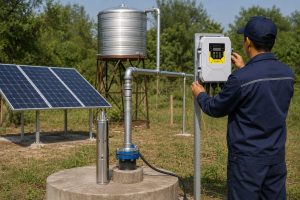
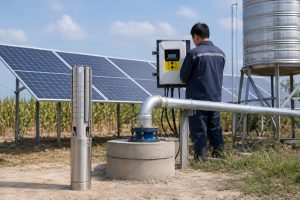
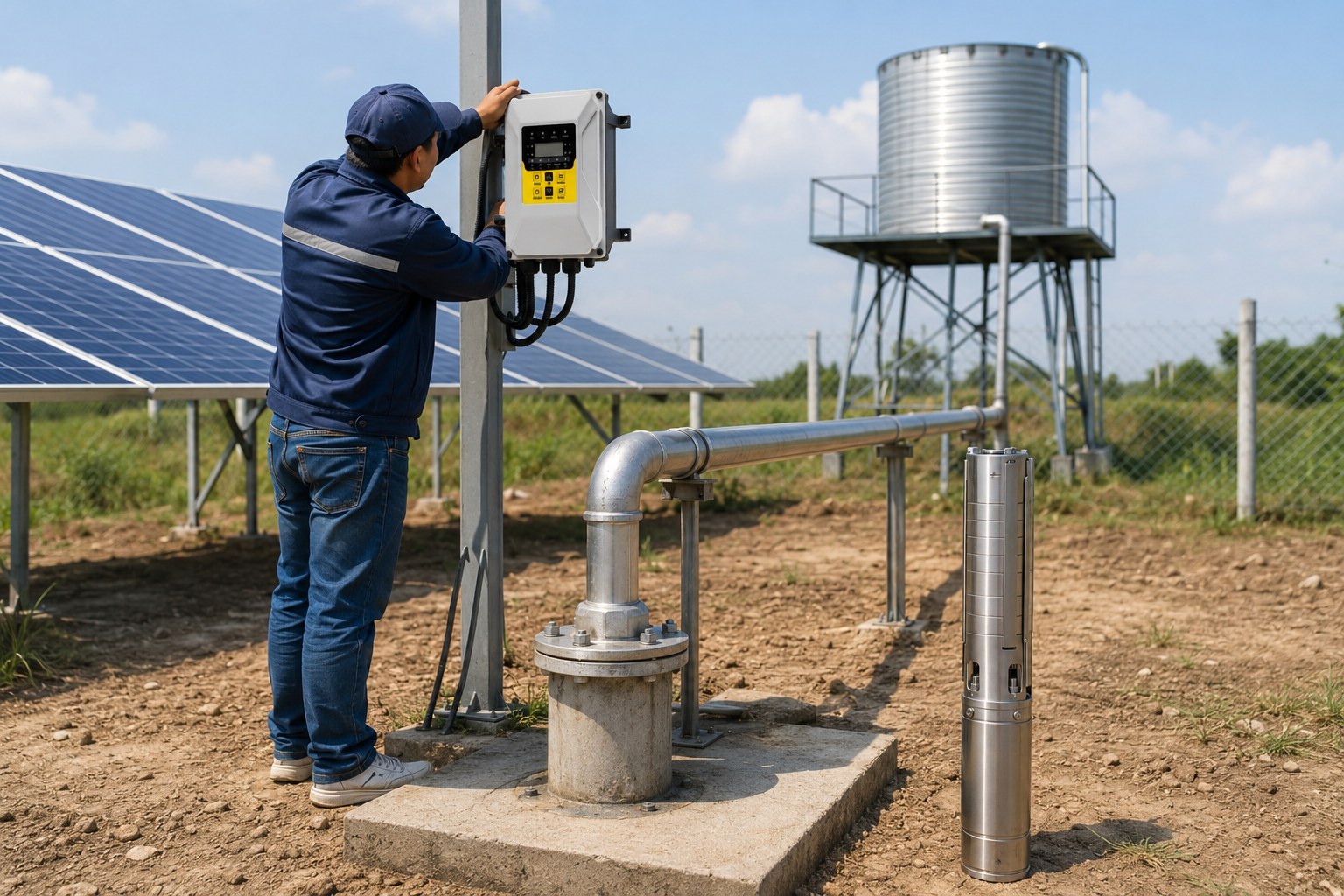
Solar water pumps offer a powerful, grid-independent solution. The "best" solar pump is not a single brand but a system combining a specialized pump end (screw, plastic, or stainless steel impeller) with a high-efficiency motor to match specific water depth, flow, and quality requirements.
With the global push for clean energy and sustainable solutions, solar water pumps have become essential.
They are transforming agriculture and domestic water access in off-grid areas across Africa, the Americas, Australia, and Asia.
Unlike traditional pumps that rely on a brand name, the effectiveness of a solar pump system is determined by its technical components.
The core of this technology is a product portfolio designed to meet diverse needs, typically revolving around three main pump types, all powered by an advanced motor.
The Solar Screw Pump: High Head for Deep Wells
This pump design is a game-changer for deep well applications.
It uses a single helical stainless steel rotor (the screw) rotating inside a rubber stator.
This action creates sealed cavities that move water upward through compression.
- Principle: Low Flow, High Head.
- Applications: Ideal for domestic water supply, livestock watering, and small-scale drip irrigation where well depths can exceed 100 meters. It is a lifeline in electricity-scarce regions of Africa and Latin America.
- Advantages: Its key advantage is the ability to generate very high pressure, allowing it to lift water from extreme depths. It also demonstrates remarkable resistance to sand and grit (up to 3% concentration), a common issue that quickly destroys other pump types.
- Limitations: The design inherently limits its flow rate, making it unsuitable for large-scale flood irrigation.
The Solar Plastic Impeller Pump: High Flow for Agriculture
This is a multi-stage centrifugal pump.
It uses a series of stacked, wear-resistant plastic impellers to accelerate water.
Each stage adds pressure, resulting in high flow rates at a medium head.
- Principle: High Flow, Medium Head.
- Applications: Perfectly suited for farm irrigation, filling livestock troughs, and residential water systems with shallower wells. It is widely adopted in the agricultural belts of the Americas and Africa.
- Advantages: It delivers a high volume of water, making it excellent for applications requiring significant output. The engineered plastic is highly resistant to abrasion from fine sand. Furthermore, it is lightweight and more economical, reducing both shipping and initial investment costs by up to 25%.
- Limitations: In highly corrosive water or very deep wells (over 80 meters), the plastic components may have a shorter lifespan compared to stainless steel.
The Solar Stainless Steel Impeller Pump: Durability for Harsh Water
This is the premium option in the solar pump portfolio.
It features impellers, diffusers, and a pump body constructed from SS304 or even SS316 stainless steel.
This design is engineered for maximum durability and longevity.
- Principle: High Flow, High Corrosion Resistance.
- Applications: Specifically designed for regions with corrosive water conditions, such as acidic or alkaline water tables. It is the preferred choice for alkaline soil regions in Australia, parts of the Americas, and for high-end residential or commercial properties demanding the highest reliability.
- Advantages: Its primary benefit is exceptional resistance to corrosion and abrasion, leading to a significantly longer service life (often 50-75% longer than other types in harsh conditions). It maintains high efficiency over its entire lifespan.
- Limitations: The use of stainless steel makes it heavier and more expensive. This targets a niche but critical market segment where water quality dictates the need for superior materials.
The Core of Performance: Is the Motor More Important Than the Brand?
You've chosen a pump, but it's inefficient.
Your energy bills are high, or you need more solar panels than expected.
The pump's performance is disappointing, regardless of the brand name on the box.
Absolutely. The motor is the heart of any pump system, dictating its efficiency, lifespan, and overall cost-effectiveness. A high-efficiency Brushless DC (BLDC) permanent magnet motor can reduce energy consumption by over 30%, making it a more critical factor than the pump brand itself.
In the world of solar pumping, the conversation is shifting from "which brand?" to "which motor technology?".
While the pump end (screw vs. impeller) determines the flow and head characteristics, the motor is what drives the entire system's efficiency.
All three solar pump types discussed—screw, plastic impeller, and stainless steel impeller—achieve their peak performance when paired with a high-efficiency BLDC permanent magnet motor.
This technology is the true competitive advantage.
What is a BLDC Permanent Magnet Motor?
A Brushless DC (BLDC) motor is a synchronous motor powered by direct current.
Unlike traditional brushed motors, it uses an electronic controller to switch the current to the motor windings.
The rotor is made of powerful permanent magnets, typically high-grade Neodymium Iron Boron (NdFeB).
This design eliminates the friction and energy loss associated with brushes, resulting in dramatically higher efficiency and a longer, maintenance-free lifespan.
The Efficiency Advantage: A Numbers Game
The difference between a standard AC motor and a modern BLDC motor is stark.
This efficiency gap has a massive impact on the total system cost and performance.
| Feature | Standard AC Induction Motor | High-Efficiency BLDC Motor | The Impact |
|---|---|---|---|
| Peak Efficiency | 60-75% | >90% | 20-30% fewer solar panels needed for the same water output. |
| Rotor Material | Aluminum/Copper Bars | 40SH Neodymium Magnets | Higher torque and power density. |
| Size & Weight | Standard | 47% Smaller, 39% Lighter | Easier and cheaper to transport, handle, and install. |
| Maintenance | Brushes may need replacement | Maintenance-Free | Zero operational maintenance costs over its lifespan. |
| Lifespan | 10-15 Years | 15-25 Years | Lower total cost of ownership and greater reliability. |
Market Impact and Advanced Control
The strategic role of the BLDC motor cannot be overstated.
By achieving over 90% efficiency, it directly reduces the number of solar panels required to power the pump.
This lowers the barrier to entry for end-users and makes solar pumping a more viable solution globally.
Furthermore, these motors are paired with intelligent MPPT (Maximum Power Point Tracking) controllers.
The MPPT controller constantly adjusts the electrical operating point of the pump to maximize the power harvested from the solar array, boosting water output by up to 30% on cloudy days or during early morning and late afternoon.
Advanced controllers also offer hybrid functionality.
They can be connected to both solar panels (DC) and the grid or a generator (AC) simultaneously.
The system prioritizes free solar energy and automatically switches to or blends in AC power when sunlight is insufficient, ensuring a reliable 24/7 water supply.
Conclusion
The "best" water pump is not a single brand, but the right technology for the job.
While global leaders offer reliability, specialized solar pumps with high-efficiency motors deliver superior, sustainable performance off-grid.
FAQs
What is the most reliable water pump brand?
Grundfos and Franklin Electric are widely regarded as the most reliable brands for general use, known for their durable construction and long service life of 15-25 years.
How long should a good water pump last?
A quality submersible pump from a top-tier brand should last 15 to 25 years.
Lifespan is affected by water quality, usage, and proper installation.
Is a more expensive water pump worth it?
Often, yes.
A more expensive pump typically offers higher efficiency and a longer lifespan, saving thousands in energy and replacement labor costs over its lifetime.
What is the best type of pump for a deep well?
For very deep wells (over 100 meters), a solar screw pump is often best due to its ability to generate high pressure (head) with excellent sand resistance.
What is the difference between a 2-wire and 3-wire submersible pump?
A 2-wire pump has its starting components inside the motor, while a 3-wire pump uses an external control box.
3-wire pumps are easier to service.
Can I use a solar pump with my existing AC power?
Yes, with a hybrid AC/DC controller.
The system uses solar power when available and automatically switches to AC power from the grid or a generator when needed.
How much does a quality submersible pump cost?
A quality pump alone costs between $600 and $2,500.
Premium brands like Franklin Electric and Grundfos are at the higher end but offer better long-term value.
What affects a well pump's lifespan?
The biggest factors are water quality (sand, minerals), run time, proper sizing, and quality of the electrical supply.
Abrasive or corrosive water can cut a pump's life in half.